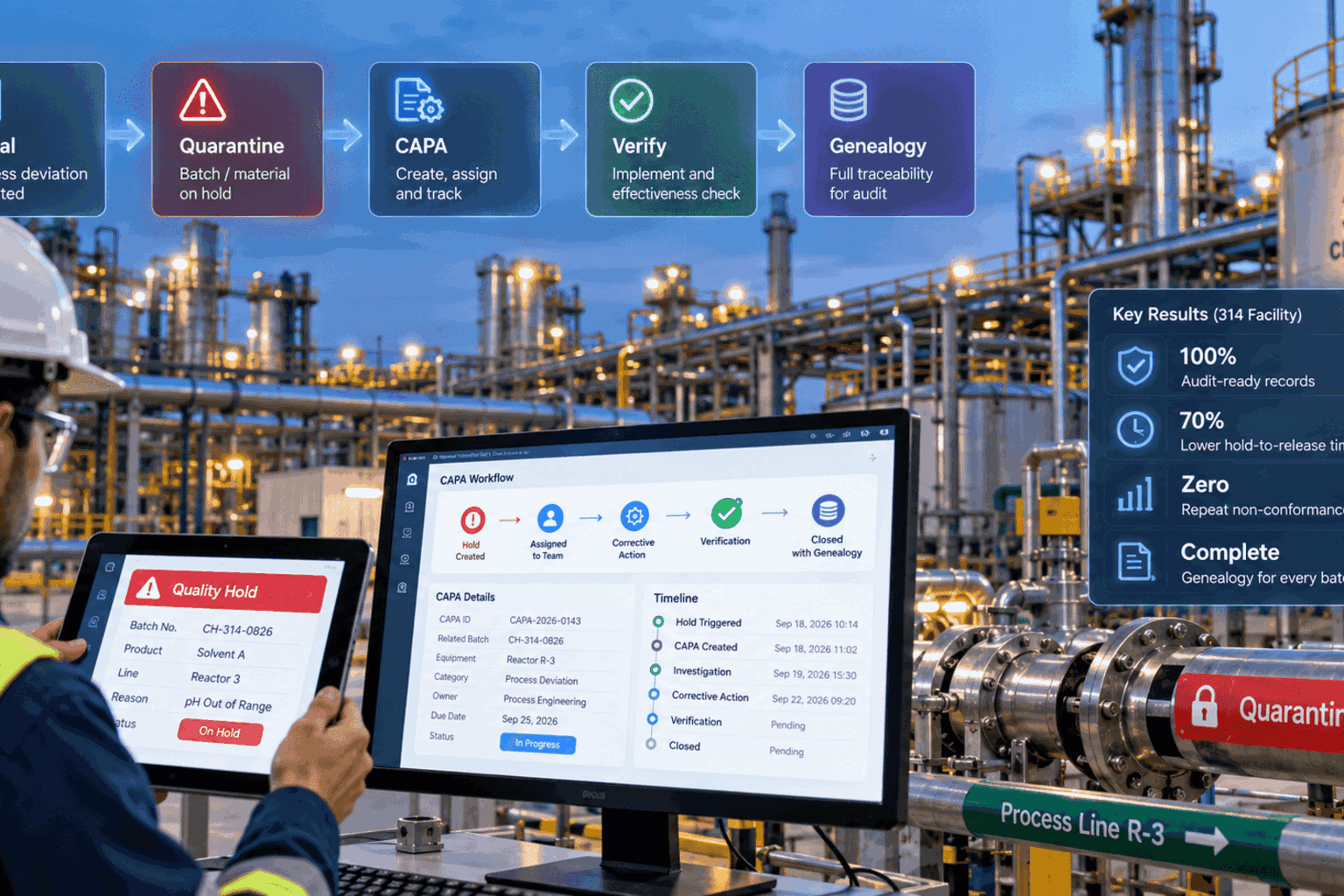
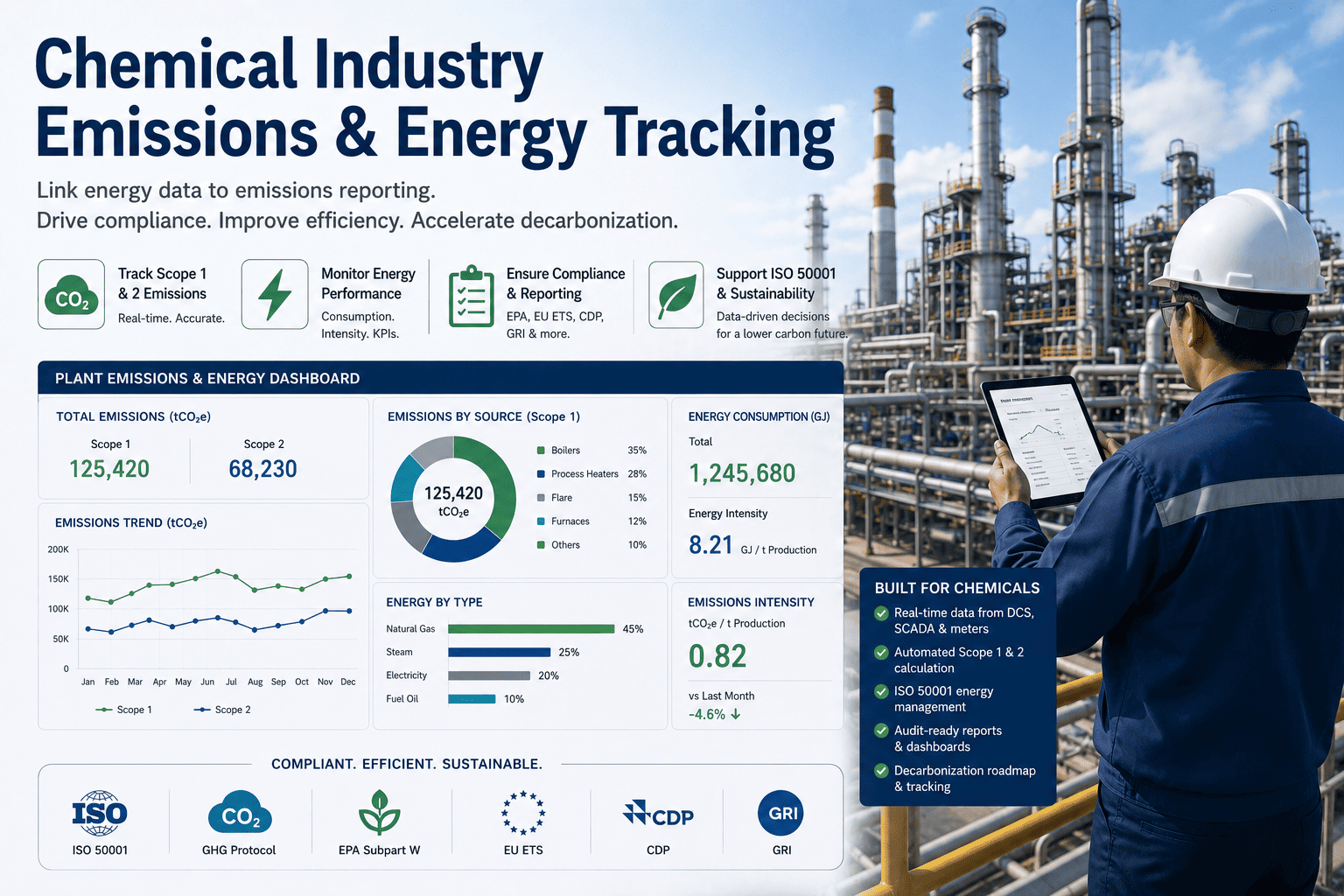
A chemical plant's air permit doesn't grade you on your best day — it grades you on data availability across the quarter. Fall below the threshold, even because an analyzer drifted out of tolerance while no one was watching the dashboard, and you owe substitute data, diagnostic tests, more frequent audits, and a regulator's attention you didn't want. The hard truth of continuous emissions monitoring is that the analyzers are only half the system; the other half is keeping them valid, catching drift before it becomes an out-of-control period, and producing a defensible record when the Title V or IED audit arrives. iFactory CEMS AI sits on top of your existing analyzers and DAHS to do exactly that — continuous monitoring of VOC, NOx, SOx, PM, CO and HAPs with drift prediction, automated QA/QC, and a one-click compliance package, CPCB / EPA / EU IED ready, on a turnkey on-premise stack.
iFactory CEMS AI · Chemical
Your Analyzers Measure. CEMS AI Keeps the Data Valid.
Continuous monitoring of VOC, NOx, SOx, PM, CO and HAPs with AI drift prediction, automated calibration and RATA tracking, and audit-ready export — CPCB, EPA 40 CFR, and EU IED compliant, on a turnkey on-premise stack.
95%+
data availability, the threshold that bites
6
pollutant classes on one platform
<15 min
to a complete compliance export
3 frameworks
CPCB · EPA · EU IED ready
Six Pollutant Classes, One Stack View
A permit that names "SOx and NOx" rarely stays a two-gas job — ESG frameworks and tightening BAT conclusions keep adding parameters. CEMS AI takes every analyzer feed into one model, each with its own limit value, averaging period, and validity state. Below is a live stack panel; the colors flag where a reading is near limit or where the data itself is degrading.
VOC
7.2 kg C/hr
Valid ELV 10 kg C/hr
NOx
142 mg/Nm³
Near limit ELV 180
SOx
96 mg/Nm³
Valid ELV 200
PM / Opacity
18 mg/Nm³
Valid ELV 50
CO
54 mg/Nm³
Valid ELV 100
HAPs · HCl / HF / NH₃
drift flagged
Check cal HCl analyzer
Every value is in limit, but the HCl analyzer is drifting toward an out-of-tolerance state. CEMS AI flagged it before the next scheduled calibration — the difference between a quiet fix and a block of invalidated data.
The Number the Permit Actually Watches
Compliance isn't only about staying under the limit — it's about proving you measured, validly, almost all the time. Most permits set a minimum data availability around 90%, with 95% as the threshold that triggers reporting and diagnostics and 97% as best practice. Each invalid hour demands substitute data, and gaps accumulate silently across a quarter until they breach the annual figure. CEMS AI tracks availability live, per analyzer, so the number never surprises you.
90%
Permit minimum
below this, you are out of compliance
95%
Trigger threshold
reporting, diagnostics, more frequent RATA
97%
Best practice
where a well-run CEMS program lives
What was your data availability last quarter, per stack? Get a turnkey AI quote and we'll show it live in the pilot.
Where AI Earns Its Place: Drift, Before It Invalidates Data
A DAHS records what the analyzer reports and applies calibration corrections — it reacts. CEMS AI reads the slow movement in zero and span checks, response time, and cross-analyzer agreement to forecast when an analyzer will cross out of tolerance, so the calibration or repair happens on a planned window instead of after a block of data is already invalid.
Monitor
Continuous reads from every analyzer plus zero, span, and drift checks logged to the DAHS.
Predict
AI projects when calibration drift will breach tolerance and the analyzer goes out-of-control.
Act
A calibration or maintenance work order is drafted for a planned window, before invalidation.
Preserve
Data stays valid, availability holds above threshold, no substitute-data scramble.
Three Frameworks, One Record
A multi-site or export-facing chemical operation answers to more than one regulator. CEMS AI maps the same validated dataset to each framework's limits, averaging periods, and report formats — so one monitoring program satisfies CPCB, EPA, and EU IED without three parallel systems.
India · CPCB
Real-time CEMS for the 17 highly polluting categories under the National Clean Air Programme — PM, SO2, NOx, HCl, HF, NH3, CO and more, telemetered to the board.
US · EPA 40 CFR
Parts 60 and 75 obligations with performance specs, RATA, cylinder gas audits, and substitute-data rules — backed by automated penalties when data capture fails.
EU · IED / BAT-BREF
24/7 validated data with BAT conclusion uncertainty bands, including total VOC and HF limits set for chemical facilities, plus ETS reporting where applicable.
Reporting to more than one regulator? Start a 6-week pilot and see one dataset satisfy all of them.
The QA/QC Lifecycle, Tracked
CEMS compliance is a calendar of obligations — daily drift checks, quarterly cylinder gas audits, annual RATA, plus the records to prove each one. Assembling that from paper logs and spreadsheets can take 40 to 80 staff hours per audit. CEMS AI keeps the lifecycle on schedule and the evidence exportable in minutes.
Daily
Calibration Drift
Zero and span checks logged, drift trended, out-of-tolerance flagged automatically.
Quarterly
Cylinder Gas Audit
CGA linearity checks scheduled and recorded with results against performance specs.
Annual
RATA
Relative accuracy test audits prepared with pre-RATA checklists across all analyzers.
On demand
Audit Export
3-to-5-year record set — cal logs, QA/QC, DAHS trail — exported as one package.
Ask the Copilot
The system answers plain language too — for the air quality engineer checking compliance posture before a reporting deadline.
Plant Copilot — Emissions
Air Quality Engineer
Are we going to make the quarterly data availability target on Stack 3?
Copilot
Stack 3 is at 96.4% quarter-to-date, above the 95% trigger but below your 97% target. The risk is the HCl analyzer — its span drift has grown over six days and I project it crossing tolerance in about two days, which would start invalidating data. If you calibrate on the next planned outage Thursday, availability holds at 96.4%. If it goes out-of-control first, you'd lose roughly 14 hours and drop to about 95.1% — still compliant, but into trigger territory.
Air Quality Engineer
Draft the calibration order for Thursday and prep the quarterly export.
Copilot
Done. Calibration work order drafted for the HCl analyzer, Thursday outage window, with the pre-cal checklist attached. Quarterly compliance export is staged — validated hourly averages for all six parameters, drift logs, the one CGA from this quarter, and the DAHS audit trail, formatted to your permit's QA/QC requirements. Both are waiting for your sign-off.
Turnkey: Hardware, Software, Live in 6-12 Weeks
iFactory ships a pre-configured NVIDIA AI server — racked, software pre-loaded. Rack it, plug in power and Ethernet, and the system is live inside your firewall. The engagement covers cabling, network, analyzer and DAHS integration, regulatory configuration, operator training, and 24×7 remote monitoring. Your existing analyzers and DAHS stay in place — no rip-and-replace.
Phase 1 · Weeks 1-4
Ship & Connect
Edge server on-prem; analyzer feeds, DAHS, and stack data connected read-only. Limits and permits configured.
Phase 2 · Weeks 5-8
Calibrate & Pilot
Drift models learn each analyzer's baseline; availability tracking and export run in shadow against your records.
Phase 3 · Weeks 9-12
Go Live
Live drift prediction, QA/QC scheduling, and audit export, with operator training and 24×7 monitoring at 99.9% uptime.
1000+
clients running iFactory
6-12 wks
to live operation
On-prem
inside your firewall
What the Air Quality Engineer Gets
Predicting drift and automating the QA/QC calendar turns CEMS from a quarterly fire drill into a controlled program — availability that holds, audits that take minutes, and a record that survives any inspection.
Held
Data availability
drift caught before it invalidates hours
<15 min
Audit export
versus 40-80 staff hours from paper logs
On time
QA/QC calendar
drift, CGA, and RATA scheduled automatically
One set
Multi-framework
CPCB, EPA, and IED from the same data
Frequently Asked Questions
Does CEMS AI replace our analyzers and DAHS?
No. It sits on top of your existing analyzers and DAHS, reading their feeds. The analyzers still measure and the DAHS still records and applies corrections; CEMS AI adds drift prediction, availability tracking, QA/QC scheduling, and audit export. No rip-and-replace.
How does it predict calibration drift?
It trends the daily zero and span checks, response time, and cross-analyzer agreement against each instrument's baseline, and projects when the drift will cross the tolerance band. That lets you calibrate on a planned window before the analyzer goes out-of-control and data is invalidated — rather than discovering it after the fact.
Can one system really cover CPCB, EPA, and EU IED?
Yes. The same validated dataset is mapped to each framework's emission limits, averaging periods, and report formats. CPCB telemetry, EPA 40 CFR Part 60/75 reports, and IED / BAT-BREF validated data are all generated from one monitoring program rather than three parallel systems.
What does an audit export actually contain?
The full evidence set a Title V or IED review expects — validated hourly and averaging-period data, calibration drift logs, cylinder gas audit results, RATA records, and the DAHS audit trail, across the required 3-to-5-year retention. It exports as one formatted package in minutes rather than the 40 to 80 staff hours of manual assembly.
Where does our emissions data live?
Entirely on-premise inside your firewall on the pre-configured NVIDIA server — read-only and inbound-only to your analyzers and DAHS. Emissions data and compliance records never leave the plant except as the regulatory telemetry your permit requires, with 24×7 remote monitoring and 99.9% uptime.
Measured. Validated. Audit-Ready. On-Prem.
See Your Stack Data Stay Compliant
Bring your analyzer list, your permit limits, and last quarter's availability figures. We'll show drift prediction, live availability tracking, and a one-click compliance export on your own data — and scope the 6-to-12-week turnkey deployment, on-prem, inside your firewall.
6 classes
VOC NOx SOx PM CO HAPs
3 frameworks
CPCB EPA IED
1000+
clients · 99.9% uptime