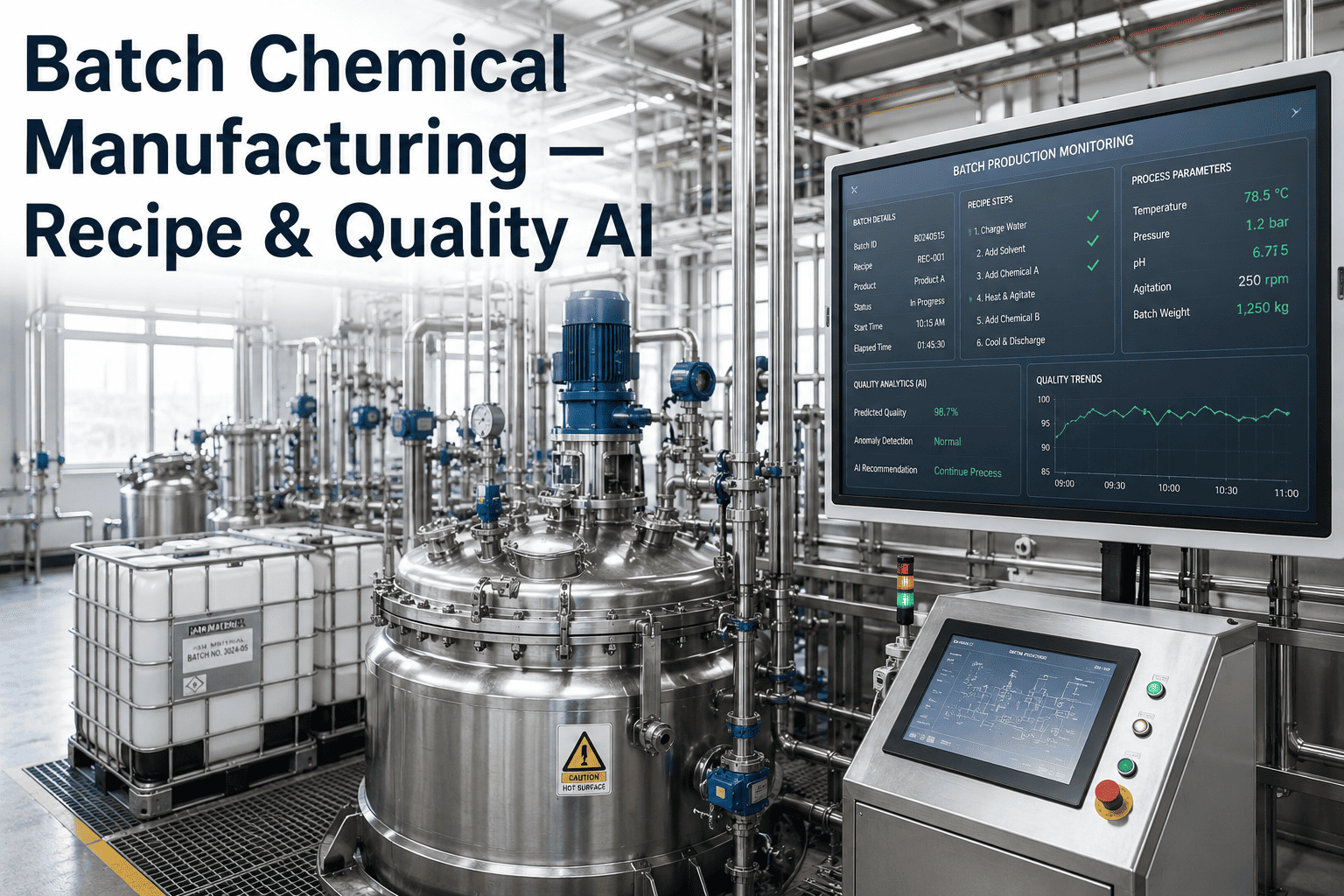
A specialty chemical plant running twelve esterification batches was drowning in 50 to 80 false-positive deviation alarms every week from its legacy statistical process control system, so process engineers quietly started ignoring them altogether. That is the quiet failure mode of most batch chemical operations: not a lack of data, but so much unreliable data that the team stops trusting any of it and reverts to fixed-time recipes with wide safety margins built in decades ago. AI-driven recipe optimization fixes the underlying problem by predicting batch quality and endpoint timing directly from process data, replacing alarms nobody trusts with recommendations engineers actually act on.
iFactory predicts batch endpoints and quality in real time, cutting cycle time without touching your safety margins.
Why Fixed-Time Recipes Leave Money on the Table
Most batch recipes were written years ago with conservative hold times built in to guarantee quality across worst-case conditions, catalyst age, feedstock variation, and equipment drift included. That conservatism is safe, but it is also expensive, because every batch that finishes early and keeps running anyway is burning reactor time, energy, and labor for no additional quality gain. AI-based endpoint prediction identifies the actual moment a batch meets specification and lets the plant stop there instead of running out a fixed clock.
How AI Recipe Optimization Actually Works
The process is not a black box replacing the process engineer, it is a continuous feedback loop layered on top of the historian and lab data most plants already collect.
Learn From Historical Batches
Models train on historical sensor readings, quality measurements, and operating records already captured by the distributed control system, so no new instrumentation is required to get started.
Predict the Endpoint in Real Time
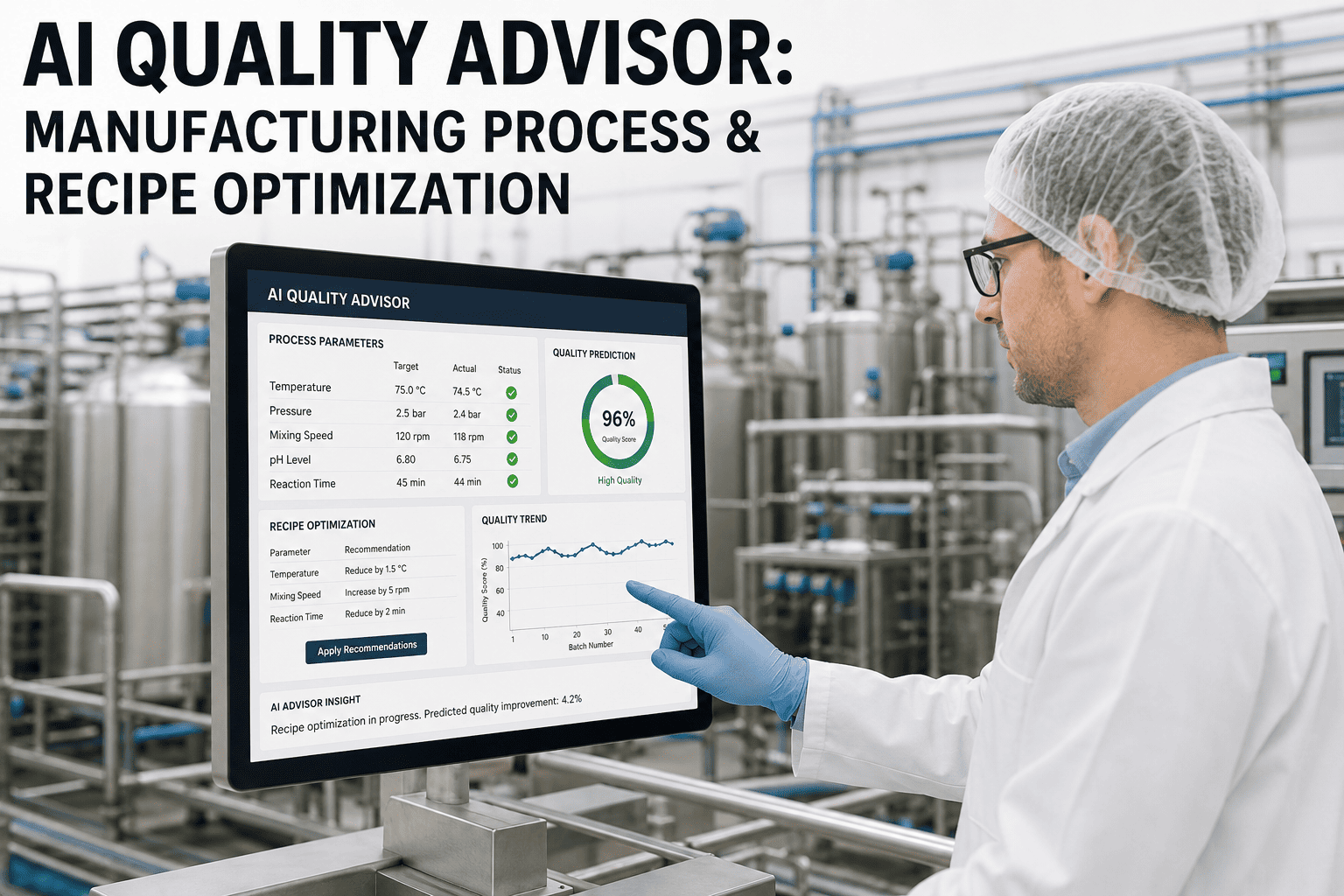
As the batch runs, the model continuously compares current process trends against the golden batch profile and predicts when specification will actually be met, not when the fixed clock says it should be.
Flag Real Deviations, Not Noise
Graded variability classification replaces blunt threshold alarms, cutting actionable alerts down to a handful per week while catching more real deviations than the legacy system ever did.
Recommend the Adjustment
When a batch drifts from its golden profile mid-run, the system recommends a specific corrective action, such as a reactor jacket temperature adjustment, rather than simply flagging that something is wrong.
What This Looks Like in a Real Plant
Two examples illustrate how the same underlying approach plays out differently depending on what was actually broken in the batch process. Book a demo to see this run against your own batch history.
Legacy SPC generated 50–80 false deviation alarms weekly across twelve esterification batches, so the team had stopped reacting to them. Graded AI variability classification cut actionable alerts to under six per week while raising true deviation catch rate from 51% to 94%. Batch cycle time improved from an 18.4-hour average to 15.2 hours as process trust was restored.
A ten-batch fermentation train was losing roughly $540,000 annually to four to six small, rotating inefficiencies that manual endpoint checks only caught after visible purity deviation, typically two to three batches after onset. Temperature profile correlation and nutrient ratio models identified all five active inefficiency patterns within 48 hours of go-live.
iFactory maps temperature, reactant ratio, and mixing patterns against your golden batch profile, 24/7, without sampling gaps.
Fixed-Time Recipes vs. AI-Optimized Batch Control
| Dimension | Fixed-Time Recipe | AI-Optimized Batch Control |
|---|---|---|
| Endpoint determination | Fixed clock with conservative margin | Real-time prediction against golden batch |
| Deviation detection | Threshold alarms, high false-positive rate | Graded classification, high true-catch rate |
| Corrective action | Post-batch analysis, next batch only | Mid-batch recommendation while it can still help |
| Catalyst & feedstock variation | Absorbed by wide safety margins | Actively compensated for in real time |
| Typical cycle time | Baseline, unchanged run over run | 28–35% reduction reported across deployments |
Frequently Asked Questions
Does this require replacing our existing DCS or historian?
No. Most deployments start with the historical sensor readings, quality measurements, and operating records the distributed control system is already capturing. Perfect data readiness is not a prerequisite, models improve iteratively as data coverage expands, and plants typically begin seeing early improvement in cycle time and off-spec reduction within the first few months.
How does AI endpoint prediction stay within our safety margins?
The model is trained against the same quality specifications and regulatory requirements the current fixed-time recipe was built to satisfy, so it identifies the earliest point specification is actually met rather than pushing the process past its safe operating envelope. Safety interlocks and hard operating limits remain fully in place and are not overridden by the optimization layer.
Will this reduce the number of false alarms our operators see?
Yes, this is typically one of the fastest and most visible improvements. Graded variability classification replaces blunt threshold-based SPC alarms, which is what allows a plant generating 50 to 80 false positives a week to drop to single digits while actually catching more real deviations than before. Book a demo to see false-alarm reduction modeled against your own alarm history.
Does this work for both batch and continuous chemical processes?
The approach applies to both, though batch processes tend to benefit more because they exhibit greater run-to-run variability that fixed recipes cannot adapt to. Continuous processes see similar gains through real-time optimization of reflux ratios, reboiler duty, and feed conditions rather than endpoint prediction specifically.
How long before we see a return on this kind of deployment?
For a mid-size chemical plant, published case studies and deployment benchmarks put combined annual benefit from yield improvement, energy reduction, and throughput increase well above typical implementation cost, often producing payback within the first several months. Early improvements in cycle time and off-spec reduction are usually visible before the full financial case is even finalized.
Stop running fixed-time recipes on equipment that could be telling you exactly when the batch is done.
.png)