Changeover Time Reduction with SMED and AI Analytics
By James Smith on August 5, 2026
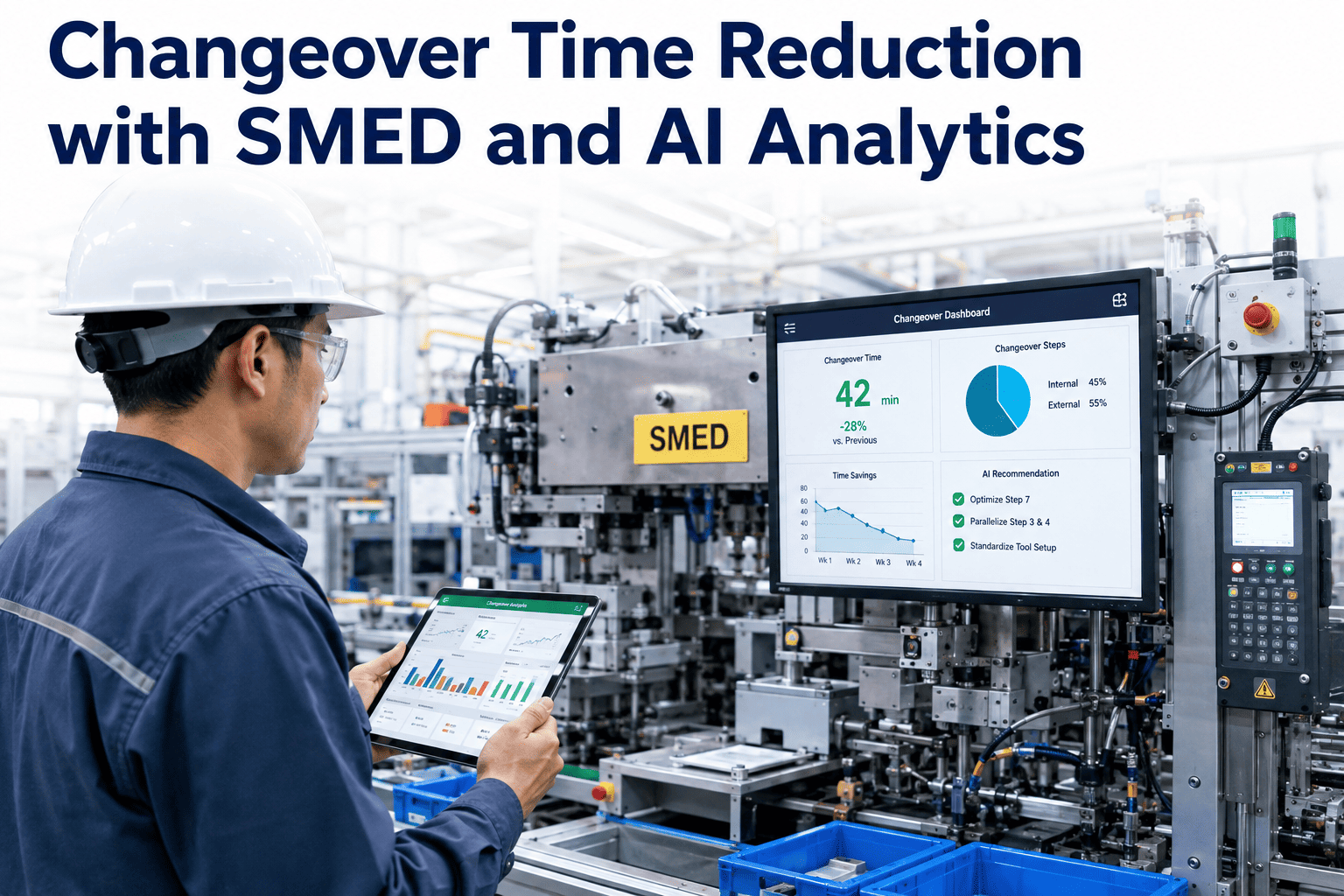
A 90-minute changeover isn't 90 minutes of necessary work — it's usually 30 minutes of work that genuinely requires the machine stopped, and 60 minutes of preparation, searching, and walking that could have happened while the prior job was still running. Shigeo Shingo proved this at Toyota in the 1950s with a methodology now applied across nearly every discrete manufacturing sector: separate every changeover step into what must happen while the machine is stopped and what could happen while it's still running, then systematically convert as many steps as possible from the first category to the second. Structured SMED implementation typically achieves 30 to 50 percent changeover time reduction on the first pass — without buying new equipment, just by reorganizing when each step actually happens. The methodology itself hasn't changed since Shingo wrote it down decades ago; what has changed is the tooling available to apply it, and that shift matters more than it might first appear. See how iFactory's video and sensor-based step timing replaces the traditional stopwatch time-and-motion study with continuous changeover data that never goes stale.
OEE Tracking & Production Optimization · Changeover Reduction
Changeover Time Reduction with SMED and AI Analytics
Single-Minute Exchange of Die methodology, powered by continuous video and sensor step timing instead of a one-time stopwatch study — identify internal steps that can convert to external, and cut setup time 30 to 50 percent on the first pass.
Typical changeover time reduction on the first structured SMED pass
2 typesInternal (machine stopped) vs. external (machine running) steps
4 stagesIdentify, separate, convert, streamline
20–40%Share of total downtime changeovers often represent
ContinuousVideo/sensor timing vs. a single manual snapshot study
What SMED Actually Is
Internal Steps, External Steps, and the Core Conversion Insight
SMED's entire methodology rests on one distinction that sounds simple and is consistently under-applied in practice: every changeover step is either internal — it can only happen while the machine is stopped — or external — it could happen while the machine is still running the prior job. Most shops never formally separate their changeover steps this way, which means steps that could be moved outside the downtime window stay locked inside it by habit rather than necessity. The distinction sounds almost too simple to be the foundation of a methodology that routinely cuts changeover time in half, but the discipline is in applying it rigorously and honestly to every single step, not in the concept itself.
01
Internal Steps
Activities that genuinely require the machine to be stopped — physically swapping a die, changing a cutting tool, removing and installing fixtures. These steps consume actual machine downtime and are the only category SMED cannot eliminate entirely, only shorten and simplify.
02
External Steps
Activities that could happen while the machine is still producing the prior job — retrieving the next tool from storage, staging materials at the machine, pre-heating a component, reviewing the next job's setup sheet. These steps consume zero machine downtime once properly identified and scheduled to happen early.
03
The Core Conversion Principle
The central SMED insight is not "work faster" — it's "work at the right time." A step that takes an operator eight minutes to walk to the tool crib and back doesn't need to be faster; it needs to happen before the machine stops, not after, which converts eight minutes of pure downtime into zero without changing anything about how the step itself is performed.
Why Manual Studies Don't Scale
The Traditional Stopwatch Study Has a Structural Problem
Classic SMED practice, as Shingo originally applied it, requires a trained analyst physically observing a changeover with a stopwatch, documenting every step and its duration, then classifying each step as internal or external. This works — it's how the methodology was proven in the first place, and it remains a completely valid way to run a first pass — but it has limitations that AI-based step timing directly addresses without changing the underlying methodology at all.
A Manual Study Is a Single Snapshot
One observed changeover, timed once, becomes the basis for the entire improvement plan — but changeover time varies meaningfully by operator, shift, and product, and a single observation can't capture that variation or reveal which specific factors drive it.
Analyst Time Is Expensive and Disruptive
A proper time-and-motion study requires a trained observer's full attention for the duration of the changeover, and operators frequently change their behavior when they know they're being timed — the classic observer effect that can quietly bias the very data the study depends on.
Gains Erode Without Ongoing Measurement
Nearly every SMED project starts strong and regresses within months once the workshop ends — new operators drift back toward old habits, and without continuous data confirming whether the improved sequence is actually being followed, nobody notices until changeover times have crept most of the way back to baseline.
How AI Step-Timing Changes the Analysis
Every Changeover Becomes a Data Point, Not a One-Time Study
Video analysis with AI activity classification and machine-state sensor data together replace the manual stopwatch study with something structurally different: continuous, automatic capture of every changeover that happens on a line, not just the one a human analyst happened to observe. Machine-state transitions — the moment production actually stops and the moment it resumes — are captured directly from equipment signals rather than a human's stopwatch reaction time, and video-based step recognition classifies what's happening during the downtime window without requiring someone standing at the machine with a clipboard.
This example illustrates the core mechanism behind nearly every SMED success story: the total time required to complete the work barely changed — finding tools still takes roughly twelve minutes, and installing the die still takes real time — but where that work happens shifted. Twenty-two minutes of work that used to sit inside the downtime window moved outside it, and the remaining internal work was streamlined through standardized fasteners that cut the install step itself. Neither change required new equipment or additional headcount, which is why SMED consistently ranks among the highest-ROI OEE improvement levers available: the gain comes from reorganizing existing work, not purchasing new capacity.
See Every Changeover, Not Just One
A Stopwatch Study Captures One Changeover. Continuous Tracking Captures Every One, on Every Shift.
iFactory analyzes changeover video and machine-state data continuously, classifying steps as internal or external automatically and flagging when a specific transition starts drifting slower than its established baseline.
SMED follows a deliberate four-stage sequence, and skipping ahead — jumping straight to streamlining before internal and external steps are properly separated — is one of the most common reasons improvement efforts underperform their potential. Each stage builds on the one before it, and rushing through the identification and separation stages to get to the more satisfying work of actually converting and streamlining steps is the single most common way teams leave improvement potential on the table.
Stage 1
Identify and Document Every Step
Capture the complete changeover as a sequence of discrete steps with individual durations — the foundation everything else builds on. Video-based capture over multiple changeover instances, rather than a single observed run, surfaces steps that a one-time study might miss entirely.
Stage 2
Separate Internal From External Steps
Classify every documented step honestly — not "could this theoretically be external" but "is this actually happening while the machine is stopped right now, and does it genuinely need to be." This stage alone, done rigorously, typically reveals the largest single improvement opportunity in the entire project.
Stage 3
Convert Internal Steps to External Where Possible
For each step still classified as internal, ask what would need to change — pre-staged materials, pre-heated components, prepared fixtures — to move it outside the downtime window. Every step successfully converted removes its full duration from the changeover.
Stage 4
Streamline Both Remaining Categories
Once conversion opportunities are exhausted, simplify what remains: standardize fasteners to eliminate tool changes mid-step, use guides and stops instead of manual alignment, and eliminate adjustment steps by designing fixtures that locate correctly the first time.
Where This Matters Most
Which Operations Get the Biggest Payoff From SMED
Changeover reduction delivers value everywhere, but the size of the opportunity varies considerably by industry and production pattern, which affects how a CI lead should prioritize SMED against other improvement initiatives competing for the same limited time and budget.
Highest Opportunity — Frequent Product Changes
Food and beverage, pharmaceutical packaging, and multi-product discrete manufacturing operations typically run changeovers frequently enough that setup time can represent 20 to 40 percent of total downtime — the highest-opportunity environments for a structured SMED program.
Moderate Opportunity — Batch Production
Automotive stamping and injection molding operations running moderate batch sizes see meaningful but generally smaller changeover-related downtime shares, since production runs between changes tend to be longer, diluting the relative impact of setup time against total scheduled hours.
Lower Priority — Long, Infrequent Runs
Operations running very long production campaigns with infrequent changeovers may find other loss categories, such as equipment breakdowns or minor stops, represent a larger share of total downtime — worth confirming against actual OEE data before assuming SMED is the highest-value first project.
Getting Started
Running a Data-Driven SMED Program
These four steps adapt the classic SMED sequence for a program built on continuous data rather than a single workshop, without changing the underlying four-stage methodology itself.
01
Confirm Changeover Is Actually the Priority Loss
Review at least two weeks of OEE data before committing to a SMED project — if changeover accounts for more than roughly 20 percent of total downtime, the opportunity is significant enough to justify structured effort; if it's a smaller share, another loss category may deserve priority first.
02
Capture Multiple Changeover Instances, Not Just One
Record changeovers across different operators, shifts, and product transitions before drawing conclusions — variation between instances is itself diagnostic information about which steps are inconsistent and worth standardizing first.
03
Pilot the Improved Sequence on One Line Before Rolling Out Broadly
Validate the new internal/external step sequence on a single line or a single changeover type first, confirm the time reduction holds up across multiple real instances, and only then standardize the improved procedure across other lines running similar changeovers.
04
Keep Measuring After the Project Ends
Continue tracking changeover time per transition indefinitely, not just during the improvement project — this is what prevents the gradual regression toward old habits that undermines most SMED initiatives within the first six months after the workshop ends.
Field Perspective
“
Every SMED project I've run starts the same way: someone insists the changeover is already tight, there's nothing left to cut. Then we actually separate the steps into internal and external, and it's almost never close — there's reliably fifteen or twenty minutes of pure walking, searching, and waiting for something that could have been staged an hour earlier. The methodology hasn't changed since Shingo wrote it down. What's changed is that we used to get one honest look at a changeover, from one stopwatch study, and now we get every single one. That means the improvement doesn't quietly decay after the consultant leaves, because the data keeps watching whether the new sequence is actually being followed, and that ongoing visibility is honestly worth more than the first-pass reduction itself.
Hector Vasquez-Lindqvist
Lean Six Sigma Black Belt · 20 years running SMED and changeover reduction programs across automotive stamping, injection molding, and packaging lines
Common Questions
Frequently Asked Questions
What changeover time reduction is realistic on a first SMED project?
Structured SMED implementation typically achieves 30 to 50 percent changeover time reduction on the first structured pass, regardless of the starting duration, with the exact figure depending on how much internal-to-external conversion opportunity existed in the original process and how disciplined the implementation is. Getting changeover time down to the "single minute" ideal of under ten minutes usually requires a second improvement pass after the first round of gains is standardized and stable — the first pass captures the most obvious conversion opportunities, and a follow-up pass targets the remaining internal steps for simplification. Book a changeover analysis to get a realistic reduction estimate for your specific changeover based on actual step data.
How is video-based changeover analysis different from a traditional stopwatch time-and-motion study?
A traditional stopwatch study captures a single observed changeover, performed by one analyst over one instance, which becomes the entire basis for the improvement plan — a snapshot that can't reveal how changeover time varies by operator, shift, or product, and that's vulnerable to operators changing behavior when they know they're being timed. Video-based analysis with automatic step classification captures every changeover that occurs, continuously, revealing the actual variation and drift a single manual study structurally cannot see, and removing the observer-effect bias that comes with a human analyst standing next to the machine with a stopwatch.
Why do SMED improvements often regress after the initial project ends?
The most common root cause is that changeover time stops being measured once the workshop concludes, so the improved sequence gradually erodes as new operators join without formal training on it, minor shortcuts creep back in, and nobody notices the drift until changeover times have crept most of the way back toward the original baseline. Continuous measurement — tracking changeover time per transition indefinitely rather than only during the improvement project itself — is what converts a one-time gain into a permanent capability, since drift becomes visible immediately rather than being discovered months later during an unrelated review.
How do we know if changeover time is actually our biggest OEE opportunity, versus another loss category?
Review at least two weeks of OEE and downtime data before committing significant effort to a SMED project — changeover time that accounts for more than roughly 20 percent of total downtime signals a strong opportunity, and this share is often highest in operations running frequent product changes such as food and beverage, pharmaceutical packaging, and multi-product discrete manufacturing. If changeover represents a smaller share of total downtime relative to other loss categories like equipment breakdowns or minor stops, those categories may deliver a larger OEE improvement for the same effort, and prioritizing by actual impact rather than assumption is the more reliable starting point.
Can SMED be applied to changeovers that don't involve dies or tooling in the traditional stamping sense?
Yes — despite the name originating from die-change operations in stamping and press work, the internal/external separation principle applies to essentially any changeover or setup transition, including injection molding tool changes, packaging line format changes, CNC program and fixture changes, and cleaning or sanitation changeovers in food and pharmaceutical production. The core methodology — document every step, classify internal versus external honestly, convert what can be converted, streamline what remains — is process-agnostic and has been applied successfully well beyond its original stamping-press context. Talk to solutions engineering about applying SMED analysis to your specific changeover type.
Cut Changeover Time Without a Stopwatch Study
Every Changeover, Continuously Timed and Classified — Not One Snapshot Study
iFactory's video and sensor-based step timing applies SMED's internal/external classification automatically across every changeover on every shift, catching drift back toward old habits before it erodes the gains a structured improvement project delivered.