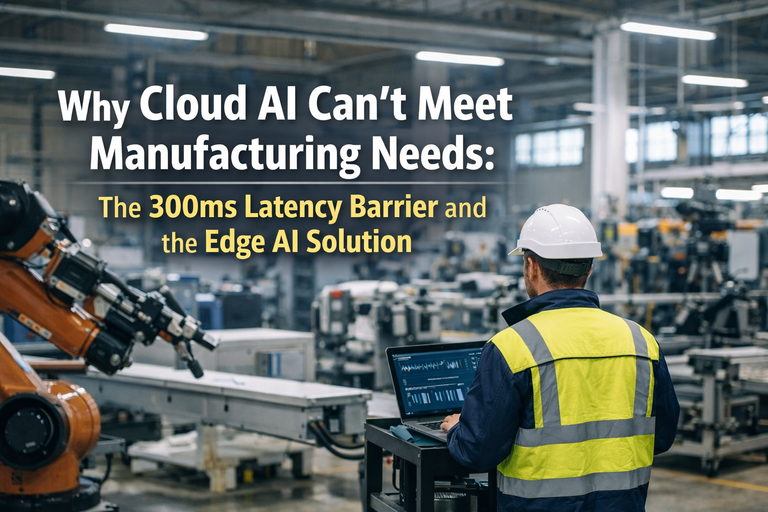
A high-speed packaging line runs at 400 units per minute. Your cloud AI detects a defective unit — but the round-trip to the data center takes over 300 milliseconds. By the time the rejection signal arrives, 3–4 more units have already passed the inspection point. The defect was seen. It just couldn't be stopped. This isn't a hypothetical. It's the daily reality for manufacturers who deployed cloud-first AI expecting real-time control — and got expensive post-mortem analytics instead. The physics of latency doesn't care about your AI vendor's marketing claims.
Edge AI for Smart Manufacturing: Eliminating the Latency Barrier
Join iFactory's expert-led session on how edge AI architecture — including sub-10ms inference, real-time control loops, and hybrid cloud integration — is transforming how manufacturers detect defects, predict failures, and optimize production without cloud latency bottlenecks.
MIT's 2025 "GenAI Divide" report found that 95% of enterprise GenAI pilots deliver zero measurable P&L impact. In manufacturing specifically, the AI project failure rate sits at 76.4%. But the problem isn't the models — it's the architecture. Cloud-based AI on the factory floor introduces 300–500ms of round-trip latency from data serialization, network traversal, cloud queuing, and response delivery. For production lines that need control decisions in under 10 milliseconds, that 30–50× speed gap turns "real-time AI" into delayed analytics that watches defects happen without being able to stop them.
The 300ms Latency Barrier: Why Physics Defeats Cloud AI
Factory automation demands control loops that respond in single-digit milliseconds. A modern production line might process 60 parts per second. Cloud AI — regardless of model quality — cannot overcome the physics of sending data to a remote data center and waiting for a response. Here's where every millisecond goes:
What 300ms Actually Costs on the Factory Floor
Latency isn't an abstract infrastructure metric — it translates directly to defective products shipped, wasted materials, and avoidable downtime. Here's what the math looks like across common scenarios every manufacturing engineer will recognize:
The hard truth: Cloud AI on the factory floor is analytics pretending to be control. It can tell you what went wrong — after the damage is done. It cannot intervene in real time. For manufacturers running at speed, this distinction costs millions annually in scrap, rework, and preventable downtime.
Is cloud latency costing your factory more than you think? iFactory's edge AI architecture runs inference in under 10ms — right at the machine. See the difference in a 30-minute demo →
Cloud AI vs. Edge AI: Where Each Actually Belongs
Cloud AI isn't bad technology — it's deployed in the wrong place. The factories getting real ROI from AI aren't choosing cloud or edge. They're splitting workloads strategically based on one principle: if the decision needs to happen in under 100 milliseconds, it must happen at the edge.
- Sub-10ms inference directly at the machine — true real-time
- Detect and reject defects before the next unit passes
- Predict failures and trigger maintenance instantly via iFactory
- Operates fully offline — no internet dependency for critical control
- Data stays on-premise — complete OT data sovereignty
- 300–500ms round-trip minimum — 30× too slow for control loops
- Reports defects after they're shipped — watches, doesn't prevent
- Network outage = complete loss of AI capability on the floor
- Bandwidth costs spiral when thousands of sensors stream to cloud
- 70% of transmitted data is unnecessary — inflating storage bills
The smart architecture: Leading manufacturers don't choose one or the other. They run hybrid edge-cloud — edge AI handles real-time decisions at the machine, while cloud manages long-term analytics, model training, and cross-facility coordination. iFactory's architecture is built for exactly this pattern. See how the hybrid model works →
5 Factory-Floor Use Cases Where Edge AI Wins
Each of these scenarios requires sub-100ms response. Cloud AI physically cannot deliver. Edge AI turns these from unsolvable latency problems into measurable competitive advantages.
iFactory: Edge AI Intelligence That Turns Speed Into Results
Edge AI delivers the speed. iFactory makes it actionable. Our AI-powered CMMS converts sub-10ms edge insights into automated work orders, predictive maintenance schedules, and real-time dashboards — closing the loop between detection and action.
The Hybrid Architecture That Actually Works
The factories winning with AI aren't cloud-only or edge-only. They split workloads strategically: edge handles time-critical decisions at the machine, iFactory's CMMS layer unifies the operational data, and cloud handles model training and cross-plant analytics. Here's how iFactory fits as the operational intelligence bridge:
Why this works: Edge AI processes sensor data locally for instant decisions. iFactory unifies that data into automated work orders, asset health tracking, and predictive scheduling — then sends curated data to cloud for cross-facility analytics and model improvement. No wasted bandwidth. No latency bottlenecks. No disconnected systems.
Real-World Results: What the Data Shows
The shift from cloud-only to edge-first AI isn't theoretical. The ROI data from manufacturers who've made the move is documented, measurable, and accelerating. Here's what you're gaining — and what you're leaving on the table:
Manufacturers adopting edge AI report average payback periods of 14 months — with savings in maintenance, scrap, overtime, and energy costs. What would those numbers look like for your plant? Find out in a 30-minute demo →
The Edge AI Market Trajectory: Where Manufacturing Is Heading
The shift from cloud-only to edge-first isn't a trend — it's a structural change in how factories deploy intelligence. Manufacturing is the fastest-growing segment at 23% CAGR. Here's the trajectory — and the cost of waiting:
How to Transition: From Cloud-Stuck to Edge-Ready
You don't need to rip out your cloud infrastructure. The most successful manufacturers start with the highest-impact, most latency-sensitive workloads and expand from proven results. Here's the proven 4-phase approach that iFactory supports at every stage:
Map which AI processes require <100ms response (quality inspection, process control, safety systems). These move to edge first. iFactory helps you map sensor data to decision points so you know exactly where latency is costing you. Timeline: 1–2 weeks.
Connect IIoT sensors through iFactory's cloud-native CMMS, deploy edge inference nodes on your most critical equipment, and establish real-time predictive maintenance. Most teams see first results within weeks, not months.
Keep cloud AI for what it's good at — trend analysis, model training, cross-facility comparisons. iFactory routes real-time data to edge and curated data to cloud. No duplication, no wasted bandwidth, no latency bottlenecks. ROI typically within 3–6 months.
Expand edge AI across all production lines and critical systems. Connect every asset into iFactory's unified operational intelligence layer. Run whole-plant optimization — energy, scheduling, quality, maintenance — with real-time data at every decision point.
Phase 1 starts with a 30-minute demo. We'll show you exactly how iFactory connects to your equipment, where latency is costing you, and how fast your maintenance team starts benefiting from edge AI insights. Book your demo and start building your edge AI foundation →
Frequently Asked Questions
5G reduces network transit time to under 10ms, but it doesn't eliminate cloud queuing, inference time, or data serialization overhead. The total cloud round-trip with 5G still averages 100–200ms — 10–20× too slow for closed-loop manufacturing control. 5G improves the network leg; edge AI eliminates the need for it entirely on time-critical decisions. The best approach: use 5G for edge-to-cloud data sync, and edge AI for real-time control.
Model size is only part of the equation. Even if cloud inference takes just 10ms, the network round-trip still adds 100–300ms of unavoidable latency. The bottleneck is physics — the speed of light across fiber optic cable plus network hops — not compute speed. Smaller models help with cloud cost, but they don't solve the latency problem. Edge deployment eliminates the network leg entirely.
Yes — this is one of the most common challenges and it's completely solvable. Retrofit IoT sensor kits attach to legacy machines to monitor vibration, temperature, and power draw. Edge computing gateways digitize analog signals and process them locally. iFactory connects to both modern and legacy equipment through IIoT sensors, giving older machines real-time AI capabilities without replacing them. We'll show you exactly how this works in your demo.
iFactory serves as the operational intelligence layer between edge and cloud. It ingests real-time sensor data from edge AI nodes, converts insights into automated work orders and predictive maintenance schedules, provides cloud-native dashboards for decision-making, and feeds clean operational data to cloud analytics platforms. Think of iFactory as the bridge that makes edge AI actionable — turning sub-10ms inference into measurable operational improvements.
Initial predictive maintenance value appears within weeks of deployment. Asset-level results — failure prediction, quality improvements, automated work orders — typically deliver measurable ROI within 3–6 months. Full hybrid edge-cloud implementations average a 14-month payback period. One documented mid-sized manufacturer saved $305K against a $215K implementation cost in the first 14 months through combined reductions in scrap, emergency maintenance, overtime, and energy waste.
Your Factory Floor Needs AI That Moves at Machine Speed
Cloud AI gave you dashboards. Edge AI gives you control. iFactory's architecture delivers sub-10ms intelligence where it matters — on the line, at the machine, in real time. See it working in 30 minutes. No commitment. No pressure. Just a live walkthrough of the platform powering the next generation of smart manufacturing.