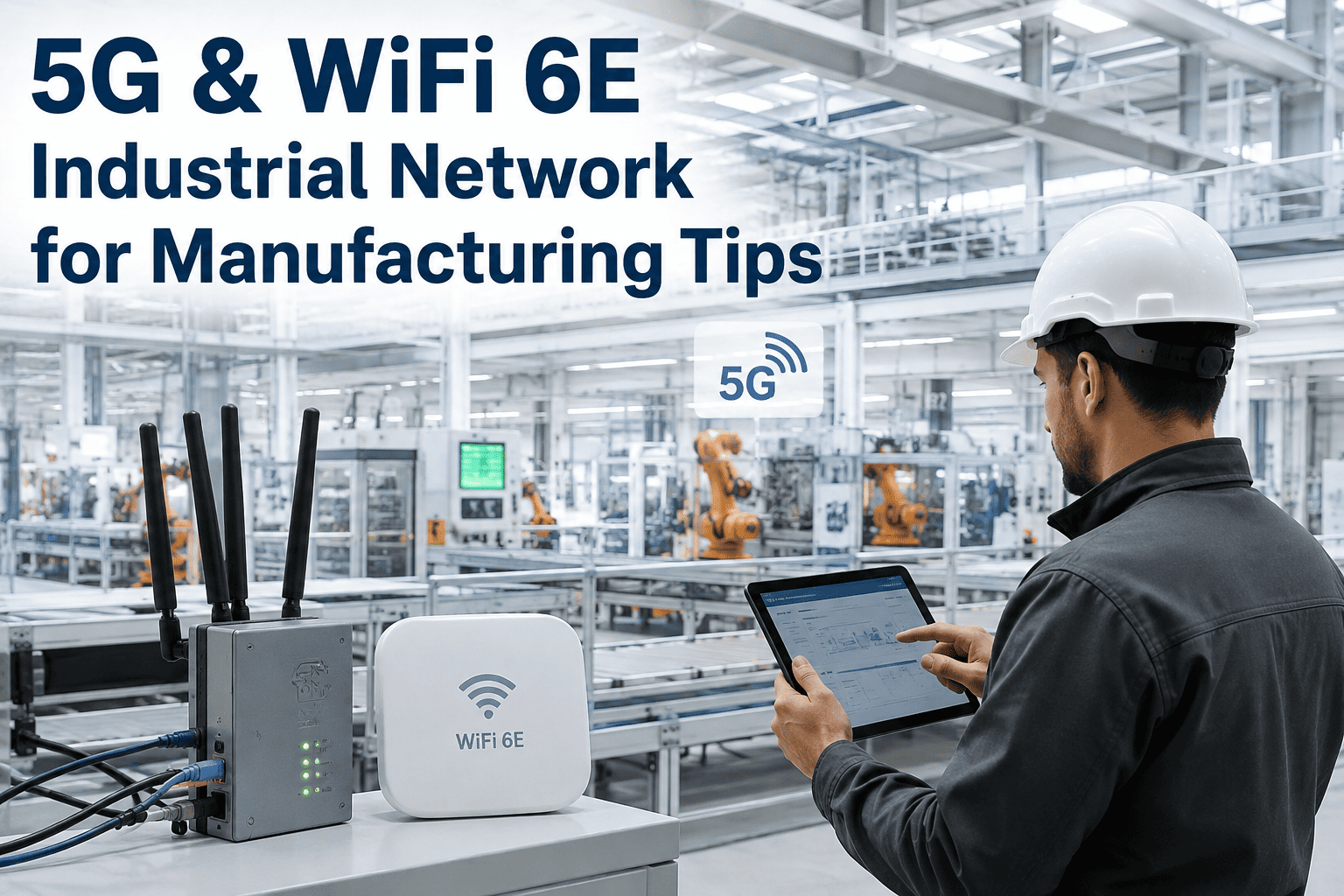
5G & WiFi 6E Industrial Network for Manufacturing Tips
By James Smith on August 6, 2026
A forklift moving between access points on a standard WiFi network briefly drops connection at every handoff — the roaming decision is made by the device, not the network, and that gap is measured in milliseconds that don't matter for a tablet but matter enormously for a safety-critical AGV control loop. Independent industry testing has measured WiFi 6 tail latency spiking as high as 264 milliseconds during mobility and client roaming, while private 5G's network-controlled handover is architected for zero packet loss as a device moves between radios. This is the real distinction driving 2026 industrial network design decisions — not which technology is newer, but which one matches the actual mobility and reliability profile of what's moving across your floor. Most facilities that get this right don't choose one technology exclusively; they deploy both, each handling the device category it's genuinely suited for. See how iFactory helps plants design hybrid 5G and WiFi 6E network architecture matched to fixed sensors, mobile assets, and everything in between.
Shop Floor Visibility · Industrial Network Design
5G and WiFi 6E Industrial Network for Manufacturing
Private 5G, WiFi 6E, and hybrid connectivity — matched to the actual mobility, density, and reliability requirements of machine data and mobile support on your floor, not chosen by which technology is newer.
This Isn't Newer-vs-Older. It's Mobility vs. Density.
The framing that leads plants astray is treating this as a technology upgrade decision — 5G as the newer, presumably better option. The actual decision runs along a different axis entirely: how much does a given device move across the facility, and how deterministic does its connection need to be. Fixed sensors and semi-mobile devices sit comfortably on one side of that line. Wide-area mobile assets with safety or real-time control requirements sit on the other. Almost every real-world design ends up needing both, in the same facility, at the same time — the question isn't which one to pick, it's which devices belong on which network.
Technology Comparison
WiFi 6E, Private 5G, and What Actually Differs
Seven dimensions capture most of what actually matters for a manufacturing floor decision — cost and spectrum are the two most commonly cited factors, but mobility performance and security model are frequently the two that determine whether a deployment actually succeeds.
Dimension
WiFi 6E
Private 5G
Spectrum
Unlicensed (2.4/5/6 GHz) — shared, subject to neighboring interference
Licensed or CBRS-type dedicated spectrum — protected from outside interference
Roaming / Handover
Device-controlled — the client decides when to switch access points
Network-controlled — the network manages handover for zero packet loss
Mobility Performance
Tail latency measured up to 264ms during mobility and roaming in independent testing
Architected for deterministic, low-latency performance under mobility
Coverage Density
Requires denser access point deployment for equivalent coverage
Wider coverage per radio due to higher transmit power and propagation
Device Security
Standard WiFi authentication (WPA3, certificate-based)
AGVs, forklifts, mobile robots, safety-critical control systems
Upfront Cost
Lower hardware cost, commodity access points
Higher per-radio cost, offset by needing fewer radios for equivalent area
The forklift in this diagram crosses the same three coverage zones on both networks — the physical environment hasn't changed, only which technology is managing the transition. On WiFi, the device itself has to notice signal degradation and initiate a new connection, and that decision process is what produces the measured latency spike. On private 5G, the network already knows the device is approaching the boundary and hands it off proactively, which is the structural reason 5G can promise deterministic performance where WiFi can only promise "usually fine."
The Gap That Doesn't Show Up on a Spec Sheet
A 264ms Latency Spike Means Nothing for a Tablet and Everything for an AGV Safety Loop
iFactory's network design team maps device mobility and criticality against the right technology — not a single wireless standard applied uniformly across every device on the floor.
The four patterns below cover the large majority of real manufacturing device categories, and most facilities will find their device inventory spread across all four rather than concentrated in just one.
WiFi 6E — Fixed & Semi-Mobile
Operator tablets, HMI terminals, fixed line sensors, and inspection cameras all work well on modern WiFi 6E without the cost and complexity of private cellular — high device density in a contained area is exactly what WiFi 6E's OFDMA and MU-MIMO improvements were built to handle.
Private 5G — Wide-Area Mobility
AGVs, forklifts, mobile robots, and safety devices moving continuously across a large or RF-challenging facility benefit from network-controlled handover and deterministic quality of service that WiFi's device-controlled roaming structurally cannot guarantee.
Private 5G — Mission-Critical Control
Safety PLCs and real-time control systems where a dropped connection has genuine safety consequences benefit from 5G's licensed or protected spectrum, which is immune to the interference that unlicensed WiFi bands can suffer from neighboring networks or non-WiFi sources.
Hybrid — Most Real Facilities
The majority of industry sources converge on the same conclusion: most facilities benefit from deploying both technologies together, each handling the device category it's actually suited for, rather than forcing every device onto a single wireless standard.
Hybrid Deployment Pattern
How Plants Actually Combine Both Technologies
A hybrid network isn't two separate projects running in parallel — it's one design exercise that assigns each device category to the technology it's actually suited for, following a sequence that keeps the decision grounded in real device requirements rather than vendor preference.
Step 1
Inventory Devices by Mobility and Criticality, Not by Type
Categorize every connected device by how far and how continuously it moves, and how severe the consequence of a dropped connection actually is — not simply by whether it's "a sensor" or "a robot," since mobility and criticality are the variables that actually determine the right technology.
Step 2
Assign WiFi 6E to Fixed and Semi-Mobile Device Clusters
Deploy WiFi 6E as the default for high-density, low-mobility device groups — tablets, fixed sensors, terminals — where its cost advantage and throughput are the right fit and mobility limitations don't matter.
Step 3
Assign Private 5G to Wide-Area Mobile and Safety-Critical Assets
Reserve private 5G specifically for the device categories that need it — AGVs, forklifts, safety PLCs — rather than deploying it facility-wide, which captures its reliability benefit exactly where it matters without paying its cost premium everywhere.
Step 4
Plan for Credential and Roaming Interoperability Between Networks
Emerging interoperability frameworks are making credential handoff between 5G and WiFi networks increasingly seamless, which matters for devices or personnel that legitimately move between zones covered by each technology during a single shift.
Design Checklist
Before Committing to Either Technology
These four assessments should happen before signing off on a network design, since each one directly changes which devices belong on which technology.
01
Map Every Device's Actual Mobility Pattern
Document which devices are truly fixed, which move within a small zone, and which travel continuously across large or multiple areas — this map is the single input that determines the rest of the design.
02
Identify Which Connections Are Genuinely Safety-Critical
Separate devices where a dropped connection is an inconvenience from devices where it's a safety event — the latter category is where private 5G's deterministic handover earns its cost premium.
03
Assess RF Interference Sources on the Existing Floor
A facility with heavy machinery, metal structures, or existing wireless congestion is more likely to see WiFi's unlicensed-spectrum vulnerabilities in practice — this assessment should happen before committing to an all-WiFi design.
04
Model Total Cost Across the Full Coverage Area, Not Per-Radio
Private 5G's higher per-radio cost is frequently offset by needing far fewer radios to cover the same area — compare total infrastructure cost for equivalent coverage, not sticker price per access point.
Field Perspective
“
The question I get asked most often is "should we switch to 5G," and it's almost always the wrong question. Nobody switches wholesale. The plants that get this right start by asking which of their devices actually need seamless mobility and deterministic latency — usually a much shorter list than people initially assume — and put 5G there specifically. Everything else stays on WiFi 6E, because it's cheaper, it's familiar to the IT team, and it does the job perfectly well for a tablet or a fixed sensor. The mistake is treating this as an either-or replacement decision instead of a device-by-device fit exercise, and that mistake usually comes from a vendor pitch rather than an actual assessment of what's moving across the floor.
Kasimir Adeyinka-Ferrante
Industrial Network Architect · 14 years designing wireless infrastructure for manufacturing and logistics facilities
Common Questions
Frequently Asked Questions
Should a manufacturing plant replace its WiFi network with private 5G entirely?
For most facilities, no — the majority of independent industry analysis converges on a hybrid approach rather than a wholesale replacement, since WiFi 6E remains the more cost-effective and appropriate choice for fixed and semi-mobile devices like tablets, HMI terminals, and line sensors. Private 5G earns its higher cost specifically for wide-area mobile assets and safety-critical systems where its network-controlled handover and licensed spectrum protection deliver a real reliability advantage that WiFi's device-controlled roaming structurally cannot match. Replacing an entire facility's WiFi with 5G typically means paying a premium for reliability guarantees that fixed devices never actually needed, while a hybrid design captures the benefit of each technology exactly where it applies. Book a network design review to map which of your specific devices would benefit from private 5G.
Why does WiFi roaming cause more disruption than 5G handover for mobile devices?
WiFi roaming is device-controlled — the client device itself decides when to disconnect from one access point and connect to another, and that transition creates a brief connectivity gap that independent testing has measured with tail latencies reaching as high as 264 milliseconds during mobility and client roaming. Private 5G's handover is network-controlled instead, meaning the network itself manages the transition as a device moves between radios, architected specifically for zero packet loss during that handoff. This distinction matters most for continuously moving devices like AGVs and forklifts, where frequent handoffs compound the disruption, and matters far less for a tablet that mostly stays within range of a single access point.
Is private 5G actually more expensive than WiFi 6E for equivalent coverage?
Per-radio, 5G hardware typically costs more than WiFi access points, but private 5G radios have higher transmit power and better signal propagation, meaning a facility often needs significantly fewer 5G radios than WiFi access points to achieve equivalent coverage — the total infrastructure cost comparison for a given coverage area can look considerably closer than the per-unit price difference initially suggests. The more accurate cost comparison evaluates total infrastructure cost for the specific coverage area and device density required, rather than comparing list prices for a single access point against a single radio.
How does SIM-based authentication in private 5G improve security over standard WiFi?
Private 5G uses SIM-based authentication — physical SIM cards or eSIM provisioning — which is considerably more difficult to compromise than standard WiFi credential-based authentication, since SIM data contains identity and subscriber information that determines exactly what level of network access a specific device has. This centralized, carrier-grade approach to identity and access control is particularly valuable in industrial IoT environments with large numbers of connected devices carrying business-critical or safety-relevant data, where compromised credentials on a single device pose a meaningfully larger risk than in a typical office WiFi environment. Talk to solutions engineering about designing device authentication policy across a hybrid 5G and WiFi 6E network.
Can devices move between a private 5G zone and a WiFi 6E zone without losing connectivity?
This is an active area of development — emerging interoperability frameworks are working toward seamless credential handoff between 5G and WiFi networks, which would simplify hybrid device fleets that legitimately need to move between zones covered by each technology. Facility design in the near term should still plan explicit boundaries and transition zones between 5G and WiFi 6E coverage areas rather than assuming automatic seamless handoff is universally available today, since interoperability maturity varies by vendor and deployment.
Match the Technology to the Device, Not the Other Way Around
Hybrid Network Design Built Around Actual Mobility and Criticality
iFactory's network design team maps your specific devices — fixed, semi-mobile, and wide-area mobile — to the right mix of WiFi 6E and private 5G, so reliability spend goes exactly where it's actually needed.