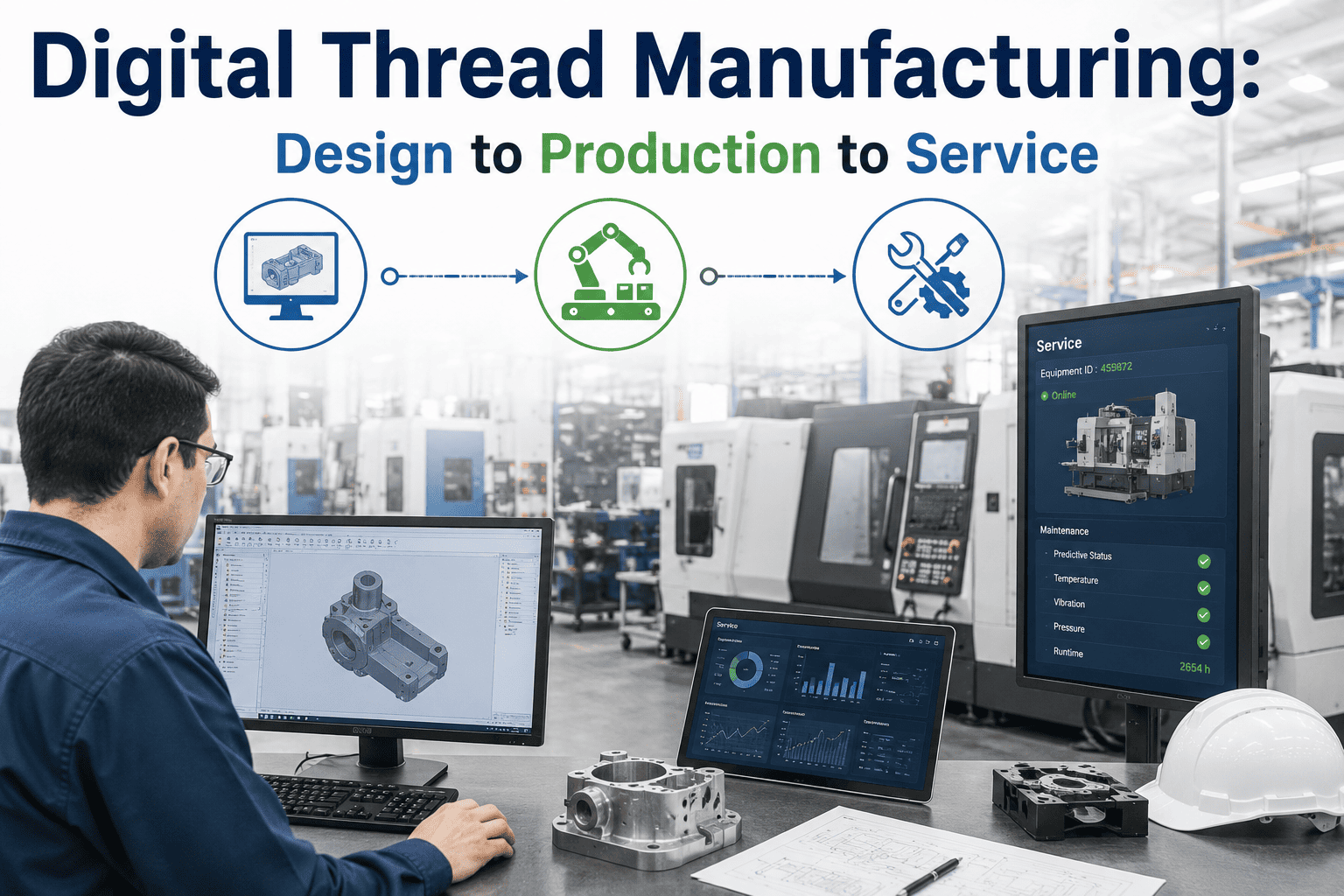
A field technician troubleshooting a failed part rarely has an easy way to ask what that part's original design tolerance was, which production batch it came from, or whether a similar failure showed up during testing years earlier. That information exists, scattered across a PLM system, an MES database, an ERP record, and a service ticketing tool that were never connected to each other. A digital thread links those systems so a single part's history, design intent, manufacturing data, and field performance, can be traced in one continuous record instead of four disconnected ones. iFactory builds that connective layer across PLM, MES, ERP, and service systems, and you can book a demo to see it mapped against the systems you already run.
This is not merely an IT convenience, it directly affects how quickly a defect gets contained, how confidently a warranty claim gets resolved, and how much trust a customer or regulator places in a manufacturer's ability to explain what happened to a specific part.
One Continuous Record From First Design Sketch to Last Field Repair
iFactory connects design, production, and service data into a single traceable thread, so any part's full history is one query away instead of a search across four disconnected systems.
Every System Boundary Is a Place Product Knowledge Gets Lost
PLM knows the design intent. MES knows what actually happened on the line. ERP knows what shipped where. Service knows what failed and why. Individually each system does its job well, but when a quality issue or field failure needs answers that span two or three of them, someone ends up manually cross-referencing part numbers, dates, and batch codes across tools that were never built to share a common identifier.
The cost of that manual cross-referencing is not just the hours it takes, it is the questions that never get asked because everyone already knows how tedious the answer will be to find. An engineer who suspects a design tolerance might be contributing to field failures across a product line, but who also knows that confirming it means manually pulling records from three separate systems, is often simply less likely to pursue the question at all. Over time, that quiet discouragement of investigation is arguably the bigger cost of disconnected systems, more than any single slow report.
Four Stages, One Record, No Handoff Gaps
A digital thread does not replace PLM, MES, ERP, or service tools, it links them at the record level so a part's identity carries forward automatically through every stage of its life.
Each handoff between stages is also where information has historically been lost, a production deviation approved verbally during a shift never makes it into the record that eventually ships with the part, or a service technician's diagnostic notes stay in a ticketing system that engineering never queries. A digital thread treats each of these handoffs as a data linkage point that should be preserved deliberately, not an informal conversation that happens to get documented if someone remembers to write it down.
The Same Data, With or Without a Common Path Between Systems
The underlying data rarely needs to change to build a digital thread, what changes is whether it can be followed automatically across systems or has to be reassembled by hand every time someone asks a cross-functional question.
It is worth being clear-eyed about what a digital thread does not do, it will not fix bad data at the source, if production records are entered inconsistently or service tickets are closed without meaningful notes, linking those records together simply makes the underlying data quality problem visible faster rather than solving it. The projects that get the most value from a digital thread usually pair the linking work with a light data quality pass on each source system first, since a well-connected thread built on inconsistent source data mostly just surfaces the inconsistency sooner.
| Question | Disconnected Systems | iFactory Digital Thread |
|---|---|---|
| What was the design tolerance for this failed part? | Search PLM manually by part number and revision | Pulled automatically from the linked design record |
| Which batch and machine produced it? | Cross-reference MES logs against shipment dates | Directly linked to the part's production record |
| Has this failure mode happened before? | Depends on institutional memory or manual ticket search | Searchable across all linked service records instantly |
| Should engineering revise the design? | Field data rarely makes it back to design teams | Field patterns surfaced directly to design and quality |
See Your PLM, MES, ERP, and Service Data Linked
iFactory connects the systems you already run into one traceable thread per part, no rip and replace required. Book a demo to see it against your own product data.
Any Manufacturer Whose Product Has a Life After It Ships
The value of a digital thread grows with product complexity and how much scrutiny a part receives after it leaves the plant, whether from a customer, a regulator, or a warranty claim.
It is also worth noting where a digital thread tends to matter less, low-complexity commodity products with minimal post-sale scrutiny and a short service life often do not justify the same investment, since the cost of an occasional manual trace is lower than the ongoing maintenance of a connected thread. Recognizing that distinction early helps teams focus the initiative on the product lines where the payoff is clearest rather than treating it as a blanket requirement across an entire manufacturing portfolio.
The Rollout That Works Starts With the Handoff Causing the Most Pain
Trying to connect all four lifecycle stages simultaneously is a common way for a digital thread initiative to stall, because it requires coordinating access, data mapping, and change management across four different teams at once, each with its own priorities and its own reasons to be cautious about a new integration touching their system of record. A more durable approach starts by identifying the single handoff causing the most friction today, often production to service, since that is where field failures most urgently need to be traced back to a specific batch, and proves the value there before expanding.
This staged approach also gives each team a chance to see their own data become more useful without feeling like their system was subordinated to someone else's initiative. A production team that sees service data start flowing back to them with clear evidence linking a recurring failure to a specific process parameter becomes an advocate for extending the thread further, which tends to build momentum for the project far more effectively than a mandate from above ever does.
Questions Engineering and Operations Ask First
Stop Losing Product History at Every System Boundary
iFactory links design, production, delivery, and service data into one traceable thread per part. Book a demo to see it built around the systems you already run.


.jpeg)
