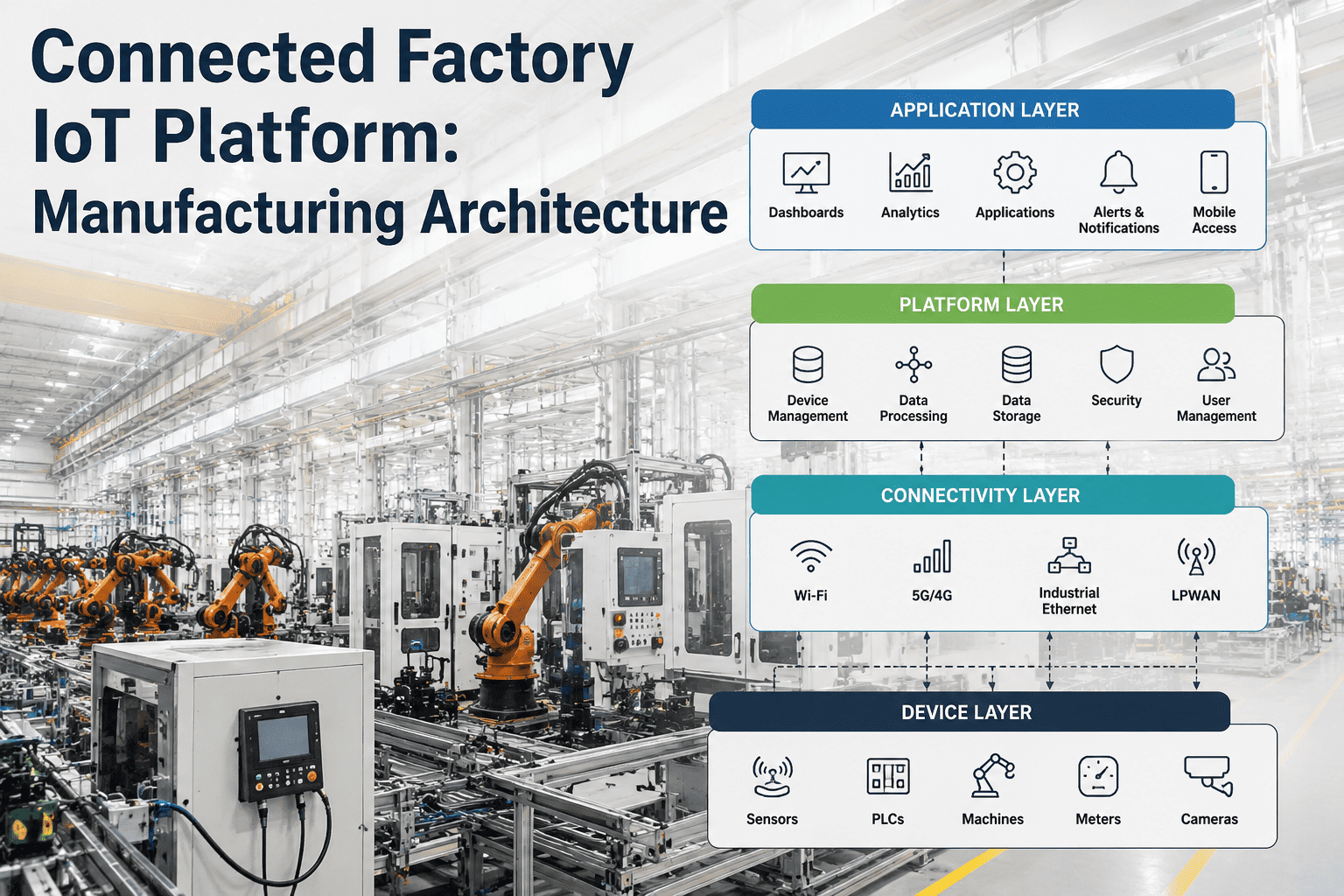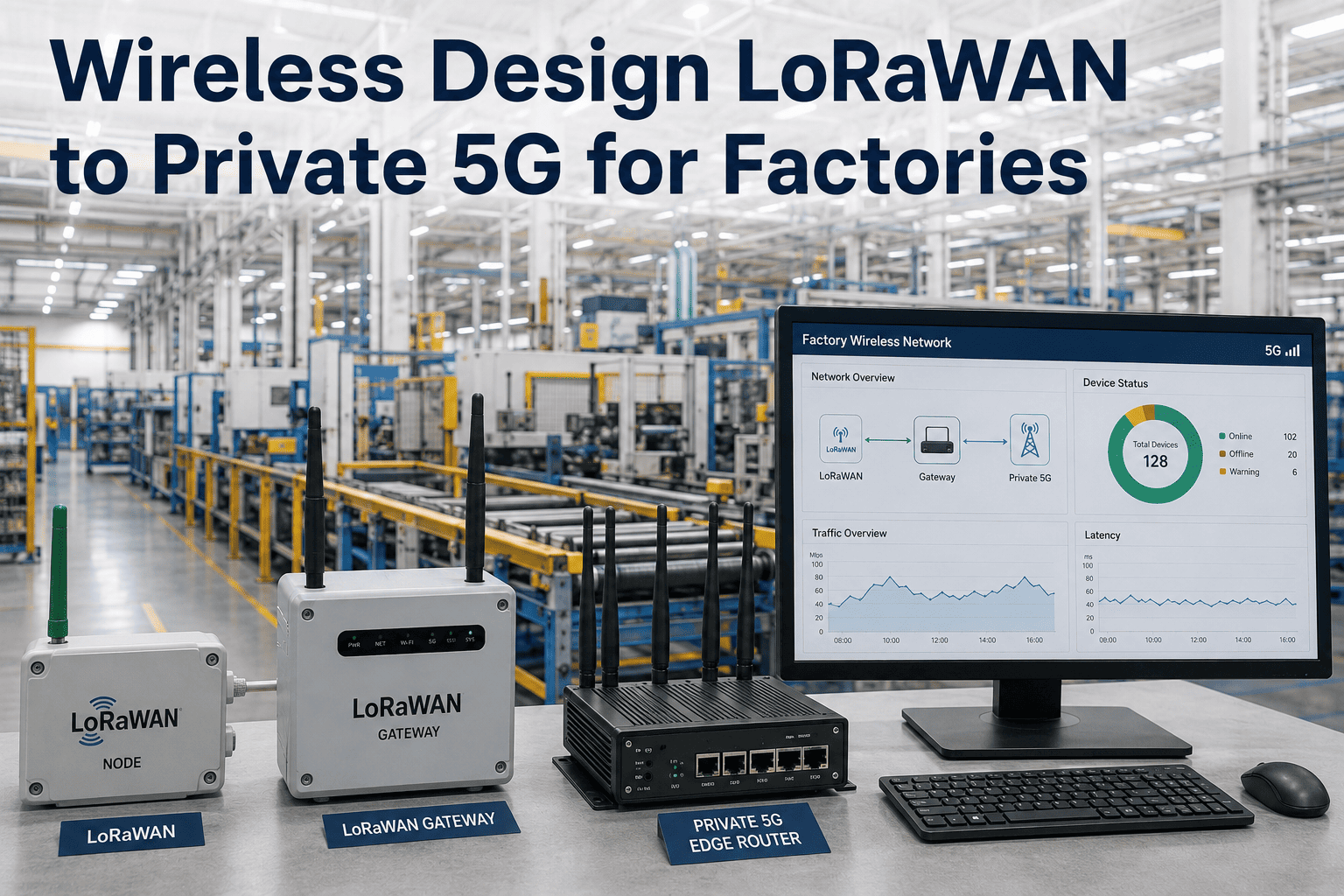
The single biggest mistake in greenfield factory wireless design is picking one radio technology and trying to make it cover every sensor on the floor. WiFi 6 delivers plenty of bandwidth for video and handheld tablets but drains a battery-powered vibration sensor in weeks. LoRaWAN covers an entire campus for ten years on a coin cell but cannot stream a single video frame. Every wireless protocol trades range, bandwidth, power, latency, and reliability against each other, and no single one optimizes all five at once, which is exactly the design problem ifactory support works through on every greenfield build.
The Right Radio for Every Sensor Class, Not One Radio for Everything
From 120+ factory builds, the decisions, specs, and sequences that turn a wireless design into a plant that actually stays connected for a decade.
Every Protocol Was Built for a Different Trade-Off
Wireless technology selection fails most often when a single team picks the protocol they know best and applies it everywhere, regardless of what each sensor class actually needs. A vibration monitor bolted to a motor bearing in a hard-to-reach corner of the plant has completely different requirements from a handheld scanner moving through a warehouse, and both are completely different again from a robotics cell that needs sub-20-millisecond command latency for a safety shut-off. Treating these as one wireless design problem instead of three or four separate ones is where greenfield builds quietly accumulate years of retrofit cost.
The global industrial wireless sensor network market has grown into a multi-billion-dollar category precisely because no single protocol won. WirelessHART and ISA100 still dominate deterministic process control, LoRaWAN is the fastest-growing choice for campus-wide monitoring, and private 5G is emerging specifically for the small subset of use cases, like mobile robotics and AR-assisted maintenance, that genuinely need high bandwidth and low latency together.
| Protocol | Best Fit | Hard Limit |
|---|---|---|
| LoRaWAN | Battery sensors, campus-wide monitoring | Cannot handle high-bandwidth or real-time command traffic |
| WiFi 6 | Tablets, video, high-density device areas | Drains sensor batteries in weeks, not years |
| Bluetooth LE | Mobile asset tracking within short range | Drops connections beyond roughly 30m in metal environments |
| WirelessHART / ISA100 | Deterministic process control loops | High per-point cost limits scalability |
| Private 5G | Mobile robotics, AR, real-time command and control | High power consumption, higher infrastructure cost |
How a LoRaWAN Network Actually Connects a Plant
A private LoRaWAN network follows a star-of-stars topology designed specifically to maximize battery life and scale to thousands of end devices without any single point requiring constant power or maintenance attention.
End devices remain in deep sleep for most of their life cycle, waking only to transmit a short packet, which is the design choice that enables multi-year operation on a single small battery. Gateways are intentionally lightweight, converting radio packets into standard IP traffic without processing application data or storing device keys, so a single indoor gateway can cover an entire factory floor at 200 to 500 meters, meaning most campuses need only two or three gateways total rather than the dense access point grid a WiFi deployment requires.
Get a Sensor-Class Wireless Plan for Your New Build
Bring your equipment list and floor plan. We will map each sensor class to the protocol that actually fits, before construction locks in the wrong infrastructure.
Matching Sensor Class to Protocol, Not the Other Way Around
The design sequence that works starts with the sensor requirement, not the vendor relationship a plant already has. Every sensor class on a greenfield build gets evaluated against the same five factors, range, bandwidth, power budget, latency tolerance, and required reliability, before a protocol gets assigned.
Weighting the Five Selection Factors
Every greenfield wireless plan should score sensor classes against the same five factors, weighted according to what actually matters for that specific plant. A pharmaceutical cleanroom weighs reliability far more heavily than a warehouse tracking pallet locations, and the weighting should reflect that rather than defaulting to a generic industry template.
Security Cannot Be an Afterthought on Any Protocol
Every wireless technology in a factory design carries its own security model, and all of them share one architectural rule that should never be skipped, wireless traffic gets inspected and filtered at the OT firewall or DMZ before it ever reaches the production network. LoRaWAN uses AES-128 encryption with per-device keys validated by the network server, WirelessHART layers network-wide and per-session keys with join authentication to block rogue devices, and private 5G relies on SIM-based mutual authentication with 256-bit encryption on the air interface. None of these protections matter if the wireless gateway itself has an unfiltered path straight into the plant's core production systems.
Frequently Asked Questions
Get a Sensor-Class Wireless Architecture for Your Build
Bring your equipment list and floor plan and we will map every sensor class to the protocol that actually fits, before construction locks in the wrong infrastructure.