An AI vision model that scored 99% accuracy at go-live can quietly slip to 91% eight months later, and most quality teams do not notice until rejected-part counts start climbing or, worse, until a defect that should have been caught reaches a customer. The drop rarely comes from a software bug. It comes from the plant floor itself changing underneath the model: a new raw material lot with a different sheen, a re-lensed camera after maintenance, a seasonal shift in ambient light near the dock doors, or a product revision that introduces a defect type the model never saw during training. Static models are built for a static world, and manufacturing floors are anything but static. The fix is not a one-time recalibration but a continuous improvement discipline built around drift detection, structured feedback loops, and a retraining cadence tied to real performance data rather than the calendar. You can book a demo to see how iFactory keeps inspection models accurate month after month without constant manual intervention.
Keep Vision Model Accuracy From Decaying After Go-Live
iFactory continuously monitors every deployed inspection model for accuracy drift, routes uncertain predictions into a structured feedback loop, and retrains on a schedule driven by real performance data instead of guesswork.
The Slow, Invisible Decline That Undermines Every AI Vision Deployment
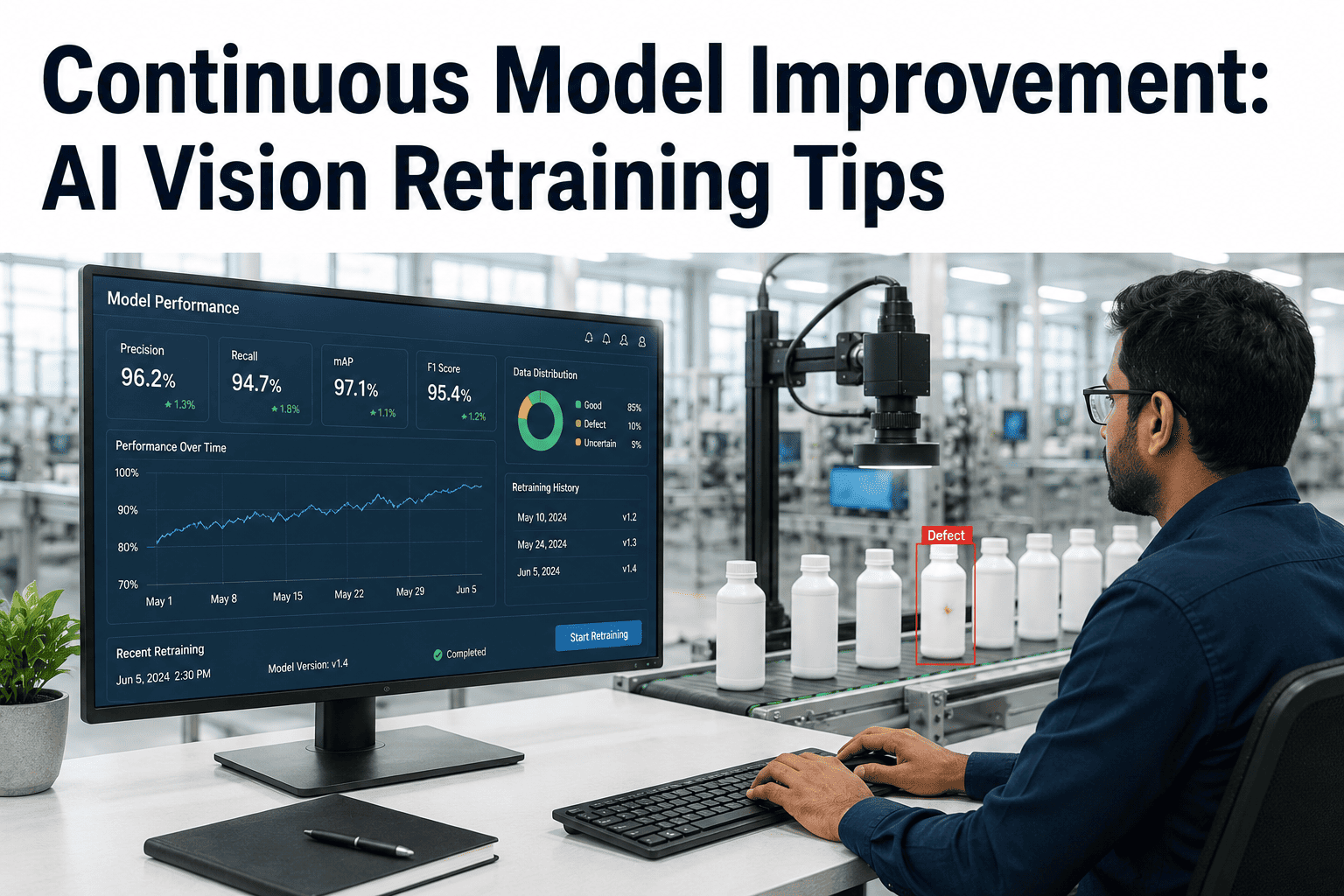
Model decay is gradual by nature, which is exactly why it is dangerous. A model does not fail overnight; it drifts a fraction of a percent at a time until the cumulative effect shows up as a spike in escapes or a wave of operator complaints about false rejects. The timeline below shows the typical decay pattern teams see when a model is left untouched after deployment. Because the decline is gradual, it rarely triggers an obvious alarm on its own, and by the time someone notices the trend in scrap reports or customer complaints, the model may have been quietly underperforming for weeks or months. This is why passive monitoring, where someone only looks at accuracy when a problem is already suspected, consistently fails to catch drift early enough to prevent real cost.
The underlying causes of drift fall into a few recurring categories that quality and engineering teams can watch for proactively. Environmental drift comes from changes in lighting, camera positioning, or ambient dust and moisture that shift how the same physical defect appears to the camera sensor. Material drift comes from new suppliers, batch-to-batch variation in raw material, or seasonal changes in humidity that affect surface appearance. Process drift comes from equipment wear, tooling changes, or maintenance events that subtly alter how parts are formed or finished. Recognizing which category is driving a given accuracy dip helps teams decide whether the fix is a camera recalibration, a targeted retraining cycle, or a broader investigation into the production process itself.
A Continuous Loop That Turns Every Uncertain Prediction Into Training Data
The core of sustainable model performance is a closed loop that captures the cases where the model is least confident, routes them to a human reviewer, and feeds the corrected label back into the next training cycle. Without this loop, the model has no mechanism to learn from the exact conditions that are causing it trouble on your specific line, and it will keep making the same category of mistake indefinitely no matter how much time passes.
What makes this loop different from a generic quality control checklist is that it is targeted specifically at the model's actual weaknesses rather than a broad, undirected sample of production images. A random sample of a thousand images from the line would mostly contain easy, unambiguous cases that the model already handles correctly, adding little value to the next training cycle. By routing only the genuinely uncertain cases into the review queue, the loop concentrates reviewer attention exactly where it produces the largest accuracy gains per labeled image, which is why plants running this approach typically see meaningful improvement from a few hundred reviewed images rather than needing thousands of new labels for every retraining cycle.
Confidence Scoring
Every inference produces a confidence score alongside the pass or fail decision, so the system knows which images the model is unsure about rather than treating every prediction as equally reliable.
Low-Confidence Routing
Images that fall below the confidence threshold are automatically queued for human review instead of silently passed or silently rejected, preventing quiet accuracy loss from going unnoticed.
Operator Verification
A quality engineer or trained operator confirms the correct label on flagged images in a lightweight review interface, taking seconds per image rather than minutes.
Dataset Enrichment
Verified labels are added to the training dataset, specifically targeting the edge cases the model was struggling with rather than diluting the dataset with redundant easy examples.
Scheduled Retraining
The enriched dataset feeds a retraining run on a defined cadence, producing an updated model that closes the specific gaps identified during the previous cycle.
Shadow Validation
Before going live, the retrained model runs in shadow mode alongside the current model, confirming the update improves accuracy before it takes over live decisions.
Five Signals That Should Trigger a Retraining Cycle, Not a Fixed Calendar Date
Retraining on a rigid quarterly schedule wastes engineering time when nothing has changed, and leaves the model stale for months when something has. A signal-driven approach retrains only when the data indicates it is actually needed, which keeps engineering effort focused on the periods where the model genuinely needs attention instead of running the same process on autopilot regardless of actual performance.
In practice, most plants end up retraining somewhere between every six and ten weeks once a stable production line settles into a rhythm, but the exact cadence should always follow the signals below rather than a number chosen in advance. Plants introducing frequent product changes, running multiple part variants through the same station, or operating in industries with seasonal material shifts tend to see triggers fire more often, while stable, single-product lines with consistent suppliers may go several months between necessary retraining cycles. The goal of the signal-driven model is not to retrain as often as possible, but to retrain exactly when the evidence justifies it and skip the cycle entirely when it does not.
Results From Manufacturing Plants Running Continuous Model Improvement
The figures below reflect aggregated outcomes from iFactory deployments that adopted the drift detection and scheduled retraining approach after experiencing accuracy decay with a static model. Results are drawn from plants across discrete and process manufacturing that had previously deployed AI vision without any ongoing maintenance program, then added structured monitoring and retraining on top of their existing inspection stations.
Four Steps to Stand Up a Continuous Improvement Program on an Existing Model
Plants that already have an AI vision system deployed without a formal retraining process can add one without ripping out existing infrastructure. The steps below describe how iFactory layers monitoring and feedback onto a model that is already running in production, so the current inspection system continues operating throughout the transition with no line downtime required to begin building the program.
Most plants complete the first three steps within a single month, since baselining and instrumenting an already-deployed model does not require new hardware in the typical case, only software-level access to the inference pipeline. The fourth step, the first actual retraining cycle, is usually the longest because it depends on how quickly enough labeled edge cases accumulate in the review queue to meaningfully improve the dataset. Plants running high production volumes with frequent part variation tend to reach a useful retraining threshold faster than low-mix, low-volume lines simply because more images pass through the system each day, generating more edge cases for the review queue to capture.
Baseline the Current Model
Run a two-week measurement window to establish current accuracy, confidence distribution, and false reject rate as the reference point for future comparisons.
Deploy Confidence Monitoring
Instrument the live model to log confidence scores on every inference, giving visibility into drift trends before they show up as production incidents.
Stand Up the Review Queue
Introduce a lightweight interface for quality engineers to review low-confidence images and confirm correct labels, building the enriched dataset over time.
Run the First Signal-Driven Retrain
Once a trigger threshold is crossed, execute the first retraining cycle and validate the improvement in shadow mode before promoting it to production.
Questions Quality Engineers Ask About Model Retraining Programs
Who Should Own the Retraining Program on the Plant Floor
A continuous improvement program only works if someone is accountable for reviewing the queue and approving retraining cycles. In most successful deployments, ownership sits with a quality engineer or a data-focused process engineer rather than IT, because the decisions involved require judgment about what actually constitutes a defect on the line, not just technical model management. IT typically owns the infrastructure that runs the monitoring and retraining pipeline, while the quality team owns the labeling decisions and the go-live approval for each new model version. Establishing this split early prevents the common failure mode where a retraining program is technically capable but nobody is actually reviewing the queue, and the model quietly drifts anyway despite the tooling being in place. A simple weekly cadence, where the quality engineer spends thirty minutes reviewing flagged images and a monthly checkpoint where retraining triggers are evaluated against the defined thresholds, is usually enough to keep the program running without becoming a burden on any one person's time.
Documentation also matters more than most teams initially expect. Every retraining cycle should log what changed in the dataset, what triggered the retrain, and what the shadow validation results showed before the new model went live. This audit trail becomes essential during customer quality audits, IATF or ISO surveillance visits, and internal root cause investigations, since auditors increasingly ask how an AI-based inspection system is maintained over time rather than only how it performed at initial validation. Plants that treat the retraining log as a living quality record, similar to a calibration log for a physical gauge, find these conversations far easier than plants trying to reconstruct the history after the fact.