A four-hour maintenance window sounds small until it lands on the one line carrying the week's tightest order. Planners who schedule maintenance and planners who schedule production usually work from two different calendars, and the gap between those calendars is where capacity gets quietly lost — not to breakdowns, but to windows that were never checked against the plan before they were approved. Getting maintenance and capacity planning onto one calendar recovers that lost time without adding a single wrench-turn of extra work, without new headcount, and without asking either team to give up the priorities that matter most to them. A 30-minute session can show what that recovered capacity looks like on your own schedule.
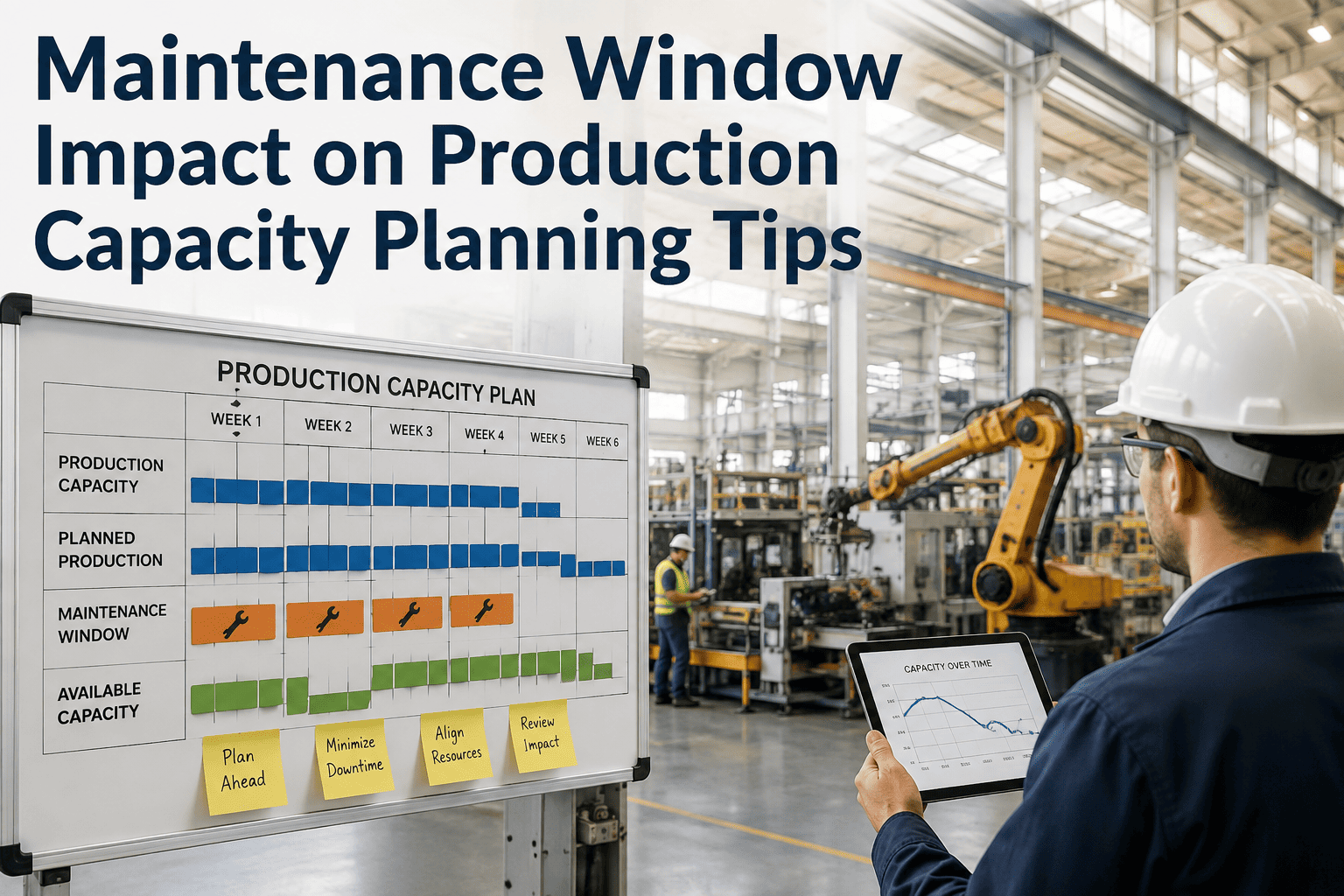
Maintenance Window Impact on Production Capacity Planning
Every maintenance window removes capacity from the schedule somewhere. The question is whether that removal was planned around your tightest constraints or dropped into the calendar without anyone checking what it would cost. The gap between "PM compliant" and "capacity protected" is where a surprising amount of a plant's annual throughput quietly disappears, one small, individually defensible window at a time.
This pattern shows up across steel, food and beverage, automotive, and textile operations alike — anywhere a maintenance calendar and a production schedule are built by two different teams working from two different sets of priorities.
Why Maintenance Windows Wreck Capacity Plans
Maintenance teams and production planners are both trying to protect uptime, but they are usually optimizing against different calendars. A maintenance window that looks perfectly reasonable on a PM schedule can land directly on top of the one shift with zero slack in the production plan. Three patterns show up again and again once a plant starts tracing where its capacity actually disappears, and none of them are the fault of either team individually — they are what happens when two well-run schedules never get compared against each other before commitments are locked in. Recognizing the pattern is usually the harder part; fixing it tends to be straightforward once both teams can see the same calendar.
Windows Set Without Schedule Visibility
PM schedules are often built months ahead, long before the actual production plan for that week exists. By the time the two get compared, the maintenance window is already locked in as a commitment, and moving it late in the process usually means displacing a task that has its own dependencies.
Windows Sized on Habit, Not History
A four-hour window becomes the default for a task type regardless of how long that task actually took the last five times it ran, leaving either wasted capacity when the job finishes early or a rushed job that risks a repeat failure when it consistently runs long.
No Feedback Loop to the Next Plan
When a window runs long or short, that variance rarely makes it back into how the next window gets sized, so the same misestimate repeats quarter after quarter and the gap between planned and actual duration never closes.
None of these three patterns is a failure of either team's judgment — they are simply what happens by default when maintenance planning and production planning are treated as two separate disciplines instead of two inputs into the same schedule.
How This Shows Up Differently Across Verticals
The underlying mechanics of a poorly coordinated maintenance window are the same everywhere, but the specific cost looks different depending on what the plant is running, what its changeover economics look like, and how tightly its customer commitments are tied to specific production windows. Understanding which vertical-specific cost applies helps prioritize which lines deserve the tightest coordination first.
Steel & Heavy Process
A window on a caster or reheat furnace during a scheduled heat sequence can cost an entire production campaign, not just the hours the window occupies, since restarting a continuous process from cold carries its own time and yield penalty.
Food & Beverage
Maintenance on a filling or packaging line during a short shelf-life production run can force a full changeover and cleaning cycle that costs far more than the window itself, especially on allergen-sensitive lines requiring full sanitation between runs.
Automotive
A window on a line feeding a just-in-time customer commitment can trigger contractual penalties well beyond the internal cost of the lost production hours, since the impact extends past the plant to the customer's own assembly schedule.
Textile
Windows on dyeing or finishing equipment during a color-matched run often force a full batch restart, turning a short maintenance task into a multi-shift loss along with the material consumed in the aborted batch.
The Hidden Cost of Reactive Maintenance Scheduling
We were hitting our PM compliance targets every month and still missing capacity commitments we couldn't explain. It took mapping every maintenance window against the actual production schedule to see that we were losing more capacity to well-intentioned maintenance timing than to unplanned downtime itself. Once we had that overlay, the fix was almost embarrassingly simple — move three recurring windows off our tightest production days.
— Plant Reliability Manager, mid-size steel producer
The cost of an uncoordinated maintenance window rarely shows up as a single line item. It shows up as overtime to make up a missed shift, as a rush order that gets bumped, as a customer commitment quietly renegotiated after the fact. None of those costs get traced back to the maintenance calendar because nobody is looking at both calendars at the same time, so the same pattern repeats month after month without ever getting flagged as a root cause worth fixing. By the time anyone connects the dots, the cost has already compounded across several planning cycles.
None of these figures require a plant-wide overhaul to start recovering. Most operations see the first measurable win from coordinating windows on just their two or three highest-constraint production lines, which is usually enough to build the case for extending the practice further across the rest of the facility over subsequent quarters.
Signs Your Plant Already Has a Window Coordination Problem
Most plants do not set out to build maintenance-capacity coordination — they get pulled into it after enough conflicts stack up. These signs usually appear well before the conflict serious enough to force the conversation, and catching them early is what turns this into a planned improvement rather than a reaction to a missed customer date.
Overtime spikes after PM weeks
A recurring bump in overtime hours the week after scheduled maintenance is a strong sign windows are landing on constrained periods.
Production reschedules windows late
If production planners regularly ask maintenance to move a window after it is already approved, the two calendars are not being checked against each other early enough.
Same task type, different durations
Wide swings in how long a repeated maintenance task takes, with no record of why, points to windows being sized on habit rather than history.
No shared calendar exists
If maintenance and production planners cannot both see the same up-to-date calendar without emailing each other, coordination is happening manually and inconsistently.
None of these signs on their own is a crisis. Together, they usually mean the coordination is happening informally, through relationships and memory rather than a repeatable process — which works until the person holding that knowledge is out for a week, moves to a different role, or simply has too many competing priorities to catch every conflict by hand.
Stop Losing Capacity to Windows Nobody Cross-Checked
iFactory puts the maintenance calendar and the production schedule in the same view, so a proposed window shows its capacity cost before it gets approved — not after the shift is already gone and the overtime request is already being written up.
Building a Maintenance-Aware Capacity Model
Coordinating maintenance and capacity planning is less about new software and more about giving both teams a shared view of the same calendar before commitments get locked in. Plants that do this well tend to follow a consistent build sequence, usually completing the full cycle within one planning quarter and refining it further as more historical duration data accumulates. The sequence below is deliberately incremental — each step produces a usable result on its own, so the project delivers value before the full model is complete, and no single step requires the others to already be finished.
Map Historical Window Accuracy
Pull the last year of maintenance windows against their actual duration to see which task types consistently run long or short, and by how much on average.
Overlay the Production Calendar
Identify which weeks or shifts carry the least schedule slack, so proposed windows can be checked against real constraint points, not just open calendar slots that look free on paper.
Add a Capacity Cross-Check to Window Approval
Before a window gets locked in, it passes through a check that flags conflicts with tight-capacity periods and suggests lower-impact alternatives that still meet the maintenance requirement.
Feed Actual Duration Back Into Sizing
Close the loop by recording actual window duration against the estimate, so the next PM cycle for that task type gets a more accurate capacity allocation instead of repeating the same default guess.
Reactive Scheduling vs Capacity-Aware Maintenance Planning
The difference between the two approaches is not the maintenance work itself — it is whether the timing of that work accounts for what it costs the production plan. The table below reflects the same underlying maintenance activities; only the coordination layer around them changes.
| Planning Approach | Reactive Scheduling | Capacity-Aware Planning |
|---|---|---|
| Window timing decision | Set by PM calendar alone | Checked against production schedule |
| Conflict detection | Discovered after approval | Flagged before approval |
| Window sizing | Fixed default per task type | Based on historical actual duration |
| Overtime from conflicts | Frequent and unplanned | Rare, mostly avoided upfront |
| Feedback into next cycle | Rarely captured | Built into every window closeout |
The right-hand column does not require a bigger maintenance team or a longer planning cycle — it requires the same information that already exists in the CMMS and the production schedule to be compared before decisions get made instead of after problems appear.
What Changes When Maintenance and Capacity Share a Calendar
Fewer Last-Minute Reschedules
Conflicts get caught during window approval instead of during the week the work is supposed to happen, which removes most of the scramble that follows a surprise conflict and reduces the frequency of emergency overtime requests.
More Accurate Window Sizing
Windows sized against historical actuals stop over-allocating capacity to tasks that consistently finish early, and stop under-allocating to the ones that consistently run long, so the calendar reflects reality rather than a rounded estimate.
Better Maintenance-Production Trust
When production planners can see the reasoning behind a window instead of just the block on the calendar, pushback drops and both teams spend less time negotiating around the same recurring conflicts every cycle.
Over time, the biggest shift tends to be cultural rather than technical: maintenance and production stop treating each other's calendar as an obstacle to work around and start treating it as a shared constraint to plan against together.
Frequently Asked Questions
Does this replace our CMMS or PM scheduling system?
No. It connects to the PM schedule your CMMS already manages and layers a capacity cross-check on top of it, so windows get flagged against production constraints before approval rather than requiring a new system for the maintenance team to learn or a parallel calendar to keep updated. Our team can walk through your current CMMS setup to confirm the integration path and timeline. In practice, the cross-check tends to reduce friction between maintenance and production rather than increase it, because it replaces informal negotiation with a shared, visible reason for why a window landed where it did.
How much lead time does the capacity cross-check need?
Most plants run the check as part of normal window approval, typically one to two weeks ahead of the scheduled date. That is enough runway to shift a window to a lower-impact period without disrupting the underlying PM schedule or delaying necessary maintenance work, and it gives production planners time to communicate any unavoidable impact to their own customers or downstream teams.
What if a maintenance window truly cannot move?
Some windows are fixed by safety, regulatory, or equipment condition requirements and genuinely cannot shift. In those cases the value is different — the production plan gets adjusted around the fixed window with full visibility and enough lead time to communicate the impact, instead of the conflict surfacing as a surprise mid-week with no time left to plan around it.
How is historical window duration data collected?
It is typically pulled from work order close-out times already logged in the CMMS. Most plants have this data available; it simply has never been compared systematically against the original window estimate to see where the gap consistently shows up, or which technicians and task types have the most reliable estimates versus the least.
How quickly can we expect to see recovered capacity?
Plants typically catch their first avoidable conflict within the first two to three scheduling cycles, since the check runs against windows that are already being approved and does not require waiting for a new planning cycle to begin. Measurable capacity recovery across the plant usually shows up over one full quarter, as more historical duration data accumulates and window sizing becomes progressively more accurate. To scope a realistic estimate for your operation, book a 30-minute scheduling assessment.
Put Maintenance and Production on the Same Calendar
iFactory checks every proposed maintenance window against your production schedule before it gets approved, and feeds actual duration back into how the next window gets sized. No new system for your maintenance team to learn, no separate calendar to maintain — just a cross-check layered on top of the scheduling process you already run every week.