Every plant manager has sat through the capital request meeting where the answer to a capacity shortfall was a new line, a new press, or a new furnace — millions of dollars and a year of lead time before a single extra unit ships. Most of the time, that capital was never the actual constraint. The real bottleneck was a changeover routine nobody had touched in years, a quality loss rate quietly eating five percent of good output, or a micro-stop pattern too small for anyone to notice on a shift-by-shift basis. Continuous improvement finds and removes that hidden capacity without the capital request, without the year-long installation timeline, and without the risk of a new asset inheriting the same inefficiencies as the one it replaced. A 30-minute debottlenecking assessment can show how much of it exists on your own lines before any equipment purchase gets approved.
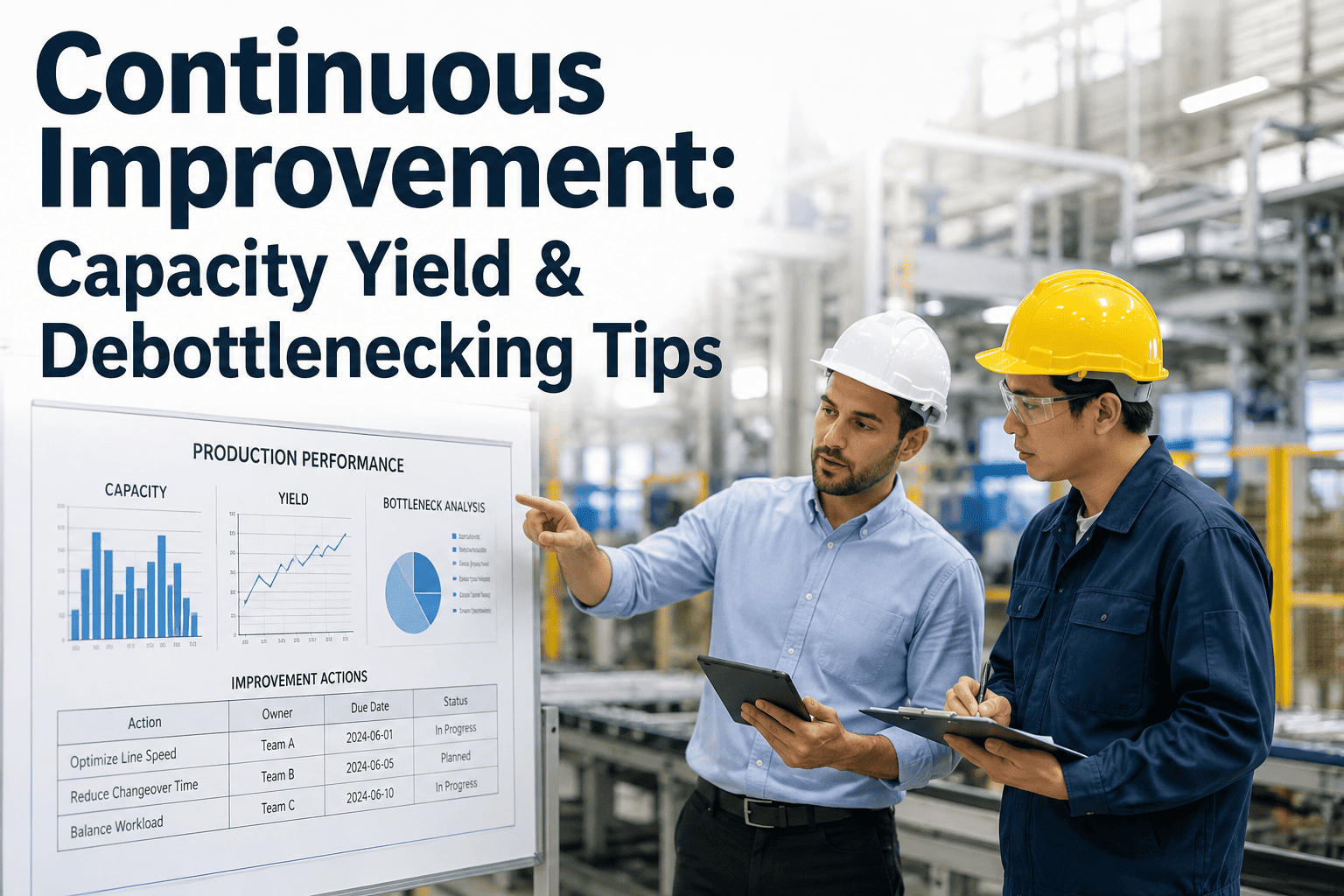
Continuous Improvement: Growing Capacity Through Yield and Debottlenecking, Not Capital
Most plants have more capacity than their capital budget assumes. It is locked inside changeovers, micro-stops, and quality loss that nobody has systematically measured — and every one of those is cheaper and faster to fix than a new line. The gap between rated capacity and what actually ships is often the single largest untapped asset on the plant's balance sheet, and it rarely shows up on any report because nobody has framed it as capacity in the first place.
The Myth of the Capital-Only Fix
When a plant is running short on capacity, the instinct is almost always to look at square footage and equipment lists. That instinct is not wrong — sometimes a genuine physical constraint does require new assets. But it is applied far more often than it should be, and it skips over a category of capacity loss that is usually larger, cheaper to fix, and faster to recover than anyone expects until they actually measure it.
Nameplate Capacity Isn't Real Capacity
The rated speed on an equipment spec sheet almost never matches sustained output once changeovers, micro-stops, and quality rework are accounted for. Plants routinely run 20-30 percent below nameplate without anyone treating that gap as recoverable, because the nameplate number was set at commissioning and rarely revisited against real operating conditions.
The Bottleneck Moves and Nobody Notices
Fix one constraint and the bottleneck shifts to the next slowest step in the line. Without continuous measurement, plants keep investing capital at the old bottleneck while the new one silently caps output, sometimes for years before anyone traces the mismatch back to its source.
Micro-Stops Don't Show Up on a Downtime Report
A thirty-second stop happening forty times a shift rarely gets logged individually, but it adds up to more lost time than the one big breakdown everyone remembers and talks about in the morning meeting. Manual downtime logs are simply not built to catch losses this granular.
Quality Loss Is Capacity Loss
Every unit scrapped or reworked consumed the same machine time, energy, and labor as a good unit. A plant chasing more capacity while running a five percent scrap rate is often trying to buy back capacity it is already producing and throwing away, which is one of the more expensive ways to solve a capacity problem.
The Economics That Make Capital the Wrong First Move
None of this is an argument against ever investing in new equipment. It is an argument for sequencing the investment correctly. A capital project sized against uncorrected losses tends to inherit those same losses on day one — a new line running at the same 25 percent loss rate as the old one delivers only a fraction of its rated capacity increase, while still carrying its full price tag and lead time. Improvement work done before the capital decision changes what that decision is actually solving for.
Where Hidden Capacity Actually Lives
Debottlenecking programs that succeed tend to look in the same five places, roughly in order of how much recoverable capacity each one typically holds. None of them require new floor space, and all five can usually be assessed using data the plant's existing PLCs, MES, or quality systems are already generating — the work is in aggregating and analyzing it at a level of detail nobody has looked at before.
Changeover Time
SMED-style changeover reduction routinely cuts setup time by 40-60 percent, turning changeover from a capacity sink into a manageable, predictable event that planners can schedule around with confidence.
Micro-Stoppages
Sensor and PLC data can surface the true frequency and pattern of short stops that manual downtime logs miss almost entirely, exposing the single largest hidden loss category on most lines once it is finally measured properly.
Speed Loss
Equipment running below its proven achievable rate, often because of a conservative setpoint nobody has revisited since commissioning, is one of the easiest gains to capture once it is measured against historical best performance.
Quality & Scrap
Reducing scrap and rework recovers machine time that was already spent, making it one of the highest-leverage capacity levers available with no additional throughput risk or capital outlay involved.
The True Constraint
Once the first four are addressed, the actual system bottleneck becomes visible for the first time, and that is the one place where additional capital investment is genuinely justified and likely to deliver its full projected return.
Curious how much of your capacity gap lives in these five categories rather than in a missing asset? Book a debottlenecking assessment and iFactory will map it against your actual OEE data.
Capital Expansion vs Continuous Improvement Debottlenecking
Both paths can grow capacity. They differ enormously in cost, speed, and risk — which is why most plants get the best return by exhausting the improvement path first and reserving capital for the constraint that remains afterward, rather than treating the two as competing options to choose between upfront.
| Factor | New Capital Equipment | Continuous Improvement |
|---|---|---|
| Typical lead time | 6-18 months | 60-120 days |
| Typical investment | $500K - $10M+ | $20K - $150K |
| Risk of underused asset | Real if bottleneck shifts | Minimal — gains apply immediately |
| Requires floor space | Usually | No |
| Organizational disruption | Significant during install | Incremental, line stays running |
The two approaches are not mutually exclusive — most successful capacity programs run improvement work continuously and treat capital investment as the final step reserved for the constraint that genuinely cannot be resolved any other way. Sequencing it this way also means any capital request that does go forward comes with a far more accurate picture of how much additional capacity it will actually deliver.
Find the Capacity You're Already Paying For
iFactory measures changeover time, micro-stoppages, speed loss, and scrap against your actual production data to show exactly where recoverable capacity is hiding — before a single capital dollar gets committed, and before the next expansion project inherits problems it was never designed to fix.
The Debottlenecking Cycle That Actually Sticks
Debottlenecking is not a one-time project — the constraint moves every time you fix one. Plants that sustain their gains run a repeatable five-step cycle instead of a single improvement sprint that fades within a year. The cycle comes from the Theory of Constraints, and it works because it forces discipline about where effort goes next rather than spreading improvement resources evenly across every line regardless of where the real limit actually sits.
Identify the Constraint
Use real production data, not intuition, to find the step that actually limits system throughput right now, since the loudest complaint on the floor is not always the true bottleneck.
Exploit It
Squeeze every available minute out of the constraint before spending money — eliminate its micro-stops, tighten its changeovers, cut its scrap rate, and protect its uptime above every other line.
Subordinate Everything Else
Align upstream and downstream steps to the constraint's pace, rather than letting them run at a speed that just creates work-in-progress piles elsewhere in the line.
Elevate If Still Needed
Only after steps one through three are exhausted does additional capital investment at the constraint become the right next move, and by this point the investment case is far better defined.
Repeat at the New Constraint
Once the old bottleneck is resolved, a new one emerges elsewhere in the line — the cycle starts again, which is why this has to be a program, not a project with a fixed end date.
What Plants See After a Debottlenecking Program
Output Gains Without New Floor Space
Plants typically recover 15-25 percent additional throughput on constrained lines within two quarters, using the same footprint, headcount, and equipment they started with — no expansion project required.
Smaller, Better-Targeted Capital Requests
When capital investment is still needed, it goes precisely to the true constraint instead of the loudest complaint, which shortens payback periods significantly and improves the odds the project delivers its projected return.
Lower Scrap Rates as a Side Effect
Because quality loss is treated as a capacity lever, scrap and rework rates tend to drop alongside throughput gains rather than as a separate initiative competing for the same improvement resources.
Operators Start Flagging Micro-Stops Themselves
Once the data makes small losses visible, operators and shift leads tend to start reporting and addressing them proactively instead of only reacting to major breakdowns that already cost real production time.
The compounding effect matters as much as any single number. Once one constraint is resolved and the next becomes visible, each successive improvement cycle tends to get faster, because the team has already built the habit of measuring before acting.
Frequently Asked Questions
How is this different from a general OEE improvement initiative?
OEE improvement often spreads effort evenly across every line and every loss category, which feels productive but rarely moves total plant output. Debottlenecking is more targeted — it identifies the single constraint limiting total system output and focuses improvement effort there first, because gains anywhere else in the line do not increase what actually ships until the true constraint is addressed. Once that constraint moves, focus moves with it.
Do we need new sensors or hardware to find hidden capacity?
Often existing PLC and control system data already captures enough detail to identify micro-stops, speed loss, and changeover patterns — it simply has not been aggregated and analyzed at that level of granularity before. Most plants are surprised by how much of this analysis can happen with data they are already collecting. Our team can assess what your current systems already capture before recommending any new hardware or sensors.
How do we know if our capacity problem is really a capital problem?
A genuine capital constraint shows up as sustained output at or near proven achievable rate with minimal loss from changeover, stoppages, or scrap. If the line is running well below its own historical best performance, the gap is very likely recoverable through improvement rather than requiring new equipment, and the historical best performance itself is usually the fastest way to test that theory.
Won't the bottleneck just move somewhere else after we fix it?
Yes, and that is expected rather than a failure of the program. The five-step cycle is designed around that reality — once a constraint is resolved, the next one becomes the new focus, which is why debottlenecking works best as an ongoing program rather than a single project with a defined end date. Plants that treat it this way tend to keep finding meaningful capacity gains for several improvement cycles in a row.
How long before we see a measurable throughput increase?
Most plants see a measurable gain on the targeted constraint within 60 to 90 days of starting focused improvement work, since the changes involved — changeover reduction, micro-stop elimination, setpoint adjustment — do not require long procurement or installation cycles the way capital equipment does. For a realistic timeline against your specific lines, book a 30-minute assessment and iFactory will scope it against your current OEE and quality data.
Your Next Unit of Capacity Might Already Be on the Floor
Before the next capital request goes in, iFactory can show you exactly how much throughput is recoverable through changeover reduction, micro-stop elimination, and scrap reduction — using data your systems are already generating, with no new hardware required to get the first answer.