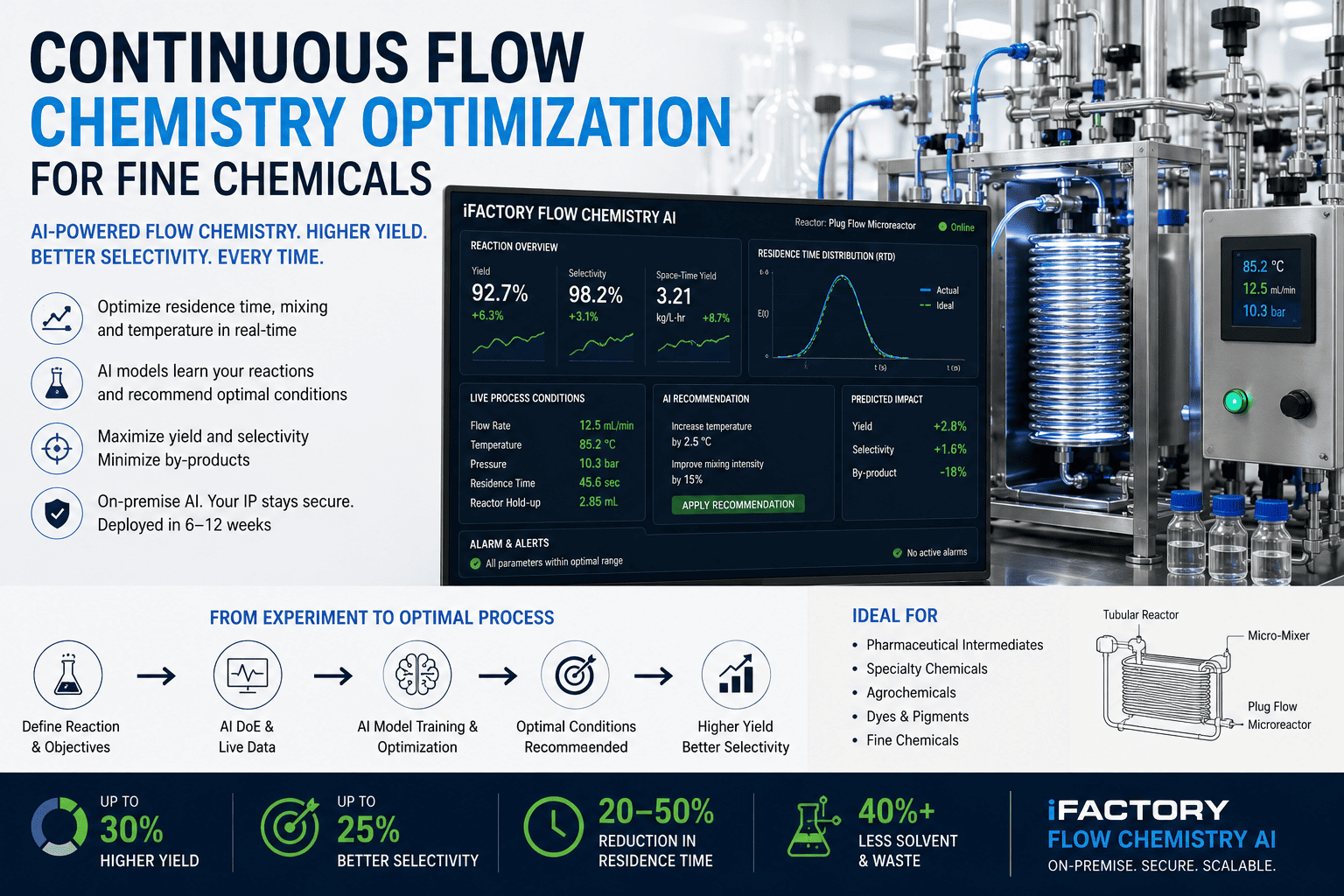
In a flow reactor, the whole reaction happens in the time it takes a slug of fluid to travel from the mixer to the outlet. Get that transit time right and you pull the product out at its peak, before it degrades or the next reaction fires. Get it wrong by a fraction of a second and you either leave conversion on the table or over-cook the intermediate into impurity. The frustrating part is that residence time, mixing, and temperature do not act alone — they pull on each other, so the sweet spot is a moving point in a space too large and too coupled to map by one-variable-at-a-time screening. That is exactly the space AI is built to navigate, and an iFactory flow chemistry layer is where it runs, on your own reactors.
iFactory · Flow Chemistry AI
Continuous Flow Chemistry Optimization for Fine Chemicals
Residence time, mixing, and selectivity are the three dials on a flow reactor, and they interact. AI maps that coupled space, finds the sweet spot for yield and purity, and holds it run to run — on plug-flow, tubular, and micro-mixer systems.
3
coupled dials: time, mixing, selectivity
sub-sec
residence control for flash chemistry
2
factors that dominate yield: time + temp
On-prem
AI runs inside your plant network
The Three Dials on a Flow Reactor
Every flow process comes down to three controllable things, and their interaction is the whole optimization problem. Residence time sets how long the chemistry has to happen. Mixing sets how fast the reagents actually meet. Selectivity — the ratio of the product you want to the byproducts you do not — is the outcome those two produce, together with temperature. Turn one dial and the others shift. That coupling is why flow chemistry rewards optimization and punishes guesswork.
Residence Time
How long does the reaction get?
Transit time from mixer to outlet, set by reactor volume and flow rate. Too short starves conversion; too long degrades the product.
Mixing
How fast do reagents meet?
Set by the micro-mixer and flow regime. It must be far faster than the residence time, or the reaction is limited by mixing, not chemistry.
Selectivity
Product vs byproduct?
The outcome the other two produce with temperature. Competing pathways win or lose on how precisely time and mixing are held.
Plug Flow: The Ideal, and the Real
The dream of a tubular flow reactor is perfect plug flow — every single molecule spends exactly the same time in the reactor. In that ideal, the residence time distribution is a sharp spike: one time, no spread. Real reactors are not ideal. Dispersion, wall effects, and channeling smear that spike into a distribution — some molecules exit early under-reacted, some linger and over-react. That spread is where yield and purity leak away. Narrowing the residence time distribution, and knowing its true shape, is a central lever of flow optimization.
Ideal plug flow
One residence time, no spread. Every molecule reacts for exactly the design time.
Real reactor
A spread of times. Some molecules exit under-reacted, some over-react — yield and purity leak here.
The Golden Rule: Mix Faster Than You React
This is the principle that governs the fastest, most valuable flow reactions — the flash chemistry of reactive intermediates and competing pathways. For precise control over the outcome, mixing has to happen in a much shorter time than the residence time in the reactor zone. If the reagents are still mixing while the reaction is running, you are no longer controlling the chemistry — the mixing is. That is why these reactions demand engineered micro-mixers that bring streams together in milliseconds, and why sub-second residence-time control becomes possible and necessary. Break this rule and selectivity collapses into a mess of byproducts.
Mixing « residence time
Chemistry controls the outcome. Clean selectivity.
Mixing ≈ residence time
Mixing controls the outcome. Selectivity collapses.
Why This Is Hard — and Where AI Comes In
Here is the crux. Studies that map flow reactions consistently find residence time and temperature to be the two most significant factors on yield — but their effect is not additive, it is interacting, and the size of the interaction changes across the operating window. One-variable-at-a-time screening cannot see that. It finds a local hill, not the true peak, because it never tests the combinations where the dials pull against each other. AI is built precisely for coupled, multi-dimensional spaces like this: it learns the response surface from your runs and PAT signals, predicts where yield and selectivity peak, and converges on the optimum far faster than a manual screen.
One-variable-at-a-time screening
becomes
The full coupled response surface, learned
A local optimum mistaken for the best
becomes
The true yield-and-selectivity peak found
Weeks of manual DoE runs
becomes
Fast convergence guided by each new run
Drift discovered in an off-spec batch
becomes
PAT signals flag the drift in real time
The optimum lost when conditions shift
becomes
The sweet spot held run to run, live
Want to see the response surface for one of your flow reactions mapped from your own run data? Talk to a flow chemistry specialist and we will model one reactor.
What Optimization Delivers for Fine Chemicals
The reason this matters commercially: in fine chemicals and API synthesis, small gains in selectivity and yield compound into large gains in cost, purity, and throughput. Optimizing the three dials pays off in specific, measurable ways.
Higher yield
Pulling the product at its peak residence time, before degradation, lifts conversion of expensive intermediates.
Cleaner selectivity
Tight time-and-mixing control starves the competing pathways, so you make more product and fewer impurities to purge.
Safer operation
The small reactor volume and superior heat transfer keep exothermic and hazardous chemistries controlled at the optimum.
Consistent quality
Holding the sweet spot run to run means the same purity every campaign — the reproducibility regulators and customers expect.
Want the optimum for your reaction found and then held automatically, run to run? Book a demo and we will scope it to your flow line.
Frequently Asked Questions
Why is residence time so critical in flow chemistry?
Because in a flow reactor the reaction only proceeds while the fluid is inside the reactor zone — the residence time is literally the reaction time. Set it too short and conversion is incomplete; too long and the product degrades or a downstream reaction fires. Studies mapping flow reactions repeatedly find residence time, alongside temperature, to be one of the two most significant factors on yield.
What is residence time distribution and why does it matter?
In an ideal plug-flow reactor every molecule spends exactly the same time inside — the distribution is a single sharp spike. Real reactors spread that out through dispersion, wall effects, and channeling, so some molecules exit under-reacted and others over-react. That spread directly costs yield and purity, which is why narrowing the distribution and knowing its true shape is a core optimization lever.
Why does mixing have to be faster than the reaction?
For fast reactions — flash chemistry with reactive intermediates and competing pathways — control over the outcome requires that mixing finishes in far less time than the residence time. If reagents are still mixing while reacting, the mixing rate, not the chemistry, determines what forms, and selectivity collapses. This is why these reactions need engineered micro-mixers that combine streams in milliseconds.
Why use AI instead of a standard design of experiments?
Because the key factors interact, and the interaction changes across the operating window. Testing one variable at a time finds a local optimum, not the true peak, because it never probes the combinations where the dials counteract each other. AI learns the full coupled response surface from your runs and PAT data, predicts where yield and selectivity peak, and converges on the optimum with far fewer experiments than an exhaustive manual screen.
Why run the AI on-premise?
Reaction routes and process conditions are among the most sensitive intellectual property a fine-chemicals maker owns. Running the optimization on-premise keeps that data inside your network, delivers the real-time response that live PAT-guided control needs, and keeps the line independent of an outside connection. The model trains on your reactors and runs in your plant.
Find the sweet spot in the coupled space — then hold it.
See Your Flow Reaction Optimized, Run to Run
Bring one reaction — plug-flow, tubular, or micro-mixer. We will learn the coupled response surface of residence time, mixing, and temperature from your runs and PAT signals, find the peak for yield and selectivity, and hold it campaign after campaign. Turnkey on-prem AI: it trains on your reactors, runs inside your network, and flags drift live. Live in weeks, not quarters.
3 dials
mapped together, not one by one
Peak
yield and selectivity, found
PAT
drift flagged in real time
On-prem
private, live in weeks