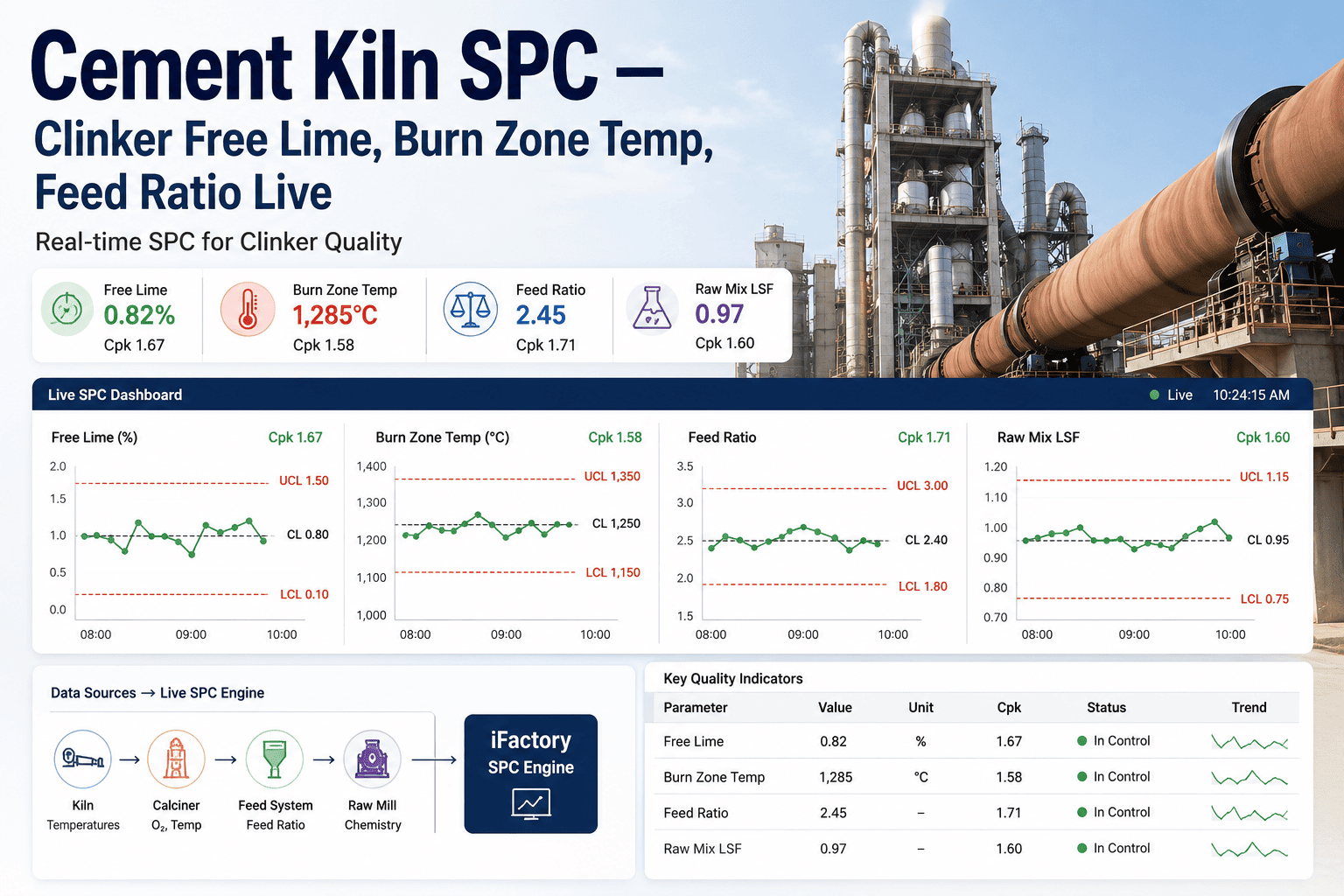
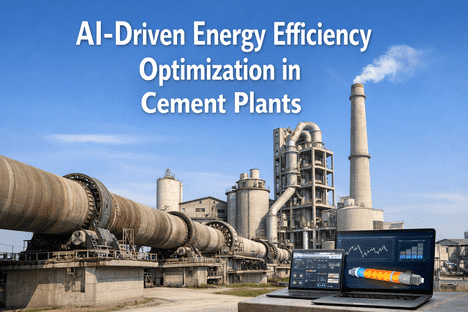
A cement kiln is one of the most thermally punishing environments in industrial manufacturing, and it is also one of the least forgiving when it comes to variance. A burning zone temperature swing of just a few degrees can shift free lime out of specification, destabilize coating thickness, and quietly burn through fuel that never shows up as a line item until the monthly energy bill lands on a plant manager's desk. AI-driven kiln optimization systems now watch burning zone temperature, feed rate, and coating behavior continuously, adjusting recommendations in near real time rather than waiting for a shift-end review. Plants running these systems report fuel consumption reductions of 8 to 15% and free lime held consistently below 1.5%. For a closer look at how this applies to your kiln configuration, Book a Demo with iFactory's cement operations team.
Stabilize the Burning Zone Before It Costs You Fuel.
iFactory AI continuously models kiln temperature, feed rate, and coating thickness to keep clinker quality and fuel efficiency within target range.
Why Kiln Temperature Control Is Still a Manual Guessing Game at Most Plants
Kiln operators have historically relied on a combination of flame observation, shell temperature scanners, and free lime lab results that arrive 20 to 40 minutes after the material has already passed through the burning zone. That lag means every adjustment an operator makes is a reaction to a condition that has already changed. By the time a lab result confirms free lime has drifted high, the kiln may have already produced hours of off-spec clinker, and the fuel burned to compensate for an unstable flame shape has already been spent.
The financial stakes compound quickly. Kiln fuel represents one of the largest variable costs in cement production, and even a modest reduction in specific heat consumption translates into significant annual savings at plant scale. AI-based kiln optimization closes the reaction-time gap by fusing shell scanner data, feed rate, kiln torque, and NOx readings into a live model that recommends adjustments before free lime or coating conditions drift out of tolerance.
The Four Process Zones an AI Kiln Model Watches Simultaneously
A rotary kiln is not a single control point — it is a sequence of thermal zones that all influence each other. AI kiln optimization platforms track each zone independently while modeling how a change in one propagates downstream to the next.
Preheater & Calciner
Cyclone temperature and calciner efficiency are tracked to ensure raw meal enters the kiln at the correct calcination degree, reducing downstream burning zone stress.
Burning Zone
Flame shape, shell temperature, and burning zone temperature are correlated in real time to catch early signs of coating loss or hot spots before refractory damage occurs.
Coating & Refractory
Coating thickness trends are modeled against feed chemistry and kiln speed to prevent both excessive buildup and premature coating loss that exposes refractory brick.
Cooler & Clinker Discharge
Clinker temperature exiting the cooler is fed back into the model, closing the loop on how burning zone decisions affect final product quality and secondary air recovery.
What Kiln Optimization Delivers Once It's Running
The value of AI kiln control shows up in three places on a plant's operating statement: fuel consumption, clinker quality consistency, and unplanned refractory replacement. The figures below reflect what cement producers report after stabilizing their kiln model against six to twelve months of operating data.
Manual Kiln Control vs AI-Assisted Kiln Optimization
The table below outlines the practical differences plant operators experience once burning zone data, feed rate, and coating monitoring are unified into a single AI-driven recommendation layer.
| Control Factor | Manual / Reactive | AI-Assisted |
|---|---|---|
| Free lime feedback loop | 20–40 min lab delay | Continuous model estimate |
| Flame shape adjustment | Operator judgment only | Data-correlated recommendation |
| Coating thickness tracking | Periodic shell scan review | Continuous trend modeling |
| Fuel blend optimization | Fixed ratio, rarely revisited | Dynamic based on kiln state |
| Refractory hot-spot detection | Reactive after damage seen | Early warning before damage |
How Kiln AI Gets Deployed Without Interrupting Production
Kiln optimization projects succeed when they respect the fact that a cement kiln cannot be taken offline for a software rollout. The deployment model below reflects how plants typically bring an AI kiln model online alongside existing DCS and shell scanner infrastructure.
Data integration — shell scanner, DCS tags, and lab free lime results are connected to the model in read-only mode, with zero changes to existing control logic.
Model calibration — the system learns your kiln's specific thermal behavior across several weeks of normal production variation before offering any recommendations.
Advisory mode — operators see live recommendations alongside their existing panel and can choose whether to act, building trust in the model's accuracy.
Closed-loop tuning — once confidence is established, select adjustments can be automated directly, with full operator override retained at all times.
What Kiln Operators and Process Engineers Say Changes First
Across plants that have run AI kiln optimization for a full production year, the most consistent feedback is not about a single dramatic metric — it is about the reduction in surprise. Operators report fewer 2 a.m. calls about a coating fall, fewer emergency refractory inspections, and a noticeably calmer control room during raw material or fuel quality changes that used to trigger extended troubleshooting.
Process engineers highlight a second, less obvious benefit: the model's historical data becomes a diagnostic tool in its own right. When a new kiln operator joins a shift, they can review exactly how the model responded to a similar coating event months earlier, shortening the learning curve that used to take years of hands-on kiln experience to build.
Cement Kiln AI Optimization — Frequently Asked Questions
Does AI kiln optimization require replacing our existing DCS system?
No. The AI layer connects to your existing DCS, shell scanner, and lab systems as an advisory layer rather than a replacement control system. Most plants keep their current DCS in place indefinitely, with the AI model providing recommendations that operators or automated setpoints act on.
How long before we see measurable fuel savings after go-live?
Most plants see initial fuel consumption improvements within the first two to three months as the model calibrates to kiln-specific behavior, with the full 8 to 15% range typically realized within six to nine months of consistent use across varying raw meal and fuel conditions.
Can this system handle alternative fuel blends alongside coal or petcoke?
Yes, the model accounts for calorific value and combustion characteristics of blended fuel streams, which is especially valuable for plants increasing their thermal substitution rate with alternative fuels while trying to hold burning zone stability constant.
What happens if the AI recommendation conflicts with operator judgment?
Operators always retain full override authority. The system is designed as a decision-support layer, and every recommendation includes the underlying data trend so operators can evaluate it against their own experience before acting.
Is this suitable for older kilns without modern shell scanners?
Yes, though the model's accuracy improves with richer sensor input. For kilns with limited instrumentation, our team typically recommends a phased sensor upgrade alongside the AI rollout. Reach out through iFactory support for a specific assessment of your kiln's instrumentation.
Find Out What an Unstable Burning Zone Is Really Costing You.
Book a session with iFactory's cement process team to review your kiln's temperature and coating history against what an AI model could stabilize.