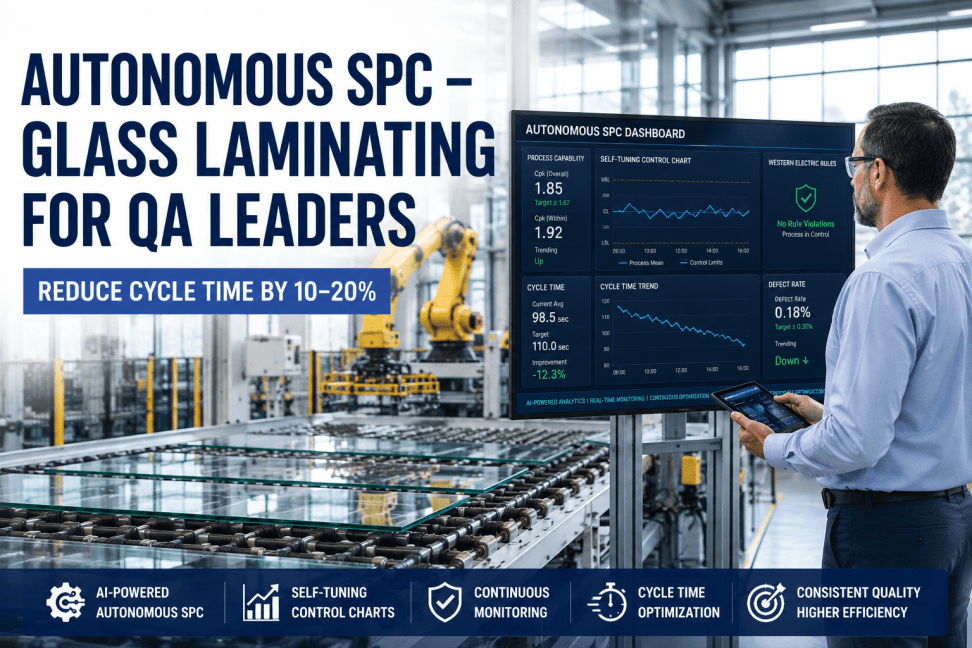
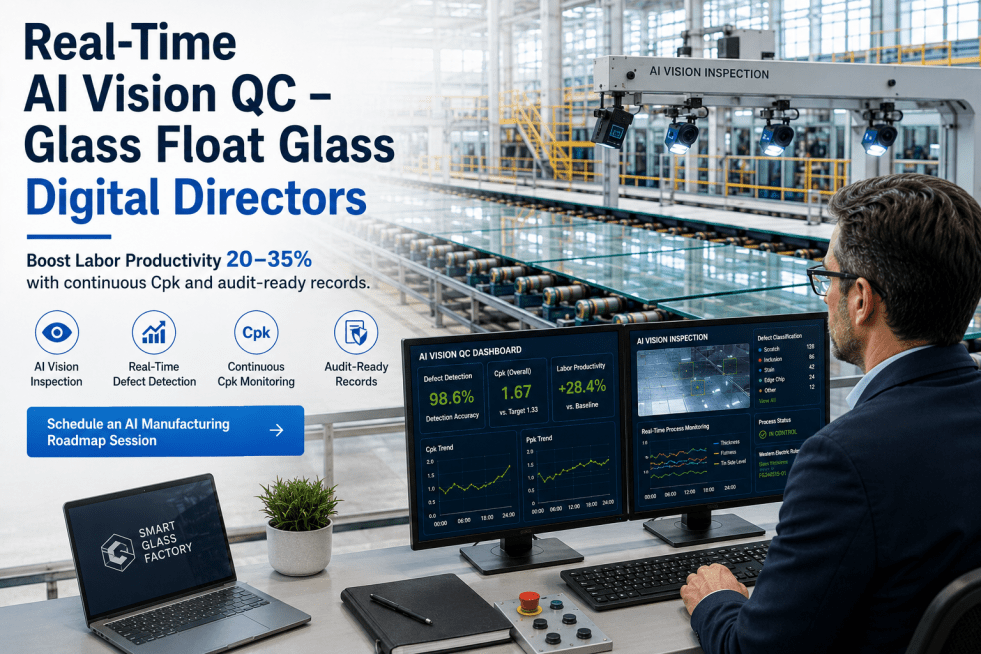
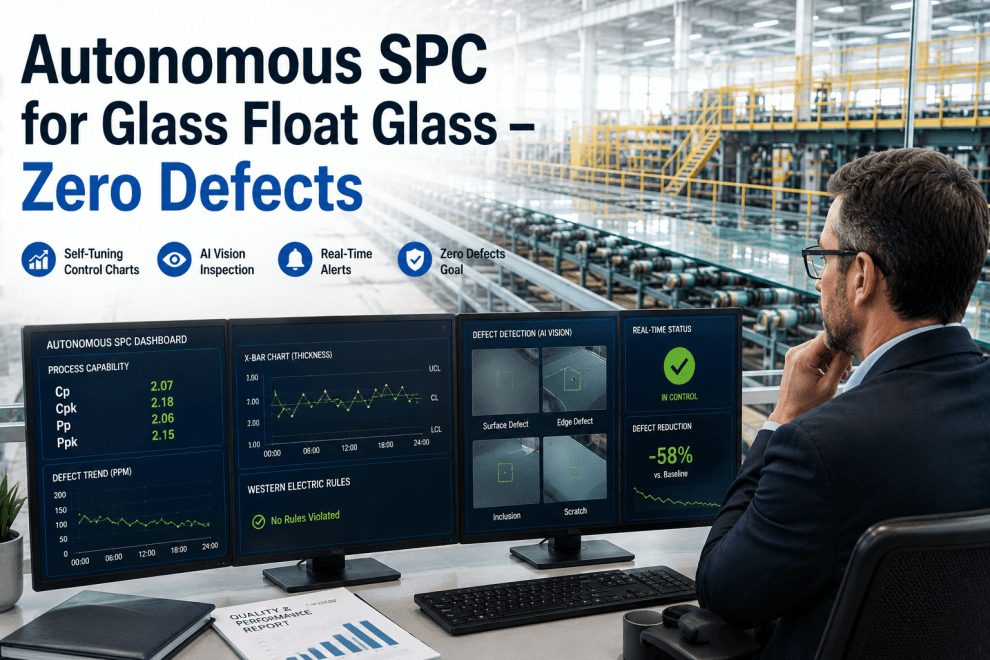
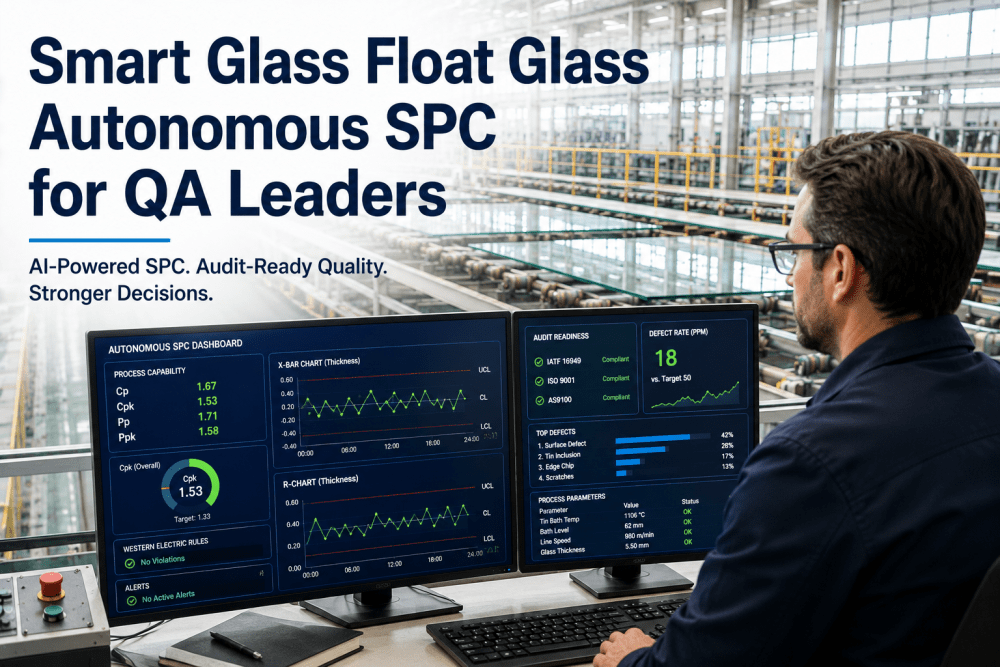
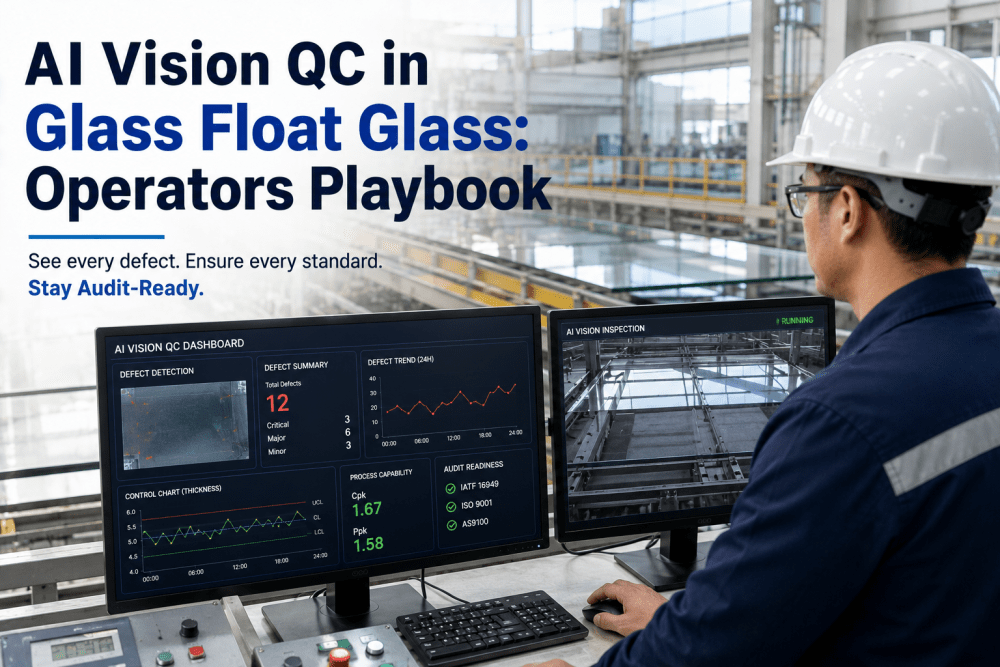
A float glass operator watches the ribbon of glass glide across the molten tin bath — 600 tons of raw material transformed into a continuous sheet that will become windows, windshields, and solar panels. The process looks steady, but beneath the surface, hundreds of variables are shifting in real time: tin bath temperature gradients, annealing lehr profiles, ribbon speed variations, and edge tension changes. Each variable can push the product outside specification limits within minutes. For decades, operators relied on periodic manual measurements and retrospective SPC analysis — catching defects after hundreds of square meters of glass were already produced. Autonomous SPC changes this paradigm entirely. iFactory's AI-powered quality platform gives float glass operators continuous, real-time visibility into process performance, with self-tuning control charts that detect the earliest signs of variation and recommend corrective actions before quality degrades.
How Operators Use Autonomous SPC in Glass Float Glass to Increase Throughput by 15-25%
iFactory's Autonomous SPC platform equips float glass operators with self-tuning control charts, AI-powered anomaly detection, and real-time process optimization — delivering measurable throughput gains while maintaining the stringent quality standards that glass manufacturing demands.
Why Traditional SPC Falls Short in Float Glass Operations
Float glass manufacturing is a continuous process where quality must be maintained across a ribbon that can run hundreds of meters long before a single sample is tested. Traditional SPC relies on manual gauge readings taken at fixed intervals — typically once per hour — creating large blind spots between measurements. A tin bath temperature drift that begins five minutes after the last reading can go undetected for 55 minutes, producing off-spec glass that must be downgraded or scrapped. Autonomous SPC eliminates these blind spots by monitoring every critical process variable continuously, applying Western Electric rules and AI-based pattern recognition to every data point in real time. The operator is notified the moment a trend, shift, or out-of-control condition emerges — not at the next scheduled sampling interval.
Six Capabilities That Make Autonomous SPC Work for Float Glass
iFactory's Autonomous SPC platform is purpose-built for continuous manufacturing environments. Each capability is designed to reduce the time between variation onset and corrective action — the single largest lever for throughput improvement in float glass operations. Book a Demo to see these capabilities in action on your line data.
Adaptive Control Limit Calculation
Control limits adjust automatically as new data arrives, accounting for natural process drift without requiring manual recalculation. The platform identifies when limits should be recalculated based on process state changes, eliminating the operator burden of periodic chart review and recalibration.
Real-Time Sensor Integration
Direct integration with tin bath temperature sensors, lehr zone thermocouples, ribbon speed encoders, and thickness gauges provides sub-second data ingestion across all critical process parameters. Every reading is evaluated against control limits immediately, with no batch processing delays.
Automated Western Electric Rule Analysis
All eight Western Electric run rules are evaluated automatically on every chart, for every parameter, in real time. The AI layer extends beyond standard rules to detect subtle pattern combinations — such as a gradual mean shift accompanied by increasing range — that human operators frequently miss during busy shifts.
Throughput-Focused Recommendations
When a control limit violation is detected, the platform provides prioritized corrective recommendations based on the specific violation type, affected zone, and current production context. Operators receive clear guidance on which parameter to adjust and by how much, reducing decision latency during critical events.
Real-Time Cp and Cpk Monitoring
Process capability indices are calculated continuously rather than retrospectively. Operators see the real-time impact of every adjustment on Cp and Cpk values, enabling data-driven decisions that balance throughput with quality requirements. The platform alerts users when capability drifts below target thresholds.
Trend History and Knowledge Retention
Every control chart, alarm event, and operator action is stored in a searchable trend history that spans across shifts, days, and weeks. Incoming operators can review the previous shift's SPC activity in minutes rather than deciphering handwritten logs, ensuring consistency in process management across the full 24/7 operating window.
Four Ways Autonomous SPC Drives Throughput for Float Glass Operators
Early Detection Compresses the Variation-to-Correction Cycle
The most direct throughput impact of Autonomous SPC is the compression of the time between process variation onset and corrective action. Manual SPC with hourly sampling creates an average detection latency of 30-45 minutes per event. Autonomous SPC with continuous monitoring detects the same events within seconds — enabling operators to make corrections while the affected glass volume is measured in meters rather than hundreds of meters. Over an 8-hour shift, this compression can recover 35-50 minutes of production time that would otherwise be consumed by off-spec operation and subsequent rework.
Self-Tuning Charts Eliminate Manual Maintenance Downtime
Control chart maintenance — recalculating limits, updating chart templates, and reviewing historical data for rule violations — consumes an estimated 6-8 hours per week per production line under traditional SPC. Autonomous SPC eliminates this overhead entirely by automating control limit calculation, chart updates, and rule evaluation. Operators redirect this time from chart administration to process optimization, directly increasing the value generated per shift.
Real-Time Capability Data Enables Faster Line Speed Decisions
Line speed changes in float glass operations require confidence that quality will remain within specification at the new operating point. Traditional SPC requires hours of data collection at each speed setting before capability can be assessed. Autonomous SPC provides real-time Cp and Cpk values that update with every new measurement, enabling operators to evaluate speed change scenarios immediately. This dynamic capability assessment supports more aggressive throughput optimization while maintaining quality guardrails.
Cross-Shift Trend Visibility Reduces Variation Amplitude
When each shift operates with isolated SPC data, process parameters drift between shifts as different operators make independent adjustments. Autonomous SPC with cross-shift trend visibility eliminates this oscillation by providing every operator with the full 24-hour process history. Shift-to-shift parameter variation is reduced, which narrows the overall control band and enables the line to operate closer to optimal throughput targets without approaching quality limits.
Traditional SPC vs Autonomous SPC in Float Glass Production
| Parameter | Traditional SPC | Autonomous SPC with iFactory |
|---|---|---|
| Sampling frequency | Once per hour (manual gauge reading) | Continuous (sub-second sensor ingestion) |
| Detection latency | 30-45 minutes average per event | Less than 5 seconds |
| Control limit updates | Weekly manual recalculation | Automatic, real-time adjustment |
| Run rule evaluation | Visual review during shift (partial coverage) | All 8 Western Electric rules, continuous, automated |
| Capability tracking | End-of-batch or end-of-day calculation | Real-time Cp/Cpk with every measurement |
| Cross-shift visibility | Separate logs per shift, limited continuity | Unified 24/7 trend history with full traceability |
| Chart maintenance overhead | 6-8 hours per week per line | Zero — fully automated |
| Throughput impact | Baseline | 15-25% increase demonstrated |
From Manual SPC to Autonomous Quality Control in Four Steps
iFactory's Autonomous SPC platform deploys on existing float glass line infrastructure with no process equipment modifications. The platform integrates with your current sensor network and connects to iFactory's MES and CMMS modules for complete production traceability.
Connect & Configure
Existing line sensors — thermocouples, encoders, gauges — are connected to the iFactory data ingestion layer. Control chart templates are auto-generated for each parameter based on historical process data, with initial control limits calculated from the baseline operating window.
Validate & Calibrate
During a 7-day parallel operation period, the Autonomous SPC platform runs alongside existing manual SPC processes. Operators validate alarm accuracy, review trend correlations, and calibrate AI detection thresholds against known process events. No production disruption occurs.
Operate & Optimize
Autonomous SPC takes over primary monitoring with operators supervising from iFactory's dashboard. Self-tuning control limits adapt to real-time process conditions. The AI layer begins building cross-shift trend baselines that improve detection accuracy over time through active learning.
Scale & Sustain
With the initial line validated, the platform is extended across all production lines. Cross-line analytics enable benchmarking and best practice transfer between shifts and lines. iFactory's continuous improvement team provides monthly performance reviews and model tuning support.
What Industry Leaders Say About Autonomous SPC in Float Glass
"The shift from manual SPC to autonomous monitoring transformed how our operators interact with process data. Instead of spending 30 minutes per hour collecting and charting measurements, they now review exception-driven alerts and focus their attention on the parameters that need intervention. Our float glass line throughput increased 19% within the first six weeks, and first-pass yield improved by 6% because variation is caught at the meter mark rather than the hundred-meter mark. The real-time Cp data alone has changed how we approach line speed decisions — operators now have the confidence to push throughput because they can see the capability impact of every adjustment immediately."
— Senior Operations Director, Tier 1 Flat Glass Manufacturer
Autonomous SPC: The Operator's Path to 15-25% Throughput Gains
For float glass operators, the gap between process variation onset and corrective action is the single largest controllable factor in throughput performance. Manual SPC with hourly sampling leaves that gap open for 30-45 minutes per event, accumulating lost production time across every shift, every day, every line. iFactory's Autonomous SPC platform closes that gap by monitoring every critical parameter continuously, detecting variation within seconds, and delivering actionable recommendations that operators can act on immediately. The 15-25% throughput increase is not theoretical — it is the documented outcome of facilities that have replaced manual SPC with autonomous, AI-powered quality monitoring. For float glass operations leaders seeking to eliminate the detection latency that limits current throughput, Book a Demo with iFactory's Autonomous SPC team. See how real-time control charting, AI-driven pattern detection, and self-tuning process optimization can transform your float glass line performance.
Ready to Increase Float Glass Throughput by 15-25%?
Your operators deserve better than hourly samples and retrospective charts. iFactory's Autonomous SPC platform delivers continuous, real-time quality monitoring with self-tuning control charts, AI-powered anomaly detection, and actionable recommendations — deployed in 3 weeks with no process modifications.
Real Answers from Float Glass Operators Adopting Autonomous SPC
Transform Your Float Glass Quality Control with Autonomous SPC
Stop losing throughput to detection latency. iFactory's Autonomous SPC platform gives your operators continuous visibility, self-tuning control charts, and real-time process optimization — all deployed in 3 weeks with no line modifications.