A bottle with a hairline stone buried in the heel looks identical to a good one under normal light, and that is exactly the problem. Glass hides its worst defects inside the material itself, not on the surface where a camera can find an easy edge to grab onto, and a human inspector staring at hundreds of containers a minute has no real chance of catching a 0.3mm inclusion before it ships. Glass manufacturers running float lines, container forming lines, and specialty coating cells are quietly accepting a scrap and claims rate that AI vision was built to eliminate, and the gap between what legacy rule-based systems catch and what actually ships out the door at ifactory support is bigger than most quality teams want to admit.
Catch the Defects Hiding Inside the Glass, Not Just on Top of It
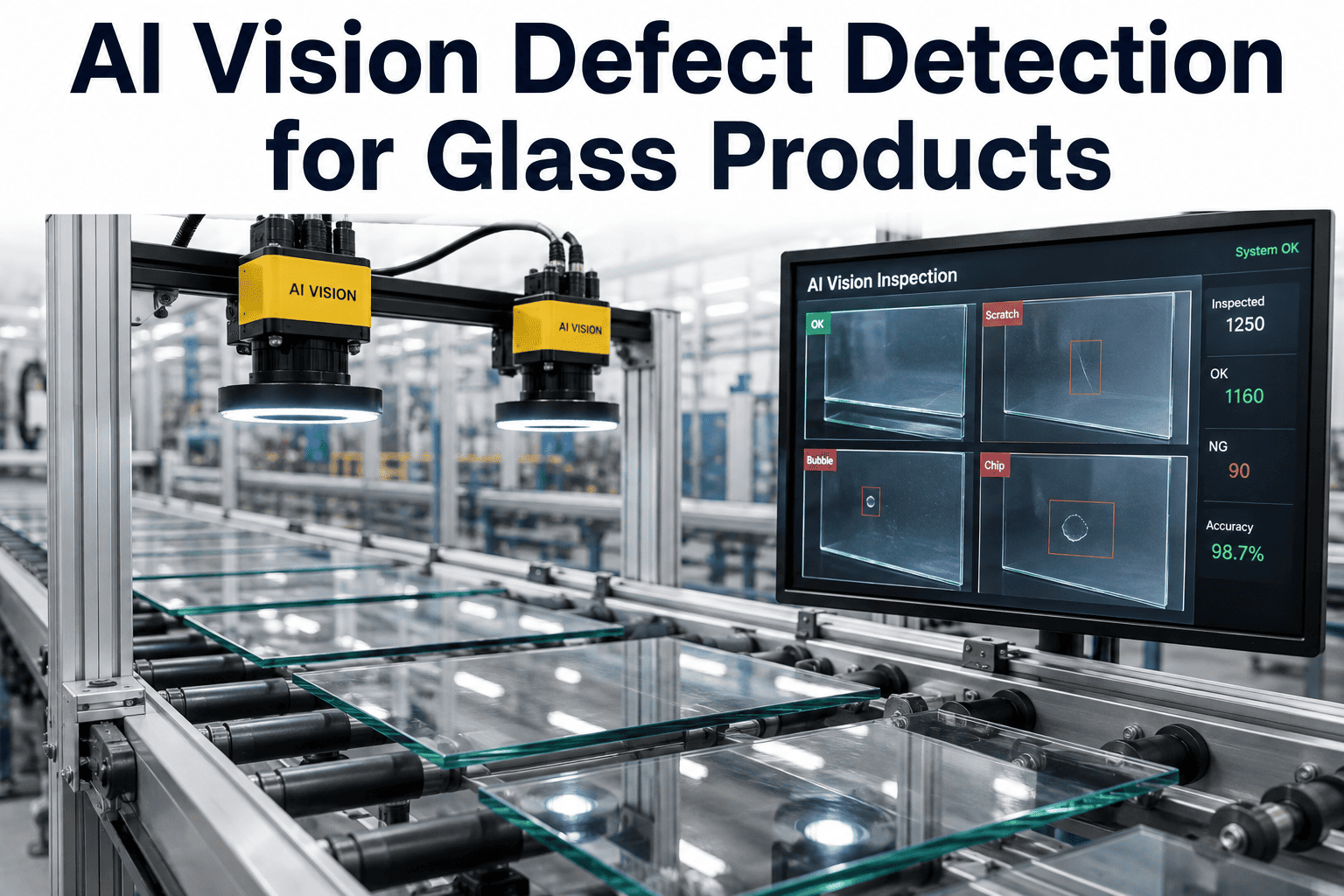
Bubbles, stones, cord, checks, and coating voids detected at full line speed with edge GPU inference, tuned specifically for the optical behavior of transparent and reflective glass surfaces.
Why Transparent Material Breaks Ordinary Machine Vision
Opaque parts are comparatively easy for a camera. Light hits the surface, bounces back at a predictable angle, and a defect shows up as a contrast difference a rule-based system can threshold against. Glass refuses to cooperate. It transmits light, refracts it at every curved edge, and reflects it differently depending on wall thickness, coating, and the angle of the light source relative to the camera. A genuine bubble trapped during melting can look optically similar to a completely normal light refraction pattern at a curved container shoulder, which forces a rule-based system into an impossible choice: calibrate tight enough to catch every real bubble and reject a large share of perfectly good product, or calibrate loose enough to keep yield reasonable and let real defects straight through to the case packer.
This is not a minor calibration inconvenience, it is the core reason glass and ceramic lines have historically had the highest false reject rates and the highest missed-defect rates of any material category in manufacturing. Deep learning changes the equation because the model learns the actual optical signature of a genuine inclusion, crack, or coating void versus the normal variation inherent to transparent and glazed surfaces, rather than relying on a fixed brightness or edge-contrast threshold that has to somehow work for every lighting condition a line will ever produce.
What Actually Happens Inside the Inspection Cell
A production line does not have time for a slow decision. iFactory's inspection sequence is built around the same four-stage flow on every glass line, from float bath output to container forming to tempering and laminating cells, so the process is predictable to operators even as the specific defect models change by product.
The classification stage is where iFactory earns its keep. Instead of a static brightness threshold, the deep learning model has seen thousands of confirmed defect images specific to your product geometry, wall thickness, and coating type, so it distinguishes a genuine 0.3mm stone from an ordinary refractive edge pattern with a confidence score, not a guess. Every inspection result, pass, fail, and defect category, is logged with a high-resolution image for traceability, so a quality engineer reviewing a customer claim six months later can pull the exact frame that shipped.
Run a Pilot on Your Specific Glass Product
Bring sample containers, flat glass, or coated parts with known defect history. We will show detection performance on your actual product, not a demo reel.
Rule-Based Vision vs AI Vision on Glass, Side by Side
Quality teams that have already run a rule-based system on a glass line know the pattern well: acceptable accuracy on the easy, obvious defects, and a frustrating ceiling on everything subtle. The table below lays out where the two approaches actually diverge in practice, not in marketing language.
| Capability | Rule-Based Vision | iFactory AI Vision |
|---|---|---|
| New product geometry setup | Manual reprogramming per SKU | Retrained from new sample images, no reprogramming |
| Subsurface bubble detection | High false reject or high miss rate | Trained specifically on transmitted-light optical signatures |
| Lighting variation tolerance | Requires tight, fixed lighting conditions | Learns tolerance across normal lighting drift |
| Defect traceability | Pass or fail flag only, limited logging | Full image log with defect category and location |
| Deployment location | Typically requires new hardware | Retrofits onto existing line cameras and PLCs |
Where This Runs on the Line
Glass manufacturing is not one process, it is several very different production environments that happen to share a raw material, and the deployment point changes accordingly. iFactory configures detection models per station rather than forcing one generic camera setup across every line in a plant.
The Cost of a Missed Defect Does Not Stay Small
A missed inclusion in premium architectural float glass does not just cost the price of that one panel. It costs the installation labor when it is discovered on site, the warranty claim, and often the relationship with a distributor who now has to explain the failure to their own customer. A missed stone in beverage container glass carries an even sharper downside, since a stress-concentrated container can fail spontaneously during high-speed filling, creating both a safety incident and a line stoppage. An undetected coating defect on a tempered automotive windshield can escalate all the way to a program-level recall.
These are not rare edge cases, they are the predictable consequence of running a detection system that was never built for the optical complexity of transparent and reflective material. The financial logic for AI vision on glass is rarely about the inspection station cost in isolation, it is about what a single field failure on a regulated safety glazing program or a recalled beverage line actually costs once legal, logistics, and reputation are added to the bill.
Frequently Asked Questions
Run AI Vision on Your Own Glass Product
Bring sample containers, panels, or coated parts with known defect history and we will show you exactly what the model catches, and what it lets through, on your specific line.