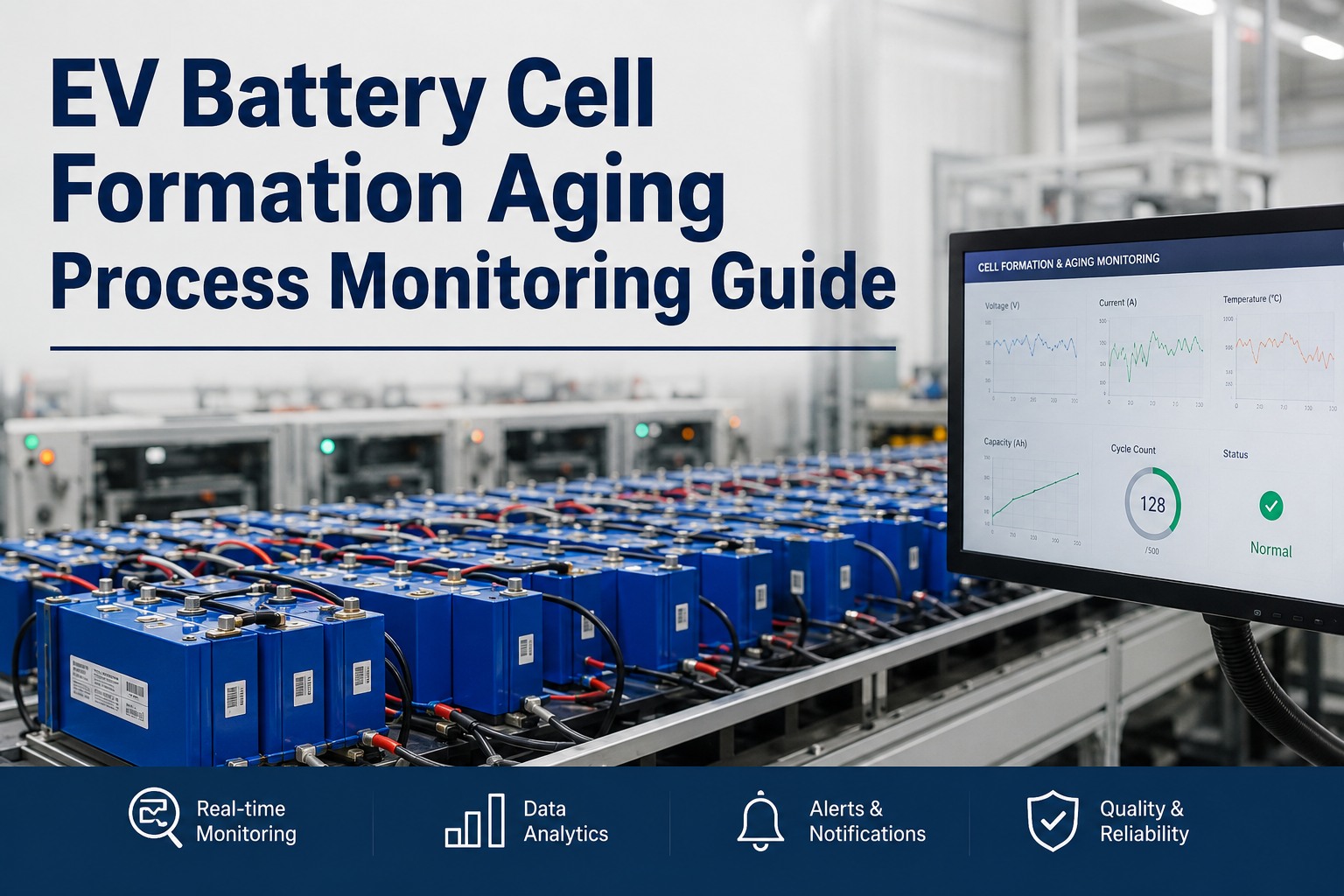
EV battery cell formation and aging are where a lithium-ion cell's cycle life and safety are effectively decided. The first controlled charge builds the solid-electrolyte interphase (SEI) on the anode, and the aging soak that follows surfaces latent defects through open-circuit voltage drift and self-discharge — across hundreds or thousands of parallel channels, the quality signal is only as good as the monitoring around it.
If your formation and aging lines generate data faster than your team can review it, iFactory can monitor every channel in real time — book a battery process demo.
Quality locked in early
Industry-typically, a large share of a cell's effective cycle life and safety behavior is set during formation and aging — these steps build the SEI and surface internal defects before cells ship.
Among the slowest, costliest steps
Formation and aging are often among the most time- and capital-intensive steps in cell manufacturing. Formation can run many hours per cell, and aging adds days of storage before grading.
Hundreds to thousands of channels
A single formation or aging hall typically monitors hundreds to thousands of channels simultaneously, each producing continuous voltage, current, and temperature time-series data.
The Formation & Aging Process Flow
Formation (SEI Build)
First controlled charge/discharge at low C-rate. Builds and stabilizes the SEI on the anode; consumes lithium irreversibly.
Degassing
Pouch cells vented and degassed after formation to remove gas generated during SEI build. Pressure monitored.
Aging: Hot / Warm / Cold
Temperature soak for days. Hot accelerates defect signals; ambient gives a cleaner baseline read.
OCV & Self-Discharge Grading
Measure OCV drift (dV/dt) and self-discharge rate to sort, grade, and scrap cells before module assembly.
What Formation Does: Building the SEI
Formation is the cell's first controlled charge and discharge, usually at a low C-rate. As lithium intercalates into the anode for the first time, electrolyte reduction products deposit on the graphite surface and form the solid-electrolyte interphase (SEI). That SEI is what makes the cell usable: it passivates the anode, limits further electrolyte decomposition, and lets lithium ions pass while blocking electrons.
The trade-off is lithium consumed in building that layer. This is first-cycle loss — the gap between charge in and charge out on cycle one — and it sets the cell's initial coulombic efficiency. A poorly tuned formation recipe (wrong current steps, temperature, pressure, or cutoffs) gives a thicker, more resistive, or non-uniform SEI. Downstream symptoms show up as higher internal resistance, lower capacity, faster fade, and in the worst case, lithium plating.
Formation is also slow and capital-heavy. Channels are expensive, and every hour of formation is an hour of work-in-process tied up. That creates a real tension between throughput and quality: pushing the recipe faster saves time but risks a weaker SEI; holding cells longer improves the layer but burns capacity and floor space.
The Aging Step: Hot, Warm, and Cold
After formation — and, for pouch cells, degassing — cells go into aging. Aging is a controlled soak at temperature, often split into hot (elevated, typically 40–60°C), warm, and cold (ambient or below) phases, held for days. The point isn't to form anything more; it's to let latent defects declare themselves.
A cell with a micro-short, a contamination particle, or a poorly formed SEI loses voltage measurably faster than a healthy one. That shows up as OCV drift (dV/dt) and elevated self-discharge. Healthy cells drift a little; bad cells drift a lot. Aging is the cheapest place to catch them, because a cell that fails here can be scrapped before it gets built into a module or pack — where a field failure is vastly more expensive.
Temperature matters because self-discharge is temperature-dependent. Hot aging accelerates the signal so defects surface faster; cold or ambient aging gives a cleaner baseline read. Many lines run both, then grade on the combined result.
If your team is still spot-checking OCV trends in spreadsheets, iFactory can roll per-channel monitoring, anomaly detection, and traceable genealogy into one platform — see it on your lines.
Parameters You Must Track
| Parameter | What it reveals | Why it matters |
|---|---|---|
| Voltage (per channel, continuous) | SEI stability, plateau behavior, end-of-charge/discharge response | First sign of recipe deviation or cell-level anomaly during formation |
| Current | Actual C-rate delivered vs. commanded | Detects channel and contact-resistance issues that corrupt capacity measurement |
| Cell temperature | Exothermic behavior, thermal runaway precursors, formation environment | Catches abnormal heat from internal shorts or poor thermal contact |
| OCV drift (dV/dt) | Self-discharge rate during aging | Primary signal for micro-shorts, contamination, and weak SEI |
| Self-discharge rate | Latent internal defects over the soak period | Sorting and grading criterion; predicts long-term retention |
| Capacity & coulombic efficiency | First-cycle loss, usable capacity, SEI quality | Yield and warranty basis; flags anode and SEI problems |
| Gassing/degassing & pressure | Electrolyte decomposition, gas generation (pouch cells) | Safety and form-factor integrity; proxy for SEI health |
Want per-channel anomaly detection on these parameters without building it in-house? Book a battery process demo with iFactory.
Monitoring at Scale: Hundreds of Channels
A formation or aging hall isn't one cell — it's hundreds to thousands of channels running in parallel, each producing continuous time-series. At that scale, manual review is impossible, and sampling means you miss the cell that matters.
Three things make monitoring work at this scale:
Per-cell traceability
Every channel, every cycle, every OCV reading has to be tied to a cell serial. That genealogy is what lets you do warranty analysis, safety recalls, and yield root-cause — and what OEMs and auditors increasingly require. Without it, a field failure can't be traced back to the channel and recipe that produced it.
Statistical process control on the channels
It's not enough to grade cells; you need to see when a channel, a cabinet, or a rack starts drifting. Channel-level SPC catches fixture and contact-resistance problems before they corrupt a whole batch. A channel that's slowly going out of tolerance will quietly degrade every cell it touches until someone notices — and by then, the damage is done.
Real-time anomaly detection
The value of catching a doomed cell in hour 2 of formation instead of day 5 of aging is direct: less WIP, less wasted capacity, less scrap cost downstream. iFactory runs per-channel anomaly models that flag voltage, temperature, and OCV-drift outliers as they happen, so you can scrap or reroute early instead of aging a cell that's already failing. The platform keeps a traceable per-cell quality record tied to each serial — for warranty, for safety recalls, and for continuous yield improvement.
Common Formation & Aging Pitfalls
- Treating formation as a black box. Running the recipe and only looking at end-of-line capacity — never the in-cycle voltage and temperature signal that tells you the SEI is forming correctly.
- No per-cell traceability. Channel data not tied to a serial, so warranty analysis, safety recalls, and yield root-cause are impossible after the fact.
- Sampling instead of 100% monitoring. Checking OCV on a subset of channels and missing the bad cell in the unmonitored majority.
- Ignoring OCV drift trends. Grading on absolute OCV instead of dV/dt, so slow self-discharge defects from micro-shorts and contamination slip through.
- Aging doomed cells. Letting a cell that already showed anomalies in formation sit through days of aging because no one flagged it in real time.
The Bottom Line
Formation decides the SEI; aging surfaces the defects. Together they set cycle life, safety, and yield — and they do it across more channels than any team can watch by hand. The gigafactories that hold quality here are the ones that monitor every channel in real time, keep a traceable record per cell, and scrap the doomed ones early. That's the job iFactory is built for.
FAQ
What is EV battery cell formation?
Formation is the first controlled charge and discharge of a lithium-ion cell, usually at a low C-rate. As lithium intercalates into the anode for the first time, electrolyte reduction products deposit and form the solid-electrolyte interphase (SEI). This step consumes some lithium irreversibly (first-cycle loss) and sets the cell's initial coulombic efficiency. It's also one of the slowest and most capital-intensive steps in cell manufacturing.
Why does the aging process matter?
Aging stores cells at controlled temperatures — hot, warm, or cold — for days after formation. The soak lets latent defects like micro-shorts, contamination, and weak SEI declare themselves through open-circuit voltage drift and elevated self-discharge. Catching a bad cell in aging is far cheaper than catching it after it's built into a module or fails in the field.
What is the SEI layer?
The SEI (solid-electrolyte interphase) is a passivation film that forms on the anode during the first charge. It lets lithium ions pass while blocking electrons and limiting further electrolyte decomposition. A well-formed SEI is thin, uniform, and stable; a poor one is thick, resistive, and non-uniform, leading to higher internal resistance, lower capacity, and faster fade.
How many channels do formation and aging monitor?
A single formation or aging hall typically monitors hundreds to thousands of channels in parallel, each producing continuous voltage, current, and temperature time-series. At that scale, 100% per-channel monitoring with traceable per-cell genealogy is the only practical way to catch anomalies and support warranty analysis.
How does iFactory help monitor formation and aging?
iFactory is an industrial-AI platform for gigafactories that monitors formation and aging channels in real time, flags voltage, temperature, and OCV-drift anomalies as they happen, and keeps a traceable per-cell quality record tied to each serial. To see it on your lines, book a battery process demo at https://calendly.com/contact-ifactoryapp/30min.