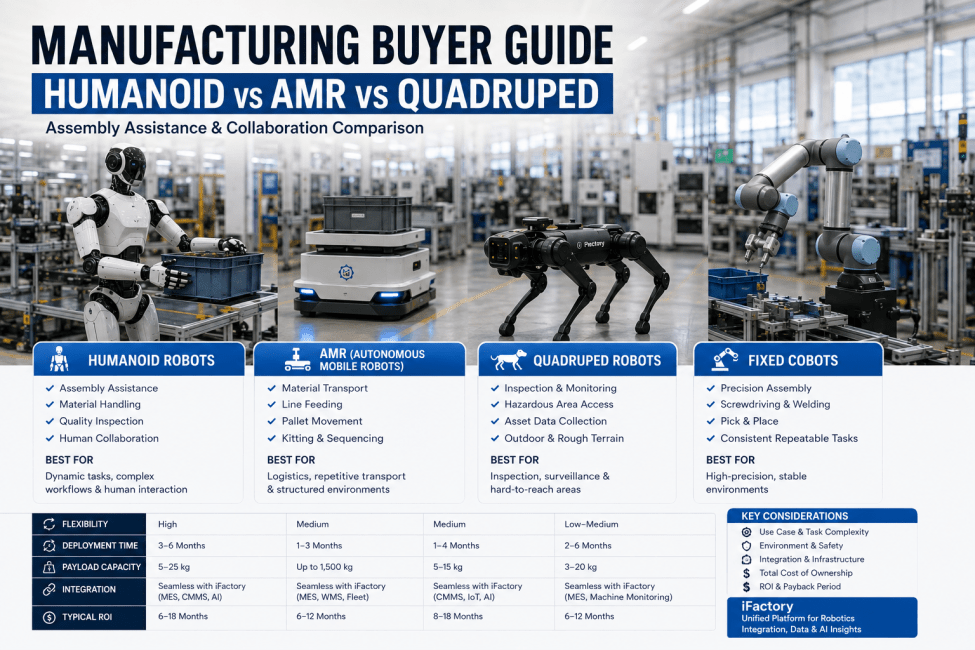
Humanoid robots have moved from trade show demonstrations to actual factory floor pilots faster than almost anyone in manufacturing expected two years ago, but the gap between a compelling demo video and a working deployment that pays for itself is still wide, and most plant leaders evaluating this category have more marketing material to read than independent data to work from. The vendors in this space differ substantially in dexterity, payload, battery life, and how close their platform actually is to reliable, repeatable factory work versus scripted demonstration tasks. Getting the ROI case right requires separating the tasks humanoids are genuinely ready for today — material handling, machine tending, simple kitting — from the tasks still years away from reliable deployment, and building a realistic integration plan around that distinction. iFactory AI's manufacturing analytics platform integrates with humanoid robot deployments to track utilization, task success rate, and downtime, giving plant leaders the operational data needed to validate ROI beyond the vendor's own numbers. Book a Demo to see how deployment tracking works for your evaluation.
Humanoid Robots in Factories — A Practical Vendor and ROI Guide
A grounded look at which humanoid robot tasks are deployment-ready today, how leading vendors compare, and the operational tracking needed to validate ROI beyond marketing claims.
What Humanoid Robots Can Reliably Do in a Factory Today
The most reliable current humanoid deployments are concentrated in tasks that are repetitive, structured, and tolerant of moderate cycle time variation — material handling between fixed points, machine tending on a single station, and basic kitting of consistent parts. Tasks requiring fine dexterity, adaptive grip strength across highly variable part geometries, or split-second reaction to unpredictable line conditions remain considerably less mature, and plants that assume otherwise based on demo footage typically face a difficult recalibration once the pilot begins.
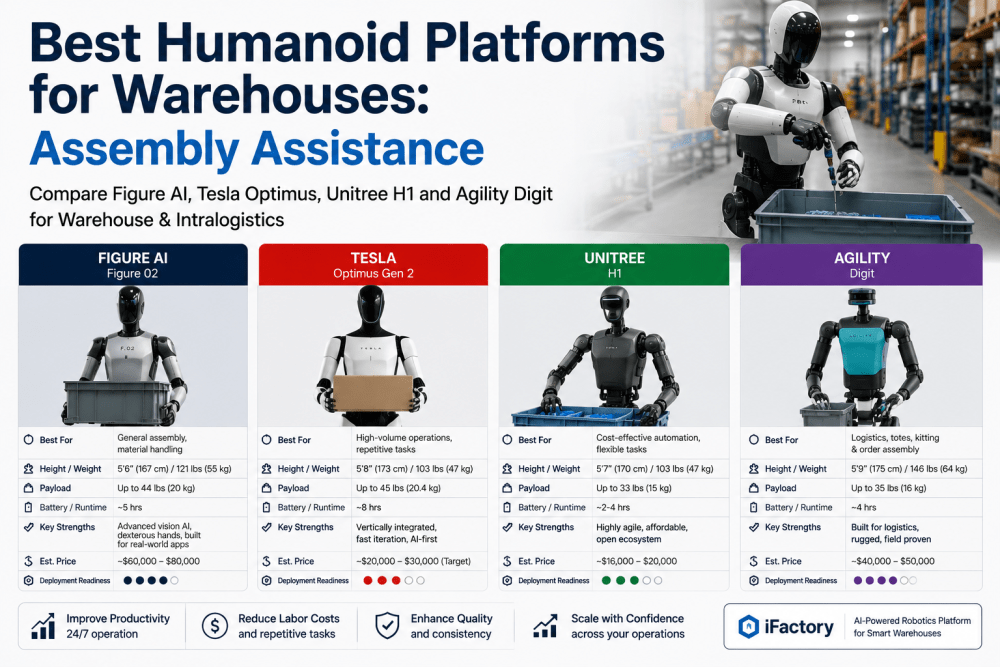
Leading Humanoid Robot Platforms — What to Evaluate
Vendor evaluation should focus less on headline dexterity claims and more on demonstrated factory deployment history, payload consistency under real conditions, and the vendor's own transparency about current task limitations. The table below outlines the evaluation criteria that matter most, independent of any single vendor's marketing narrative.
| Evaluation Criteria | Why It Matters | Questions to Ask |
|---|---|---|
| Deployment History | Demo performance rarely matches sustained production reliability | How many units are running in live production today, not pilots? |
| Payload Consistency | Rated payload often degrades with reach distance and duration | What is rated payload at full extension over a full shift? |
| Battery and Uptime | Charging downtime directly affects achievable utilization | What is real-world uptime percentage across a full production week? |
| Safety Certification | Determines what proximity to human workers is actually permitted | What safety standards is the platform certified against for your task type? |
| Integration Support | Determines total cost and timeline beyond the hardware price | What integration, training, and ongoing support is included? |
A Realistic Deployment Roadmap for Humanoid Robots
Plants that see genuine ROI from humanoid pilots generally follow a disciplined, staged approach rather than committing to a plant-wide rollout immediately after a promising demonstration. The roadmap below reflects the sequence that consistently produces defensible business cases.
Task Selection and Feasibility Screening
Candidate tasks are screened against current platform capability limits, prioritizing structured, repetitive work over tasks requiring fine dexterity or highly variable handling.
Single-Station Pilot with Data Tracking
A single humanoid unit is deployed at one station with utilization, task success rate, and downtime tracked continuously to build a real, independently verified performance baseline.
ROI Validation Against Baseline Cost
Pilot performance data is compared against the true fully loaded cost of the task performed manually or by a fixed-task cobot, producing an ROI figure grounded in actual operating data.
Phased Expansion to Additional Stations
Once ROI is validated at a single station, deployment expands to additional stations or lines, with the same tracking discipline applied to each new deployment before further expansion.
Fixed-Task Cobots vs. General-Purpose Humanoids — When Each Makes Sense
Humanoid robots are not a universal replacement for fixed-task cobots, and choosing between them should be based on task variability rather than novelty. The comparison below reflects where each approach currently makes the stronger business case.
- Higher reliability and lower cost for a single, well-defined repetitive task
- Mature safety certification and integration ecosystem
- Limited flexibility if the task or product changes significantly
- Faster typical payback for narrow, high-volume applications
- Better suited to environments with frequently changing tasks or layouts
- Can be redeployed across multiple stations without re-engineering
- Currently higher cost and lower task success rate than mature cobots
- Stronger long-term case as platform reliability continues to mature
Validate Humanoid Robot ROI With Real Operational Data, Not Vendor Claims
iFactory AI tracks utilization, task success rate, and downtime across your humanoid pilot, giving you an independent, defensible ROI case before you commit to plant-wide rollout.
Humanoid Robots in Manufacturing — Frequently Asked Questions
What manufacturing tasks are humanoid robots actually ready for today?
The most reliable current deployments involve structured, repetitive tasks such as material handling between fixed points, single-station machine tending, and basic kitting of consistent parts. Tasks requiring fine dexterity, adaptive grip across highly variable part geometries, or rapid reaction to unpredictable line conditions are considerably less mature, and plants should evaluate demo footage skeptically until they see comparable performance sustained across a full production shift.
Should we choose a humanoid robot or a fixed-task cobot?
The choice should be driven by task variability rather than novelty. Fixed-task cobots generally deliver better reliability and faster payback for a single, well-defined repetitive task, while general-purpose humanoids make a stronger case in environments where tasks or layouts change frequently enough that redeployment flexibility outweighs the current cost and reliability gap between the two approaches.
How do we validate a humanoid vendor's ROI claims before committing?
Independent operational tracking during a single-station pilot is the most reliable way to validate ROI claims — measuring actual utilization, task success rate, and downtime against the fully loaded cost of the task performed manually or by an existing cobot. Vendor-provided performance figures should be treated as a starting hypothesis to test, not a number to plan a plant-wide rollout around. Contact Support to discuss pilot tracking setup.
What safety requirements apply to humanoid robots working near people?
Safety requirements depend on the specific task, proximity to human workers, and the platform's safety certification, which varies significantly between vendors and should be confirmed directly rather than assumed from general marketing claims. Tasks involving close human collaboration typically require more rigorous certification than tasks where the humanoid operates in a segregated or lightly supervised area.
How long does a realistic humanoid deployment take from pilot to production?
Most plants following a disciplined staged approach — task screening, single-station pilot, ROI validation, then phased expansion — should expect twelve to twenty-four months from initial pilot to reliable multi-station production deployment. Plants that skip the validation stages and attempt plant-wide rollout immediately after a demo typically face longer timelines due to unanticipated task limitations. Book a Demo to build a realistic deployment timeline for your use case.
.png)