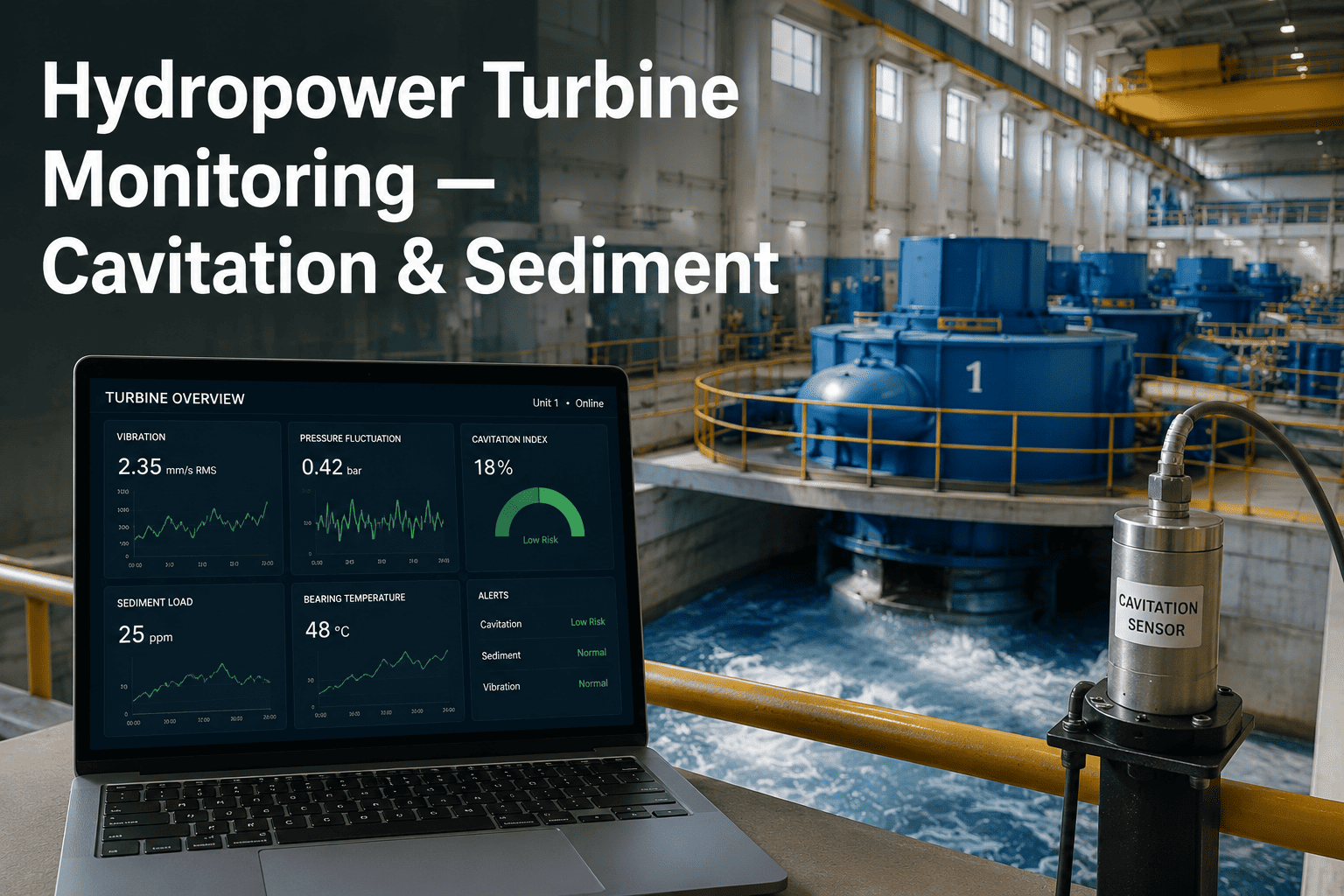
Hydropower plants face relentless challenges from cavitation, sediment erosion, and guide bearing wear, which silently degrade turbine efficiency and shorten runner life by up to 30%. Traditional inspection methods involve costly shutdowns and reactive maintenance, often missing early warning signs until severe damage occurs. With iFactory's AI-driven vibration analytics, plant operators can now detect these issues in real time, predict remaining useful life, and schedule condition-based maintenance. This comprehensive guide explores the physics of cavitation and sediment erosion, their impact on Francis, Kaplan, and Pelton turbines, and how advanced monitoring delivers a 25% extension in runner life while reducing overhaul costs. Book a Demo to see how iFactory transforms your hydropower asset management.
Intelligent Hydropower Turbine Monitoring
Detect cavitation, sediment erosion, and bearing wear with AI-powered vibration analytics. Extend runner life 25% and reduce overhaul costs by 20%.
Understanding Cavitation in Hydropower Turbines
Cavitation occurs when pressure drops below the vapor pressure of water, forming vapor bubbles that collapse violently near turbine surfaces. This phenomenon is most prevalent in Francis and Kaplan turbines operating at off-design conditions, such as partial load or high head. The collapsing bubbles generate micro-jets with pressures exceeding 1000 MPa, eroding the runner blades, guide vanes, and draft tube walls over time. For Pelton turbines, cavitation typically affects the bucket inner surfaces and splitter edges, especially when operating with high jet velocities. The erosion pattern often appears as pitting, honeycombing, or material loss, leading to reduced efficiency and increased vibration levels. iFactory's accelerometers, mounted on the turbine bearing housings and casing, capture high-frequency vibration signatures (up to 20 kHz) that correlate with cavitation intensity. By analyzing these signals using machine learning algorithms, the system can differentiate cavitation from other mechanical faults, providing early warnings weeks before visible damage occurs. This proactive approach allows plants to adjust operating parameters, such as wicket gate opening or runner blade angle, to minimize cavitation and extend component life.
Francis Turbine Cavitation
Francis turbines are highly susceptible to cavitation on the runner blades near the trailing edge, especially at part-load conditions. The collapse of vapor bubbles near the blade surface causes material erosion and increased hydraulic losses. iFactory's vibration monitoring detects the characteristic high-frequency broadband energy associated with cavitation, enabling operators to avoid operating zones that accelerate wear.
Kaplan Blade Cavitation
Kaplan turbines experience cavitation on the blade tips and hub, particularly under low-head conditions. The adjustable blades create complex flow patterns that can lead to vortex cavitation. iFactory's analytics track blade angle and head variations, correlating them with vibration data to identify cavitation-prone operating points and recommend optimal blade settings.
Pelton Bucket Erosion
Pelton buckets suffer from erosion due to high-velocity water jets carrying sediment particles. The impact causes material loss on the bucket inner surface and splitter, reducing efficiency and increasing jet deflection. iFactory's monitoring uses acoustic emission sensors to detect the high-frequency stress waves generated by particle impacts, providing early erosion detection.
Cavitation Detection Methods Comparison
| Method | Detection Accuracy | Lead Time | Cost | Applicability |
|---|---|---|---|---|
| Visual Inspection | Low | After damage | High (shutdown) | All turbine types |
| Ultrasonic Testing | Medium | After damage | Medium | Francis, Kaplan |
| Vibration Analysis | High | Weeks before | Low | All turbine types |
| Acoustic Emission | Very High | Months before | Low | Pelton, Francis |
| AI Predictive Analytics | Extremely High | Months before | Medium | All turbine types |
Implementing AI Vibration Monitoring: A Step-by-Step Timeline
Sensor Deployment
Install tri-axial accelerometers on turbine bearing housings, casing, and guide bearing supports. For Francis turbines, place sensors on the head cover and draft tube. For Kaplan, add sensors on the blade hub. For Pelton, mount sensors on the bucket wheel and casing.
Data Acquisition & Edge Processing
Connect sensors to iFactory's edge gateway, which samples vibration at 20 kHz and performs FFT analysis. The gateway extracts key features such as RMS velocity, crest factor, and spectral kurtosis, transmitting only relevant data to the cloud to minimize bandwidth.
AI Model Training
iFactory's machine learning models are trained on historical vibration data from similar turbine types, incorporating operating parameters like head, flow, and wicket gate position. The models learn to distinguish cavitation, erosion, and bearing wear patterns with high accuracy.
Real-Time Monitoring & Alerts
The system continuously monitors vibration levels and compares them against model predictions. When cavitation or erosion is detected, alerts are sent via email, SMS, or dashboard notifications, with severity levels and recommended actions.
Predictive Maintenance Scheduling
Based on remaining useful life predictions, the system recommends optimal maintenance windows, minimizing production losses. Integration with CMMS systems allows automatic work order generation for inspection or replacement.
Ready to Transform Your Hydropower Maintenance?
Join leading hydro plants using iFactory to extend runner life and reduce costs. Schedule a personalized demo today.
Sediment Erosion: The Silent Threat to Turbine Efficiency
Sediment erosion is particularly severe in run-of-river and high-head hydropower plants where water carries abrasive particles like quartz and feldspar. These particles impact turbine surfaces at high velocities, causing material loss and surface roughening. For Francis turbines, erosion is most pronounced on the runner blade leading edges, guide vanes, and labyrinth seals. Kaplan turbines suffer erosion on blade tips and hub, while Pelton buckets experience erosion on the bucket inner surface and splitter. The erosion rate depends on particle concentration, size, hardness, and flow velocity. Studies show that sediment concentrations as low as 100 ppm can reduce turbine efficiency by 1% per year, with severe cases causing up to 5% efficiency loss annually. iFactory's monitoring system uses vibration and acoustic emission sensors to detect the high-frequency stress waves generated by particle impacts. By analyzing the frequency spectrum and amplitude, the system can estimate erosion severity and predict remaining component life. This allows plant operators to schedule maintenance during planned outages, avoiding unplanned shutdowns and reducing overhaul costs.
Real-Time Erosion Tracking
iFactory's AI models continuously estimate erosion depth and surface roughness using vibration and acoustic data. Alerts are triggered when erosion exceeds predefined thresholds, enabling proactive maintenance.
Operating Parameter Optimization
The system correlates erosion with operating conditions such as head, flow, and wicket gate angle. Recommendations are provided to adjust parameters and minimize erosion without sacrificing power output.
Remaining Useful Life Prediction
Using historical erosion data and current operating conditions, iFactory predicts the remaining life of runner blades, guide vanes, and buckets. This enables condition-based maintenance scheduling, reducing downtime and costs.
Guide Bearing Wear Prediction and Monitoring
Guide bearings in hydropower turbines support the rotating shaft and maintain alignment, but they are subject to wear from radial loads, misalignment, and contamination. Bearing wear increases clearance, leading to increased vibration, reduced efficiency, and potential shaft damage. Traditional monitoring relies on temperature and vibration sensors, but these often detect wear only after significant damage has occurred. iFactory's advanced vibration analytics use envelope analysis and high-frequency demodulation to detect early signs of bearing wear, such as spalling or pitting. By tracking vibration trends over time, the system can predict bearing remaining useful life with high accuracy. For Francis and Kaplan turbines, guide bearings are particularly critical due to the high radial loads from hydraulic forces. iFactory's system integrates bearing wear predictions with other turbine health indicators, providing a comprehensive view of asset condition. This enables plant operators to plan bearing replacements during scheduled outages, avoiding catastrophic failures and reducing maintenance costs.
Integrating Penstock Pressure and Wicket Gate Position Monitoring
Penstock pressure fluctuations and wicket gate position deviations are critical indicators of turbine health and hydraulic stability. Sudden pressure changes can indicate cavitation, water hammer, or sediment blockage, while wicket gate misalignment leads to uneven flow distribution and increased vibration. iFactory's monitoring system integrates pressure transducers and position sensors with vibration data to provide a holistic view of turbine condition. Machine learning models analyze correlations between pressure, gate position, and vibration to identify anomalies and predict failures. For example, a gradual increase in vibration at the wicket gate frequency may indicate gate erosion or misalignment, prompting inspection during the next outage. Similarly, pressure fluctuations in the draft tube can indicate surging, which affects turbine stability. By combining these data sources, iFactory enables proactive maintenance and optimized operation, extending component life and improving plant availability.
Frequently Asked Questions
How does iFactory detect cavitation in hydropower turbines?
iFactory uses high-frequency accelerometers mounted on turbine bearing housings and casing to capture vibration signatures up to 20 kHz. Cavitation generates broadband high-frequency energy with distinct spectral characteristics. Machine learning models trained on historical data from similar turbines identify cavitation patterns and differentiate them from other faults. The system provides real-time alerts and recommends operating parameter adjustments to minimize cavitation. For more details, visit our support page or book a demo to see a live demonstration.
What is the cost savings potential from using iFactory for turbine monitoring?
Plants using iFactory typically see a 20% reduction in overhaul costs due to condition-based maintenance, a 25% extension in runner life, and a 30% reduction in unplanned downtime. For a typical 100 MW hydro plant, this translates to annual savings of $500,000 to $1 million. The ROI is usually achieved within 6 to 12 months. Contact us at support for a customized ROI analysis or book a demo to discuss your plant's specific needs.
Can iFactory monitor multiple turbine types simultaneously?
Yes, iFactory's platform supports Francis, Kaplan, Pelton, and small hydro turbines within a single dashboard. Each turbine type has specific sensor configurations and machine learning models tailored to its failure modes. The system aggregates data from all units, providing a comprehensive view of plant health. For more details, visit our support page or book a demo to see how we handle multi-unit plants.
How accurate is the remaining useful life prediction for turbine components?
iFactory's remaining useful life predictions achieve an accuracy of ±10% based on validation studies across multiple hydro plants. The models incorporate historical failure data, current operating conditions, and real-time sensor inputs. Predictions are continuously updated as new data becomes available. For more information, visit our support page or book a demo to discuss your specific components.
What is the installation process and downtime required?
Installation typically takes 2 to 3 days per turbine and can be performed during a scheduled outage. Sensors are mounted on bearing housings and casing using industrial adhesives or magnetic bases, requiring no modifications to the turbine. The edge gateway connects to existing plant network infrastructure. iFactory provides full installation support and training. For more details, visit our support page or book a demo to discuss your plant's schedule.
Take Control of Your Hydropower Asset Health
Extend runner life, reduce costs, and improve availability with AI-driven monitoring. Book a demo with iFactory today.