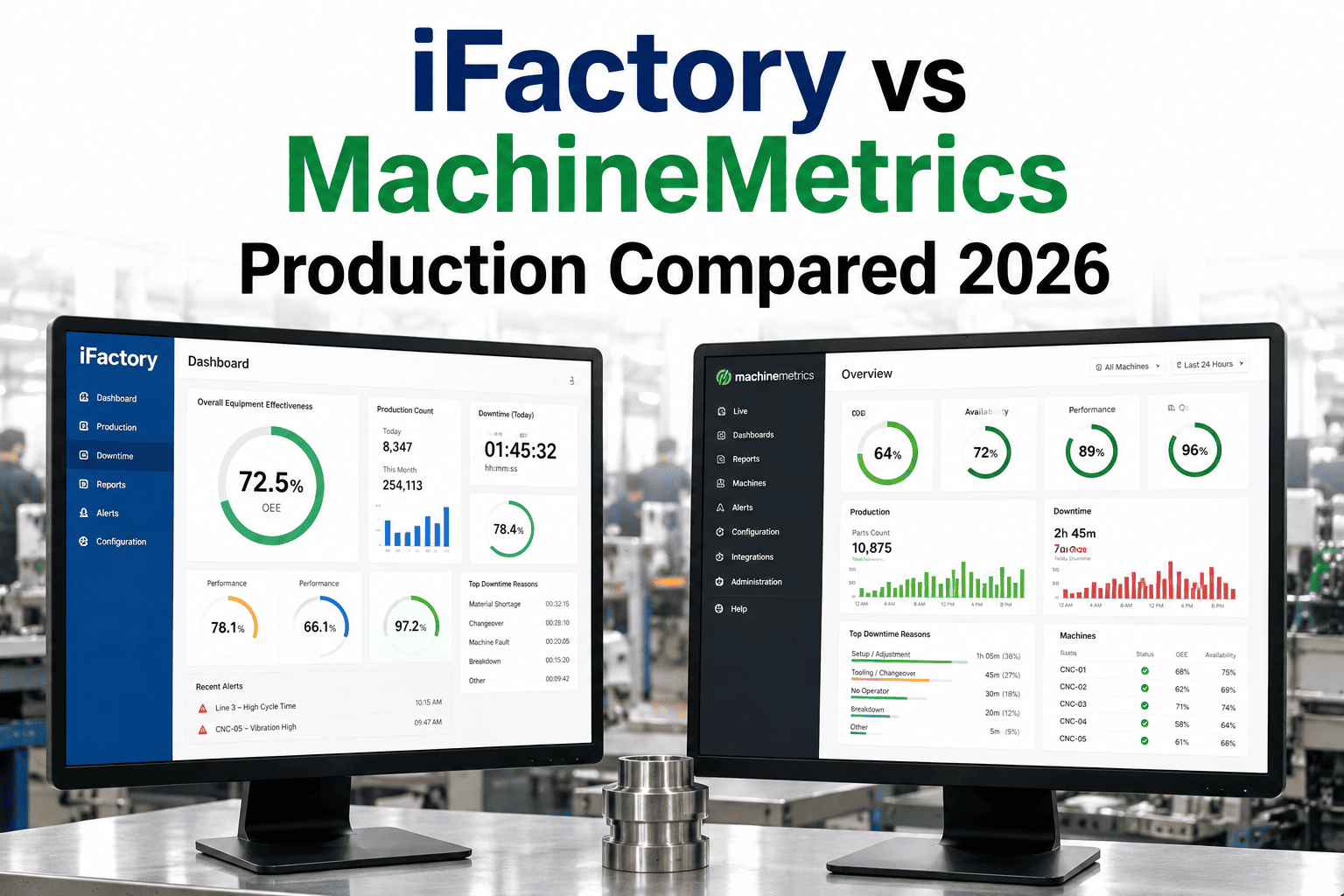
Evocon has earned a solid reputation among small and mid-sized manufacturers for making OEE tracking simple, with plug-and-play sensors and dashboards that get a plant measuring downtime and performance within days rather than months. That simplicity is a real strength, but it also marks the edge of what the platform does: Evocon tells you what happened on the line, without predicting what's about to happen or catching defects before they leave the machine. iFactory starts from the same OEE foundation but layers AI-native prediction and vision inspection on top, aiming to close the loop between measuring performance and improving it automatically. Teams weighing the two can book a demo to see the AI layer in action.
SMART FACTORY PLATFORM COMPARISON
iFactory vs Evocon: AI-Native OEE vs OEE Tracker
A criteria-based look at capabilities, deployment options, and total cost, honest about where each platform is genuinely the better fit.
Quick Take
Evocon
Fast setup, plug-and-play sensors
Clean, simple OEE dashboards
Best fit for pure downtime and OEE visibility
iFactory
OEE tracking plus predictive maintenance
Native AI vision defect detection
Best fit for plants ready to act on data, not just see it
Deployment and Setup Compared
| Factor | Evocon | iFactory |
|---|---|---|
| Initial Setup Time | Days, plug-and-play sensors | 1-2 weeks including AI model baseline |
| Hardware Requirement | Lightweight sensor kits | Sensor kits plus optional edge GPU for AI modules |
| OEE Reporting Depth | Standard availability, performance, quality | Golden-run baseline with live deviation alerts |
| Predictive Capability | Not included | Native failure prediction 7-30 days out |
| Vision Inspection | Not included | Native edge GPU defect detection |
See What Adding AI Prediction Looks Like
Watch how golden-run OEE baselines and predictive maintenance extend what a standard OEE tracker can show you.
Honest Fit Guidance
Evocon remains a strong, lower-complexity choice for plants whose immediate priority is simply getting clean OEE numbers in front of supervisors without managing AI models or GPU hardware. Smaller operations with limited technical staff often value that simplicity directly. iFactory asks for more setup investment upfront in exchange for a platform that keeps improving decisions autonomously as it learns your equipment, rather than stopping at a dashboard someone still has to interpret manually.
Total Cost of Ownership Considerations
Evocon Cost Profile
Lower upfront cost tied to lightweight sensor hardware and a narrower feature set, with limited path to expand into predictive or vision capabilities without adding a separate platform.
iFactory Cost Profile
Higher initial investment covering AI model deployment, offset over time by scrap reduction, avoided unplanned downtime, and the elimination of a second monitoring tool once fully rolled out.
Frequently Asked Questions
Can we start with just OEE tracking and add AI modules later?
Yes, a phased rollout starting with core OEE and downtime tracking, similar in scope to what Evocon provides, then adding predictive maintenance and vision inspection modules later is a common path for teams testing the platform incrementally. This lets a plant confirm value at each stage before expanding scope, and a phased plan can be discussed through support.
Is iFactory too complex for a smaller plant with a lean team?
Complexity scales with how many modules are deployed, so a smaller plant can run the OEE and monitoring layer alone with a setup and management overhead comparable to a simpler tracker, without being forced into managing predictive models or vision pipelines until the team is ready. Evaluating team readiness is a standard part of the initial planning conversation.
How does data migration work if we're switching from Evocon?
Historical OEE and downtime data can typically be exported and imported to preserve trend continuity, and a parallel-run period is recommended so supervisors can compare reporting accuracy between the two platforms before fully cutting over. Specifics depend on the export formats available from your current Evocon account.
Does the AI vision module require different sensor hardware than the OEE tracker?
Yes, vision inspection requires cameras and an edge GPU unit in addition to the standard OEE sensor kit, since image classification has fundamentally different hardware requirements than downtime and cycle counting. This is why vision is typically added as a second-phase module rather than bundled into the initial OEE rollout.
Which platform is easier to justify to plant leadership for a first purchase?
A pure OEE tracker like Evocon is often an easier first purchase to justify given its lower cost and faster visible payback in dashboard clarity alone, while an AI-native platform requires a slightly longer business case built around scrap reduction and avoided downtime. Booking a demo is the fastest way to get ROI figures specific to your plant to support either case.
Scaling Considerations as a Plant Grows
The right choice at 20 employees and one line often looks different at 200 employees and six lines, since the operational complexity a platform needs to manage grows faster than headcount alone would suggest.
| Growth Stage | Evocon Fit | iFactory Fit |
|---|---|---|
| Single Line, Early Stage | Strong fit, fast setup | Workable but more setup than needed initially |
| 3-5 Lines, Growing Complexity | Adequate for visibility, gaps in prediction | Strong fit, AI value compounds across lines |
| Multi-Plant Operation | Requires additional tooling for cross-plant AI needs | Built for fleet-wide model and baseline management |
What Plants Wish They'd Asked Before Choosing
Teams that have gone through this decision consistently point to a few questions they wish they had pushed harder on: how much engineering time will ongoing model maintenance actually require, what happens to historical trend data if we ever switch platforms again, and whether the vendor's support team has direct experience with our specific molding or extrusion equipment rather than general manufacturing knowledge alone.
Compare Both Platforms Against Your Own Data
Get a side-by-side evaluation scoped to your plant's current monitoring setup and goals.