Gartner estimates that 60 percent of AI projects will be abandoned through 2026 for lack of AI-ready data infrastructure, and MIT research found that 80 percent of the actual work in moving a pilot to production is data engineering, governance, and integration, not model selection (Gartner, 2026; MIT, 2026). iFactory, an on-premise AI platform built around data quality validation, addresses exactly this gap before a model is ever trained. Manufacturing teams who want their own data readiness assessed can discuss their plant data and use case with our team.
Industrial AI Data Quality · 2026
The Model Isn't What Fails. The Data Underneath It Does.
iFactory AI validates sensor coverage, tag consistency, and timestamp accuracy before any model is trained, closing the gap that research consistently names as the real cause of industrial AI failure.
71%
of industrial AI pilots affected by insufficient labelled training data
64%
affected by poor OT data quality or sensor drift
80%
of pilot-to-production work is data engineering, not modeling
Why pilots mislead
A Pilot's Data Is Curated. Production Data Isn't.
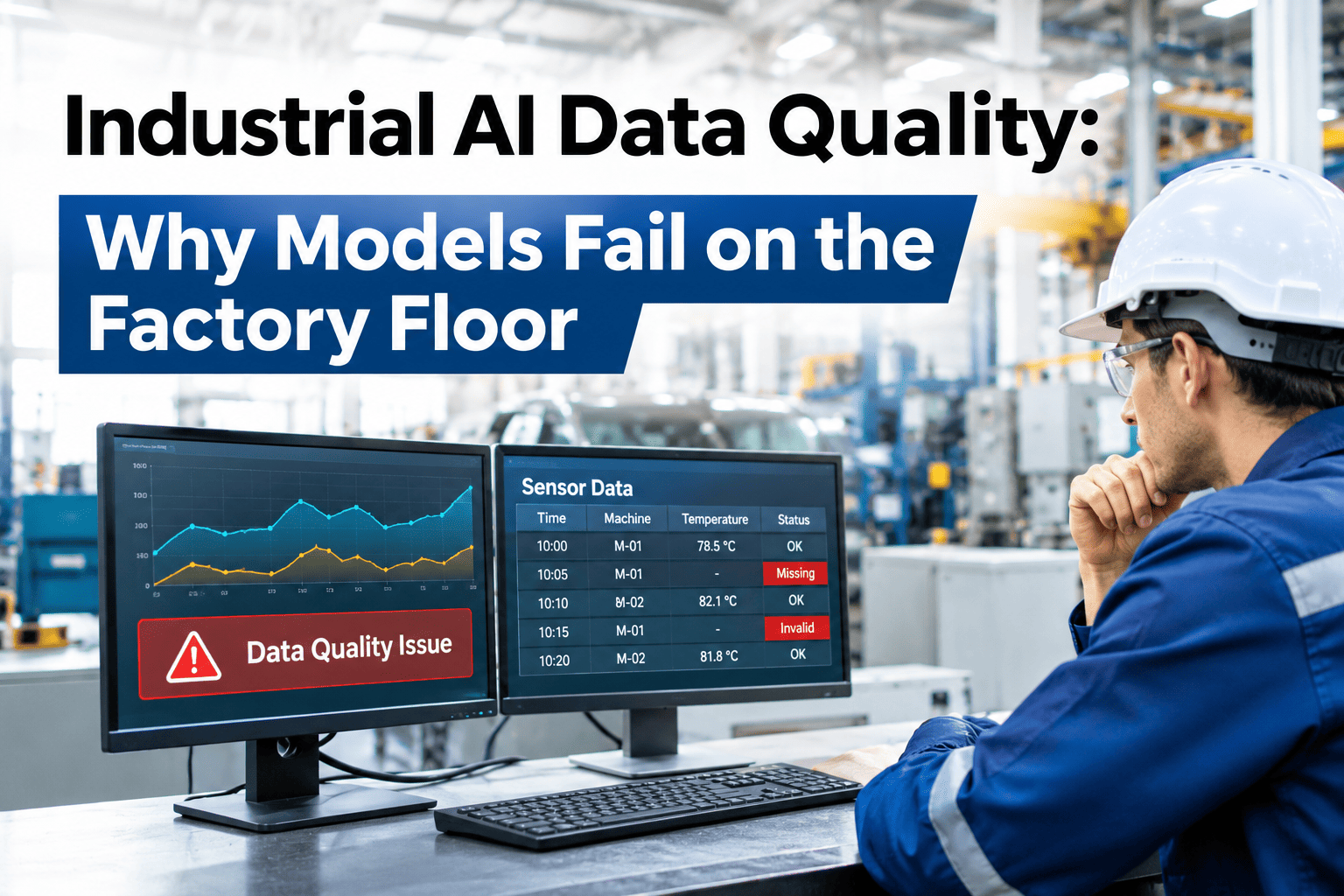
A typical AI pilot runs on data from a specific time period, hand-picked to represent clean, well-understood conditions on a single asset or line. Production data is messier by nature — it includes sensor dropouts, machine states the pilot never saw, and the full range of real operating conditions, which is exactly why a model that performed well in the pilot can falter once it meets the data it was never actually tested against.
Five data quality issues that undermine a model
What Actually Breaks on the Factory Floor
Missing values
Sensor dropouts or network gaps leave holes a model has to handle or be trained around.
Inconsistent tags
The same signal named differently across PLCs or lines breaks any model trying to generalize across them.
Poor timestamps
Clock drift between systems misaligns cause and effect in the training data itself.
Changing machine states
A model trained without state context can't tell a real anomaly from a normal idle or changeover period.
Weak asset context
Data without a clear link to which specific asset, product, and condition produced it limits what any model can learn.
Sparse events compound the problem
Why Rare Defects Are Especially Hard on Data Quality
A production line running at high quality yield generates thousands of normal observations for every single defect event, which means any data quality issue in that small defect population has an outsized effect on a model trying to learn from it. A handful of mislabeled or poorly timestamped defect events can distort a model's understanding of what it's actually trying to detect.
See Where Your Own Data Quality Gaps Actually Sit
Share a sample of your sensor and production data, and iFactory AI will walk through the specific gaps that would affect a model trained on it.
Curated pilot data vs production reality
What Changes Between the Demo and the Real Deployment
Pilot conditions
Hand-picked clean time period
Single asset or line, well understood
Labeling done carefully, often by a specialist
Production conditions
Full range of real operating data, messy included
Many assets and lines, each with its own quirks
Labeling at the scale and pace production actually runs
Fixing the foundation first
Four Steps to Close the Pilot-to-Production Gap
1
Validate before training
Check sensor coverage, tag consistency, and timestamps before a model ever touches the data.
2
Test against production-representative data
Validate on the messy, full range of conditions, not just the clean pilot window.
3
Monitor data quality continuously
A model in production needs its input data quality tracked, not just its output accuracy.
4
Scale the data foundation with the model
Every new line or asset added needs the same validation the pilot's original data received.
Expert review
What a Data Science Lead Checks First
Data quality work earns its place when it happens before model training, not as an explanation offered afterward for why a model underperformed.
Verdict
Strong when the pilot's test data genuinely reflects production's messy range, not a curated best case.
Watch for
Sparse defect labeling being treated as a model problem when it's actually a data collection and labeling problem.
Do next
Audit your pilot's training data against the five common issues above before assuming a disappointing production result is a model problem.
Frequently asked questions
What Teams Ask About Industrial AI Data Quality
Is data quality really a bigger factor than model choice?
How do we know if our data has the issues described here?
A structured audit against sensor coverage, tag consistency, timestamp accuracy, and asset context is the standard way to surface these issues before they show up as a disappointing model result.
Ask support about a data quality audit.
Why are rare defects especially sensitive to data quality problems?
Because defects are such a small fraction of total observations on a well-run line, a handful of mislabeled or mistimed defect events can disproportionately distort what a model learns to recognize.
Discuss defect labeling for your process.
Can a pilot that performed well still fail in production?
How often should data quality be monitored once a model is in production?
Continuously, ideally — data quality can degrade over time as sensors drift or machine configurations change, so ongoing monitoring of the input data is as important as monitoring the model's output accuracy.
Talk through ongoing monitoring for your deployment.
Fix the data before you blame the model
Validate Your Data Before It Trains a Model That Fails in Production
Book a session with iFactory AI to assess your data readiness before your next industrial AI project.