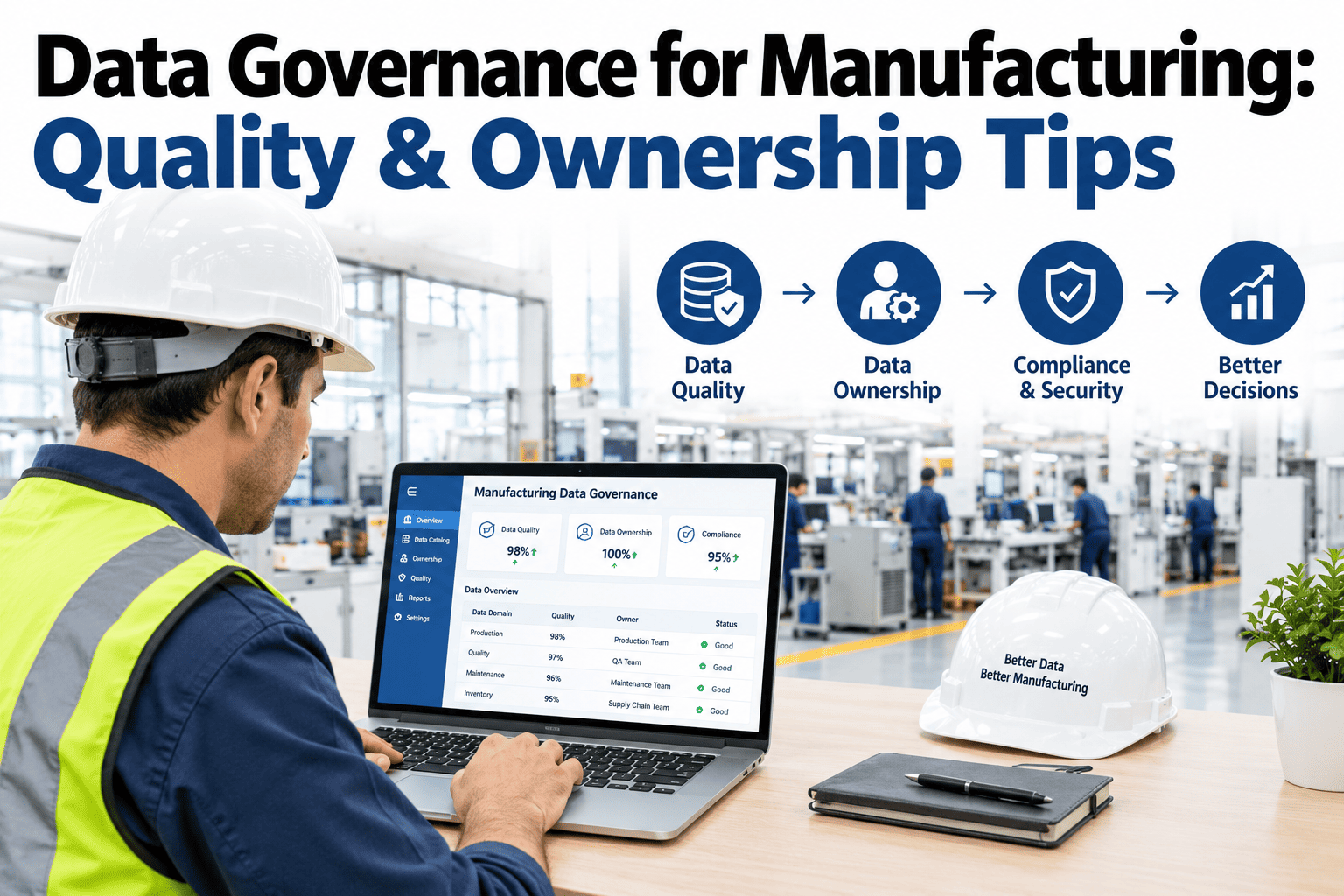
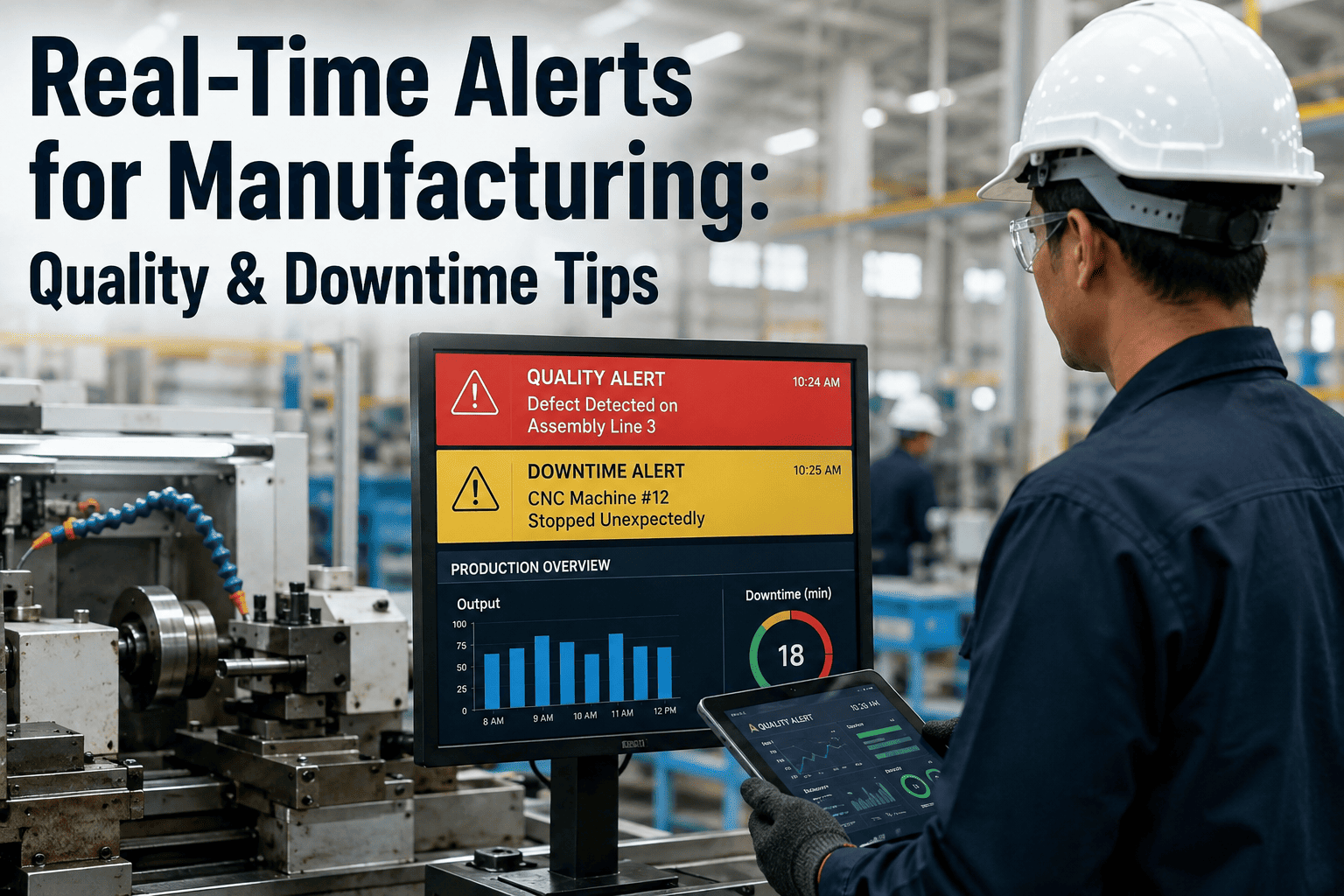
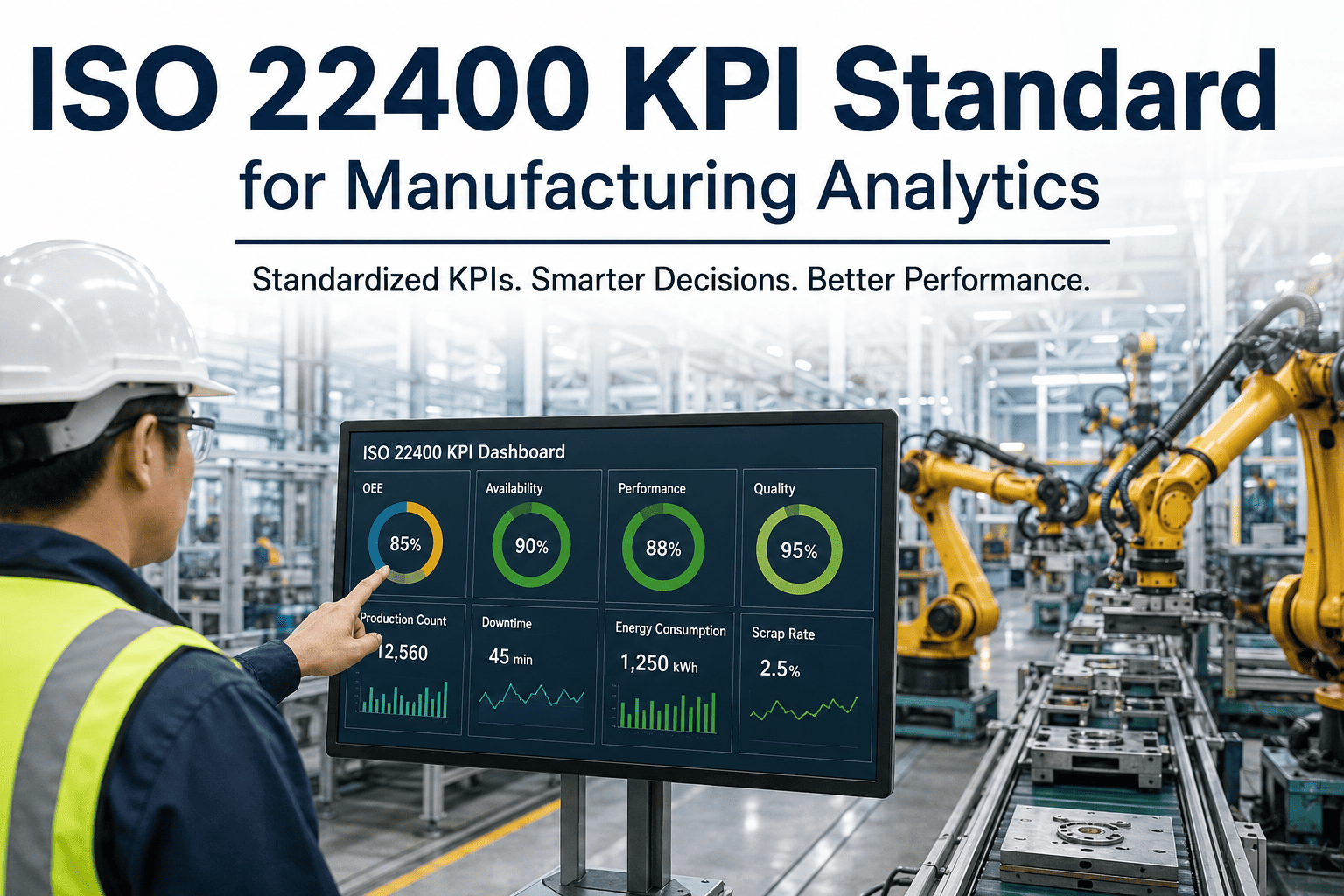
Most manufacturers don't actually have a data problem because they lack data, they have a data problem because nobody ever agreed on what the data means, who's accountable for keeping it accurate, or how a downtime reason gets recorded consistently from one shift to the next. Two operators log the same stoppage three different ways, an OEE number means something different in Plant A than it does in Plant B, and every analytics or AI initiative built on top of that inconsistency inherits the same confusion rather than resolving it. That missing rulebook is exactly what data governance provides, and it's the layer that sits beneath everything else: reliable reporting, credible sustainability numbers, and any serious AI project all depend on it working correctly first. If your analytics results feel inconsistent across plants or shifts, book a demo to see what a governed data foundation actually looks like.
MANUFACTURING ANALYTICS · DATA GOVERNANCE
The Rulebook Beneath Every Trustworthy Dashboard
iFactory establishes the data ownership, quality standards, and standardized definitions that make your manufacturing analytics and AI initiatives trustworthy instead of just decorative.
DATA OWNER
DATA STEWARD
DATA CONSUMER
GOVERNANCE COUNCIL
GOVERNANCE VS MANAGEMENT
Two Terms That Get Confused Constantly
Data governance and data management sound interchangeable and aren't, and mixing them up is one of the most common reasons a governance initiative stalls before it produces anything useful.
DATA GOVERNANCE
The policy layer above everything else: who is accountable, what "good" looks like, how standards get defined, and how disputes over data meaning get resolved.
DATA MANAGEMENT
The day-to-day execution: entering data correctly, running the pipelines, storing records, and applying the standards governance has already defined.
Without governance defining the rules first, data management just executes inconsistency more efficiently, which is exactly why plants that jump straight to buying analytics tools without addressing governance end up with faster, more confident-looking dashboards built on the same unreliable foundation.
THE FIVE PILLARS
What a Working Governance Framework Actually Includes
01
Ownership & Stewardship
A named owner accountable for each data source's accuracy, and a steward responsible for day-to-day quality and hygiene.
02
Standardized Definitions
A shared glossary and consistent downtime reason codes so "planned stop" and "on-time" mean the same thing in every plant.
03
Quality Standards & Validation
Rules that catch bad data at the point of entry rather than discovering it months later during an analytics review.
04
Access & Security Controls
Clear rules for who can see and edit which data, and how sensitive operational information is classified and protected.
05
Continuous Monitoring
Ongoing auditing so data quality improves over time rather than decaying quietly after the initial rollout excitement fades.
Find out where your data governance actually has gaps
iFactory can assess your current data ownership, standards, and quality processes against all five pillars.
WHY AI MAKES THIS URGENT NOW
An AI Model Inherits Every Governance Gap You Have
Poor data governance was always a reporting problem. Once a plant starts feeding that same data into a predictive maintenance model, an anomaly detector, or a scheduling algorithm, it becomes a much more expensive problem, because AI learns directly from whatever patterns exist in the data, inconsistencies included.
Inconsistent Failure Codes
A model trained on inconsistently coded failure history learns noisy, unreliable patterns instead of genuine failure signatures.
Undefined Ownership
When no one is accountable for a data source's accuracy, errors compound silently until a model's predictions quietly drift from reality.
Siloed, Unlinked Systems
A model that can only see part of the picture, missing maintenance context, missing quality data, makes recommendations based on an incomplete story.
GOVERNED VS UNGOVERNED DATA
What Changes When the Rulebook Actually Exists
| Factor |
Ungoverned Data |
Governed Data |
| Downtime reason consistency |
Varies shift to shift, plant to plant |
Standardized codes applied consistently everywhere |
| Cross-plant comparison |
Numbers technically exist but aren't comparable |
Genuinely apples-to-apples across every facility |
| AI model reliability |
Learns noise alongside genuine patterns |
Trains on clean, consistent, trustworthy signal |
| Accountability when data is wrong |
Nobody owns the fix |
A named steward is responsible for correction |
| Time to trust a new dashboard |
Months of skepticism and manual verification |
Immediate, since the underlying data is already trusted |
TURNKEY DEPLOYMENT
How iFactory Builds Your Governance Framework
What Gets Delivered
Named data owners and stewards assigned across every critical data source
A standardized glossary and downtime reason code taxonomy
Quality validation rules built into data entry points, not after the fact
Access and classification policy aligned to your security requirements
Ongoing quality monitoring and a governance council cadence
Rollout Timeline
Weeks 1-2: Current-state audit across all five governance pillars
Weeks 3-5: Ownership assignment, standards definition, validation rules
Week 6: Governance council established, monitoring cadence begins
FREQUENTLY ASKED QUESTIONS
What Manufacturers Ask About Data Governance
Do smaller manufacturers really need a formal governance program?
A full enterprise-scale governance council is more than most smaller manufacturers need, but the underlying discipline still matters proportionally, since even a single-page agreement on downtime definitions and a clearly named person accountable for data quality prevents the majority of inconsistencies that undermine OEE reporting and any AI initiative built later. The right-sized version of governance scales down to fit a smaller operation without losing the core principle: someone has to own the definitions, and someone has to be accountable when the data is wrong.
Book a demo to right-size a governance approach for your specific plant scale.
Who should actually own data governance inside our organization?
Effective governance requires a cross-functional structure rather than resting entirely on IT or entirely on operations, typically a governance council with representation from both, plus named data owners at the source, often a plant manager or department head, and stewards responsible for day-to-day hygiene, frequently a reliability engineer or CMMS administrator for maintenance data specifically. The critical failure mode to avoid is leaving ownership implicit or shared by "everyone," since that consistently produces accountability gaps where data quality issues never get resolved because no one felt specifically responsible.
Contact our support team to design a governance structure that fits your organization.
How long does it take to see the benefit of a governance initiative?
Some benefits are immediate, standardizing downtime reason codes alone often clarifies confusing OEE discrepancies within the first reporting cycle after the change takes effect, while other benefits compound over a longer period as consistent, high-quality data accumulates and any AI or predictive model trained on it becomes measurably more reliable than it would have been on the old, inconsistent data. Treating governance as a one-time project rather than an ongoing discipline is the most common reason initial gains erode, since data quality decays without continuous monitoring the same way any other operational standard does.
Book a demo to set realistic expectations for your specific starting point.
Won't adding governance rules slow down how fast our teams can log data?
Poorly designed governance can absolutely create friction, which is exactly why quality validation rules need to be built into the data entry point itself, structured dropdowns for downtime reasons rather than free text, for example, so following the standard is actually faster than not following it rather than adding a slow, separate compliance step after the fact. The goal is never governance as bureaucracy, it's governance embedded into the normal workflow so consistency becomes the path of least resistance rather than an extra burden layered on top of existing work.
Contact our support team to review how validation rules would be built into your specific data entry points.
How does data governance specifically affect the accuracy of an AI or predictive maintenance model?
An AI model learns whatever patterns actually exist in the data it's trained on, which means inconsistent failure coding, missing ownership accountability, and siloed systems that never connect to a full operational picture all get learned right alongside genuine failure signatures, degrading prediction quality in ways that are difficult to diagnose after the fact since the model appears to be working, just less accurately than it should. Plants with governed, consistently coded data see meaningfully better model reliability and faster time-to-confidence during training specifically because the model isn't spending its early learning cycles trying to make sense of noise that governance would have eliminated before it ever reached the training pipeline.
Book a demo to see how governance gaps in your current data would affect a predictive model.
THE FOUNDATION EVERYTHING ELSE DEPENDS ON
Build the Rulebook Before You Build the Dashboard
iFactory establishes clear data ownership, standardized definitions, and quality controls, so your manufacturing analytics and AI initiatives are built on data you can actually trust.