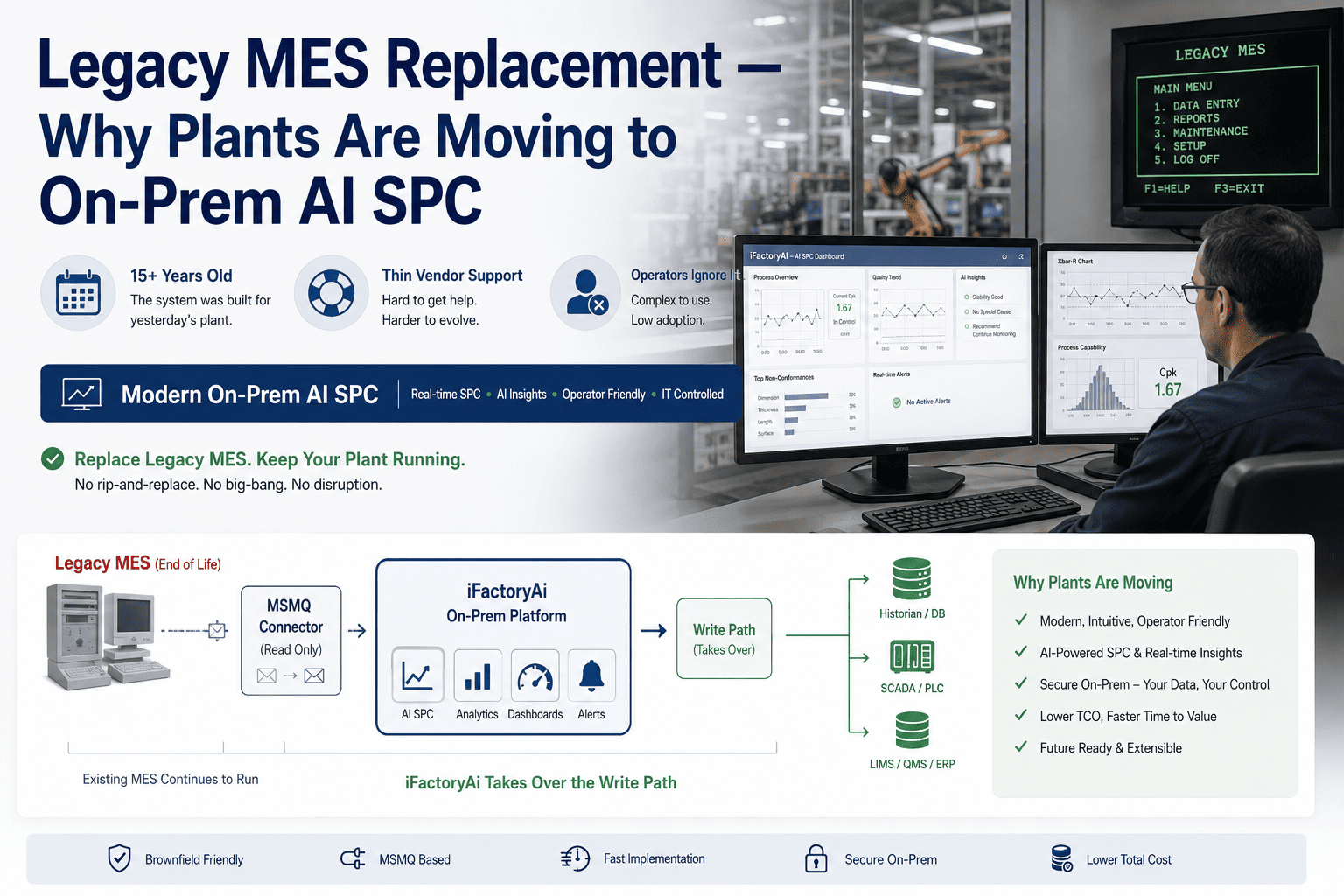
The MES is fifteen years old. The vendor answers tickets slowly and roadmap questions never. The codebase is early .NET on MSMQ, the engineer who built the customizations is two years from retirement, and the operators have quietly built their real workflow in spreadsheets around it. Every Manufacturing IT Director knows this system — and knows why it is still running: a big-bang cutover bets the plant, and unplanned downtime averages $125,000 an hour, up to $2.3 million an hour in automotive. iFactory\'s legacy MES replacement path removes the bet instead of taking it: an MSMQ-based brownfield connector reads the legacy system first, runs in parallel until trust is earned, and only then does iFactoryAI take over the write path. The MES retires; the plant never notices a cutover.
iFactory Legacy MES Replacement Path
Replace the Legacy MES Without Betting the Plant on a Cutover
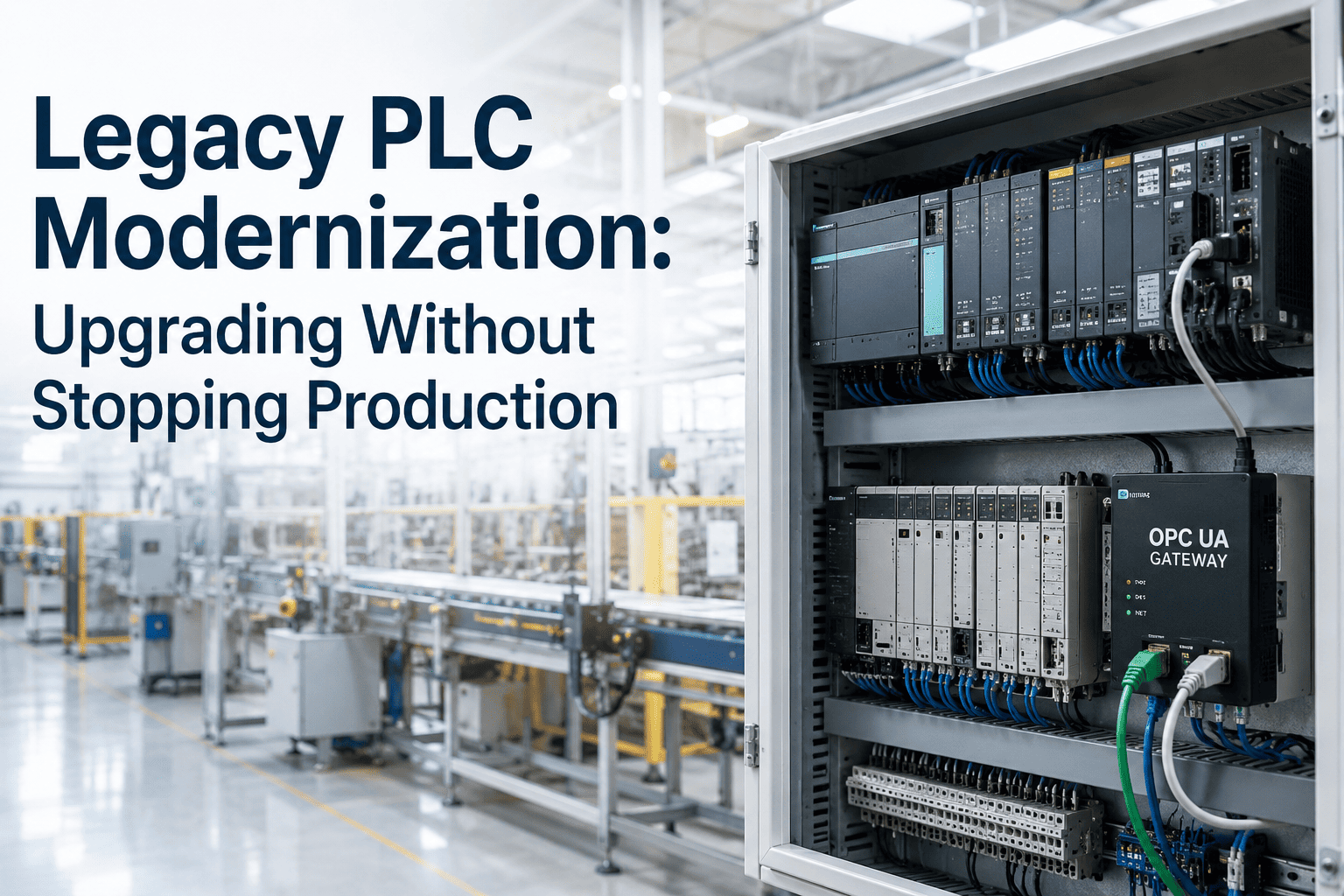
The brownfield connector reads your legacy MES over MSMQ while it keeps running. iFactoryAI shadows, proves itself in parallel, then takes the write path — modern on-prem AI SPC, zero rip-and-replace weekend.
$125K/hr
average cost of unplanned downtime
90%
of firms held back by legacy systems
0
big-bang cutover weekends required
45%
less unplanned downtime after modernizing
You Already Know the Symptoms
End-of-life rarely announces itself; it accumulates. If more than two of these read like your plant, the system is past modernization-someday and into liability-now — and the compounding cost of waiting is already on your books as workarounds, risk, and deferred integrations.
Vendor Support Is Thin
Tickets take weeks, the roadmap is silence, and every quote for a change order looks like a ransom note.
Operators Route Around It
The real workflow lives in spreadsheets, whiteboards, and WhatsApp — the MES is updated after the fact, if at all.
The Stack Is a Museum
Early .NET or VB6 on MSMQ and an aging SQL Server, with OS versions security can no longer defend.
One Engineer Holds It Up
The customization logic lives in one head approaching retirement — undocumented, untested, irreplaceable.
Integrations Get Deferred
Every request from ERP, quality, or analytics teams dies in the queue because touching the MES is too risky.
No SPC, No AI, No Future
The system records what happened; it cannot chart capability, flag drift, or run a model — and never will.
Why Rip-and-Replace Keeps Failing
The classic MES replacement fails for a knowable reason: the legacy system is one link in a chain of PLCs, ERP, quality, and historians, and replacing the link without mapping every connection is how migrations become outages. The alternative isn\'t living with the museum — it\'s replacing it in phases the plant can survive.
Big-bang cutover
One Weekend, All the Risk
Undocumented dependencies surface in production
Rollback means restoring a system you just disconnected
Operators retrained under fire on day one
Every hour of failure billed at downtime rates
Phased takeover
Read First, Earn the Write Path
Connector reads MSMQ traffic; legacy stays in control
Parallel run proves parity with evidence, not hope
Rollback at any phase is switching a flag, not a weekend
Operators migrate workflow by workflow, not all at once
Have a dependency map of your MES — or need one? Book a demo and bring your integration diagram, however ugly.
The Takeover, Phase by Phase
The migration is a controlled transfer of two responsibilities — who reads, and who writes. The legacy MES keeps both until the new platform has proven itself on your traffic. Authority moves one workflow at a time, and at every phase the previous state is one configuration switch away.
Phase 1 · Listen
Connector Reads the Legacy Bus
iFactoryAI
Reads via MSMQ
The brownfield connector subscribes to the MSMQ queues your MES already uses — work orders, results, transactions — with zero changes to legacy code. Live SPC, dashboards, and AI run on real traffic from day one.
Phase 2 · Prove
Parallel Run, Side by Side
iFactoryAI
Reads
Shadow writes
Both systems process the same events; outputs are reconciled transaction by transaction. Discrepancies are findings, not incidents — fixed while the legacy system still holds authority. IT signs off on evidence.
Phase 3 · Take Over
iFactoryAI Owns the Write Path
Legacy MES
Read-only archive
Workflow by workflow, write authority transfers. History is migrated, the legacy system drops to read-only archive, and the maintenance contract finally ends. No weekend, no war room, no bet.
The Questions an IT Director Should Ask — Answered
A migration plan is only as good as its failure modes. These are the concerns that kill MES projects, and how the phased path is built around each one.
What\'s the rollback story?
At every phase, the legacy system is intact and authoritative or one switch from it. Rollback is configuration, not restoration — no backup-tape archaeology under pressure.
What touches my legacy code?
Nothing. The connector consumes MSMQ messages the MES already emits. No patches to a codebase nobody dares recompile, no agent installed on a fragile server.
Where does the data live?
On-premise, on a pre-configured edge server inside your firewall. Inbound-only integration, no external egress — the security review is short because the surface is small.
What about 15 years of history?
Migrated and validated during the parallel phase, while the source is still alive to check against — not extracted in a panic after decommissioning.
Will operators actually use it?
They migrate one workflow at a time, trained on a system already running their real data — and they gain live SPC and AI assistance the old MES never offered them.
What if the project stalls?
Every phase is independently valuable. Even pausing at Phase 1 leaves you with live SPC and analytics on legacy traffic — value banked, nothing broken.
Which question is blocking your replacement business case? Talk to our integration team and pressure-test the plan.
What You Retire vs What You Gain
The point of replacement is not parity with a fifteen-year-old system — it is everything that system could never do. The comparison the steering committee actually needs:
| Capability | Legacy MES | iFactoryAI On-Prem |
|---|
| Statistical process control | Reports after the fact, if configured | Live SPC engine — charts, run rules, Cpk per shift |
| AI & predictive analytics | Architecturally impossible | Built in: drift detection, prediction, plant copilot |
| Integration | Custom point-to-point, vendor change orders | Standard connectors; MSMQ brownfield bridge included |
| Security posture | Unpatched OS, deprecated middleware | Current stack, on-prem, inbound-only, inside your firewall |
| Vendor dependency | One thin vendor, one retiring engineer | Supported platform with 24×7 remote monitoring |
| Replacement risk | Big-bang cutover or nothing | Phased read-then-write takeover, rollback at each step |
What Modernization Returns
The business case is no longer speculative. Manufacturers that committed to modernizing legacy systems report an average 35% ROI on the investment, 45% reductions in unplanned downtime, and 30% throughput gains — against a baseline where downtime bills at six figures an hour.
35%
Average ROI
reported on manufacturing digital modernization investments
45%
Less unplanned downtime
against a $125K/hr average bill for every hour avoided
30%
Throughput gain
reported by manufacturers committed to digital transformation
Ended
Legacy contract
maintenance, change orders, and single-engineer risk retired with the MES
What does a year of legacy MES maintenance, workarounds, and risk actually cost you? Talk to our team and build the replacement case on numbers.
Frequently Asked Questions
How does the MSMQ brownfield connector work?
It subscribes to the Microsoft Message Queuing traffic your legacy MES already produces — work orders, transactions, results — without modifying legacy code or installing anything on the legacy server. iFactoryAI builds its live picture of the plant from that stream, which is why Phase 1 delivers SPC and analytics before any migration decision is made.
How long does the legacy system keep running?
As long as the evidence requires. It holds full write authority through Phase 1 and Phase 2, hands over workflow by workflow in Phase 3, and then drops to a read-only archive. There is no date where everything must work by Monday — the schedule follows reconciliation results, not a project Gantt chart.
What happens to our historical MES data?
It migrates during the parallel phase, while the source system is still live to validate against — record counts, spot checks, and reconciliation reports before anything is decommissioned. Fifteen years of genealogy, quality records, and transactions arrive in the new platform checked, not assumed.
Is this a cloud migration in disguise?
No. iFactoryAI runs on a pre-configured edge server on-premise, inside your firewall, with read-only inbound-only integration and no external egress. For plants whose security model — or whose regulators — require production data to stay on site, that is the architecture, not an option.
What does the legacy vendor need to do?
Nothing — which is usually the honest answer to what they would do anyway. The connector reads message traffic that already exists; no cooperation, licensing change, or professional-services engagement from the incumbent is required to start Phase 1.
Read First. Prove It. Then Take the Write Path.
Retire the Legacy MES Without the Cutover
Bring your MES version, integration map, and biggest fear. We\'ll show the MSMQ connector reading a legacy bus live, walk the three-phase takeover with its rollback points, and scope Phase 1 for your plant — on-prem, inside your firewall, with the legacy system untouched.
Phase 1
value before migration
On-prem
inside your firewall