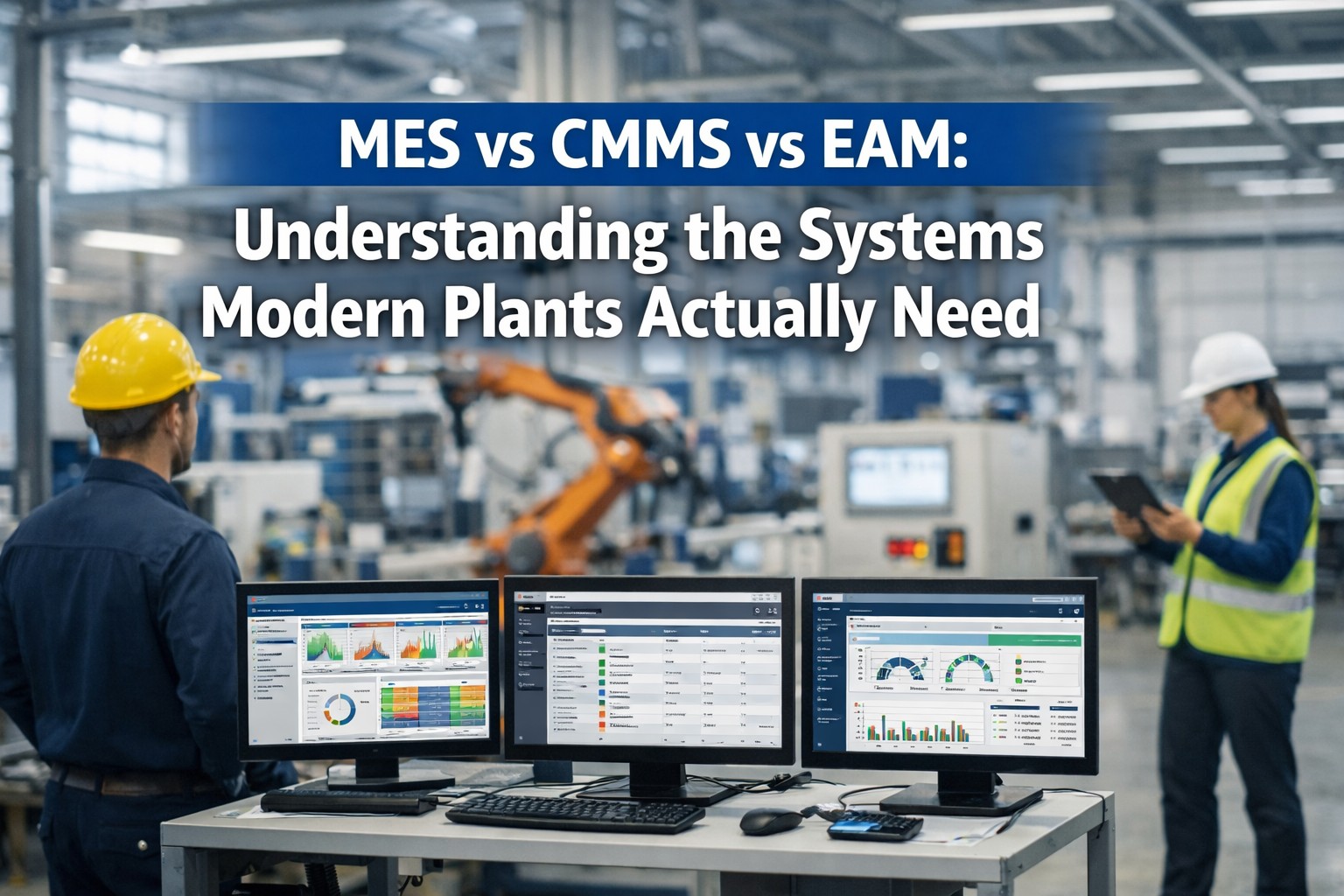
Every manufacturing leader faces the same critical question in 2026: Should you invest in a Manufacturing Execution System (MES), a Computerized Maintenance Management System (CMMS), or both? With unplanned downtime costing Fortune 500 companies approximately $2.8 billion annually ,and 95% of implementations reporting positive ROI, making the right choice has never been more consequential.
$2.8B
Annual Downtime Cost
30-50%
Downtime Reduction
MES vs CMMS: The Core Difference
Before making any investment decision, you need to understand what each system does. Simply put: MES manages what you make and how you make it. CMMS ensures the machines that make it stay operational. One manages the process; the other manages the machines.
MES
Manufacturing Execution System
- Real-time production monitoring
- Quality control & traceability
- Work order execution
- OEE calculation & analytics
Best for: Production Managers, Quality Engineers
CMMS
Computerized Maintenance Management
- Preventive maintenance scheduling
- Work order management
- Spare parts inventory
- Asset lifecycle tracking
Best for: Maintenance Managers, Facility Teams
Not sure which system fits your operation? Talk to our team for a personalized recommendation.
Feature Comparison: Where Each System Excels
ROI Analysis: Real Numbers
Based on industry research from McKinsey and Deloitte, here is what organizations can realistically expect from each system.
10-20%
Efficiency Increase
20-30%
Lead Time Reduction
12%
OEE Improvement
18-25%
Maintenance Cost Reduction
30-50%
Downtime Reduction
20%
Equipment Life Extension
Need help calculating your specific ROI potential? Schedule a personalized assessment with our specialists.
The 2026 Trend: Why Integrated Platforms Are Winning
The most significant shift in manufacturing software for 2026 is the convergence of MES and CMMS capabilities into unified platforms. Forward-thinking manufacturers are adopting solutions that combine production execution with maintenance management in a single interface.
Traditional Approach (Pre-2020)
Data silos
Manual sync
2x licensing
Complex IT
Modern Approach (2026+)
Single source of truth
Auto-triggers
1 platform
Faster ROI
Which System Do You Need?
Choose MES If:
- Missing production targets
- High scrap or quality issues
- Poor product traceability
- Compliance documentation gaps
Choose CMMS If:
- Frequent equipment breakdowns
- Reactive maintenance mode
- Parts shortages
- No maintenance history
Choose Integrated Platform If:
- Both production and maintenance issues
- Need unified data visibility
- Industry 4.0 readiness goal
- Want single vendor solution
See Integrated MES + CMMS in Action
Discover how iFactory eliminates the MES vs CMMS dilemma with AI-driven production monitoring and predictive maintenance in one platform.
Industry-Specific Recommendations
Pharma & Medical Devices
MES Essential
FDA compliance, batch records, traceability requirements
Mining & Utilities
CMMS Essential
Heavy equipment reliability, safety compliance
Discrete Manufacturing
Integrated Ideal
Production scheduling with equipment availability
Food & Beverage
Integrated Ideal
Quality, traceability, equipment hygiene
Operating in multiple industries or regions? Book a consultation to discuss your integration strategy.
Expert Analysis
The manufacturing execution systems market is undergoing fundamental transformation. The winners in 2026 will be manufacturers who break down silos between production execution and maintenance management.
$32.4B
MES Market by 2033
$1.92B
CMMS Market by 2030
Have questions about your facility's needs? Reach out to our support team for tailored guidance.
Transform Your Manufacturing Operations
Join manufacturers across the USA, UK, Germany, and Australia who have eliminated the MES vs CMMS dilemma with iFactory.
Frequently Asked Questions
What is the main difference between MES and CMMS?
MES manages production processes—tracking work orders, monitoring quality, and calculating OEE. CMMS focuses on equipment reliability—scheduling maintenance, managing repairs and tracking spare parts. MES manages what you make; CMMS ensures machines can keep making it.
Can MES and CMMS work together?
Yes, and they should. Integrated platforms create a feedback loop where production data triggers maintenance actions and equipment status informs production scheduling. This integration typically delivers 15-25% greater OEE improvement than either system alone.
Which system has better ROI?
CMMS typically shows faster payback (6-18 months) due to immediate maintenance cost savings. MES ROI takes longer (12-24 months) but often delivers larger long-term value through quality improvements and production efficiency gains.
Do small manufacturers need MES or CMMS?
Yes. Cloud-based solutions have made both accessible to SMEs. Start with the system addressing your biggest pain point—usually CMMS for equipment-heavy operations or MES for quality-focused production.
How long does implementation take?
Cloud-based CMMS can be operational in 2-4 weeks. MES implementations typically require 3-6 months due to production process mapping. Integrated platforms may take 4-8 months for full deployment.