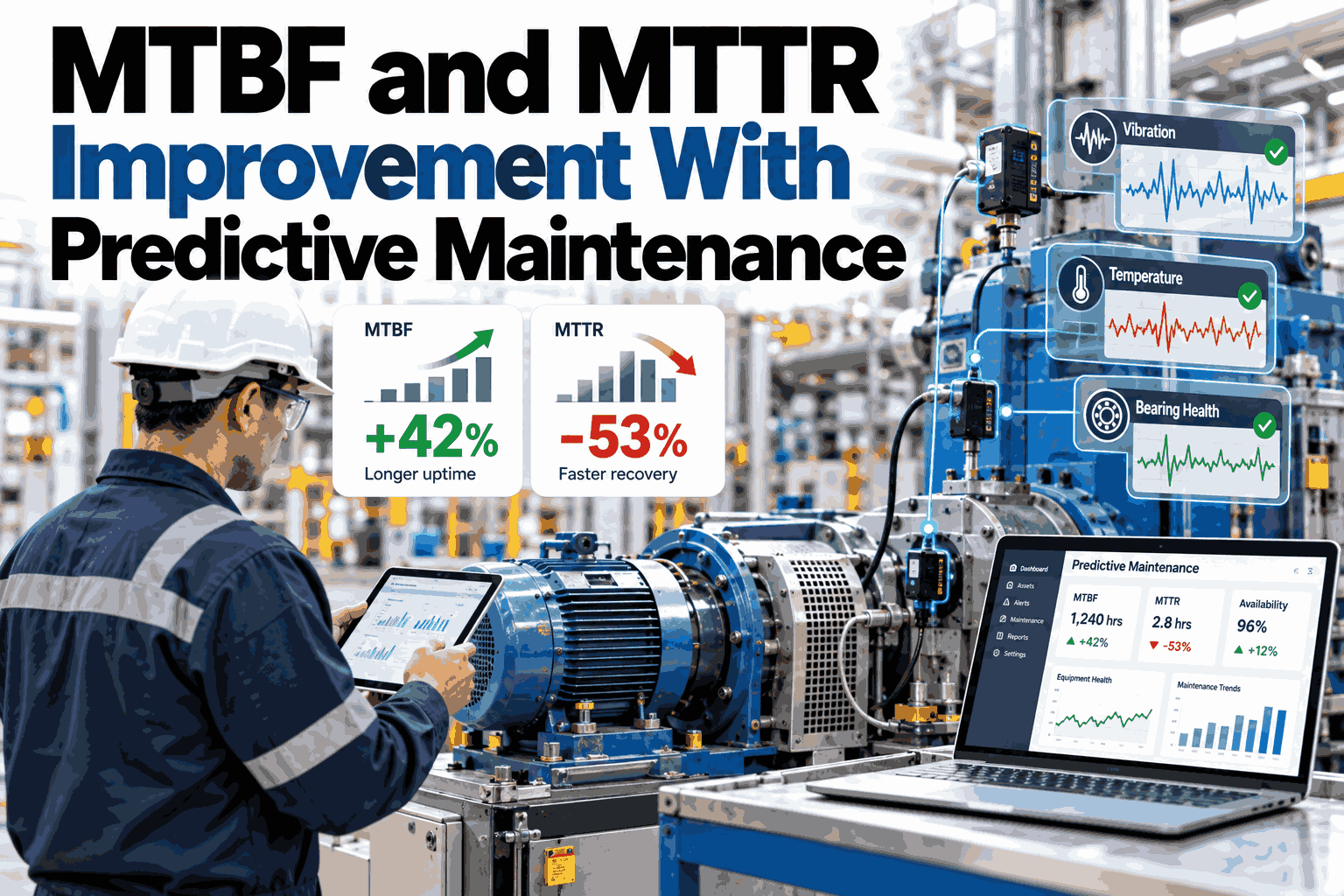
Two numbers decide how much unplanned downtime a plant lives with, and most reliability teams can recite them without knowing exactly where either one is losing ground. Mean time between failures measures how long equipment runs before something breaks, and mean time to repair measures how long it takes to get that equipment running again. A plant can improve one without touching the other, which is why a single downtime percentage hides which lever actually needs attention. Predictive maintenance moves the needle on both at once, catching failures before they happen and giving technicians a head start on the repair itself. Teams wanting to see where their own MTBF and MTTR stand against a predictive baseline can review their current failure data with the iFactory AI team.
MTBF and MTTR Improvement With Predictive Maintenance
iFactory AI combines condition data, failure history, and work order integration to extend MTBF and shorten MTTR across rotating and stationary equipment.
Two Metrics, Two Different Problems
Treating MTBF and MTTR as one combined downtime number hides which part of the failure cycle actually needs work.
MTBF, Mean Time Between Failures
MTTR, Mean Time To Repair
A plant with strong MTBF but weak MTTR fails rarely but loses hours each time it does, and the fix lives in a completely different part of the process.
Where Repair Time Actually Goes
A repair event is rarely dominated by the wrench time itself. Most of the clock runs before a technician even touches the asset.
Diagnosis
Time spent figuring out what actually failed, often starting from a vague alarm rather than a specific component signal.
Parts and Tools
Time walking to a parts crib, discovering the part is out of stock, or locating the right tool for the job.
Travel and Access
Time moving between the maintenance shop and the asset, especially on large sites with equipment spread across buildings.
Verification
Time confirming the repair actually fixed the problem before the line is handed back to production.
Documentation
Time logging what was done, which is often skipped under pressure and quietly erodes the next diagnosis.
Actual Repair Work
The hands-on time, which is usually the smallest share of the total clock once everything else is counted.
Predictive alerts shrink diagnosis time directly by naming the likely component before a technician arrives on site.
Failure Modes Predictive Monitoring Catches Early
Different equipment types fail in different ways, and the sensor data that predicts each one is specific to the failure mode, not generic to the machine.
| Equipment Type | Common Failure Mode | Leading Indicator | Typical Lead Time |
|---|---|---|---|
| Rotating Motors | Bearing wear | Vibration signature change | Weeks to months |
| Pumps | Seal degradation | Pressure and flow deviation | Days to weeks |
| Electrical Panels | Loose or corroding connections | Thermal imaging hotspots | Weeks to months |
| Conveyors | Belt or roller wear | Current draw and vibration trend | Days to weeks |
| Compressors | Valve or piston wear | Acoustic and pressure pattern shift | Weeks |
| Hydraulic Systems | Fluid contamination or leakage | Pressure drop and particle count | Days to weeks |
Lead time varies with how aggressively thresholds are tuned, and tighter thresholds trade earlier warning for more false alarms to review.
See Where Your Own MTBF and MTTR Are Losing Ground
Book a 30-minute session and bring recent failure records. iFactory AI will show which assets would benefit most from predictive monitoring first.
The Path From Sensor Data to a Shorter Repair Cycle
Predictive maintenance only improves MTBF and MTTR once data, models, and the maintenance workflow are actually connected.
Establish the Failure Baseline
Historical failure records are reviewed to understand which assets fail most often and what each failure actually cost in downtime.
Instrument the Priority Assets
Vibration, thermal, pressure, or current sensors are installed on the assets identified as the highest-value monitoring targets.
Train the Failure Model
Sensor patterns are matched against known failure events so the model learns what a developing fault looks like before it fully occurs.
Tune Alert Thresholds
Thresholds are adjusted so maintenance gets enough lead time to act without being buried in false alarms.
Connect Alerts to Work Orders
A triggered alert automatically creates a work order with the likely component and recommended parts attached.
Review and Refine
Every alert is checked against what was actually found, and the model is refined as new failure patterns appear.
Skipping the work order connection is the most common reason a predictive program improves MTBF but leaves MTTR untouched.
A Composite Scenario: One Line, Six Months of Data
A packaging line with recurring unplanned stops moved from reactive repair to predictive monitoring on its highest-failure assets. Figures below are an illustrative composite, indexed to a starting point of 100.
The MTTR gain came mostly from work orders arriving with a named component and part number instead of a technician starting from an unlabeled alarm.
What iFactory AI Adds to Predictive Maintenance
iFactory AI is smart manufacturing and industrial software that connects condition monitoring directly to the maintenance workflow, not just a dashboard nobody checks.
iFactory AI arrives pre-configured on an NVIDIA server that ships racked and ready with software pre-loaded. Rack it, connect power and Ethernet, and condition data starts flowing. Scope covers cabling, network, ERP and MES integration, team training, and 24x7 remote monitoring.
Predictive Maintenance Self-Check
Use these checks to see whether your program is improving MTBF, MTTR, or neither.
Each unchecked box is a place where predictive data exists but is not yet shortening the repair cycle.
Frequently Asked Questions
How much historical failure data is needed to start?
A clear baseline usually needs at least a year of failure records per priority asset, though monitoring can begin sooner on assets with frequent, well-documented failures. Ask how much history your plant already has to work with.
Does predictive maintenance replace preventive maintenance schedules?
No. Predictive alerts typically supplement a preventive schedule, catching the failures that happen between scheduled services rather than replacing the service plan itself. See how the two work together on your assets.
Which assets should get sensors first?
The assets with the highest combination of failure frequency and repair cost usually deliver the fastest return, which is why the baseline review comes before any hardware is ordered.
How does this actually shorten MTTR and not just MTBF?
MTTR drops when a technician starts the repair already knowing the likely component and the part needed, which is why alerts are tied directly into work order creation rather than left as a standalone dashboard notice. Talk through work order integration with the team.
What happens when an alert turns out to be a false alarm?
Every alert outcome is logged, whether confirmed or false, and that feedback is used to retune thresholds so the model gets more precise with every cycle. Plan a threshold tuning review after your first few months live.
Extend MTBF and Shrink MTTR on Your Highest-Risk Assets
iFactory AI connects condition data, failure history, and work orders into one predictive maintenance workflow. Book a walkthrough using your own asset list.