Every condition monitoring program eventually faces the same practical question: should this asset be watched continuously, or checked on a schedule. The answer isn't the same for every asset, and treating it as a single plant-wide policy — everything continuous, or everything periodic — almost always means overspending on low-risk equipment or underprotecting the assets that can least afford a missed early warning. Teams working through this decision can Book a Demo to review a monitoring strategy matched to actual asset risk.
Two Ends of a Spectrum, Not Two Fixed Categories
Continuous and periodic monitoring are often presented as a binary choice, but in practice they sit at opposite ends of a spectrum defined by monitoring frequency, and most real deployments land somewhere along that spectrum rather than at either extreme. A truly continuous system streams data constantly with no gap between readings. A truly periodic system checks an asset on a fixed schedule — weekly, monthly — with long gaps in between. Many practical deployments sample more frequently than a traditional periodic route but short of genuine continuous streaming, landing in a middle ground that balances cost against detection speed.
The Cost-Benefit Tradeoff Behind Every Monitoring Decision
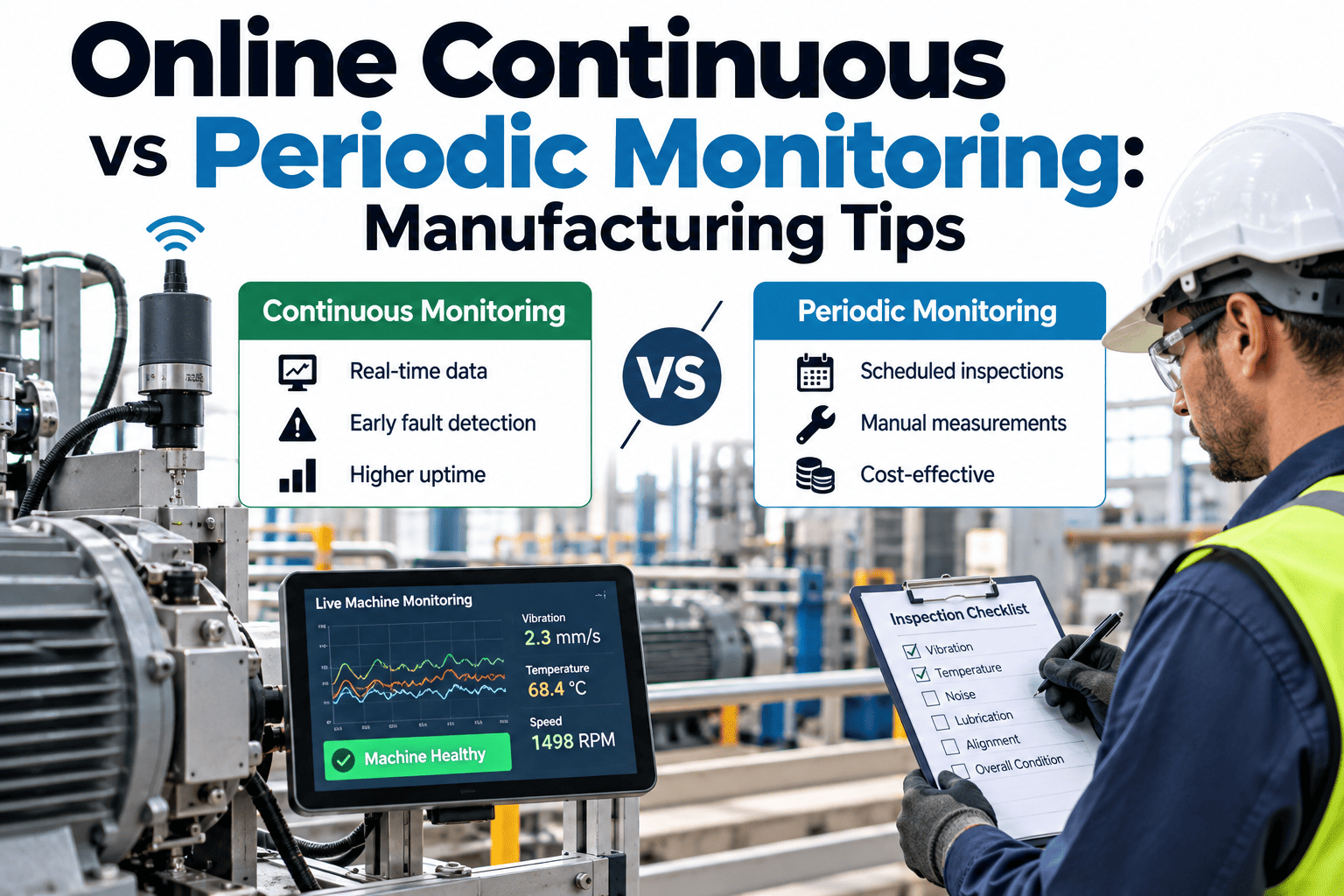
Continuous monitoring costs more per asset — more sensor hardware, more data transmission, more infrastructure to support constant streaming — but it also detects developing faults faster, since there's no gap during which a fast-progressing problem could go unnoticed. Periodic monitoring costs less per asset but accepts a detection gap equal to the length of the monitoring interval, which is only acceptable when the asset's failure modes progress slowly enough that the gap doesn't meaningfully increase risk. The right choice for any given asset comes down to weighing that cost difference against how much risk the detection gap actually introduces for that specific equipment.
Continuous Monitoring
Higher per-asset cost, minimal detection gap, best suited to bottleneck assets and fast-developing fault modes.
Periodic Monitoring
Lower per-asset cost, detection gap equal to the route interval, suited to slow-developing faults on lower-criticality assets.
Criticality-Based Deployment: Letting Asset Risk Drive the Decision
A criticality ranking — weighing production impact, repair cost, and known failure progression speed — gives a defensible, repeatable framework for deciding which assets warrant continuous monitoring and which are well served by a periodic approach, rather than making that call asset by asset on gut feel. The highest tier typically includes bottleneck assets with no redundancy and equipment known for fast-developing fault modes. The lowest tier includes redundant, low-cost-to-repair equipment where a missed early warning has limited downside.
| Criticality Tier | Typical Monitoring Choice | Rationale |
|---|---|---|
| Tier 1 — Bottleneck, no redundancy | Continuous monitoring | Any missed early warning risks a full line stoppage |
| Tier 2 — Moderate impact, some redundancy | Frequent periodic or hybrid interval | Balances cost against a moderate but non-critical detection gap |
| Tier 3 — Low impact, redundant | Standard periodic route | Detection gap carries limited downside given available redundancy |
Revisiting the Split as the Program Matures
The initial continuous-versus-periodic assignment for a given asset shouldn't be treated as permanent. An asset placed on a periodic route might reveal, after a year of data, a pattern of fault progression faster than initially assumed, making a strong case to upgrade it to continuous coverage. Building a periodic review of this split into the broader monitoring program — checking whether observed fault behavior still matches the assumptions the original tier assignment was based on — keeps the deployment strategy aligned with what the plant actually learns about its own equipment over time, rather than freezing a decision made with limited initial information.
Frequently Asked Questions: Online Continuous vs Periodic Monitoring
Is there a rule of thumb for how many assets in a typical plant warrant continuous monitoring?
There's no universal ratio that applies across every plant, since the right proportion depends entirely on how many genuine bottleneck assets and fast-fault-progression equipment types exist in a specific facility, but most plants find that a relatively small percentage of their total asset population — often concentrated in a handful of clear bottlenecks — accounts for the large majority of assets that truly justify continuous monitoring's added cost. Teams can Book a Demo to review criticality ranking for a specific asset population.
Can the same sensor hardware support both continuous and periodic use cases?
Many modern sensors, particularly wireless ones, can be configured for either continuous or periodic sampling through software settings rather than requiring different physical hardware for each mode, which gives plants flexibility to adjust an asset's monitoring frequency later without a full hardware change if criticality or risk assessment shifts.
How do we decide the right interval length for assets on a periodic schedule?
The interval should be shorter than the fastest realistic progression time for that asset's known failure modes, with enough margin to schedule a repair before the fault reaches failure, so a bearing that can progress from detectable to failed within roughly a month needs a considerably shorter interval than a slow-wearing gearbox that takes many months to progress through the same stages.
Does hybrid or frequent-interval monitoring provide most of continuous monitoring's benefit at lower cost?
For many moderate-criticality assets, a frequent interval short enough to catch most developing faults with adequate lead time can capture much of the practical benefit of true continuous monitoring at a meaningfully lower cost, which is why this middle ground has become a popular default for the torso of a plant's asset population rather than only using it as a temporary stepping stone.
What's the biggest mistake plants make when choosing between continuous and periodic monitoring?
The most common mistake is applying a single policy uniformly across the entire plant rather than tailoring the choice to each asset's actual criticality and failure behavior, which typically results in either significant overspending on low-risk equipment monitored continuously for no real benefit, or dangerous under-coverage on a genuine bottleneck asset monitored only periodically because that was simply the plant's default approach. Contact iFactory Support for help building a criticality-based deployment plan.