A single unplanned power event on a factory floor GPU rack does not behave like a data center outage. In a colocation facility, a power event means a service ticket and a failover to another region. On a factory floor running edge inference for vision-based defect detection, a power event means the inspection line either stops — halting production — or worse, keeps running with inspection blind, shipping unverified product until someone notices. Across more than 120 factory AI deployments, power redundancy planning is consistently the infrastructure decision most underestimated by IT/OT teams who have data center power experience but have never sized a UPS and generator system for a facility with motor starts, welding loads, and voltage sag on the same electrical service as the GPU rack. See how iFactory's deployment engineering team specs power redundancy for factory-floor AI infrastructure based on what has actually failed and held up across real installations.
On-Premise AI & GPU Infrastructure · Power Redundancy
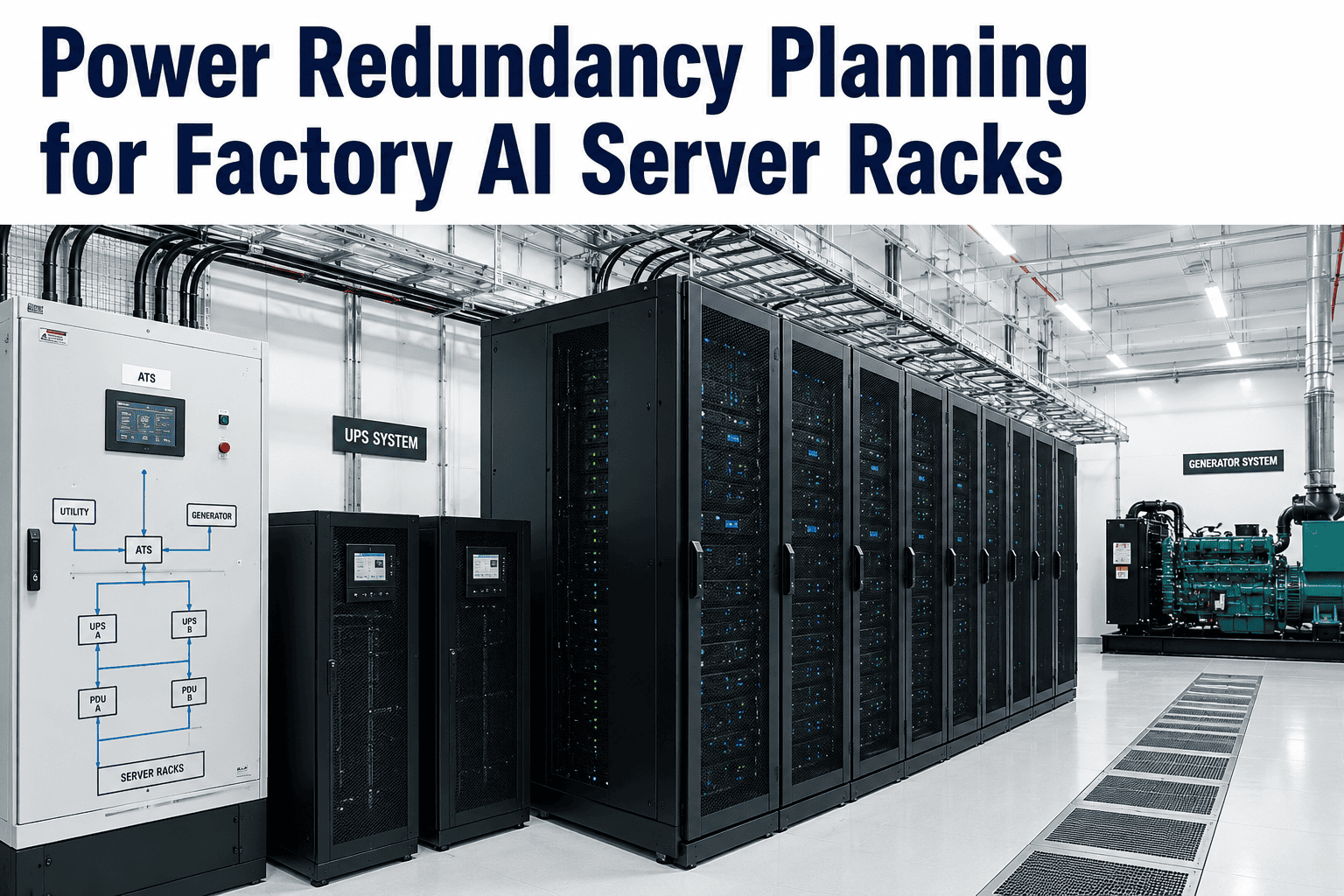
Power Redundancy Planning for Factory AI Server Racks
Dual feed configurations, UPS runtime sizing, and generator specification for GPU inference racks on the factory floor — practical guidance drawn from 120+ deployments, not data center theory that doesn't survive contact with a motor start.
10–50 kW
Realistic power draw range for a factory-floor edge inference rack
3 layersUPS, ATS, and generator — each solving a different failure window
10–15 minTypical UPS bridge time to generator start and stabilization
125%Recommended generator sizing margin over sustained rack draw
120+Factory AI deployments this guidance is drawn from
Why Factory Floors Are Different
The Electrical Environment a Data Center Engineer Has Never Seen
An engineer specifying power redundancy for a colocation rack works from a clean electrical service, purpose-built cooling, and a facility team with a single job: keep the power on. A factory floor GPU rack shares the same electrical service as arc welders, large motor starts on conveyors and compressors, and often decades-old switchgear never designed with sensitive electronics in mind. The redundancy plan has to account for problems a data center engineer rarely encounters firsthand.
01
Voltage Sag From Motor Starts
A large motor starting on the same electrical service can pull voltage down 10–15% for several cycles — often enough to trip a poorly configured UPS into battery mode or cause a GPU power supply to brown out, even though utility power never actually went out.
02
Harmonic Distortion From Variable Frequency Drives
VFDs on conveyor and pump motors inject harmonic distortion into the electrical service that clean IT-grade UPS systems were not necessarily designed to filter, requiring either isolation transformers or UPS units specifically rated for industrial harmonic environments.
03
Dust, Thermal Load, and Non-Data-Center Cooling
Factory floors run hotter and dirtier than data center white space, and UPS batteries lose meaningful service life for every degree above their rated operating temperature — a UPS rated for a 25°C data hall will underperform its stated runtime in a 32°C production environment.
04
The Consequence of Downtime Is Different
A data center power event triggers automated failover to another availability zone. A factory floor inference rack going down either stops the line or, more dangerously, leaves quality inspection blind while production continues — which is why the redundancy tier decision has to start with what happens downstream of the rack, not just the rack itself.
There is a fifth difference worth naming explicitly, because it changes the entire sizing conversation: GPU rack power density on the factory floor is not the same as the hyperscaler figures dominating current infrastructure headlines. Training-focused racks running the latest high-density accelerator platforms can draw well over 100 kW per rack in a purpose-built data center, and industry reporting has covered densities climbing toward several hundred kilowatts per rack for the most extreme training deployments. Factory-floor edge inference racks running vision inspection or predictive quality workloads sit in a dramatically different and more modest range — typically 10 to 50 kW depending on GPU count and server configuration — because inference workloads at the edge rarely run the sustained near-peak utilization that training clusters do, and factory deployments are generally sized around a handful of GPUs per rack rather than dense multi-GPU training pods. An engineer who anchors a factory floor power redundancy plan on training-cluster benchmarks will systematically oversize the UPS and generator, adding unnecessary capital cost to a deployment that never needed data-center-scale infrastructure in the first place.
Redundancy Tier Decision Framework
How Much Redundancy Does This Specific Rack Actually Need
Not every factory AI rack needs full 2N data-center-grade redundancy, and specifying it universally wastes capital that could go toward a second rack or additional line coverage. The right tier depends on what happens on the production floor in the seconds and minutes after the rack loses power — a framework more useful than defaulting to whatever tier a data center consultant would recommend.
Tier 1 — Ride-Through Only
Fits: Advisory or non-blocking inference (e.g., predictive maintenance alerts) where a brief outage delays an alert but does not stop production
UPS sized for 5–10 minutes runtime, no generator, no ATS. Accepts graceful shutdown on extended outage.
Tier 2 — Bridge to Generator
Fits: Inline inspection where the line itself has a manual fallback (operator inspection) if the rack goes down, but extended downtime is costly
UPS sized for 10–15 minutes runtime, automatic transfer switch, single generator sized to full rack load. Standard configuration for most factory AI deployments.
Tier 3 — Dual Feed + Generator
Fits: Inline inspection with no manual fallback, or lines where a stopped inspection station stops the entire production line behind it
Dual utility feeds where available, UPS with N+1 battery strings, automatic transfer switch, generator with automatic start. The realistic ceiling for most factory floor deployments.
Tier 4 — Full 2N (Rarely Justified)
Fits: Safety-critical inspection (e.g., pressure vessel or medical device final inspection) where an inspection failure has regulatory or life-safety consequences
Fully redundant UPS, ATS, and generator paths with no single point of failure anywhere in the chain. Data-center-grade cost and complexity — justify carefully before specifying this tier for a standard production line.
The most common sizing mistake in the field is not choosing the wrong tier outright — it is defaulting to Tier 3 or Tier 4 out of caution without documenting what specifically justifies the extra capital cost. A useful discipline is requiring the redundancy tier decision to reference a specific, named downstream consequence: not "this is an important line" but "if this rack loses power for more than 15 minutes, station 4 has no manual inspection fallback and product ships uninspected for the remainder of the shift." That level of specificity forces the tier decision to track actual operational risk rather than general risk aversion, and it gives the capital approval process a defensible justification when a Tier 3 configuration costs meaningfully more than Tier 2.
The Three Redundancy Layers
UPS, Transfer Switch, and Generator Each Solve a Different Failure Window
These three components are frequently specified together but they are not interchangeable — each is sized against a different duration and type of power event, and undersizing any one of them creates a gap the others cannot cover. Understanding which layer is actually responsible for which failure window prevents the common mistake of over-investing in one component while leaving a genuine gap in another.
Layer 1
UPS — The Immediate Bridge
Covers the gap between a power event and generator stabilization — typically 10 to 15 minutes for a diesel generator to start, reach rated frequency, and take load. Size the UPS to the rack's sustained kW draw under actual inference load, not the power supply's nameplate rating, which overstates real consumption by a meaningful margin. Battery chemistry matters in a factory environment: lithium-ion UPS batteries handle elevated ambient temperature better than traditional VRLA batteries and take up less floor space, an increasingly common choice for factory-floor deployments where cooling is imperfect.
Layer 2
Automatic Transfer Switch — The Handoff
Detects loss of utility power and switches the load to generator supply automatically, without requiring a technician on site. On a factory floor, specify an ATS rated for the harmonic and transient conditions of an industrial electrical service, not a lighter-duty commercial-grade switch designed for cleaner data center power. Transfer time should be fast enough that the UPS bridges the gap without depleting — typically well under a second for the switch itself, with the total gap dominated by generator start time, not switch speed.
Layer 3
Generator — The Sustained Backup
Covers extended outages beyond what UPS battery runtime can bridge. Size to at least 125% of the rack's sustained power draw to account for motor-start inrush from any cooling equipment on the same circuit and to avoid running the generator at a continuous load level that shortens its service life. Fuel capacity should match the facility's realistic worst-case outage duration — many factory sites underestimate this by sizing for a typical outage rather than the multi-hour utility restoration windows that severe weather events can produce.
Get the Sizing Right the First Time
Undersized Generators Are the Most Common Failure We See Across 120+ Deployments
iFactory's deployment engineering team reviews your rack's actual sustained power draw, existing electrical service conditions, and downstream production dependency to spec a redundancy tier that matches real risk — not a generic data center template.
Worked Sizing Example
A Full Calculation for a Realistic Factory Inference Rack
The scenario below models a Tier 2 deployment — the most common configuration across factory AI installations — for a mid-density inference rack running the type of vision inspection workload covered in iFactory's machine-shop defect detection guidance.
Scenario: 8-GPU Inference Server, Single Rack, Inline Inspection With Manual Fallback
Sustained rack power draw under inference load18 kW (measured, not nameplate)
UPS runtime target12 minutes at full load
UPS sizing (kW × runtime, with headroom)20 kW UPS module, N+1 battery string configuration
Generator sizing (125% of sustained draw)18 kW × 1.25 = 22.5 kW minimum — specify 25 kW standard unit
Fuel Capacity Calculation
Target outage coverage (severe weather scenario)8 hours
Diesel generator fuel consumption at partial load~1.8 gal/hr at 22.5 kW average draw
Minimum fuel tank capacity specified~15 gallons, rounded up to standard 20-gallon sub-base tank
This configuration is a starting reference, not a substitute for a site-specific electrical assessment — actual sustained draw should always be measured under real inference workload rather than assumed from GPU nameplate specifications, since inference utilization patterns vary significantly from the sustained near-peak draw typical of AI training workloads.
The Cost of Getting Sizing Wrong
Both Directions of Sizing Error Carry Real Cost
Engineers tend to worry more about undersizing, but oversizing carries its own real and often overlooked cost, and understanding both failure directions helps justify the time spent measuring actual load before finalizing a spec.
Undersizing Consequences
A UPS that runs out before generator stabilization causes an uncontrolled shutdown rather than a graceful one, risking data corruption on the inference server and requiring a full restart and revalidation cycle before the line can resume. A generator sized without adequate margin runs closer to its continuous rating, shortening service life and increasing the risk of nuisance trips during motor-start events elsewhere on the shared circuit.
Oversizing Consequences
A UPS and generator sized to training-cluster power density assumptions when the actual rack is a modest inference deployment adds tens of thousands of dollars in unnecessary capital cost, larger battery strings that need more floor space and more frequent replacement, and a generator running at a lower percentage of its rated capacity than is efficient for long-term fuel economy and service life.
Deployment Checklist
What to Verify Before Commissioning
These are the items most frequently missed during factory AI rack commissioning, based on post-installation issues logged across prior deployments.
01
Measure Actual Sustained Draw Under Real Workload
Run the rack under representative inference load for at least 24 hours and log actual power draw before finalizing UPS and generator sizing — nameplate and vendor-quoted TDP figures consistently overstate real-world sustained consumption for inference workloads specifically.
02
Test Generator Start Under Actual Motor-Start Conditions
Schedule a generator test transfer during a period when nearby motor loads are also cycling, not during a quiet maintenance window — a generator that performs cleanly in isolation can still struggle when the ATS transfer coincides with a compressor or conveyor motor start elsewhere on the same service.
03
Verify UPS Battery Derating for Actual Ambient Temperature
Confirm the UPS runtime specification was derated for the rack room's actual measured ambient temperature, not the manufacturer's standard 25°C test condition — a UPS rated for 15 minutes at 25°C may deliver meaningfully less runtime in a 32°C factory floor equipment room.
04
Document the Downstream Failure Mode
Confirm with production and quality teams exactly what happens on the line when the rack loses power — does the line stop automatically, does inspection default to a manual fallback, or does production continue without inspection — since this determines whether the redundancy tier chosen actually matches the operational risk.
Field Perspective
“
The single most common mistake I see is engineers pricing out a UPS and generator using the GPU vendor's nameplate power figures, then discovering during commissioning that the real sustained draw under inference load is 20 to 30 percent lower than what they sized for — which sounds like a lucky miss until you realize the reverse mistake happens just as often when someone undersizes because they assumed inference draws less than it does at sustained high utilization. The fix is not a better spreadsheet formula, it's measuring the actual rack under actual production load for at least a day before finalizing anything. Every deployment where we skipped that step and sized off vendor specs alone needed a generator swap within the first year. Every deployment where we measured first got it right the first time.
Owen Vasquez
IT/OT Infrastructure Engineer · 14 years specifying power and network infrastructure for factory-floor compute deployments across automotive, food processing, and precision manufacturing
Common Questions
Frequently Asked Questions
Should we size UPS and generator capacity using GPU nameplate TDP or measured sustained draw?
Always use measured sustained draw under representative production inference load, not nameplate thermal design power. Nameplate TDP represents a worst-case peak rating that inference workloads rarely sustain continuously, while training workloads run much closer to peak — conflating the two leads to oversized, unnecessarily expensive infrastructure in some cases and undersized infrastructure that trips under real load in others. Running the rack under actual production conditions for at least 24 hours and logging power draw at the outlet, not estimating from component specifications, is the single highest-value step in the entire sizing process.
Book a power sizing review and we'll help establish an accurate measured baseline before you finalize any UPS or generator specification.
Do factory floor GPU racks need the same power redundancy tier as a data center?
Rarely, and specifying full data-center-grade 2N redundancy for a standard production inspection line typically wastes capital that would be better spent on additional rack capacity or line coverage elsewhere. The redundancy tier should match what actually happens downstream when the rack loses power — a line with a manual inspection fallback tolerates a brief outage very differently than a safety-critical final inspection station with no fallback and regulatory consequences for a missed defect. Most factory AI deployments land at a Tier 2 configuration: UPS bridge plus automatic transfer switch plus a single generator sized to full rack load, reserving full dual-path redundancy for genuinely safety-critical applications.
How do motor starts and welding loads on the factory electrical service affect UPS reliability?
Large motor starts and welding loads can cause voltage sag of 10 to 15 percent for several electrical cycles, which is often enough to trigger a UPS into battery mode even though utility power technically never failed — an event called a false transfer that unnecessarily depletes battery runtime and can shorten battery service life if it happens frequently. Specifying a UPS rated for industrial power quality conditions, with appropriately configured sag and swell thresholds rather than the tighter thresholds typical of clean data center power specifications, reduces false transfers significantly. An electrical service assessment before UPS selection — measuring actual voltage sag events on the specific circuit the rack will share — is worth the time it takes.
What generator fuel capacity should we plan for at a factory site with unreliable utility restoration times?
Fuel capacity should be sized against the facility's realistic worst-case outage duration, not the typical outage duration — severe weather events can produce multi-hour or even multi-day utility restoration windows in some regions, and a generator that runs dry partway through an extended outage provides no more protection than having no generator at all. A common practical target is 8 to 24 hours of runtime at expected sustained load depending on regional utility reliability history and how critical the specific line is, with a documented refueling plan for outages that exceed on-site fuel capacity.
Talk to deployment engineering about establishing a realistic outage duration target based on your facility's utility reliability history.
Can lithium-ion UPS batteries handle factory floor ambient temperatures better than traditional VRLA batteries?
Generally yes — lithium-ion UPS batteries tolerate elevated ambient temperatures with less service-life degradation than traditional valve-regulated lead-acid batteries, which lose meaningful runtime capacity and calendar life for every degree above their rated operating temperature. Since factory floor equipment rooms rarely maintain the tightly controlled 20 to 25°C environment of a data center white space, lithium-ion has become an increasingly common choice for factory AI deployments specifically because it holds its rated runtime more reliably under realistic ambient conditions, despite a higher upfront cost than comparable VRLA capacity.
Size It Right the First Time
Power Redundancy That Matches Your Actual Production Risk, Not a Generic Template
iFactory's deployment engineering team specs UPS, transfer switch, and generator configurations based on measured rack draw and your facility's actual electrical conditions — drawing on lessons from 120+ factory AI installations, including the sizing mistakes that caused real downtime elsewhere.