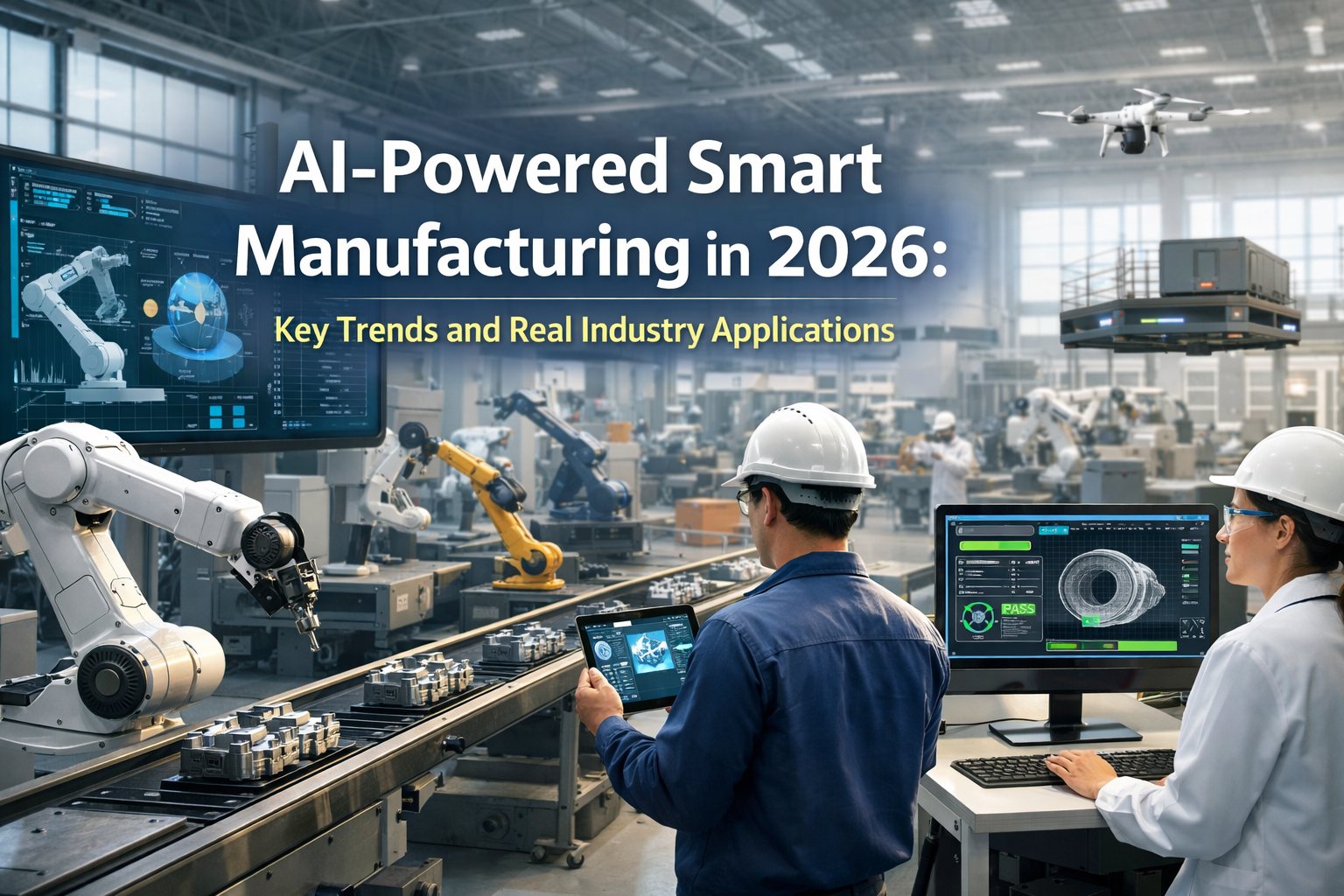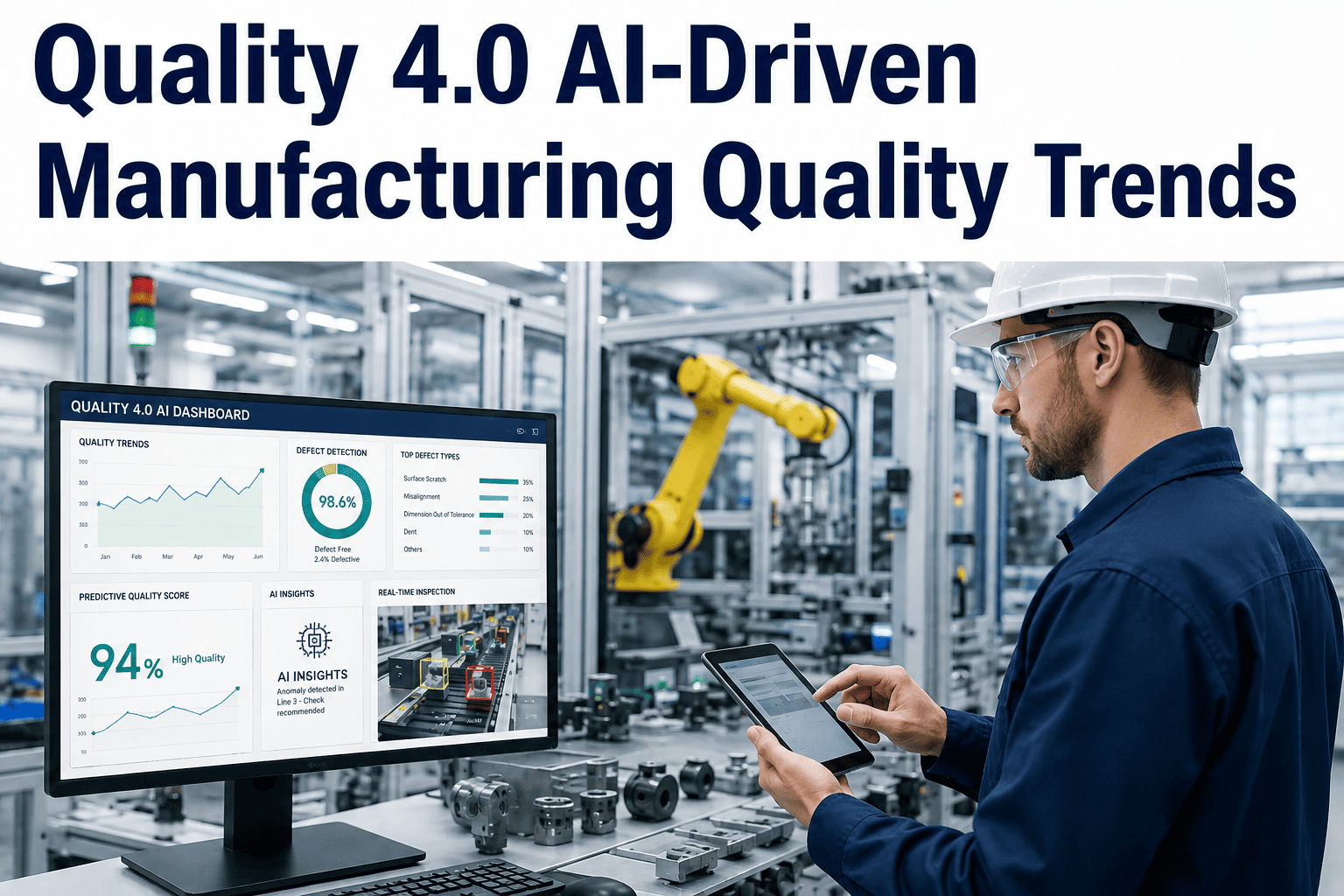
Nearly half of manufacturers now use AI somewhere in their quality operations — 47 percent as of early 2026, up from 33 percent the year before, according to the Pulse of Quality in Manufacturing survey of 2,263 managers and directors across the US, UK, and Germany. That is the headline number. The number that matters more for a VP of Operations building next year's budget is this: a separate Deloitte Germany survey of manufacturers found that while 84 percent already generate measurable value from AI, only 20 percent of those use cases have actually been scaled beyond a pilot. Quality 4.0 in 2026 is not a story about whether AI works in quality control — the data says it does. It is a story about the gap between adoption and scale, and closing that gap is where the real competitive advantage sits this year. See how iFactory helps operations leaders move quality AI initiatives from pilot to scaled deployment without repeating the industry's most common scaling failures.
Quality 4.0 in 2026: What's Actually Changing, and What the Data Says About It
A sourced read on where predictive quality actually stands relative to traditional inspection this year — the survey data behind the adoption numbers, the scaling gap most manufacturers haven't closed, and what operations leaders should actually prioritize before the next budget cycle.
Prediction Is Joining Inspection, Not Replacing It
The framing that "AI is replacing inspection" oversimplifies what the data actually shows. Quality Magazine's 2026 trends analysis identifies the emergence of hybrid quality strategies — combining statistical process control with AI-driven prediction — as the single most significant trend of the year, explicitly noting that SPC remains the trusted language of quality on the shop floor and in the boardroom, particularly in regulated industries where explainability and auditability are non-negotiable. The practical pattern showing up across manufacturers in 2026 is not wholesale replacement of inspection with prediction, but layering: SPC charts continue providing the real-time, auditable process control that compliance teams require, while AI and machine learning models analyze the same data streams to surface subtler patterns, anticipate process drift, and recommend interventions before a defect actually occurs.
The market data supports the same reading. The global quality management software market was valued at roughly $12.3 billion in 2025 and is projected to reach $13.4 billion in 2026, growing at an 11.5 percent compound annual rate toward $28.8 billion by 2033 — a market expansion driven specifically by manufacturers integrating IoT, robotics, and digital twin technologies into existing QMS platforms rather than replacing those platforms outright. This is consistent with the broader Industry 4.0 market, which multiple analyst estimates place between roughly $205 billion and $240 billion in 2026 depending on scope and methodology, with double-digit compound growth projected through the early 2030s. The dollars are flowing toward augmentation of existing quality infrastructure, not wholesale replacement of it — a distinction that matters when an operations leader is deciding whether to build an entirely new quality stack or extend the SPC and QMS systems already in place.
What the 2026 Manufacturing Surveys Actually Found
Four independent 2026 surveys, run by different organizations across different manufacturer populations, converge on a consistent picture: broad AI adoption in quality, real measurable value, and a persistent gap between piloting and scaling. The table below summarizes the key findings each study reports.
| Survey | Sample | Key Finding |
|---|---|---|
| Pulse of Quality in Manufacturing 2026 (Octave / Censuswide) | 2,263 managers & directors, US/UK/Germany, mid-to-large manufacturers | 47% currently use AI in quality processes, up from 33% in 2025; 71% plan increased quality investment; skills shortage affects 85% of quality outcomes |
| AI in Manufacturing 2026 (Deloitte Germany) | Manufacturing leaders, Germany-focused with broader relevance | 84% generate measurable value from AI; only 20% of use cases are scaled beyond pilot; 43% cite high implementation cost as the top barrier |
| 2026 State of Manufacturing Industry (Parsec) | 1,200 manufacturing leaders across executive, operational, and technical roles | 72% have adopted AI in some form; just 10% have deployed it at scale; 60% worry more about being too hesitant than too aggressive with AI |
| 2026 AI Impact Survey (Grant Thornton) | Cross-industry with manufacturing sector detail | Only 14% of manufacturers feel extremely prepared for AI-related privacy and security challenges, the lowest of any surveyed industry; 57% cite compliance uncertainty as a top scaling barrier |
Reading across all four studies, the consistent finding is not disagreement about whether AI delivers quality value — every survey confirms it does, and by wide margins. The consistent finding is that the gap between initial adoption and full-scale deployment remains the central unresolved challenge of 2026, with roughly seven in ten manufacturers having started somewhere and roughly one in ten having actually scaled.
It is also worth noting what these surveys do not show, since an accurate read of the data requires being precise about its limits. None of the four studies claims AI-driven prediction has overtaken manual or SPC-based inspection as the dominant quality method across the industry — the 47 percent adoption figure describes any use of AI somewhere in quality processes, which includes document automation and training applications that have nothing to do with predictive defect detection specifically. The narrower claim that AI-based defect prediction has become the primary quality control method at most plants is not supported by the current survey data, and operations leaders should be skeptical of vendor messaging that implies otherwise. What the data supports is a more measured claim: predictive AI is a rapidly maturing complement to existing quality infrastructure, concentrated most heavily in vision-based inspection, with real but still-developing traction in broader process-parameter prediction.
Most Manufacturers Have Started. Few Have Scaled. That Gap Is the Opportunity.
iFactory's solutions engineering team works with operations leaders to identify which quality AI pilots are ready to scale, what data foundation and governance gaps are holding them back, and how to sequence expansion across additional lines without repeating the 80% that stall in pilot.
The Business Pressures Making 2026 a Turning Point for Quality Investment
The urgency behind quality AI investment in 2026 is not purely technological — it reflects converging business pressures that the survey data captures clearly. The Pulse of Quality survey found that 59% of manufacturers report increased external regulatory requirements, and product recalls remain a costly and persistent challenge despite rising investment in quality systems, a combination that raises the cost of quality failures at the same time regulatory scrutiny is intensifying. Separately, the Parsec 2026 State of Manufacturing report found that 70% of manufacturers have completed or are actively pursuing reshoring, a dramatic increase from 33% just two years earlier, bringing production back onshore into facilities and workforces that in many cases have less accumulated quality-process history than the overseas operations they are replacing.
These two pressures compound each other in a way that makes 2026 a genuinely different moment than the AI pilots of 2023 and 2024. A newly reshored line has no multi-year defect history to build a traditional SPC baseline from, which pushes operations teams toward AI-assisted approaches that can establish reliable quality baselines faster than waiting years to accumulate the same statistical confidence manually. At the same time, tightening regulatory and compliance requirements raise the cost of getting quality wrong, which is part of why 71% of surveyed organizations are increasing quality investment even as overall manufacturing capital budgets remain under pressure from tariffs and cost-cutting priorities reported elsewhere in the same surveys. Quality is being funded not despite the broader cost pressure in manufacturing, but partly because of it — a defect that reaches a customer or triggers a recall is now measurably more expensive to absorb than it was three years ago.
Where to Focus in 2026 If the Goal Is Scale, Not Another Pilot
Given the survey data, the operations leaders making the most measurable progress in 2026 are not the ones running the most AI pilots — they are the ones systematically converting a small number of proven pilots into scaled, multi-line deployments. Three concrete priorities separate that group from the broader 72% who have adopted AI somewhere but remain stuck below the 10% that has scaled, and none of the three require waiting for a more mature vendor market or a bigger annual budget cycle to begin.
The story operations leaders should take from the 2026 data is not "AI is transforming quality" — that headline has been true for two years and everyone already knows it. The story is that the industry has quietly sorted itself into two groups: a large group that has proven AI works in one place and stopped there, and a small group that has figured out how to make that proof repeatable across a dozen lines. The second group isn't smarter or better funded — the surveys show cost is the top barrier across the board, so budget alone doesn't explain the gap. What separates them is that they solved data standardization and governance before scaling, not after. Every operations leader I talk to in 2026 already has a quality AI pilot running somewhere in their plant, usually more than one. The question worth asking isn't whether to start another pilot — it's why the ones already running haven't gone anywhere in eighteen months.
Frequently Asked Questions
The Data Says AI Works in Quality. The Real Question Is Whether It's Scaled.
iFactory's solutions engineering team helps operations leaders close the gap between a proven quality AI pilot and a scaled, multi-line deployment — addressing the data standardization, governance, and change management barriers that stall roughly 80% of manufacturers before they reach full scale.