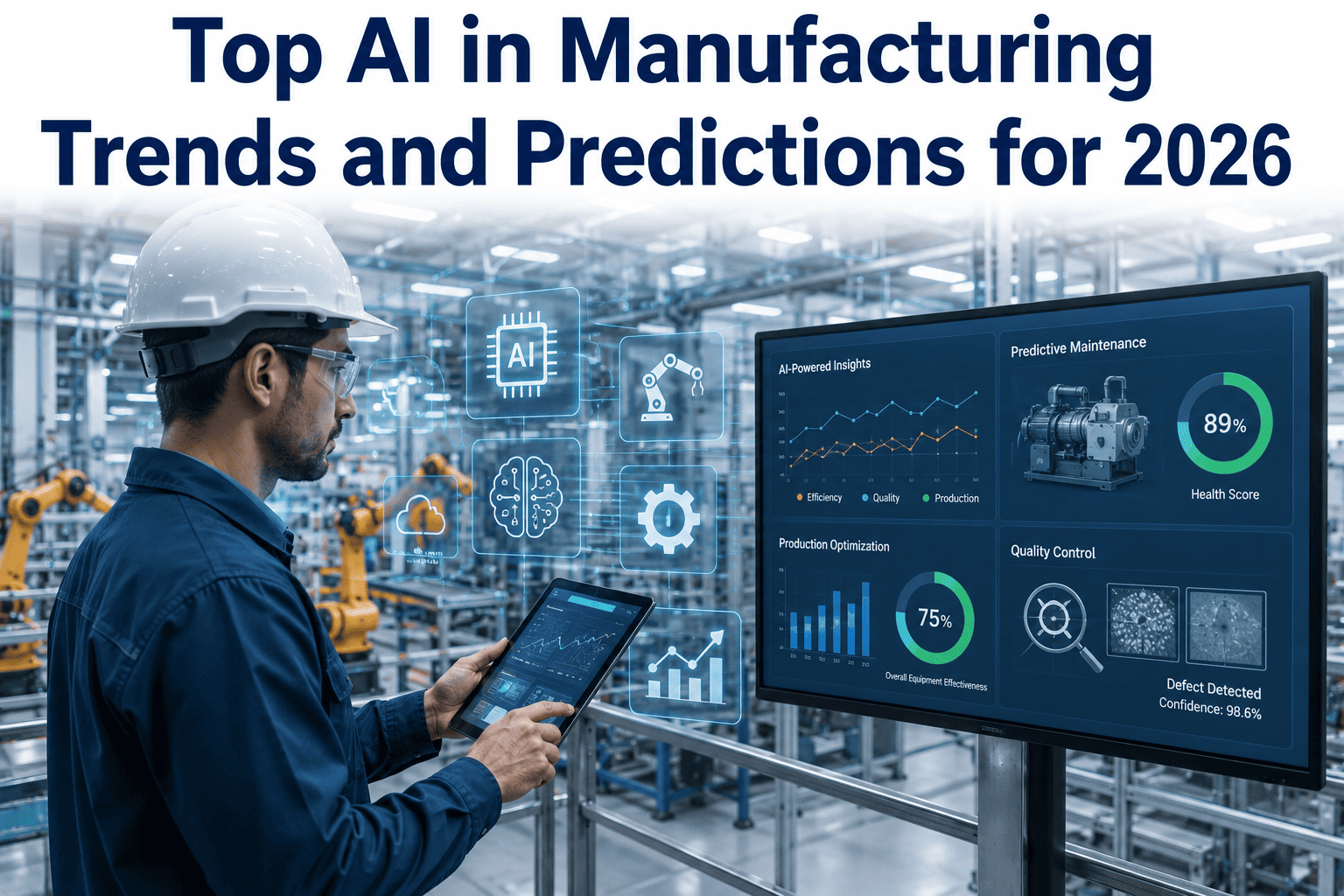
Deloitte's 2026 State of AI in the Enterprise report puts a number on the shift everyone in manufacturing has been talking about: agentic AI adoption is projected to roughly quadruple this year, from 6 percent to 24 percent. That statistic matters less for what it says about AI generally and more for what it signals specifically — 2026 is the year manufacturers stopped asking whether AI could analyze factory data and started asking whether it could act on it without a human approving every step. This is a sourced read on the five trends actually reshaping factory operations this year, not a speculative wish list, and it deliberately spends as much time on where the evidence is thinner than the headlines suggest as it does celebrating what's genuinely working. See how iFactory helps operations leaders evaluate which of these trends are ready for their specific plant versus which ones remain further out.
Top AI in Manufacturing Trends and Predictions for 2026
Agentic AI, vision-guided robotics, digital twins, and reshoring-driven automation — a sourced look at what's actually changing on the factory floor this year, and where the evidence is thinner than the headlines suggest.
Agentic AI Moves From Pilot to Governed Infrastructure
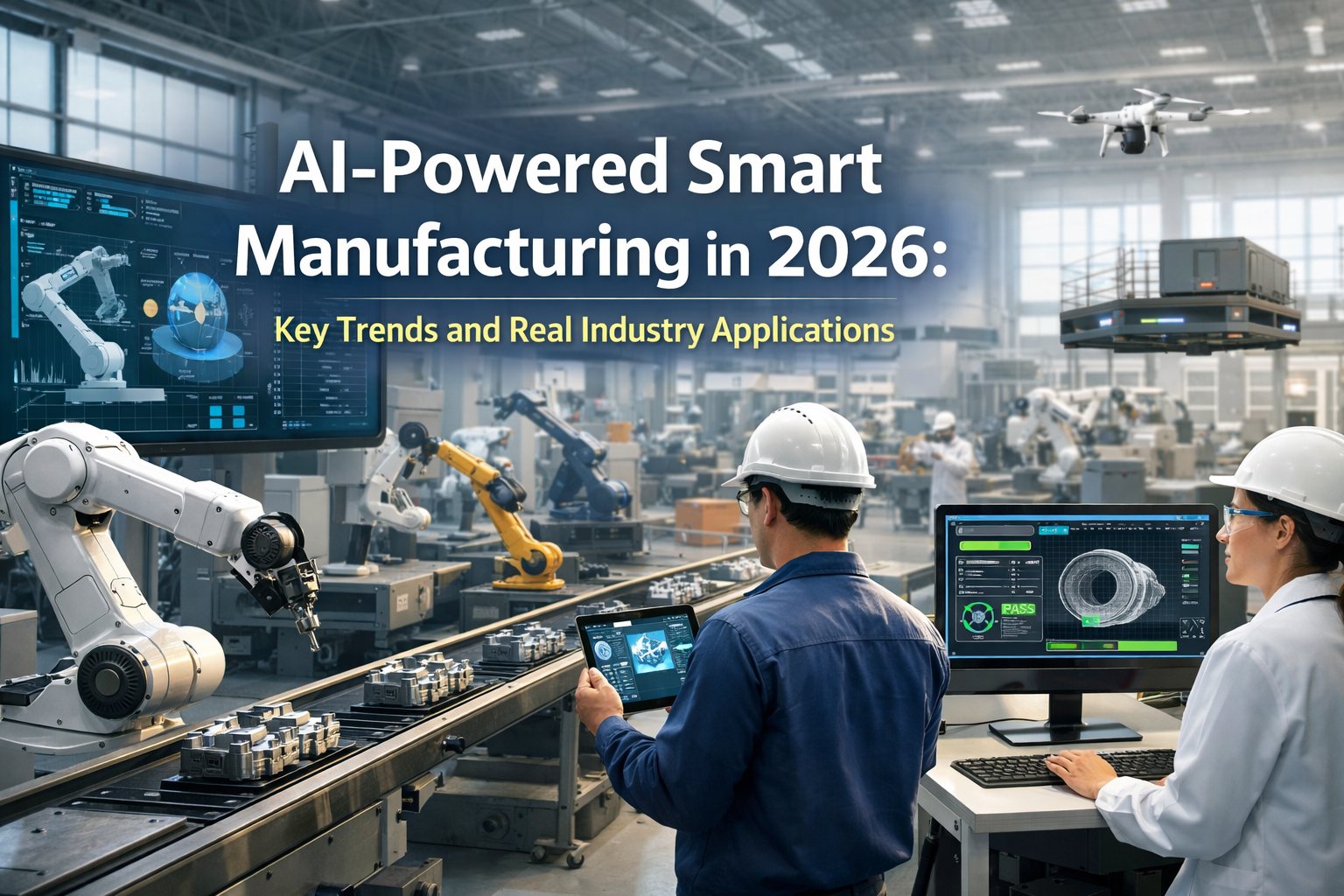
The defining shift of 2026 is not that AI got smarter at analysis — that's been true for several years — it's that a meaningful share of manufacturers are now letting AI systems take action without a human approving every step. Deloitte's fourfold adoption growth projection is corroborated across multiple independent sources this year, from Manufacturing Dive to TeepTrak's automation trends coverage, and the pattern is consistent: agent-driven workflows identifying deviations, adjusting schedules, updating work orders, and triggering supplier follow-ups automatically.
The practical read for an operations leader: agentic AI in 2026 is real and delivering results at early-adopter plants, but the gap between broad interest and scaled deployment remains wide, and the plants succeeding are consistently the ones anchoring their first agent deployment to a single measurable metric — OEE, scrap rate, or changeover time — rather than attempting a broad rollout before the underlying data infrastructure is ready. This mirrors a pattern seen in earlier AI adoption cycles: the technology capability tends to outpace the organizational readiness to deploy it safely at scale, and the manufacturers who read the readiness caveats as carefully as the adoption statistics are the ones avoiding the worst outcomes.
Physical AI and Humanoid Robots Move Past the Demo Stage — Cautiously
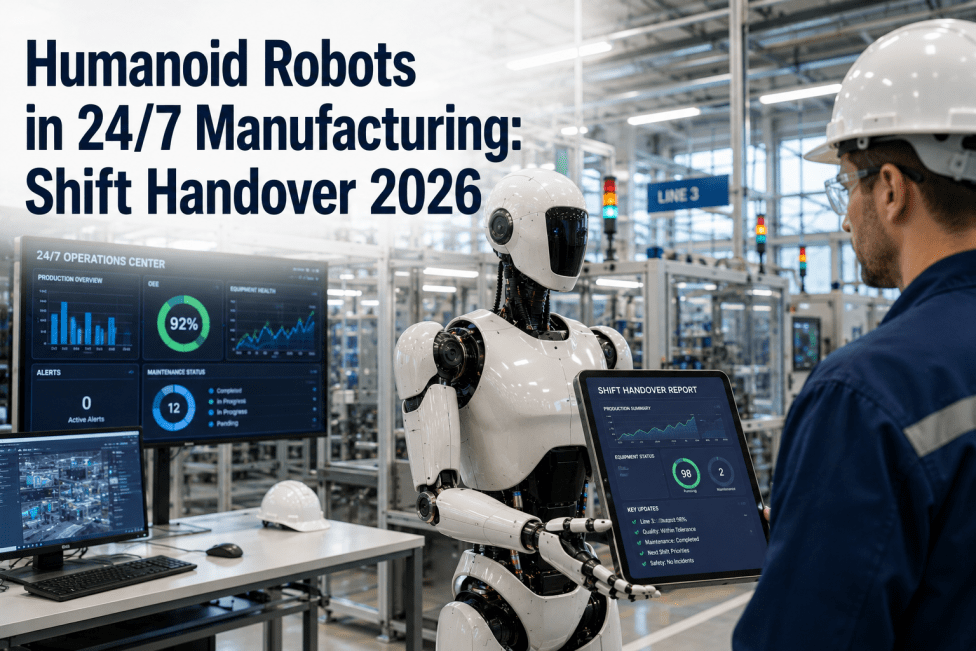
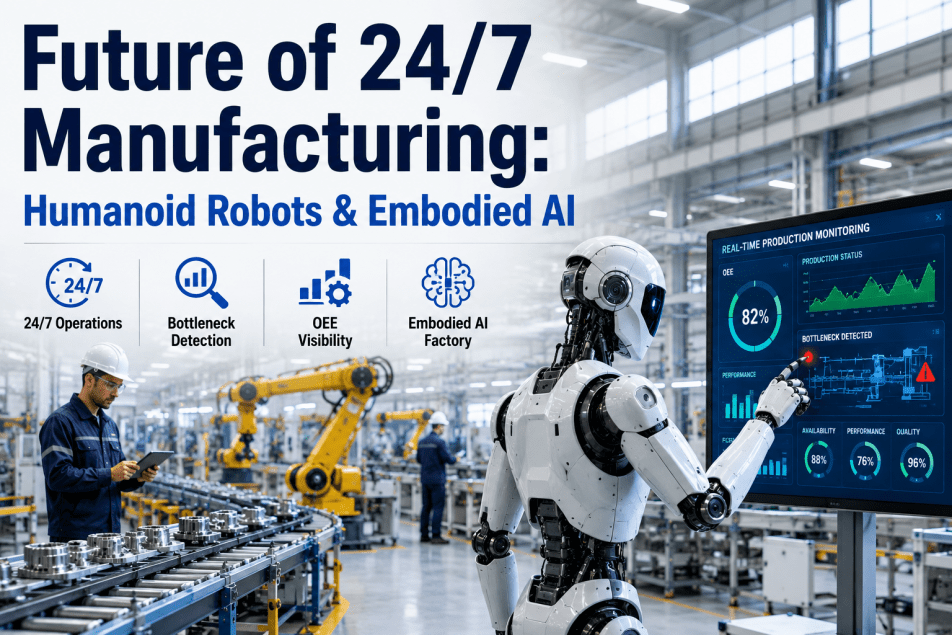
Humanoid and mobile robots capable of navigating unstructured factory environments generated significant attention in 2026, with Boston Dynamics, Hyundai, and Foxconn among the companies publicly deploying or piloting the technology. A Manufacturing Leadership Council survey found roughly 22 percent of manufacturers plan to use physical AI, including robotic dogs and humanoids, by 2027 — a meaningful minority, not yet a majority trend, and worth reading as a signal of where serious capital is heading rather than as evidence the technology has already crossed into mainstream deployment.
Digital Twins Shift From Monitoring Tool to Purchase Gate
The most concrete shift in digital twin adoption this year is not the technology itself — simulation has existed for years — it's the point in the buying process where it now sits. Industry coverage describes a "simulate-then-procure" pattern becoming standard: entire work cells are built and tested in a digital twin environment before a dollar is spent on physical equipment, rather than twins being deployed only after installation for ongoing monitoring.
This shift is reflected in the market sizing data tracking the category specifically. The chart below shows the projected growth trajectory for digital twin technology in sustainable manufacturing applications, illustrating both the scale of investment analysts expect and the multi-year window over which this shift from post-installation monitoring tool to pre-purchase decision gate is expected to mature across the industry.
A near-20 percent projected compound annual growth rate over eight years is a substantial trajectory for a category that many manufacturers still treat as a nice-to-have visualization tool rather than a core purchasing input. The gap between that market growth projection and current adoption maturity at any individual plant is worth checking directly — a digital twin market growing at this pace industry-wide doesn't guarantee any specific manufacturer's own simulation capability is mature enough to reliably de-risk a major capital decision yet.
Broad Industry Trends Don't Automatically Translate to Your Specific Floor
iFactory's solutions engineering team helps operations leaders separate which of 2026's manufacturing AI trends are genuinely ready to deploy at their plant from which ones remain further out than the coverage suggests.
Reshoring Reframes Automation as Necessity, Not Optimization
Rising tariffs, shipping costs, and overseas labor costs are consistently cited across 2026 industry coverage as the strongest current driver of U.S. manufacturing automation investment — not because reshored production is inherently more automatable, but because reshored facilities need to compete against overseas labor costs without the same labor pool, and automation is the primary lever available. Multiple sources place North American robot order value at approximately $2.25 billion in 2025, with 2026 described as the year pilots give way to full-scale deployment across a broadening range of industries beyond automation's traditional automotive stronghold.
"Dark Factories" Are Being Replaced by a More Honest "Dim" Framing
The fully lights-out, worker-free "dark factory" has been a recurring manufacturing narrative for decades, and 2026 coverage is notably more skeptical of the literal version of that vision than in prior hype cycles. Recent industry analysis explicitly argues the future factory isn't dark — it's "dim, autonomous, and safer" — with humans, cobots, autonomous systems, and AI agents operating within the same environment, and trust between humans and increasingly capable machines emerging as the actual limiting factor rather than robotic capability itself.
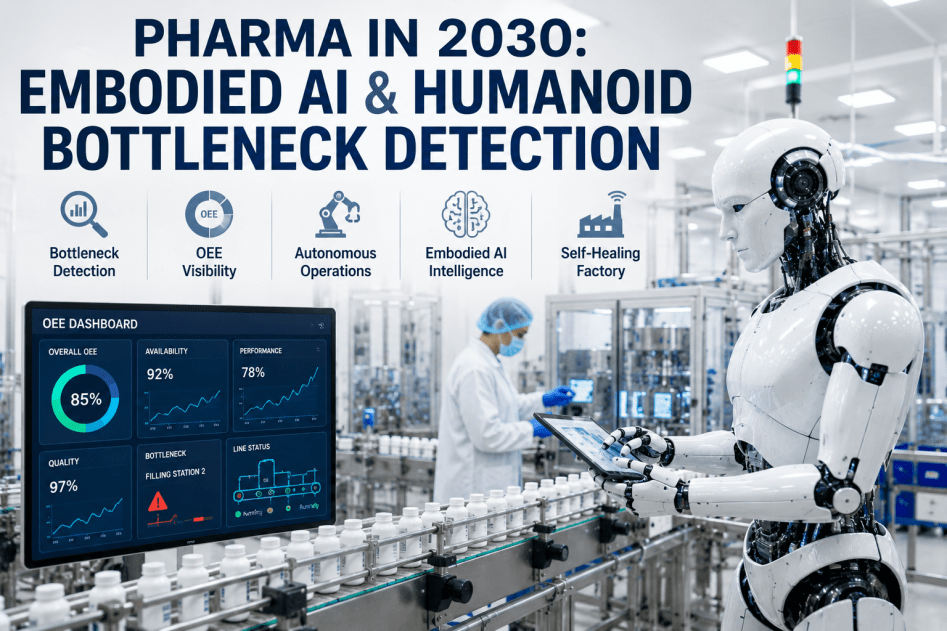
This distinction matters for an operations leader evaluating vendor claims. Fully autonomous, human-free production remains concentrated in narrow, highly controlled applications — some pharmaceutical and semiconductor environments are the most commonly cited examples — rather than representing a broad manufacturing trend. The more accurate and more broadly applicable 2026 pattern is deepening human-machine collaboration with a shrinking but still essential human oversight role, not the wholesale disappearance of factory workers that "dark factory" branding implies. A vendor pitch built around the literal dark-factory narrative is worth extra scrutiny in 2026, since the more careful industry coverage itself is actively pushing back against that framing.
Separating Signal From Noise Across These Five Trends
Reading across all five trends, a consistent pattern emerges: the manufacturers making genuine progress are not the ones chasing every headline simultaneously, but the ones matching trend adoption to a specific, measurable business problem and a realistic data readiness assessment. Three priorities separate that group from the broader field still evaluating which of these trends deserve real budget in 2026.
The pattern I'd flag for any operations leader reading the 2026 coverage is how consistently the most credible sources hedge their own headlines. Deloitte reports the fourfold agentic AI adoption jump and, in the same report, that only one in five manufacturers feel ready to scale it. Gartner talks up agentic AI's potential and projects 40 percent of those same projects get cancelled within a year. The industry isn't lying about the trend — it's genuinely happening — but the gap between "adoption is growing fast" and "this is working reliably at scale" is wider than most vendor pitches let on. The plants that avoid becoming a cancellation statistic are the ones that read past the headline number to the readiness caveat sitting right next to it, and then honestly assess whether their own data infrastructure matches what the caveat is actually describing.
Frequently Asked Questions
2026's AI Trends Are Real. Which Ones Fit Your Plant Is a Separate Question.
iFactory's solutions engineering team helps operations leaders assess data readiness against the specific trends most relevant to their operations — agentic maintenance, vision-guided quality, or digital twin simulation — before committing capital to a broad rollout.
.png)