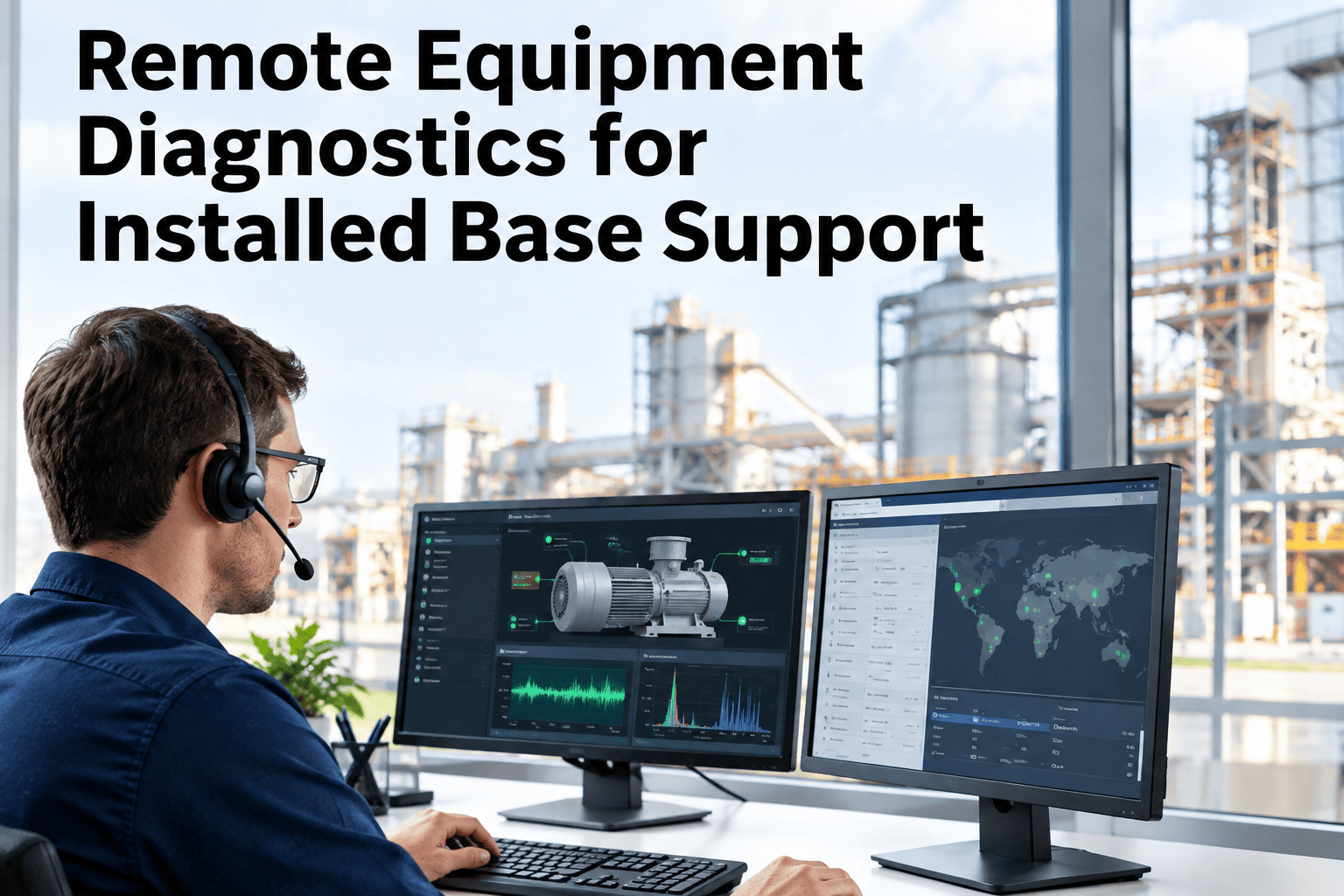
Dispatching a field engineer to read a fault code is one of the most expensive ways to gather a single piece of information, and in a distributed installed base it is also the default response when nobody has visibility into what the equipment is actually reporting. Remote equipment diagnostics connect fault codes, sensor readings, and telemetry from fielded machines back to a support team, so the simple cases can be resolved without a truck ever leaving the yard. Industry research on industrial equipment remote support puts the typical remote resolution rate at 40 to 58 percent once AI-guided diagnostics are in place, up from a baseline where most cases escalate by default (industrial remote-support research, 2026). iFactory, an on-premise AI platform with AI Assistant and connected-equipment monitoring built in, gives product support teams that visibility directly. Teams that want to see what share of their own dispatches could be resolved remotely can review a remote diagnostics setup with our team.
Remote Equipment Diagnostics · Installed Base Support, 2026
Most Simple Service Calls Can Be Resolved Before a Truck Leaves the Yard
iFactory AI reads fault codes and condition data from your installed base directly, so support engineers diagnose the issue before deciding whether a dispatch is even needed.
Without remote diagnostics
Call logged, symptoms described secondhand
Engineer dispatched on a guess
Wrong part on first visit, second trip scheduled
4–7 days total resolution time
With remote diagnostics
Fault code and telemetry read directly
Simple cases resolved without dispatch
When a visit is needed, correct part is known first
Hours, not days, for most cases
What changes
Why a Truck Roll Is the Most Expensive Diagnostic Tool
Every dispatch carries a fixed cost before a single wrench turns — travel time, the engineer's day, and the risk of arriving with the wrong part. Field-service research puts the average cost of an unnecessary truck roll around $850 once travel, labor, and lost productivity are counted (field-service cost research, 2026).
Resolved in minutes
A fault code or sensor pattern that matches a known failure signature can often be diagnosed and resolved remotely.
Pre-diagnosed dispatch
When a visit is genuinely required, the engineer arrives knowing the fault and the part, not guessing on arrival.
Escalation with evidence
Complex cases escalate with telemetry attached, instead of a secondhand description of symptoms.
What drives resolution rate
The Gap Between Reported and Actual Resolution
Without shared visibility into equipment data, support engineers escalate cases they could have resolved remotely simply because they cannot see what the field engineer would see on arrival.
Escalation rate, no remote visibility
42%
Remote resolution rate, with AI-guided diagnostics
58%
Log analysis time reduction
83%
Figures from industrial remote-support and field-service research, 2026, illustrative of typical ranges rather than a guaranteed outcome for any one installed base.
Connectivity
What Data a Remote Diagnostics Setup Actually Needs
| Data source | What it tells support | Typical connection |
|---|
| PLC/controller fault codes | What the machine itself reported at the moment of failure | OPC-UA, Modbus |
| Sensor telemetry | Vibration, temperature, pressure trends leading up to the event | MQTT, IoT gateway |
| Service history | Prior repairs and parts replaced on this specific unit | CMMS record |
| Installed base profile | Model, configuration, and firmware version | Asset record |
Find Out How Much of Your Current Dispatch Volume Is Avoidable
Share a sample of recent service calls and iFactory AI will show which ones a remote diagnostics setup would likely have resolved without a visit.
Security
Secure Remote Connection Does Not Mean Open Access
Product support managers are usually the ones who have to answer for connectivity risk, not just resolution speed. A workable setup keeps the connection narrow and auditable.
Read-only by default
Diagnostic connections pull data out; they do not write commands back to the equipment unless explicitly authorized.
Scoped per asset
Support engineers see the specific unit under investigation, not the entire customer network.
Logged sessions
Every remote session is time-stamped and tied to a service record for audit purposes.
Expert review
What a Product Support Manager Checks First
Remote diagnostics only pays off if the data reaching the support desk is good enough to make a real dispatch decision, not just a status light.
Verdict
Strong when fault codes and telemetry are both connected — fault codes alone miss slow-developing issues.
Watch for
Treating remote visibility as a replacement for field visits entirely — some failures still need hands on the machine.
Do next
Start with your highest-volume equipment family and connect PLC fault codes before adding sensor telemetry.
Frequently asked questions
What Support Teams Ask About Remote Diagnostics
What share of service calls can realistically be resolved remotely?
Industrial remote-support research puts typical remote resolution rates at 40 to 58 percent once AI-guided diagnostics and telemetry are connected, though the exact share depends on equipment type and failure mix (industrial remote-support research, 2026).
See an estimate for your installed base.
What equipment needs to be connected first?
Does remote access create a security risk for the customer's network?
How long does it take to see a reduction in truck rolls?
Most OEMs see measurable payback within 6 to 12 months once remote diagnostics are connected across a meaningful share of the installed base.
Discuss a rollout timeline.
Can remote diagnostics replace field engineers entirely?
No — the goal is resolving the simple, well-understood cases remotely so field engineers spend their time on the complex cases that genuinely need hands on the machine.
Talk through how this fits your team.
Stop sending an engineer to read a fault code
Connect Your Installed Base to Remote Diagnostics
Book a session with iFactory AI to see which of your equipment families are the best fit for remote diagnostics first.
{"@context":"https://schema.org","@type":"FAQPage","mainEntity":[
{"@type":"Question","name":"What share of service calls can realistically be resolved remotely?","acceptedAnswer":{"@type":"Answer","text":"Industrial remote-support research puts typical remote resolution rates at 40 to 58 percent once AI-guided diagnostics and telemetry are connected."}},
{"@type":"Question","name":"What equipment needs to be connected first?","acceptedAnswer":{"@type":"Answer","text":"Most programs start with the highest-volume equipment family, since that generates the fastest return on connecting PLC and sensor data."}},
{"@type":"Question","name":"Does remote access create a security risk for the customer's network?","acceptedAnswer":{"@type":"Answer","text":"A properly scoped setup is read-only by default, limited to the specific asset under investigation, and every session is logged."}},
{"@type":"Question","name":"How long does it take to see a reduction in truck rolls?","acceptedAnswer":{"@type":"Answer","text":"Most OEMs see measurable payback within 6 to 12 months once remote diagnostics are connected across a meaningful share of the installed base."}},
{"@type":"Question","name":"Can remote diagnostics replace field engineers entirely?","acceptedAnswer":{"@type":"Answer","text":"No, the goal is resolving the simple, well-understood cases remotely so field engineers spend their time on complex cases that need hands on the machine."}}
]}