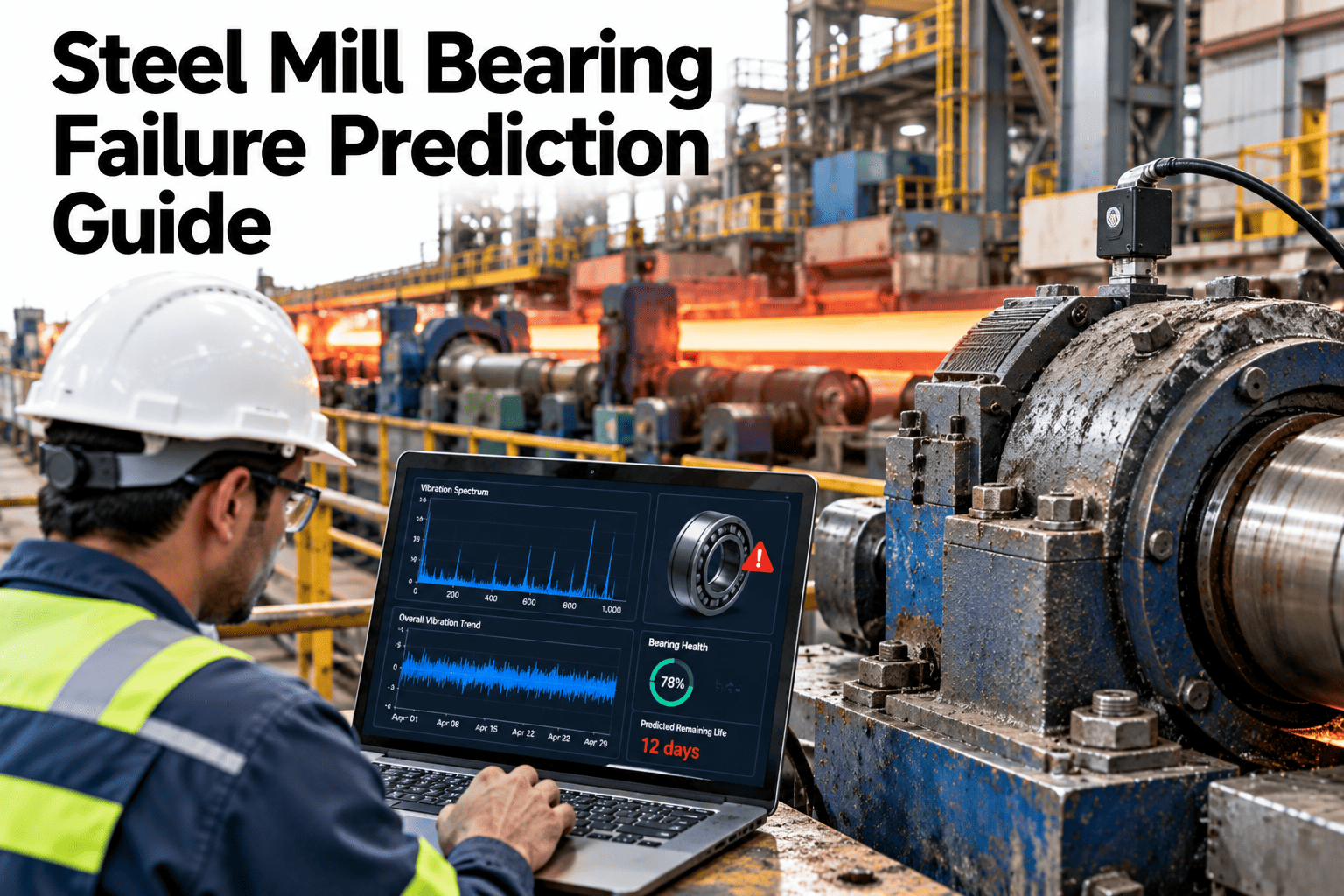
A rolling mill bearing rarely fails without warning. Weeks before the chock runs hot or the roll neck seizes, the bearing is broadcasting its condition through vibration frequencies, temperature drift, and oil contamination that accumulate in measurable patterns as the failure progresses through four distinct stages. The gap between detectable degradation and functional failure is where prediction earns its value — and where plants that monitor correctly convert an 18-hour emergency strip-down into a 6-hour planned roll change scheduled at the next available maintenance window. iFactory AI detects that degradation signal and connects it directly to a maintenance work order before the window closes. See how AI bearing failure prediction works on your rolling mill equipment.
Your Bearing Announced Its Failure Weeks Ago
The four degradation stages that separate a planned 6-hour roll change from an unplanned 18-hour emergency — and the AI signals that detect them early enough to act.
No vibration change visible
BPFO / BPFI appear in envelope
Sidebands visible
Temperature starting to rise
Housing running hot
Audible noise
Why Rolling Mill Bearings Are Hard to Keep Alive
No other bearing in a manufacturing plant endures the combination of forces a hot strip mill finishing stand backup roll bearing faces continuously — extreme load, thermal stress, water, and scale, all at once.
Bearings cannot be accessed for inspection while the mill is running, so manual monitoring is inherently periodic and late. By the time an operator hears or feels a problem, the bearing is already in Stage 3 or 4 — and the planning window has closed.
Emergency crew premium
Potential roll and housing damage
Delayed customer orders
Standard crew, no premium
No collateral damage risk
Orders unaffected
Reading the Bearing Failure Signatures
Four vibration frequency families define the complete bearing failure signature set for rolling mill bearings. Each corresponds to a different component of the bearing and a different failure mode.
| Frequency Signature | What It Detects | Failure Component | First Detection Stage |
|---|---|---|---|
| BPFO — Ball Pass Frequency, Outer Race | Outer race spalling or pitting | Outer race defect | Stage 1–2 (earliest, most common) |
| BPFI — Ball Pass Frequency, Inner Race | Inner race damage | Inner race defect | Stage 2 (sidebands with shaft frequency) |
| BSF — Ball Spin Frequency | Rolling element damage | Ball or roller defect | Stage 2–3 |
| FTF — Fundamental Train Frequency | Cage damage or lubrication failure | Cage defect | Stage 2–3 |
These frequencies are calculated from bearing geometry — number of rolling elements, pitch circle diameter, and contact angle — and are specific to each bearing type at each position on the mill. Monitoring requires load-normalized baselines, because rolling mills cycle between full rolling load and idle, and the vibration change between these states can look like a fault to simple threshold monitoring while being completely normal behavior.
The Four Signal Layers That Make Prediction Work
Vibration analysis is the primary signal, but reliable bearing failure prediction at rolling mills combines four data streams that each contribute information the others cannot provide alone.
Accelerometers at bearing housings detect defect frequency signatures up to several weeks before failure. Load-normalized models separate genuine defect signatures from load-change artifacts that trigger false alarms in simple threshold systems.
Bearing temperature rises as damage advances, but only significantly in Stage 3 and beyond. Temperature is a confirmation and progression signal, not an early detection signal. AI separates bearing heat from process heat by comparing against strip temperature and cooling water conditions simultaneously.
Particle count and morphology in oil samples detect bearing surface fatigue and contamination. While periodic sampling is slower than continuous vibration monitoring, oil analysis independently confirms what vibration suggests and reveals contamination-driven failure modes that vibration detects later.
Motor current signature analysis detects bearing degradation through load variation patterns visible in drive current, without requiring direct vibration access at the bearing location. Particularly useful for bearings in locations where accelerometer placement is physically constrained by the mill structure or temperature.
Bearing Types and Monitoring Priorities by Mill Position
Not all bearings on a rolling mill carry equal failure consequence. Monitoring investment should be proportional to the production impact of failure at each position.
| Bearing Position | Typical Bearing Type | Primary Failure Mode | Failure Impact | Monitoring Priority |
|---|---|---|---|---|
| Backup roll chock | Four-row cylindrical roller | Outer race spalling under high load | Full mill stop, potential roll damage | Highest |
| Work roll neck | Back-up roll type (smaller) | Fatigue spalling, contamination | Roll change required | High |
| Drive gearbox (pinion stand) | Cylindrical roller and thrust | Gear tooth fatigue, bearing damage | Stand shutdown, strip cobble risk | High |
| Motor drive end bearing | Cylindrical roller | Lubrication failure, overload | Drive outage | Medium |
| Entry/exit table rolls | Self-aligning roller | Contamination, misalignment | Table roll replacement | Lower — high quantity, low individual impact |
From Prediction to Planned Work Order
Bearing failure prediction is only valuable when it reliably triggers a maintenance action before the failure occurs. iFactory AI connects the bearing signal directly to the maintenance workflow.
Stop Your Next Rolling Mill Bearing Failure Before It Starts
iFactory AI detects bearing degradation 3–8 weeks before failure on hot strip mills and connects the signal directly to a maintenance work order. Book a session to see how it maps to your mill configuration.
Frequently Asked Questions
How far in advance can AI actually detect a rolling mill bearing failure?
Three to eight weeks for documented deployments, with BPFO outer race defects — the most common mode — typically giving five to seven weeks' notice at Stage 1 or 2. Discuss detection lead times for your specific bearing types.
Do we need to install new sensors on every bearing in the mill to get started?
No — a phased rollout starting with backup roll chock bearings and pinion stand gearboxes captures most of the risk reduction, and iFactory AI can integrate with sensors already installed. Get an assessment of your existing sensor coverage before deciding on new installations.
How does iFactory AI handle the load variation that causes false alarms on rolling mills?
Load-normalized baselines model separate normal-condition signatures for full rolling load and idle, so alerts stay sensitive to real defects without the false-alarm noise of a fixed threshold. See load normalization applied to your mill's operating profile.
What is the difference between overall vibration RMS monitoring and bearing defect frequency monitoring?
RMS only rises once damage reaches Stage 3–4, while defect-frequency envelope analysis isolates specific bearing-component signatures as early as Stage 1 or 2 — RMS alone isn't enough for early detection on rolling mills. Ask about the envelope analysis method used for your equipment.
Can iFactory AI predict failures on blast furnace blowers and other steel plant rotating equipment beyond rolling mill bearings?
Yes — the same vibration and temperature methods extend to blowers, induced draft fans, caster withdrawal drives, and reheat furnace fans, each with its own configured baseline. Walk through the full equipment coverage scope for your plant.
Convert Your Next Bearing Emergency into a Planned Repair
iFactory AI detects the four-stage bearing degradation signal at Stage 1 or 2 and gives your maintenance team weeks to plan the replacement. Book a walkthrough to see the detection framework applied to your rolling mill.