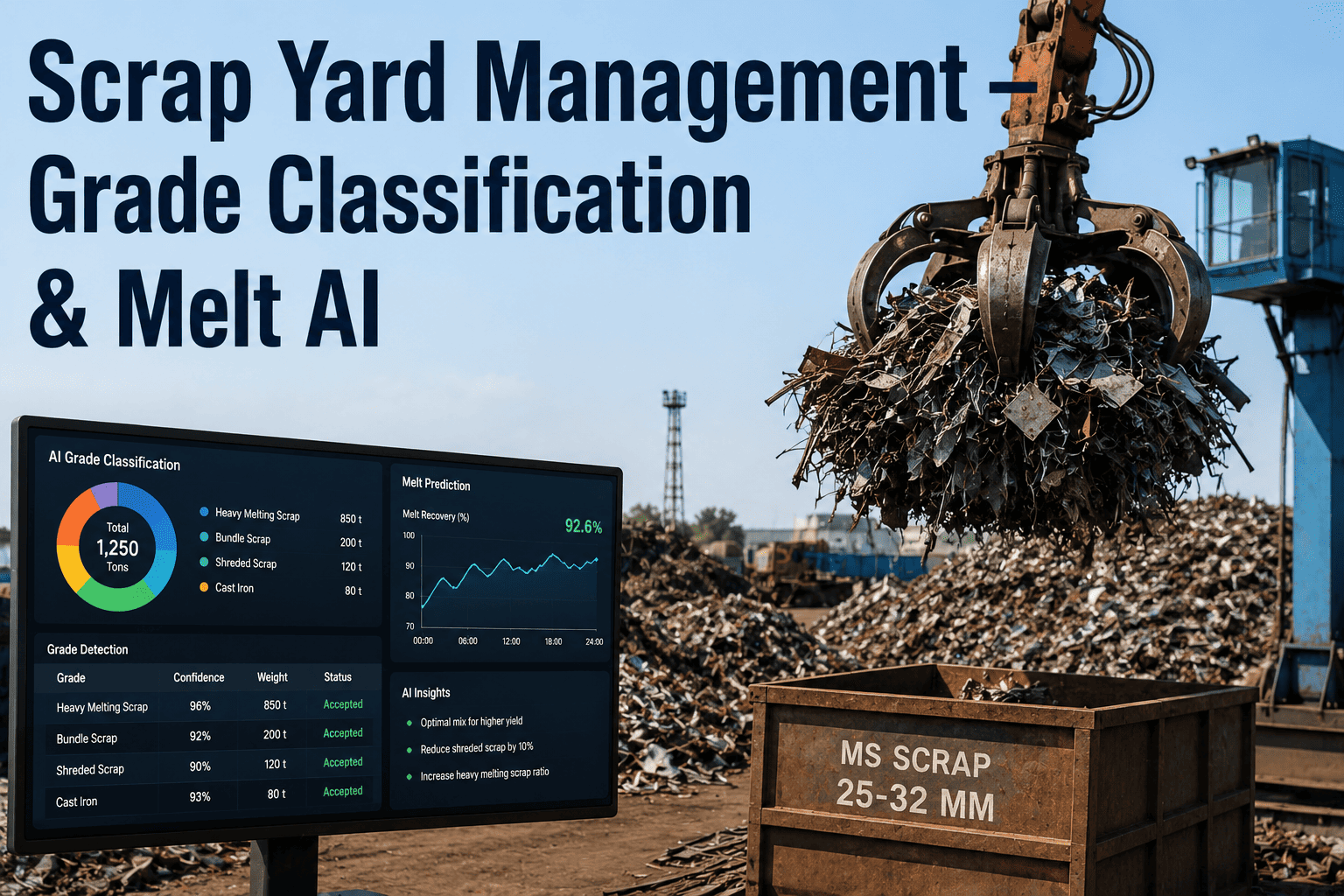
In the high-stakes environment of modern steelmaking, raw material costs represent up to 70% of total production expenses, with scrap being the most volatile and complex input. Traditional scrap yard management relies heavily on manual visual inspection, subjective grader judgment, and fragmented data systems, leading to inconsistent charge chemistries, costly over-specification, and missed opportunities for margin improvement. The integration of AI-driven image recognition and machine learning for scrap grade classification is revolutionizing how melt shops approach charge optimization, supplier quality assessment, and inventory management. By deploying computer vision systems that can analyze scrap loads in real time—identifying grade, estimating density, and predicting residual element content—steel producers can achieve unprecedented precision in meeting target chemistries while reducing procurement costs by 8 to 12 percent. This comprehensive guide explores the technical architecture, implementation strategies, and measurable outcomes of AI-powered scrap yard management, providing enterprise decision-makers with actionable insights to transform their raw material operations. Book a Demo to see how iFactory's solution can be tailored to your facility.
AI-Powered Scrap Grade Classification for Melt Shop Excellence
Reduce procurement costs 8–12% with real-time image recognition and charge optimization.
Transform Your Scrap Yard Today
Unlock hidden savings and improve melt quality with AI-driven classification.
The Economics of Scrap Yard Inefficiency
Steel mills globally grapple with the challenge of accurately classifying incoming scrap. A single misgraded load can shift chemistry away from target specifications, forcing costly additions of virgin iron units or alloying materials. Manual inspection, even by experienced graders, suffers from subjectivity and fatigue, leading to inconsistent quality assessments. The financial impact is substantial: a 1% error in scrap grade can translate to hundreds of thousands of dollars in annual losses for a medium-sized melt shop. Moreover, the inability to predict residual elements like copper, chromium, and nickel from visual inspection alone forces operators to either over-specify (paying premium for higher-grade scrap) or risk off-spec heats that require reallocation or downgrading. Advanced AI systems address these pain points by providing consistent, objective, and real-time classification that aligns procurement with production targets.
Hidden Costs of Traditional Grading
- Labor dependency: Grader availability and shift changes create bottlenecks in unloading.
- Inconsistent standards: Different graders assign varying grades to identical material.
- Delayed chemistry data: Laboratory analysis takes hours, too slow for real-time decisions.
- Supplier disputes: Lack of objective evidence leads to conflicts and renegotiations.
Technical Architecture of AI Scrap Classification
Image Acquisition & Preprocessing
High-resolution cameras positioned at unloading stations capture images of scrap piles from multiple angles. Lighting conditions are normalized using adaptive algorithms to ensure consistent input quality. Preprocessing includes segmentation to isolate individual scrap pieces and correction for perspective distortion.
Deep Learning Model Inference
Convolutional neural networks (CNNs) trained on thousands of labeled scrap images classify material into grades such as HMS 1, HMS 2, shredded, and busheling. Models also estimate density and predict residual element concentrations using transfer learning from metallurgical datasets.
Real-Time Integration
Classification results are fed into the yard management system (YMS) and melt shop execution system (MES) via API, enabling immediate charge adjustments. Alerts for off-grade material trigger re-routing or rejection workflows.
Continuous Learning Loop
The model improves over time by incorporating feedback from laboratory analysis and melt outcomes. Active learning techniques identify uncertain predictions for human review, refining accuracy with each cycle.
Step-by-Step Implementation Roadmap
Site Assessment & Camera Setup
Evaluate yard layout, lighting, and unloading processes to determine optimal camera positions. Install industrial-grade cameras with protective housings and network connectivity.
Data Collection & Model Training
Collect 10,000+ labeled images covering all scrap grades and conditions. Train custom CNN models using transfer learning, achieving >95% classification accuracy before deployment.
Integration with MES/YMS
Deploy API connectors to push real-time grade predictions into existing systems. Configure alerts for grade deviations and charge recipe adjustments.
Pilot & Validation
Run parallel operations for 30 days, comparing AI classifications with manual grades and lab results. Fine-tune model thresholds based on validation data.
Full Rollout & Continuous Improvement
Scale to all unloading stations, integrate supplier scorecards, and establish feedback loop for model retraining monthly.
Ready to Optimize Your Scrap Yard?
Achieve 8–12% cost reduction and improve melt quality with AI-driven classification.
Comparative Analysis: Traditional vs. AI Classification
| Metric | Traditional Manual | AI Image Recognition | Improvement |
|---|---|---|---|
| Classification Accuracy | 75–85% | 95–98% | +15% |
| Time per Load | 5–10 minutes | 30 seconds | 90% faster |
| Residual Element Prediction | Not available | ±0.05% Cu | New capability |
| Supplier Quality Score | Subjective | Objective, data-driven | Consistent |
| Annual Savings (500kT mill) | Baseline | $1.5M–$2.5M | 8–12% |
Real-World Impact: Steel Mill Case Study
Challenge
A 2 million ton per year EAF mill faced 12% of heats falling outside target chemistry due to inconsistent scrap grading. Procurement costs were 7% above benchmark.
Solution
Deployed AI classification at 4 unloading stations, integrated with existing MES. Model trained on 15,000 images across 10 scrap grades.
Results
Off-grade heats reduced to 2%. Procurement costs dropped 9.5%. Unloading throughput increased 25%. Supplier disputes decreased 70%.
ROI
Full system payback achieved in 8 months. Annual savings of $2.1M realized from cost reduction and quality improvement.
Deep Dive: Residual Element Prediction Using Computer Vision
One of the most transformative capabilities of AI scrap classification is the ability to predict residual element concentrations from visual features alone. Copper, chromium, nickel, and molybdenum are critical tramp elements that affect steel properties and must be tightly controlled. Traditional methods rely on expensive and time-consuming lab analysis, which cannot keep pace with real-time charging decisions. Modern computer vision models, trained on paired image-chemistry datasets, learn to correlate visual indicators such as surface oxidation, coating presence, and physical form with elemental composition. For example, heavily oxidized scrap tends to have higher copper content due to the presence of copper-bearing coatings. By integrating these predictions into the charge recipe calculation, melt shops can dynamically adjust the scrap mix to stay within target limits without over-specifying expensive low-residual grades. This capability alone can reduce alloy addition costs by 5–8% and improve product consistency.
Model Training Approach
- Collect paired image and XRF/spectrometer data for 5,000+ samples.
- Use multi-task learning to simultaneously predict grade, density, and residual elements.
- Apply data augmentation techniques to handle varying lighting and pile configurations.
- Validate predictions against lab results with a target RMSE of <0.03% for Cu.
Supplier Quality Management with Objective Data
Automated Grading Reports
Every load receives an AI-generated grade certificate with confidence scores and residual predictions. Reports are automatically shared with suppliers via portal.
Scorecard Analytics
Track supplier performance over time based on grade consistency, residual levels, and load variation. Identify top performers and negotiate better terms.
Dispute Resolution
Objective image-based evidence eliminates he-said-she-said conflicts. Suppliers can view classification images and accept adjustments without arbitration.
Dynamic Pricing Models
Link payment to actual grade and residual content, incentivizing suppliers to deliver consistent, high-quality scrap. Reduce premium for over-specification.
Frequently Asked Questions
How does AI scrap classification handle mixed loads with multiple grades?
Advanced computer vision models are trained to detect and classify individual pieces within a pile, generating a composition report that estimates the percentage of each grade present. The system uses instance segmentation to identify distinct scrap items and assigns a grade to each, then aggregates the results to provide a weighted average for the entire load. This granularity allows melt shops to precisely calculate the effective chemistry of a mixed load and adjust the charge recipe accordingly. For example, a load containing 60% HMS 1 and 40% shredded can be accurately characterized, enabling the optimizer to use lower-cost shredded scrap without exceeding residual limits. The model continuously improves as it encounters new combinations, and operators can review segmented images for verification. Book a Demo to see mixed-load classification in action.
What is the typical accuracy of residual element prediction from images?
Our models achieve a root mean square error (RMSE) of less than 0.03% for copper and 0.04% for chromium when validated against laboratory XRF analysis. Accuracy is highest for common tramp elements like Cu, Cr, and Ni, which have strong visual correlations with surface conditions and physical form. For elements like tin or molybdenum, which are present in lower concentrations and lack distinct visual signatures, prediction accuracy is lower but still useful for trend detection. The model provides confidence intervals for every prediction, allowing operators to decide when to rely on the AI estimate versus requesting a lab confirmation. Continuous retraining with new data further improves accuracy over time. Contact support for detailed validation reports.
How long does it take to implement an AI scrap classification system?
A typical implementation timeline is 12 to 16 weeks from initial site assessment to full production deployment. Phase 1 (weeks 1–4) involves site evaluation, camera installation, and network setup. Phase 2 (weeks 5–8) focuses on data collection and model training, during which we capture at least 10,000 labeled images covering all scrap grades encountered at the facility. Phase 3 (weeks 9–12) includes integration with existing MES/YMS, user training, and a two-week parallel validation run. Phase 4 (weeks 13–16) is the full rollout and establishment of continuous improvement processes. The timeline can be accelerated if the facility already has high-resolution cameras and digital infrastructure in place. Book a Demo to discuss your specific timeline.
Can the system integrate with my existing scrap yard management software?
Yes, the AI classification platform is designed with open APIs and supports integration with major MES (e.g., Siemens, Rockwell), YMS (e.g., Sert, Konecranes), and ERP systems (e.g., SAP, Oracle). We provide RESTful web services that push classification results in real-time, as well as a webhook mechanism for event-driven updates. For legacy systems without API support, we offer a middleware adapter that can read from and write to databases directly. The integration layer is configurable to match your data schema and workflow requirements. Our team works closely with your IT department to ensure seamless data flow and minimal disruption. Get support for integration planning.
What is the ROI timeline for an AI scrap classification investment?
Based on deployments across multiple steel mills, the typical payback period is 6 to 12 months. The primary drivers of ROI are reduction in scrap procurement costs (8–12%), decrease in off-grade heats (from 10–15% to under 3%), and increased unloading throughput (20–30%). For a mill processing 500,000 tons of scrap annually, these improvements translate to $1.5M to $2.5M in annual savings. Additional benefits include reduced alloy addition costs (5–8%), lower dispute resolution overhead, and improved supplier relationships. The total cost of ownership includes hardware (cameras, computing), software licensing, and ongoing model maintenance, which is typically less than 20% of the annual savings. Book a Demo to get a customized ROI analysis for your facility.
Transform Your Scrap Yard Operations
Achieve 8–12% cost reduction, improve melt quality, and gain a competitive edge with AI-driven scrap classification.