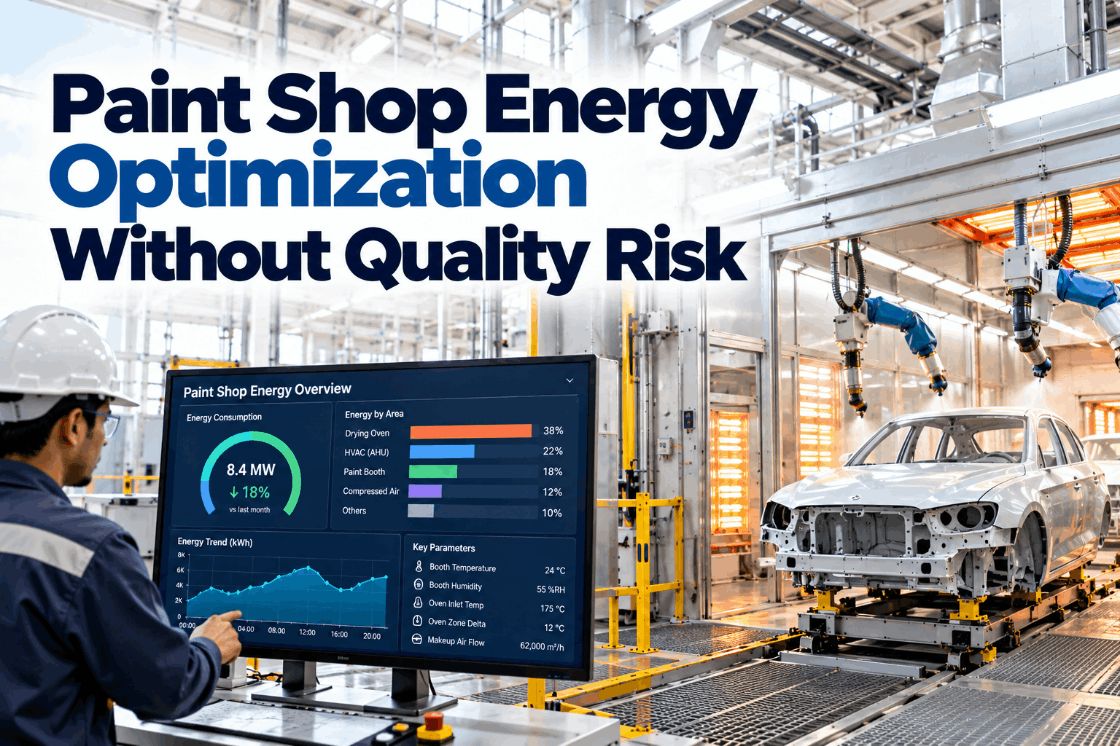
The paint shop is where an automotive plant spends most of its energy and where it can least afford a quality mistake. Booths must hold temperature and humidity inside a narrow window, ovens must cure every body fully, and airflow must keep dirt off wet paint. Cutting energy carelessly shows up as orange peel, dirt inclusions, under-cure and rework, which quickly costs more than the energy saved. This guide explains where paint shop energy goes, which quality limits must never move, the levers leading OEMs use, how to cut idle energy safely and how to prove that finish quality held. To see paint shop energy tracked alongside quality, book a short walkthrough.
Paint Shop Energy Optimization Without Quality Risk: Cut kWh per Vehicle, Keep the Finish
Booth air, ovens and pretreatment run to real demand, with every change checked against temperature, humidity, cure and rework so finish quality never pays for the saving.
Why Paint Shop Energy Is So Large and So Sensitive
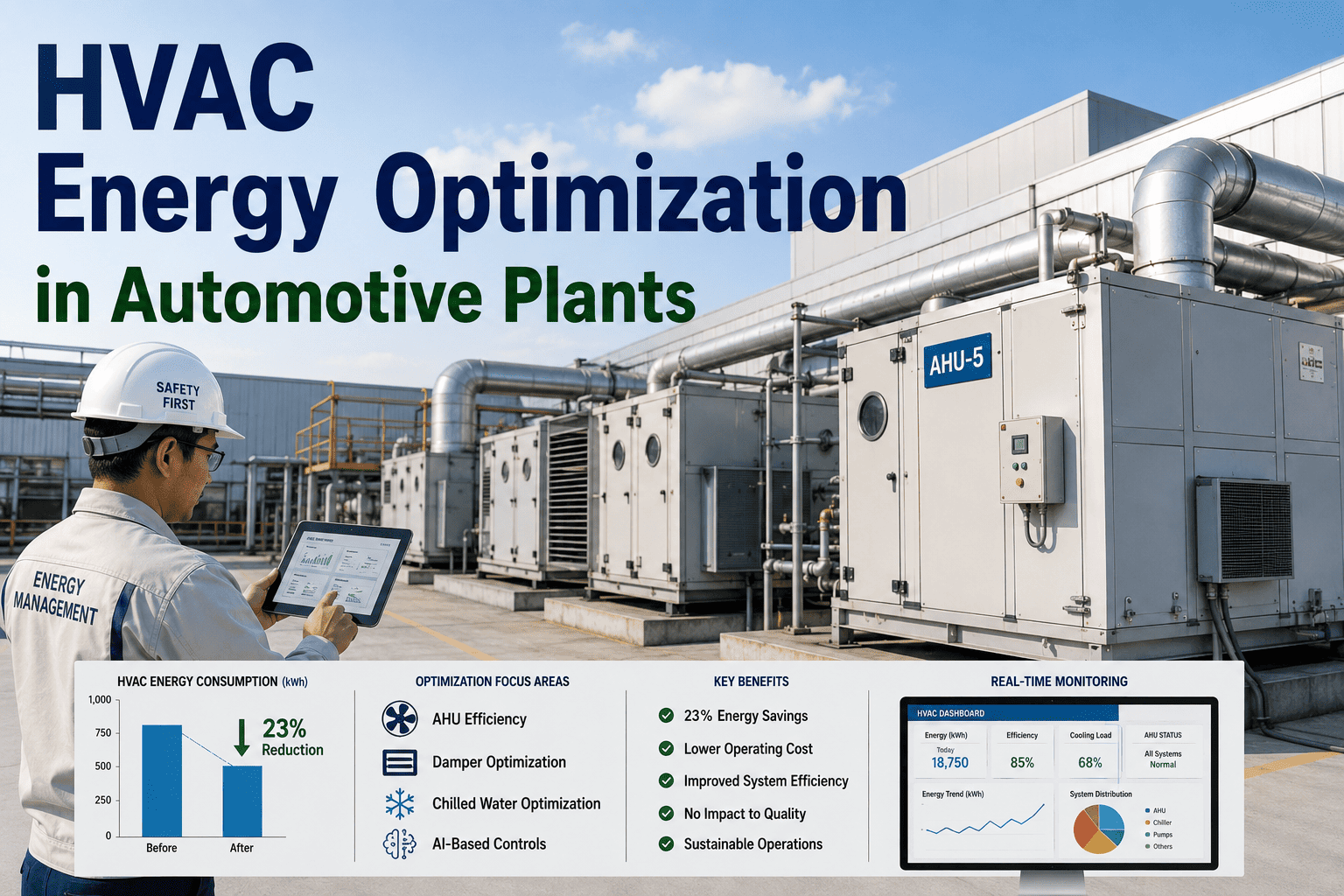
A paint shop conditions huge volumes of air, heats bodies in long ovens and keeps heated baths running for pretreatment and electrocoat. Automotive Manufacturing Solutions reports that paint shops account for 45–70% of the energy needed to build a car, with an electrical load of roughly 8–10 MW and booth fans alone drawing up to about 4 MW. Stellantis reports that its paint shops use around 60% of plant natural gas, 50% of electricity, 55% of water and 65% of plant CO2 emissions.
That concentration makes the paint shop the obvious target for energy savings. It also makes it the riskiest. The same air handling that drives energy use protects the finish from dust and keeps paint flowing properly. The same ovens that burn gas decide whether coatings are fully cured. A careless change can cost more in rework and warranty than it saves in energy.
A note on the numbers: published shares vary with plant design, climate and how the boundary is drawn. Ranges from around 45% to 70% of production energy are the best-supported figures, so this guide uses them rather than a single headline.
The goal is to cut energy while keeping every quality limit in place. We can review your paint shop energy profile on a call.
Paint Shop Processes and Their Energy Drivers
Each process has its own energy drivers and its own quality constraints.
Booth air and ovens together usually dominate. That is why air volume, recirculation and oven exhaust rates are where most large savings come from, and why they need the most careful quality checks.
Sub-metering each process makes the drivers visible. We identify metering gaps during a site review.
The Quality Limits That Must Never Move
Every energy measure must respect limits set by the paint supplier and the plant’s own process specifications. These limits act as guardrails.
| Parameter | Why it matters | Guardrail approach |
|---|---|---|
| Booth temperature | Paint viscosity, flow and flash-off | Stay within the paint supplier window at all times during painting |
| Booth humidity | Waterborne paint drying and appearance | Stay within the supplier window; standby only when no bodies are painted |
| Booth downdraft velocity | Overspray removal and dirt control | Hold design velocity during painting |
| Oven time at temperature | Full cure of coatings | Verify with oven data loggers after any profile change |
| Booth pressure balance | Keeps dust out of painting zones | Monitor continuously, alarm on deviation |
| Film build and appearance | Customer-visible quality | Track rework and appearance scores before and after each change |
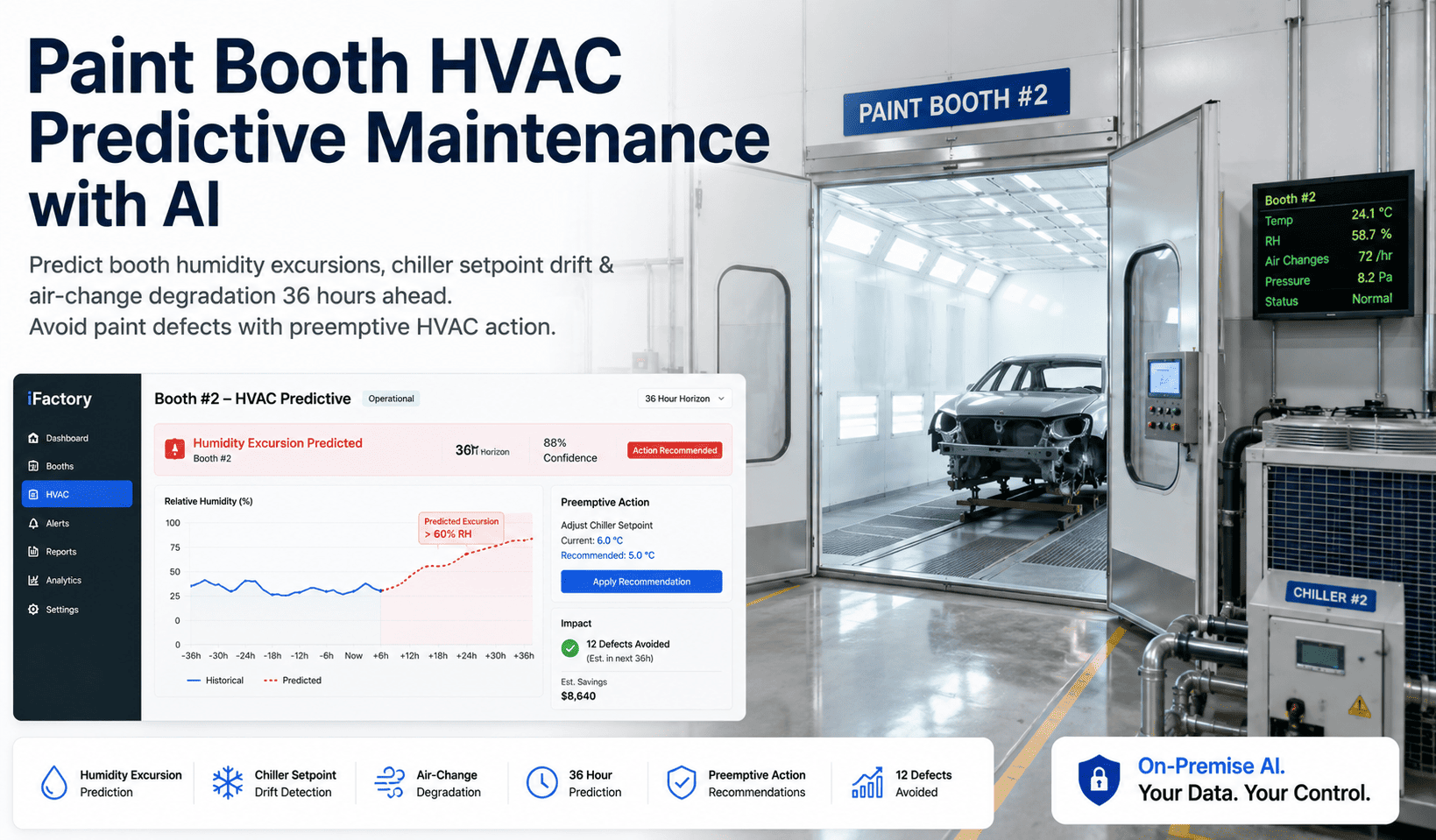
Standby modes act only when no body is being painted. Recirculation changes keep downdraft velocity and air quality within limits. Oven changes are validated with data loggers on bodies, not just oven air temperatures.
Plants that treat these guardrails as fixed find that energy projects gain trust quickly. Paint engineers are far more willing to try changes when they know the limits will not be crossed and that any drift will trigger an alarm before it reaches a body.
Writing these guardrails down before any energy change is the single most important step. Our engineers help define them with your paint team.
Energy Levers Leading OEMs Use
Paint shop energy savings come from a handful of proven levers.
Reduce booth air and oven heat when no bodies are present, with tested restart sequences.
Dry separation systems allow a larger share of booth air to be recirculated instead of fully conditioned.
Recover heat from exhaust to preheat air or water.
Match fan and pump speed to demand instead of throttling.
Wet-on-wet processes remove primer ovens and booths; Stellantis reports up to 30% less energy for a four-wet process.
Fewer gaps between bodies and larger colour blocks reduce idle and purge losses.
Automotive Manufacturing Solutions reports that software-based optimization alone can save around 5–10% of paint shop energy, and that variable speed drives can cut fan energy by up to 70% where fans previously ran at constant speed. Process changes such as compact paint lines deliver larger savings but need capital and requalification.
Scheduling is the lever most often overlooked. Gaps in body flow leave booths conditioned and ovens hot for nothing, and short colour runs add purge losses. Better sequencing upstream can reduce paint shop energy without any change to the equipment itself.
The right mix depends on your equipment age and layout. Discuss options with our specialists.
Cutting Idle Energy Safely
Paint shops spend many hours with no bodies: breaks, shift changes, gaps in body flow and weekends. Idle energy can be cut sharply if restart is managed.
Illustrative. Standby power depends on fan curves and the restart time your booth needs to return within limits.
Automotive Manufacturing Solutions describes controlled standby reducing idle consumption from around 60% of normal operation to around 20%. The practical constraint is restart time: the booth must be back inside its temperature, humidity and downdraft window before the next body arrives.
Measuring actual restart time is essential. Many booths recover faster than operators assume, which allows standby to be used in shorter gaps. Where recovery is slow, standby can still be used for longer breaks and weekends while shorter gaps are left alone.
Linking standby to the body tracking system makes it automatic. See it working in a demo.
Manual Versus Data-Driven Paint Energy Control
The difference between guesswork and managed optimization shows in daily operation.
- Booths run at full flow whenever the shift is on
- Ovens held hot through breaks
- Energy seen only on the monthly bill
- Changes tried without quality tracking
- Savings lost when people change
- Paint team wary of energy projects
- Booth flow linked to bodies present
- Ovens set back within restart limits
- kWh per vehicle tracked daily
- Every change checked against rework and appearance
- Controls built into automation
- Paint team owns the guardrails
The most important difference is trust. When the paint team sees that energy measures never breach quality limits and that rework is tracked, they support further steps instead of resisting them.
That trust is built with evidence, one measure at a time. Our team can show how the evidence is tracked.
Paint Shop Energy Checklist
Use this checklist to organize paint shop energy work.
Most plants find standby and fan speed control give the quickest results. Plan them in a paint review.
What Paint Shop Energy Optimization Is Worth
Because the paint shop is so large, even modest percentage savings are significant.
Stellantis offers a public benchmark: it reported a 27% reduction in paint shop energy compared with 2021, a target average of 321 kWh per vehicle across its paint shops by 2025 and 245 kWh per vehicle at its Gliwice plant. Every plant starts from a different baseline, but those figures show what focused work can achieve.
Carbon matters as much as cost for many OEMs. With the paint shop carrying a large share of plant emissions, paint energy work is often the fastest route to meeting published climate targets.
A review of your paint shop data usually shows where the first savings are. Book one with our advisors.
How iFactory Delivers Paint Shop Energy Optimization
Paint shop kWh tracked daily and normalized.
Temperature, humidity, downdraft and cure watched live.
Booth and oven standby linked to body tracking.
Conditions verified before the next body arrives.
Rework and appearance compared before and after.
Verified savings and carbon for management.
It works with your booth controls, oven PLCs, meters and MES. Share a month of paint shop data and we will show your idle energy in a session.
Find the Idle Energy in Your Paint Shop
Share a month of booth, oven and energy data. We map idle energy, check it against your quality guardrails and show the savings that are safe to take.
Booth air is conditioned at full flow for 35 minutes after the last body. Reducing to standby flow after 5 minutes keeps conditions within the paint window.
A Standby Change Checked Against Quality
This exchange shows how a paint shop engineer might use iFactory.
iFactory ships as a pre-configured NVIDIA AI server, racked and ready with the paint shop energy and quality analytics models loaded. Rack it, plug in power and Ethernet, and the AI is live on your network. Our scope covers sensors and data connections across paint booths, ovens, pretreatment and utilities, PLC/SCADA, MES, CMMS and ERP integration, cabling and network setup, operator and quality team training, and 24×7 remote monitoring.
Server installed, PLC, MES and ERP links live, historical production, quality and maintenance data loaded.
Models calibrated on your own lines, then run in advisory mode on one line or area with your planners and engineers reviewing every output.
Rollout to the agreed lines under your change management, planner, supervisor and engineer training, and 24×7 remote monitoring in place.
Software, server and integration come as one package. For pricing on your plant, contact our sales team.
Frequently Asked Questions
Automotive Manufacturing Solutions reports paint shops account for 45–70% of the energy needed for car production, with typical electrical loads around 8–10 MW.
Booth air supply units and curing ovens, followed by pretreatment, electrocoat and exhaust abatement.
By defining quality guardrails first, then applying standby, recirculation, drives and heat recovery only within those limits, and tracking rework and appearance for every change.
A mode that reduces booth air flow and conditioning when no bodies are being painted, with a tested restart sequence that returns conditions within limits before the next body.
Stellantis reported a 2025 target average of 321 kWh per vehicle across its paint shops, with its Gliwice plant at 245 kWh per vehicle.
A first booth or oven can typically be tracked and optimized within a 6–12 week rollout. Plan it with our engineers.
Lower Paint Shop kWh per Vehicle and Keep the Finish
iFactory links paint shop energy to booth conditions, oven cure and rework, so every saving is taken within quality guardrails and proven on real bodies.
Illustrative. Each step is checked against finish quality and rework before it stays.