A plant can hit every internal capacity target and still miss the ship date, because the bottleneck was never on the floor — it was three tiers up, at a vendor who ran out of a critical alloy and never told anyone until the PO was already late. Capacity planning that stops at the plant fence is only half the picture. Coordinated capacity planning pulls supplier lead times, material availability, and vendor throughput into the same view as internal scheduling, so a shortage shows up as a flag weeks before it becomes a missed order. This is what that looks like in practice, and how a coordinated capacity model gets built around your existing supplier network.
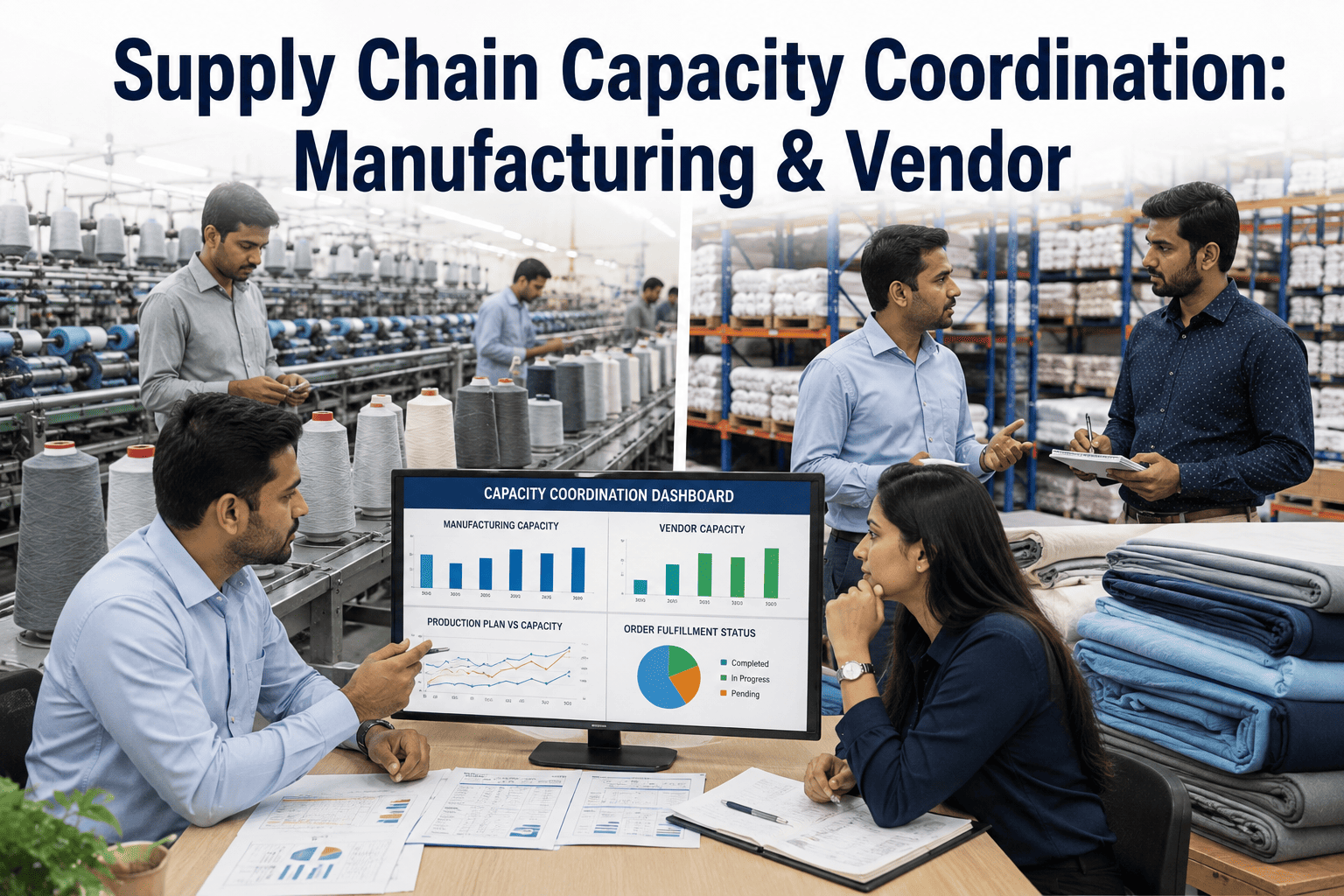
Supply Chain Capacity Coordination: Aligning Vendor Capacity With Your Production Plan
Most capacity plans assume the supply chain will simply deliver. Coordinated capacity planning treats supplier capacity, material availability, and your own schedule as one connected system — so disruptions get caught while there is still time to act, not after a line is already stopped waiting on a part that should have shipped two weeks ago.
The approach applies whether you are running continuous steel operations, batch food and beverage lines, automotive assembly, or textile production — anywhere internal capacity depends on a chain of upstream suppliers whose own constraints rarely get modeled into the plan.
The Coordination Gap — Why Internal Capacity Plans Keep Getting Blindsided
Most manufacturers plan capacity as if their own four walls were the whole system. Machine hours, labor shifts, and changeover time all get modeled carefully. Then a tier-one supplier's furnace goes down, or a resin allocation gets tightened, and the plan that looked solid on Monday is unworkable by Thursday. The problem is not forecasting skill — it is that the forecast has no visibility past the loading dock.
This gap shows up differently depending on the vertical, but the underlying pattern repeats everywhere. A steel producer discovers a scrap or alloy shortage only when the charge cannot be made up as scheduled. A food and beverage plant finds out an ingredient allocation was cut only when the receiving dock flags a short shipment against a production run already staged. An automotive supplier learns a tier-two component is delayed only after the line has already started and a just-in-time buffer runs dry. In every case, the information existed somewhere upstream days or weeks earlier — it simply never reached the people building the schedule.
Supplier Capacity Is a Black Box
Purchase orders get confirmed, but the supplier's own capacity utilization, backlog, and competing customer demand stay invisible until a delivery slips. By the time the delay is known, there is rarely enough runway to source an alternative, requalify a backup vendor, or adjust the production sequence without a schedule impact.
Material Windows Shift Without Notice
Raw material availability changes weekly on volatile commodities, but most plants only find out when a scheduled receipt does not arrive. Production plans built on assumed material timing collapse the moment reality diverges from the PO date, and the ripple effect usually touches several work orders at once, not just the one directly waiting on that material.
Planning Cadences Don't Match
Internal S&OP might run weekly while a key supplier reviews capacity monthly. The mismatch means your plan is always working from someone else's stale snapshot, even when everyone is acting in good faith.
No Shared Source of Truth
Email threads, spreadsheets, and phone calls carry the actual coordination work. None of it is structured, none of it is searchable, and none of it feeds back into the production schedule automatically.
The Four Pillars of Coordinated Capacity Planning
Closing the coordination gap does not mean renegotiating every vendor contract. It means building four connected capabilities that turn supplier data from a once-a-quarter phone call into a live input on your production plan. None of the four require replacing your ERP, your MES, or the relationships your purchasing team has already built — they layer coordination on top of what exists rather than starting over.
Supplier Capacity Visibility
A shared portal or API feed where key suppliers report current utilization, open backlog, and committed lead time — updated on a cadence that matches your planning cycle, not theirs, so the data your planners see is never more stale than the decisions being made on top of it.
Material Availability Tracking
Live inbound material status tied to specific work orders, so a delayed shipment automatically flags every downstream job that depends on it instead of surfacing as a surprise on the floor.
Collaborative Planning Cadence
A structured review rhythm with top-tier vendors that aligns their capacity outlook with your production calendar, replacing ad hoc calls with a repeatable, documented cycle.
Synchronized Buffer Strategy
Safety stock and capacity buffers sized against actual supplier risk data rather than a flat rule of thumb, so working capital is not tied up protecting against risks that no longer exist, while genuinely volatile suppliers get the larger buffer they actually need.
Want to see which of the four pillars would move the needle first for your supplier base? Book a capacity coordination assessment and iFactory will map it against your current vendor mix.
Spreadsheet Coordination vs Connected Capacity Visibility
Nearly every plant already does some version of supply chain coordination — it just lives in spreadsheets, inboxes, and someone's memory of last quarter's call. That version works fine until the person holding the knowledge is unavailable, or until two teams are working from two different versions of the same spreadsheet without realizing it. The table below shows what changes when that coordination moves onto a connected platform instead, using the same underlying activities a planning team already performs today.
| Capability | Spreadsheet & Email Coordination | Connected Capacity Platform |
|---|---|---|
| Supplier capacity updates | Manual, requested reactively | Live feed, refreshed automatically |
| Material shortage detection | Discovered at receiving dock | Flagged 3-6 weeks ahead |
| Impact on production schedule | Traced manually, job by job | Auto-linked to affected work orders |
| Planning cadence with vendors | Ad hoc, inconsistent | Structured, calendar-driven reviews |
| Buffer stock sizing | Flat rule of thumb | Risk-weighted by supplier data |
| Audit trail for delays | Scattered across email | Single timestamped record |
| Handover when a planner is out | Knowledge lost or delayed | Continuous, documented history |
The gap between the two columns is rarely a technology limitation — most of the underlying data already exists somewhere in a supplier's system or a purchasing inbox. What changes is whether that data reaches the production schedule automatically or depends on someone remembering to ask for it at the right moment.
Six Signals Your Plant Already Has a Coordination Problem
Most operations teams do not decide one day to build supplier coordination — they get pushed into it after enough near-misses. The signals below usually show up well before the disruption that finally forces the conversation, and recognizing them early is what turns this into a planned project instead of a reaction to a crisis.
Expedite freight keeps climbing
A rising expedite freight bill is usually the clearest financial signal that shortages are being discovered too late to solve with normal shipping lanes.
Planners rebuild the schedule weekly
If the production schedule gets meaningfully reworked every week because of a late material or component, the plan is reacting to supply chain surprises rather than anticipating them.
Safety stock keeps growing everywhere
Buffer stock that expands uniformly across every SKU, rather than being concentrated where real supplier risk exists, is a sign the plant is buying insurance against uncertainty instead of managing it.
Supplier status lives in someone's inbox
When the only record of a supplier commitment is an email thread with one buyer, that information disappears the moment that person is out of office or leaves the role.
Disruptions repeat with the same vendors
If the same two or three suppliers keep causing schedule risk quarter after quarter, that is a strong candidate list for the first tier of coordinated visibility.
Customer service dates keep slipping
When on-time delivery to your own customers is missed for reasons that trace back to a vendor delay rather than an internal capacity issue, the coordination gap has already reached the customer.
Every Uncoordinated Supplier Is a Schedule Risk You Haven't Priced Yet
iFactory connects supplier capacity data, material availability, and your production schedule into one live view — so a shortage three weeks out shows up as a flag, not a fire drill. Built around your existing vendor network, no rip-and-replace required.
How Coordinated Capacity Planning Actually Gets Rolled Out
Plants that succeed with supply chain capacity coordination do not try to onboard every vendor on day one. They start with the suppliers that carry the most schedule risk, prove the model, then expand. The typical rollout looks like this, and most plants move through it over a single quarter rather than a multi-year program.
Rank Suppliers by Schedule Risk
Identify the handful of vendors whose delays have historically caused the most downstream disruption. This is usually 15-20 percent of suppliers driving the majority of past schedule risk, and the ranking often surprises teams once it is based on data rather than gut feel.
Establish a Shared Data Feed
Set up capacity and material availability reporting with those priority vendors, whether through a portal, EDI feed, or API — matched to a cadence your planning team can actually act on.
Link Supplier Data to Work Orders
Connect incoming material status directly to the jobs that depend on it, so a delay automatically surfaces which orders are at risk instead of requiring someone to trace it manually.
Run a Joint Planning Cadence
Introduce a recurring review with priority suppliers that aligns their capacity outlook with your production calendar, replacing one-off calls with a structured cycle.
Expand and Re-Size Buffers
Once the model is proven with priority vendors, extend it to the broader supplier base and re-size safety stock against real risk data rather than historical guesswork, freeing up working capital that was previously locked into blanket buffer policies.
What Changes When Everyone Is Working From the Same Plan
Coordination does not just prevent fire drills — it changes how planning teams spend their time. Instead of chasing status updates, they spend their week acting on flagged risks that still have runway attached. Over a few quarters, the shift tends to show up in four measurable places across the business.
Fewer Late-Stage Schedule Rewrites
With material and capacity risk visible weeks out, production schedules stop getting rebuilt at the last minute — planners adjust early, when options still exist.
Less Expedite Freight, More Lead Time
Early warning on shortages means alternative sourcing or adjusted scheduling can happen before expedite shipping becomes the only option left.
Buffer Stock Sized to Actual Risk
Safety stock stops being a flat percentage applied everywhere and starts reflecting which suppliers genuinely carry delivery risk, freeing up working capital elsewhere.
Coordination Instead of Escalation
Structured planning cadences replace crisis phone calls, which tends to improve the working relationship with vendors as much as it improves schedule reliability.
None of these outcomes require a perfect rollout. Even partial visibility into a handful of high-risk suppliers tends to surface the first avoidable disruption within weeks, which is usually enough to secure budget and internal buy-in for expanding the program further.
Frequently Asked Questions
Do we need every supplier connected for this to work?
No. Most plants see the majority of benefit from connecting a priority tier of 15-20 percent of suppliers — the ones with the largest historical impact on schedule risk. Starting narrow lets the planning team prove the model, build internal confidence in the data, and refine the review cadence before expanding coverage to the broader vendor base. Trying to onboard every supplier at once usually stalls the project rather than accelerating it. Our team can help you identify which vendors belong in that first tier based on your past disruption history and delivery performance data.
How is this different from a standard S&OP process?
S&OP typically aligns internal demand and supply plans on a monthly cycle, and it usually treats supplier capacity as an input someone gathers ahead of the meeting rather than something monitored continuously. Capacity coordination extends that same discipline outward to suppliers, with a data feed and review cadence that catches disruptions between S&OP cycles rather than waiting for the next monthly meeting to surface them. The two work well together — coordination feeds fresher, more current supplier data into the same S&OP process you already run.
What if our suppliers won't share capacity data?
Most reluctance comes from suppliers not having an easy way to share it, not unwillingness. A lightweight portal or simple structured form usually gets adoption where a request for raw ERP access does not, because it asks for a status update rather than system access. For strategic vendors, capacity visibility is increasingly becoming a standard part of the commercial relationship rather than a special ask, especially with suppliers who already report similar data to other customers.
Can this integrate with our existing ERP and planning tools?
Yes. Supplier and material data connects into the same schedule your ERP or APS already manages, so work orders show risk flags in the tools your planners already use daily. There is no separate system for the team to check — coordination data feeds directly into the existing planning workflow, and the integration is built around your current systems rather than requiring a parallel platform for planners to maintain.
How long does it take to see results?
Plants connecting their top-risk suppliers typically see the first meaningful catch — a shortage flagged with real lead time to act on it — within the first four to eight weeks. Full buffer re-sizing and freight savings tend to show up over a full quarter as more disruption data accumulates. To scope a realistic timeline for your supplier base, book a 30-minute assessment.
Stop Finding Out About Shortages at the Receiving Dock
iFactory builds coordinated capacity visibility around the suppliers that matter most to your schedule — connected to the production plan you already run, with no rip-and-replace required. Start with your highest-risk vendors and prove it before you scale it.