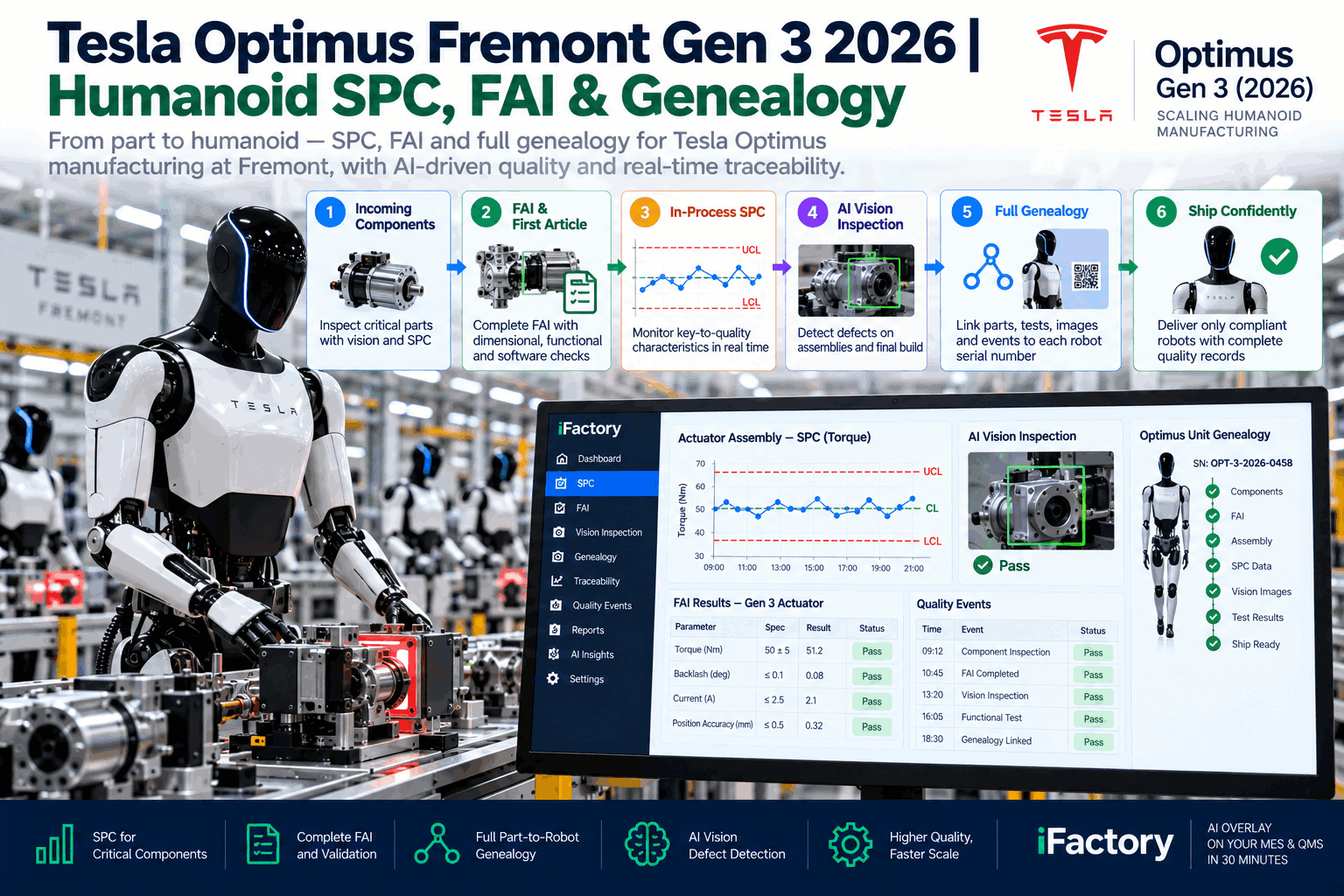
7:42 a.m. inside a Fremont-style cell, a humanoid finishes an insertion cycle, the vision system flags a low-confidence pick, and the next unit is already on its way. If the affected part keeps moving while someone reviews the signal later, the plant just created hold lag on top of a robot that was supposed to make the line more responsive. That is the real 2026 question for automotive quality: not whether the humanoid works, but whether release discipline keeps pace when the cell changes faster than the quality system reacts. iFactory AI overlays inspection, SPC, holds, CAPA, and genealogy beside MES and QMS so humanoid automation stays inside a controlled release envelope. Book a 30-minute closed-loop walkthrough.
Humanoid automation adds flexibility. It does not remove the need for first article inspection, statistical process control, quarantine, CAPA, or lot and VIN genealogy before ship.
Why This Refresh Matters
Tesla Optimus in a Fremont production context gets attention because it signals scale, automation depth, and a shift in how manufacturers may staff and route work. The high-intent question for 2026 planning is not whether the robot can perform tasks. It is whether the plant can keep quality control intact when the cell is changing, learning, and interacting with real production variation.
For automotive quality leaders, the control logic remains the same even if the cell is more flexible: humanoid automation does not replace control plans, FAI, SPC, or genealogy. It makes the quality system more important because the process now has more ways to drift, more conditions to monitor, and more opportunities for hold lag if the response is manual or delayed.
In a Fremont-style environment, every affected unit still needs a defined path — detect, quarantine or hold, CAPA, verify, genealogy. That closed-loop structure is where iFactory AI fits, overlaid beside MES and QMS so automation does not outrun the quality record.
Humanoid Cell — The Quality-Relevant Capability View
The market narrative around Tesla Optimus Gen 3 focuses on dexterity, scale, and the possibility of humanoids operating in live manufacturing. Vendor-reported commentary and industrial reporting suggest the next phase of humanoid adoption is not just demo footage — it is operational deployment. That matters because an operational robot cell introduces quality-control demands that are easy to underestimate.
A humanoid robot inside a production line is not a substitute for manufacturing controls. It is another process element subject to incoming part variation, software drift, task variation, fixture and tool wear, missed picks and placement errors, sensor misreads, line-side changeovers, and undocumented exception handling. The more flexible the cell becomes, the more the plant must preserve statistical discipline. In automotive, that still means SPC, FAI, layered checks, containment, and genealogy.
Hype vs Non-Negotiables: What Cannot Be Allowed to Slip
This is the core quality question for humanoid deployment planning — what cannot be allowed to slip just because the process is more automated? The hype frame and the reality frame diverge on almost every point, and the reality frame is what your audit and your recall containment will rest on.
- Robots learn tasks autonomously
- Automation reduces inspection burden
- AI can self-correct quality issues
- Human oversight becomes optional
- Traceability can be handled by the robot vendor
- First article inspection remains mandatory
- SPC still governs variation
- Out-of-control conditions must trigger holds
- Lot and VIN genealogy preserved before ship
- Release authority stays inside the quality system
The first unit, first shift, first tool change, first software revision, and first material lot still require release discipline. FAI confirms the process is producing what engineering intended.
AI may detect anomalies faster, but it does not remove the need for control charts, limits, reaction plans, and documented responses to out-of-control conditions.
Detection without containment is not quality control. Signals outside limits should move affected parts to quarantine or hold until disposition is complete — including adjacent lots.
Lot, batch, serial, VIN, cell version, operator, and inspection state must be preserved. This is what protects ship authorization, warranty defense, and recall containment.
Book a walkthrough of the closed-loop overlay for a humanoid cell — how iFactory sits beside the systems of record instead of replacing them.
Why Humanoid Cells Expand Variation Paths
Humanoid automation adds flexibility, but flexibility expands variation paths. In a conventional fixed automation line, variation is often localized. In a humanoid cell, the system may be doing more tasks across more product conditions — which means more sources of instability, more places where drift can hide, and more moments where a fast response matters.
When the control surface expands, quality teams need faster containment and clearer release rules. The practical answer is not less inspection. It is smarter inspection plus stronger workflow discipline — detect nonconformance in-line, hold affected material immediately, route to CAPA with full evidence, verify corrective action effectiveness, and preserve genealogy for the full chain of custody.
iFactory AI Role — Overlay Quality Beside MES and QMS
iFactory AI is not positioned as a replacement for MES, QMS, control plans, or core manufacturing execution. It overlays them with the practical layer quality teams need to act fast. For an Optimus-style manufacturing environment, iFactory AI helps create the closed loop between detection and release across five connected roles.
AI vision, process signals, and SPC thresholds identify defects, anomalies, or drift in real time.
Affected parts, lots, or assemblies are placed on hold automatically when process rules are violated.
Structured corrective action workflows launch with image evidence, root-cause notes, and accountability.
Follow-up inspection and process data confirm the corrective action worked before release resumes.
The issue is linked to the exact lot, serial, VIN, cell, timestamp, and process state — auditable end to end.
Practical Deployment Guidance for Fremont-Style Robot Cells
Here is the shortest version of what good looks like — eight phases that keep humanoid automation inside a controlled quality envelope instead of running ahead of it.
Document the task, part family, expected variation, and the limits that separate normal operation from a signal that requires action.
Automation does not own quality release by itself. Named roles hold the release authority for each release decision.
Not just at program start — FAI is required after tooling changes, software retraining, end-effector changes, and material lot changes.
Detect variation before defects escape. Reaction plans define who acts when a signal moves out of control.
No informal decisions to let it run. Affected material moves to quarantine and downstream use is blocked until disposition.
Every suspect lot and VIN must be traceable. The suspect chain resolves to a single, auditable record before any release consideration.
Verify the fix with data. The verification step is the evidence that separates a documented miss from a controlled disposition.
Use AI to accelerate the loop, not to replace the record. iFactory sits beside your systems of record, not in place of them.
Manual Review vs Automated Hold and Release Workflow
Legacy quality review often depends on emails, spreadsheets, and a supervisor remembering to escalate a signal before the next batch moves. That approach can work in a low-complexity environment, but it becomes fragile when humanoid cells generate more data, more exceptions, and more release pressure.
- Email escalation after the shift
- Spreadsheets tracked by one person
- Supervisor memory of pending signals
- Delayed hold decisions
- Reconciled evidence after the fact
- Weak genealogy on suspect lots
- Signal freezes affected material immediately
- CAPA path opens with owner and due date
- Evidence attaches to the lot record
- Verification routes before release authority
- Genealogy preserved for every disposition
- Audit trail visible in one place
An automated hold and release workflow does not eliminate judgment. It makes judgment actionable. That is a better fit for 2026 deployment planning because it matches the speed of robotic line SPC without loosening quality discipline.
What Automotive Quality Teams Should Ask About a Humanoid Cell
For Tesla Optimus Fremont-type deployments, automotive quality and advanced manufacturing engineers should ask practical questions. If the answer to any of these is that it will be reviewed later, the line is exposed — and the risk shows up first as hold lag, then as containment burden, then as a shipment issue.
- What are the control plan triggers for robot-induced variation?
- Are FAI gates required after software changes, tool changes, or end-effector replacements?
- How are SPC limits defined for robot-performed operations?
- What happens automatically when a measurement goes out of control?
- Are suspect parts quarantined by lot, serial, or VIN immediately?
- Can genealogy trace the exact robot version and inspection state before ship?
- Is release authority tied to verified CAPA closure?
- Is the process aligned to MES and QMS, or running in a separate data silo?
What a Useful 30-Minute Demo Looks Like
A useful demo stays close to the plant reality. In 30 minutes, you should see how iFactory AI handles the full closed loop without turning quality into another disconnected dashboard — signal to hold to CAPA to verification to release, connected to MES and QMS instead of duplicating it.
Industrial Edge AI as Market Context
A useful market pattern is emerging across industrial AI inspection programs. Vendor-reported market context associates industrial edge AI visual inspection with improved commissioning speed and quality signal quality. Those vendor-reported outcomes matter because they show how AI gets adopted in production — AI augments inspection and SPC, supports faster deployment and better signal quality, and helps reduce waste and variation, but does not replace control plans, FAI, or formal release discipline.
The same logic applies to humanoid cells. If a robot can move faster, the plant still needs the control plan that defines the expected process, the FAI that proves first-off conformity, the SPC that detects drift, the genealogy that limits exposure, and the CAPA loop that prevents recurrence. In other words, industrial AI can scale quality — but only when it is wired into the quality system, not used as a shortcut around it.
Frequently Asked Questions
No. Humanoid robots may improve speed and flexibility, but SPC is still required to monitor variation, detect drift, and trigger reaction plans. The signal is what protects the shipment gate.
Because the robot is part of the process, not a substitute for process validation. FAI confirms the first-off product meets engineering intent after changes or startup conditions — including software retraining and tool changes.
Affected parts should be quarantined or held immediately, then routed through CAPA and verification before any release decision. Detection without containment is not quality control.
Genealogy ensures the plant can trace which lots, VINs, or serials were affected, which process version ran, and what inspection or disposition cleared the product. It is the backbone of ship authorization, warranty defense, and recall containment.
iFactory AI overlays the quality execution layer beside MES and QMS so detection, holds, CAPA, verification, and genealogy happen in a closed loop instead of disconnected tools. Your systems of record stay in place — the overlay makes them faster.
FAI. SPC. Quarantine. CAPA. Genealogy. When those five pieces work as one closed loop, humanoid automation delivers speed without giving up release discipline.


.png)