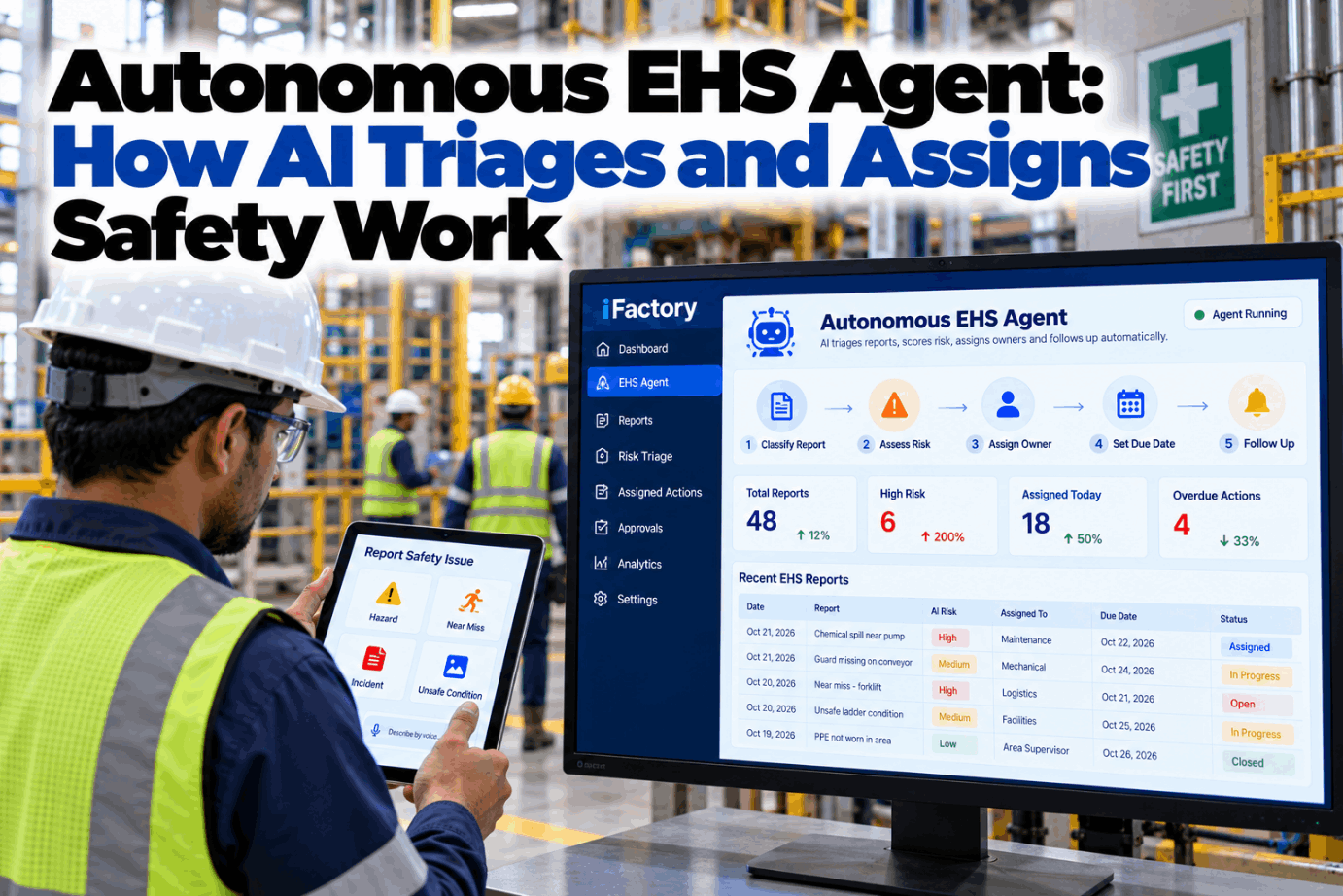
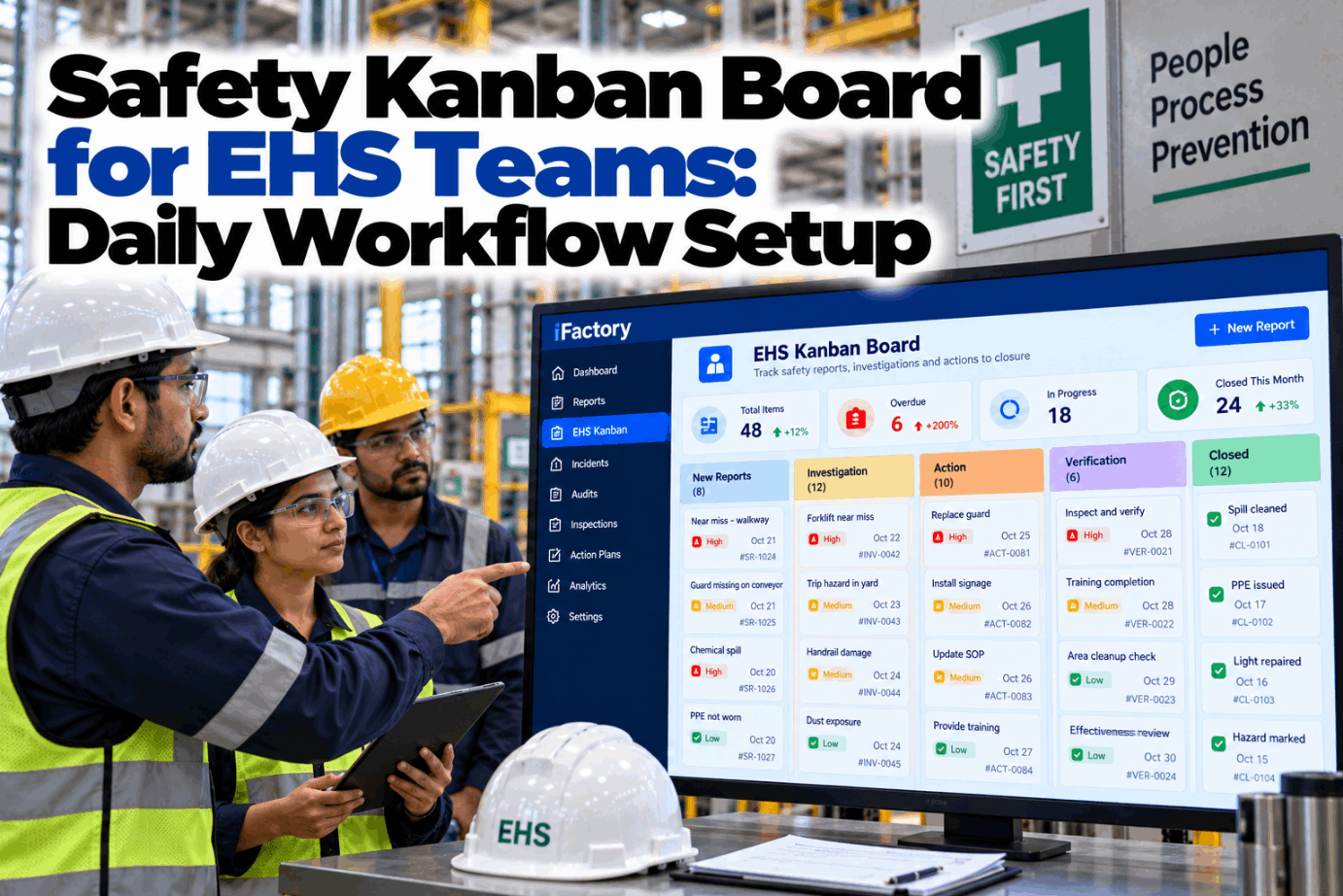
Every EHS inbox fills up the same way: near misses, hazard observations, first aid logs, the odd spill and a few damaged racks, all arriving on different forms at different hours. Someone has to read each one, decide how serious it is, find the right owner and chase the actions that slip. An autonomous EHS agent does that sorting and chasing, and leaves the judgment calls with your safety team. See it handle a real week of reports in a short EHS agent demo.
AUTONOMOUS AGENT · EHS TRIAGE
An EHS Agent That Sorts, Assigns and Chases, While Your Safety Team Decides
The iFactory EHS Agent classifies every report, scores the risk, proposes an owner and due date, and escalates critical actions that go overdue. Each step is logged with its reasoning for review.
EHS agent · new reportDraft triage
06:52 · Aisle 4 by the press shop · voice report
"Forklift reversed out of aisle 4 with no spotter. Missed a walker by about a metre."
TypeNear miss
Risk scoreL3 × S4 = 12 · High
Proposed ownerLogistics supervisor
Proposed dueInterim control today, fix in 14 days
WHAT LANDS IN THE INBOX
Six Report Types, Six Different First Moves
An EHS agent is not a smarter form. It is software that works through several steps toward a goal, inside limits you set. The first step is knowing what kind of report it is holding, because each type starts a different chain of work and some start a legal clock. A near miss needs an owner. A possible recordable injury needs a case file and a person to judge it. A spill may need an immediate phone call. Walk through your own report mix with our EHS support team.
Near missScores the credible worst outcome and routes it to the area owner.No external clock
Hazard observationLinks it to a location or asset and checks for open duplicates first.Duplicate check
First aidRecords the care given and watches for later treatment that changes the case.Watch for change
Possible recordableOpens a case file, gathers the facts and flags EHS for a determination.7-day log clock
Environmental spillCaptures substance and amount, checks your reportable list and pages EHS.Immediate notice check
Property damageRoutes the repair to maintenance and asks whether anyone was exposed.Dual-tag check
SAFETY TRIAGE AI
Risk Scoring on the Matrix You Already Use
The agent should score risk the way your team already does, not invent a new scheme. Most plants use a likelihood by severity matrix, often 5 × 5. The agent reads the report, the photo, the location history and similar past events, then proposes a score and explains it. In the hero example, two earlier forklift reports in the same aisle raise likelihood to 3, and a pedestrian struck by a forklift could be seriously hurt, so severity is 4. The bands below are an example. Load your own matrix during a configuration session.
Severity
5
5
10
15
20
25
4
4
8
12
16
20
3
3
6
9
12
15
2
2
4
6
8
10
1
1
2
3
4
5
1
2
3
4
5
Likelihood
Low 1–4
Medium 5–9
High 10–16
Critical 20–25
OWNER AND DUE DATE PROPOSALS
Who Owns It and By When, Proposed in Seconds
Finding the right owner is often the slowest part of triage. The agent uses three lookups: the area map (who owns aisle 4), the asset register (who maintains the press), and the report type (spills go to the environmental lead). It then proposes a due date from the risk band. The policy below is an example, not a standard. For high and critical items a person approves before anything is routed. Ask our support team to map your own routing rules.
Question Any Proposal Before You Approve It
Every type, score, owner and due date arrives with the reasoning behind it. EHS managers can ask the agent why, change the proposal in one step and approve. Every edit is kept in the log.
Report NM-1184 · EHS manager and agent
EHS managerWhy logistics and not the press shop supervisor?
AgentAisle 4 is a logistics zone on the area map, and the forklift belongs to the logistics fleet. The press shop supervisor is copied because the walker was his operator.
EHS managerMake it 10 days, not 14.
AgentDone. Due date set to 10 days, approved by you at 07:10. Interim control check is due by end of shift.
AUTONOMOUS EHS AGENT FOR PLANT MANAGERS
An Escalation Ladder for Overdue Critical Actions
Most actions that go overdue are not refused. They are forgotten under production pressure. The agent watches every open action and climbs a ladder you define when a high or critical one passes its due date. At each step it first checks whether an interim control is in place, because a late permanent fix with a working barrier is a different risk from a late fix with nothing. It never extends a due date itself. Set up your own ladder in an escalation planning call.
Due date
Owner remindedHazard summary, photo and interim control status sent to the owner+1 day
Owner's manager copiedRequest for a revised date with a reason, or proof of completion+3 days
Plant and EHS managersItem flagged on the plant dashboard with days overdue and exposure+5 days
Daily meeting agendaStanding item until closed, with interim control checked in the field
HUMAN APPROVAL IN SAFETY
Six Decisions That Always Stay With People
Some EHS decisions carry legal weight or affect a person's job and health. The agent can gather facts, start the clock and alert the right person, but it does not make these calls. Under 29 CFR 1904.39, a work-related fatality must be reported to OSHA within 8 hours, and an in-patient hospitalization, amputation or loss of an eye within 24 hours. Under 1904.29, a recordable case must be entered on the OSHA 300 Log within seven calendar days. Review these limits with our EHS specialists.
RecordabilityWhether a case meets the 1904.7 criteria, such as medical treatment beyond first aid, days away or restricted work. The agent lists the facts; EHS decides.
Severe injury reportsThe 8-hour and 24-hour OSHA reports. The agent starts a visible countdown and pages the on-call EHS lead, who makes the report.
Release notificationsReleases at or above a reportable quantity must be reported immediately under EPCRA and CERCLA. A responsible person calls.
Return to workRestrictions, transfers and return dates are agreed with the injured person, medical providers and HR.
DisciplineNever inferred from reports. 1904.35 bars retaliation against employees for reporting injuries or illnesses.
Closing critical actionsA person checks the fix in the field before a high or critical action is closed as effective.
REASONING LOGS
One Report, Every Step on the Record
When an auditor, an investigator or your own team asks why a report was handled the way it was, the answer should take one click. The agent writes a log entry for every step: what it saw, what it decided, why, and what a person did next. Human edits are kept, not overwritten, which also shows where the agent needs tuning. Here is the full trail for the forklift near miss. See a live trail in a log walkthrough.
06:52
ReceivedVoice report and photo from aisle 4, sent by a press shop operator.Why: sender is a registered handheld on the press shop team
06:52
Classified as near missNo injury, no damage, a person in the path of moving equipment.Why: "missed a walker" describes exposure without contact
06:53
Scored 12, HighLikelihood 3, severity 4 on the plant matrix.Why: 2 similar aisle 4 reports in 30 days; forklift contact could seriously injure
06:53
Owner and due date proposedLogistics supervisor, interim control today, fix in 14 days.Why: aisle 4 is a logistics zone; high band policy is 14 days
07:10
Approved with an editEHS manager kept the owner and shortened the due date to 10 days.Human change recorded against the proposal
AUTONOMOUS EHS AGENT COST AND ROI
A Worked Example: One Week of EHS Reports
The clearest value is EHS workload reduction: hours that move from sorting and chasing to time on the floor. Every input below is assumed for illustration, so replace each one with your own figures. Injury costs are left out on purpose, because a prevented injury can't be counted honestly in advance. Our team can help you build the case from your own report history.
Assumed weekly volume · one plant80 reports
Near misses34
Hazard observations28
First aid cases9
Property damage6
Environmental spills2
Possible recordables1
Manual triage per report, assumed12 min × 80 = 960 min = 16 h
Review and approve per report with the agent, assumed3 min × 80 = 240 min = 4 h
Triage time moved per week16 h − 4 h = 12 h
Chasing overdue actions, before and after, assumed3 h − 1 h = 2 h
Total per week, then over 48 working weeks14 h per week · 14 × 48 = 672 h per year
AUTONOMOUS EHS AGENT IMPLEMENTATION GUIDE
Best Practices for a Safe Start
Agentic AI projects fail more often from weak scoping than from weak models. Gartner predicts that over 40% of agentic AI projects will be canceled by the end of 2027, citing rising costs, unclear business value and inadequate risk controls. The pairs below are the habits that keep an EHS agent useful and trusted. Plan your first site with our EHS agent team.
✓Run shadow triage on one site and compare the agent's calls with your team's
×Switch on automatic routing everywhere on day one
✓Write down what the agent may do alone, draft only, or never touch
×Let its scope grow informally after go-live
✓Load your existing risk matrix, routing map and due date policy
×Introduce a new scoring scheme people must relearn
✓Track override rate, time to owner and overdue critical actions
×Judge success by report count alone
✓Tell every reporter what happened to their report
×Let the agent become a black box for the shop floor
TURNKEY AI DEPLOYMENT
EHS Agent, Connectors and AI Server Delivered Together
iFactory delivers the EHS Agent as a turnkey bundle. A pre-configured NVIDIA AI server ships racked and ready with the agent, report intake and reasoning log pre-loaded, so injury and incident data stays on site. You rack it, plug in power and Ethernet, and the AI is live. To scope it for your plant, request a turnkey quote.
What's Included
- Pre-configured NVIDIA AI edge server, racked and ready
- Report intake by handheld, voice, QR code and web form
- Your risk matrix, area map and routing rules loaded
- Owner and due date proposals with approval steps
- Escalation ladder for overdue high and critical actions
- Reasoning log for every step, with human edits kept
- 24×7 remote monitoring of the agent and hardware
Live in 6–12 weeks
Wk 1–4
Install and Load
Server installed, intake channels connected, matrix, area map and routing rules loaded.
Wk 5–8
Shadow Triage
The agent proposes type, score and owner while EHS triages as usual and compares.
Wk 9–12
Go-Live and Training
Approvals and escalation switched on, supervisors trained, baseline KPIs recorded.
HOW iFACTORY FITS
EHS Automation That Keeps Your Team in Charge
The iFactory EHS Agent takes on the sorting and chasing so your safety team can spend more time where the hazards are. Our support team can walk you through a pilot plan.
1
Classifies every report. Near misses, hazards, first aid, injuries, spills and damage are typed and scored on your matrix.
2
Proposes owner and due date. Area, asset and type lookups suggest who and when, for a person to approve.
3
Escalates overdue critical actions. A ladder you define reaches the right manager, step by step.
4
Logs each step with reasoning. Every decision and human edit is on record for review.
1000+
Industrial clients running iFactory
99.9%
Platform uptime for round-the-clock plants
6-12 wks
From racked server to a live EHS agent
FREQUENTLY ASKED QUESTIONS
What EHS Leaders Ask About Autonomous EHS Agent Software
What is an autonomous EHS agent?
It is AI software that carries EHS reports through several steps on its own, within limits you set. It classifies each report, scores the risk on your matrix, proposes an owner and due date, follows up on overdue actions and logs every step with its reasoning. Decisions with legal or personal weight stay with people.
Can the agent decide whether an injury is OSHA recordable?
No. It gathers the facts that matter under 29 CFR 1904.7, such as the treatment given, days away and work restrictions, and puts them in front of your EHS lead. A person makes the determination and enters the case on the OSHA 300 Log within the seven calendar days allowed by 1904.29.
How does it handle a serious injury?
It treats it as urgent. The agent opens the case, starts a visible countdown for the OSHA report, 8 hours for a fatality and 24 hours for an in-patient hospitalization, amputation or loss of an eye, and pages the on-call EHS lead. The report to OSHA is made by a person.
What if the agent picks the wrong owner?
The approver changes it in one step and the edit is logged. High and critical items are never routed before a person approves. Repeated corrections show where the area map or routing rules need fixing, and they are the main input for tuning during the shadow period.
Will workers stop reporting if an AI reads their reports?
Reporting usually depends on whether people see action. The agent tells each reporter what happened to their report and who owns the fix. It never links reports to discipline, which also respects the OSHA rule against retaliation for reporting injuries.
How do we start?
Start with shadow triage at one site. Load your risk matrix and routing rules, let the agent propose while your team works as usual, and compare the results for several weeks. Then switch on approvals and escalation. Our
support team can plan that pilot with you.
Less Sorting, Faster Owners, No Forgotten Critical Actions
Connect your report channels, load your risk matrix and let the agent triage, assign and chase on every shift while your team approves. The full system is delivered turnkey and goes live in 6 to 12 weeks.
Example agent summary · this week
Reports triagedTyped, scored, routed for approval
Owners proposedApproved or edited by EHS
Overdue critical actionsEscalated on your ladder
Recordability and OSHA reportsDecided by people only
Every step logged with reasoning