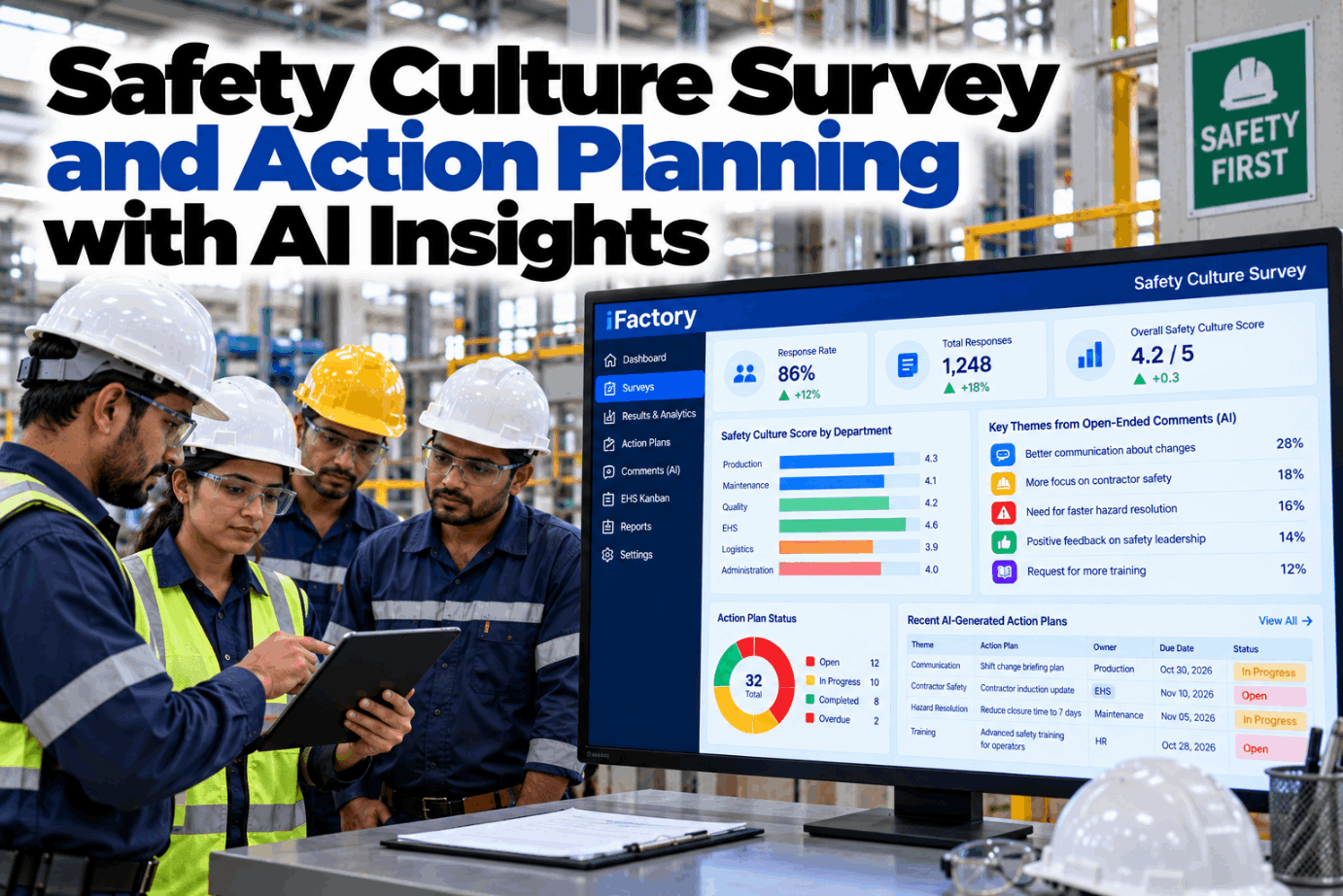
Most plants measure safety by what already went wrong: injuries, first aid cases, lost days. A safety culture survey asks the people doing the work how safety really feels on their line and their shift, before the numbers move. The hard part is not running the survey. It is reading hundreds of comments fairly, acting on them and showing people that their answers changed something. See how that loop works in a short survey module demo.
Ask Every Shift, Hear Every Comment, Act Where It Counts
The iFactory Survey Module runs safety culture surveys on handhelds and break-room kiosks in several languages. AI groups open comments into themes for your team to review, and agreed actions go straight onto the EHS kanban.
What a Survey Can and Can't Measure
The two terms are often used as one, but they are different. Safety culture is the deep layer of shared values and habits that builds up over years. Safety climate, a term introduced by Dov Zohar in 1980, is the shared perception of how safety is really treated here and now. A survey measures climate. That is useful, because climate moves faster and points to where culture is heading. Talk through what your survey should measure with our safety culture team.
- Deep values, beliefs and unwritten rules
- Changes slowly, over years
- Seen in behaviour, decisions and stories
- Assessed with interviews, observation and records
- Shared perceptions of safety right now
- Can shift within weeks after events
- Differs by department, shift and manager
- Measured with a safety perception survey
Start From a Tested Questionnaire, Not a Blank Page
Home-made surveys often ask leading questions. A validated instrument has been tested so its questions measure what they claim. One widely used option is NOSACQ-50, the Nordic Occupational Safety Climate Questionnaire from Denmark's National Research Centre for the Working Environment. It has 50 items across seven dimensions, answered on a four-point scale, and is available in over 50 languages. See the dimensions mapped to a dashboard in a results walkthrough.
Will People Speak Up Before Something Goes Wrong?
A plant can have good procedures and still miss hazards if people stay quiet. Harvard professor Amy Edmondson's research on teams gives this a name, and it belongs in any safety culture survey. Low scores here often sit behind low near-miss reporting. The statements below are examples written for a plant setting. Add a short block like this to your survey with help from our support team.
A Four-Part Survey That Takes About 15 Minutes
Keep the survey short enough to finish on a break. Use one agreement scale throughout, with no neutral middle if you follow NOSACQ's four-point format. Ask only for department and shift, never age or job title in small teams, so nobody can be singled out. End with two or three open questions, because comments are where the action ideas come from. Get this blueprint as a ready survey in a setup session.
Honest Answers Need Real Anonymity
People answer honestly only when they trust that answers can't be traced back to them. Survey platforms commonly hide results for any group with fewer than five respondents, and some set a higher limit for comments. Microsoft's Viva Glint, for example, uses five for scores and ten for comments by default. Small groups should be rolled into a larger one, not shown with a warning. Review your group structure with our support team.
Reach the People Who Never Open Email
Many production workers have no company email or desk. Turnout depends on the survey coming to them: a QR code on the shift board, a shared kiosk in the break room, and every question in the language people think in. The Survey Module offers all three channels and logs response rates by department and shift while the survey is open, so you can push where turnout is low. Try the kiosk flow in a short demo.
Ask Your Survey Results a Plain Question
Plant managers can ask the Survey Module what a department or shift is saying and get the reviewed themes, the numbers behind them and the actions already on the EHS kanban.
A Worked Example: Results by Department and Shift
This example is illustrative, not a real plant. It shows four of the seven NOSACQ-50 dimensions for a plant where 104 of 130 people answered. The plant mean is weighted by group size, and cells are shaded by the developers' guide bands. Following NOSACQ advice, compare each group with the plant mean before drawing conclusions. Maintenance nights had only four responses, so they are rolled into one maintenance group. Ask our team for a blank version of this view.
From 61 Comments to Four Reviewed Themes
Reading every comment is the first thing to slip. AI drafts the themes: it groups comments that say the same thing in different words and languages, counts them and pulls short, anonymised examples. A person then reviews every draft theme, merges or renames it and removes anything that could identify someone. Nothing is reported until that review is done. See the review screen in a theme review demo.
Action Planning on the EHS Kanban
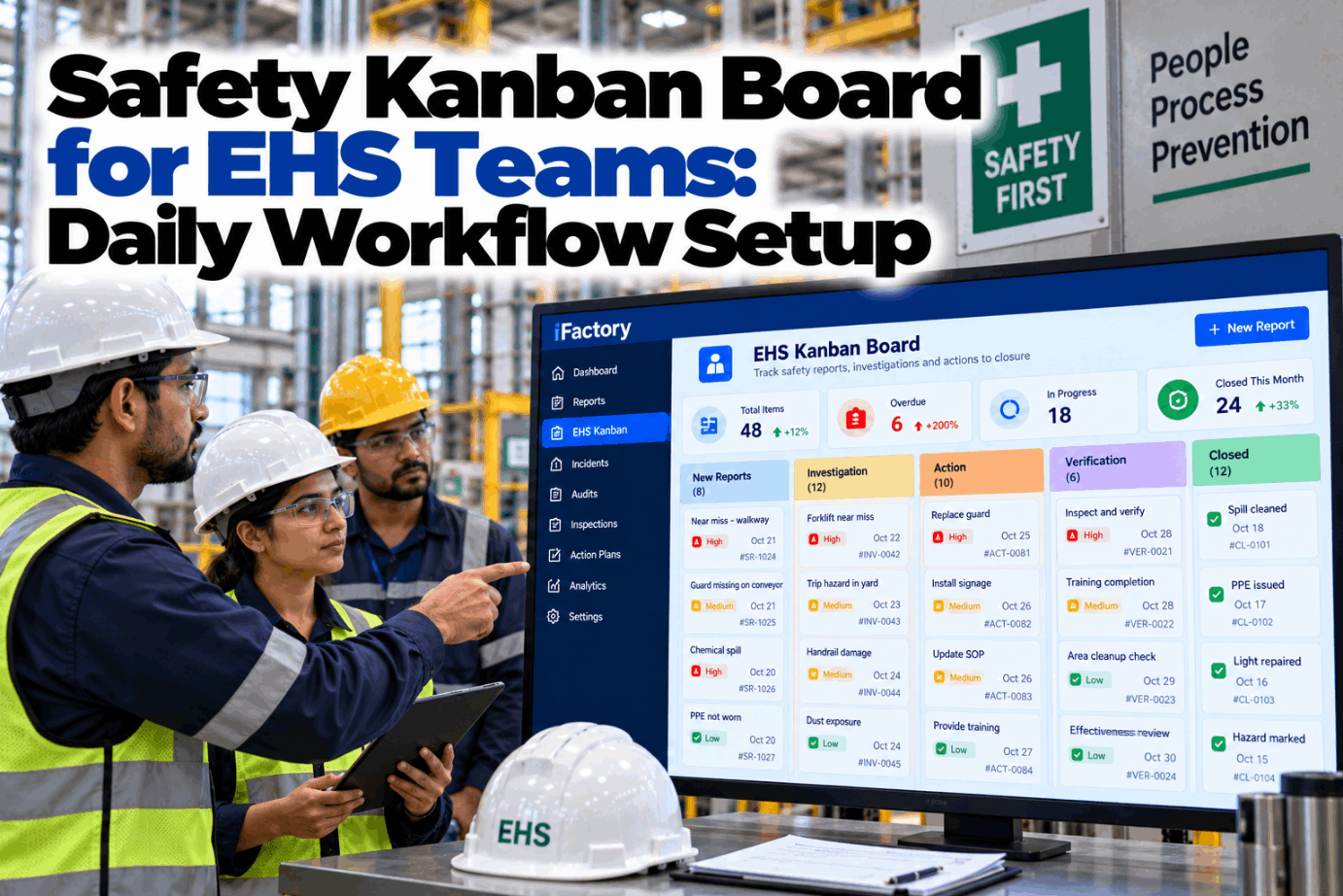
A survey without visible action does more harm than no survey, because it teaches people that speaking up changes nothing. Turn each reviewed theme into one or two specific actions with an owner and a due date, agreed with the teams who raised them. On the EHS kanban, survey actions sit beside incident and audit actions, so they get the same follow-up. Ask our support team how survey actions are tagged and tracked.
Close the Loop Where People Can See It
The last step is telling people what happened. A short "you said, we did" notice on shift boards, kiosks and in toolbox talks shows that the survey was read and acted on. Report what was not done too, and why. That honesty builds more trust than a list of wins, and gives people a reason to answer next time. See a sample notice in a short walkthrough.
Six Steps From Launch to Pulse Survey
Plan the whole cycle before launch, including who will act on results. Brief supervisors and worker representatives first, because people take their cue from them. Keep the survey open long enough to reach every shift, then act while answers are fresh. Plan your timeline with our survey team.
Where the Time Goes in a Survey Round
The biggest cost of a survey is people's time, so the return depends on acting on what they tell you. The worksheet below sizes both sides for a larger site. Every input is assumed, so replace each one with your own. It leaves out any claimed injury reduction, which a single survey can't prove. Build your own case in a planning call.
Survey Module and AI Server, Ready on Site
iFactory delivers the Survey Module as a turnkey bundle. A pre-configured NVIDIA AI server ships racked and ready with the survey engine and comment theme models pre-loaded, so employee comments are analysed on site and never leave the plant. You rack it, plug in power and Ethernet, and the AI is live. To scope it for your plant, request a turnkey quote.
- Pre-configured NVIDIA AI edge server, racked and ready
- Survey engine with NOSACQ-style and custom question sets
- Handheld QR and break-room kiosk survey modes
- Multilingual surveys with per-person language choice
- Anonymity thresholds and group roll-up rules
- AI theme extraction with a human review step
- Action plans on the EHS kanban and 24×7 remote monitoring
Server installed, question set, languages, groups and anonymity rules agreed.
Kiosks placed and a pilot run with one department to test wording and turnout.
Plant-wide survey launched, EHS trained on theme review and kanban actions.
Survey Analytics That End in Action
iFactory connects the survey to the work that follows it, so results become actions people can see. Our support team can walk you through a pilot plan.
What Plant Leaders Ask About Safety Culture Surveys
Turn What Your People Say Into Safety Actions
Run multilingual surveys on every shift, let AI draft themes from every comment and track agreed actions on the EHS kanban until people can see the change. Delivered turnkey and live in 6 to 12 weeks.