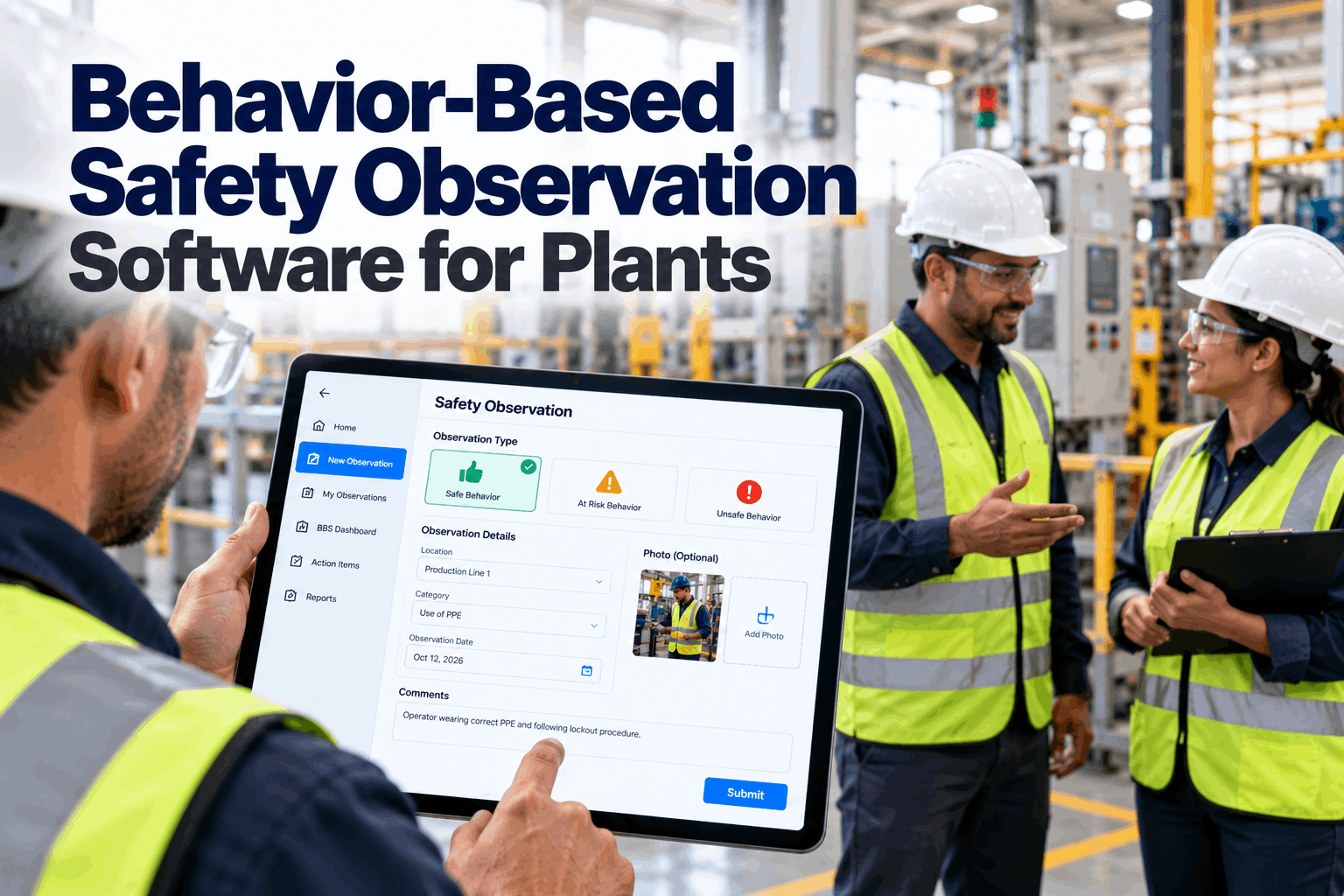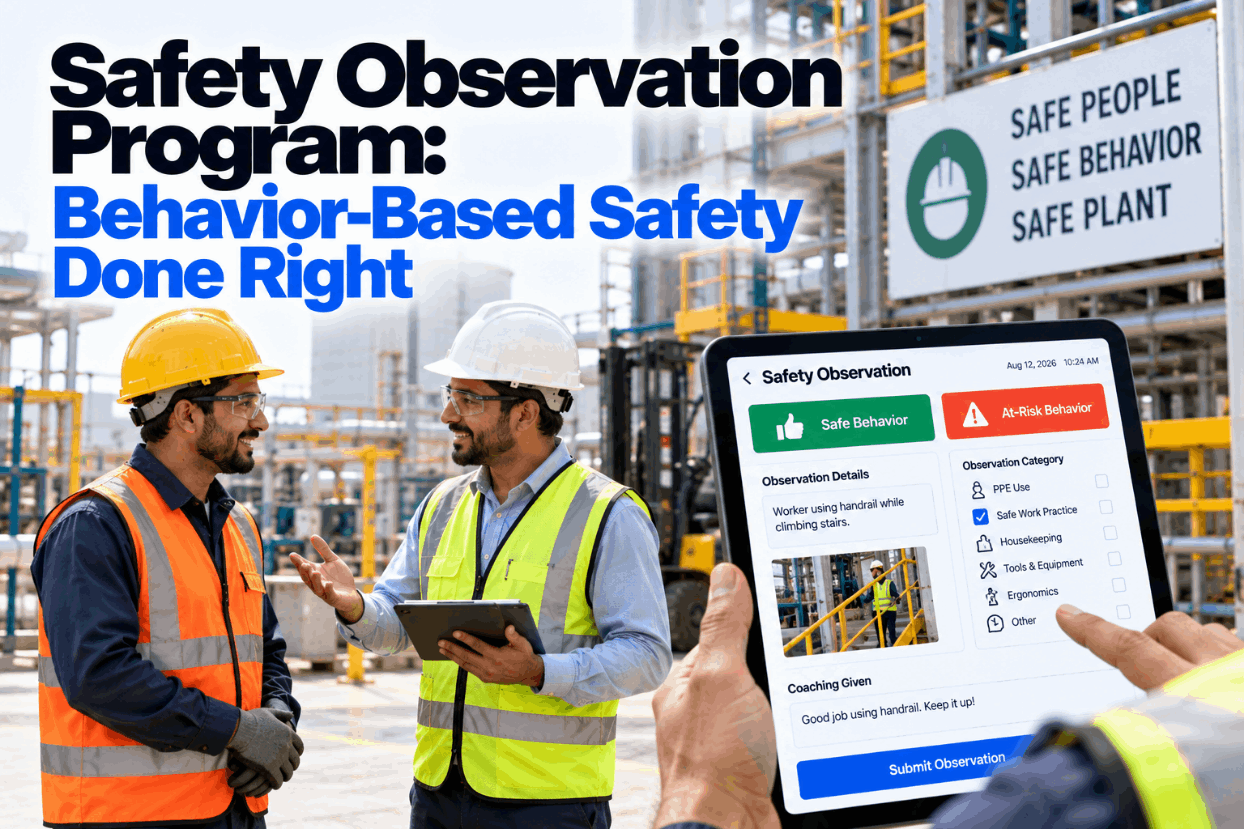
Supervisors fill in 20 observation cards a month because the target says 20. The cards all say safe, they go in a box and nobody reads them. Then a hand injury happens on a task nobody ever observed. This guide shows how to run a safety observation program that captures real behavior, coaches on the spot and shows trends leaders act on. See a sample card.
Safety Observation Program: Behavior-Based Safety Done Right
Observation cards by mobile or voice in under a minute, coaching prompts for supervisors and AI clustering that groups at-risk behaviors by task and area, so leaders fix the conditions that drive them.
- Why behavior-based safety programs lose trust
- What a useful observation card captures
- How AI trends point to conditions to fix
Why Behavior-Based Safety Programs Lose Trust
Watching people is not the same as helping them.
Behavior-based safety earned a poor reputation in some plants because it was used to count and blame. Older claims that most incidents are caused by unsafe acts have been widely challenged. Current thinking, often called human and organizational performance, starts from the idea that behavior is shaped by the work: tools, layout, time pressure and procedures. ISO 45001 also requires worker participation. A good observation program builds on both. Talk it through in a program review.
Quota cards
Targets drive counts, not quality.
Blame
Cards used to discipline people.
No feedback
Workers never see what changed.
All safe
Cards that only record safe behavior.
What a Good Observation Card Captures
Short, specific and about the work.
A useful card is quick to fill in and says something a leader can act on. The most important field is why: the condition that made the at-risk behavior make sense to the person doing it. Ask our safety coaches to review your current card.
People rarely take risks for no reason. Asking what made the shortcut easier often reveals a missing tool, a bad layout or a time pressure that a supervisor can fix. Coaching without asking why treats the symptom.
Coaching on the Spot
Four steps, two minutes.
The observation is only half the value. The conversation that follows is where behavior and conditions change. Supervisors get a short prompt on the phone to guide it. Try the prompts in a coaching demo.
Observe
Watch the task for a few minutes.
Ask
Ask what makes the task hard or slow.
Agree
Agree a safer way and any fix needed.
Follow up
Close the fix and tell the crew.
Turn Cards into Changes
Start with one area and one card. Leaders see the first clustered trends within weeks.
AI Trend Clustering
Group the cards, find the condition.
Reading hundreds of cards a month is not realistic. The AI groups at-risk behaviors by task, area and stated reason, so a pattern across many cards stands out as one issue with one owner. Ask our support desk how clusters are reviewed.
By task
The same shortcut on the same job, across crews.
By area
Behaviors that cluster in one part of the plant.
By condition
Missing tools, layout or time pressure behind the behavior.
By time
Patterns on nights, weekends or at shift change.
Emerging
A new behavior that has started to appear.
High energy
At-risk behaviors near high-energy sources flagged first.
Peer Observations and Leader Walks
Two programs, two purposes.
Peer observations build ownership among crews. Leader walks show that managers care and give them a direct view of conditions. Both work best when cards are anonymous by default and focused on learning. Plan both in a design session.
Peer observations
- Crew members observe each other
- No names by default
- Focus on learning and conditions
- Results shared at huddles
Leader walks
- Managers observe and listen
- Questions about what makes work hard
- Commitments to fix conditions
- Follow-up visible to the crew
Measuring the Program
Measure quality and action, not counts.
Card counts are the easiest number to report and the least useful. Track measures that show whether cards are honest and whether they lead to change. Agree the measures with our safety coaches.
Cards with a why
Share of at-risk cards that record the condition behind the behavior.
Fix closure
Share of identified conditions fixed within the agreed time.
Trend by task
At-risk behaviors per task falling after fixes go in.
A target of 20 cards per supervisor per month produces 20 cards, most of them safe. A target of fixing the top three conditions each month produces safer work.
Observation Program Mistakes to Avoid
Trust is built slowly and lost fast.
Observation programs live or die on whether workers trust them. A short program check looks at the card, the follow-up and the culture around both.
What works
- Short cards with a why
- Coaching conversations, not tickets
- Trends grouped by task and condition
- Fixes reported back to crews
What fails
- Quotas for card counts
- Names used for discipline
- Cards that only record safe behavior
- No follow-up on conditions found
How iFactory Runs the Observation Module
Cards, coaching and clusters on one platform.
iFactory’s Observation Module takes mobile or voice cards in under a minute, clusters trends by task and area with AI and gives supervisors coaching prompts, on an on-prem server and linked to work orders for the fixes. Fit questions go to our solutions team.
Quick cards
Mobile or voice cards in under a minute.
Coaching prompts
Short guides for the conversation.
AI clusters
Behaviors grouped by task, area and condition.
Condition fixes
Fixes raised as work orders.
Anonymous by default
Names optional for peer observations.
Crew feedback
Fixes shared back with the people who raised them.
Program results depend on leadership follow-up as much as on the tool. We measure card quality and fix closure on your own data during the pilot.
Turnkey AI: Delivered, Connected and Live in 6–12 Weeks
You do not build this. It arrives ready.
iFactory ships as a pre-configured NVIDIA AI server with the software pre-loaded, racked and ready. Rack it, plug in power and Ethernet, and the AI is live on your network. Our team handles cabling, network setup, PLC, SCADA and CMMS integration, card design and area set-up, operator training and 24×7 remote monitoring. Data stays on your network. For a scope matched to your plant, request a turnkey quote.
Ship, network and data
Server installed. Areas, tasks and card design loaded.
Clustering and pilot
Cards and coaching prompts run in one area.
Go-live and training
Live in all areas. Supervisors and crews trained. 24×7 monitoring begins.
Frequently Asked Questions
What is a safety observation program?
A program where supervisors and workers observe tasks, record safe and at-risk behaviors, talk about them on the spot and use the results to fix conditions.
Is behavior-based safety still useful?
Yes, when it focuses on learning and conditions rather than counting and blame.
Should observation cards be anonymous?
For peer observations, anonymous by default works best. Leader walks can record the observer but not the worker.
How many cards should we aim for?
Focus on quality and action rather than a count. A few honest cards that lead to fixes beat many cards that say safe.
How does AI help?
It groups at-risk behaviors by task, area and reason, so patterns across many cards stand out.
Can a card become a work order?
Yes. When a condition needs a fix, it becomes a work order linked to the card.
How do we start?
Pick one area, agree a short card and run a short pilot with coaching prompts. To plan it, contact our team.
Make Observations Lead to Fixes
In thirty minutes we look at your current card, how cards are used and what happens after they are filed. You keep the notes either way.
- 1Your current observation card
- 2Card counts for the last quarter
- 3A list of fixes that came from cards
- 4Your coaching guide, if any
- 5One observation that changed something