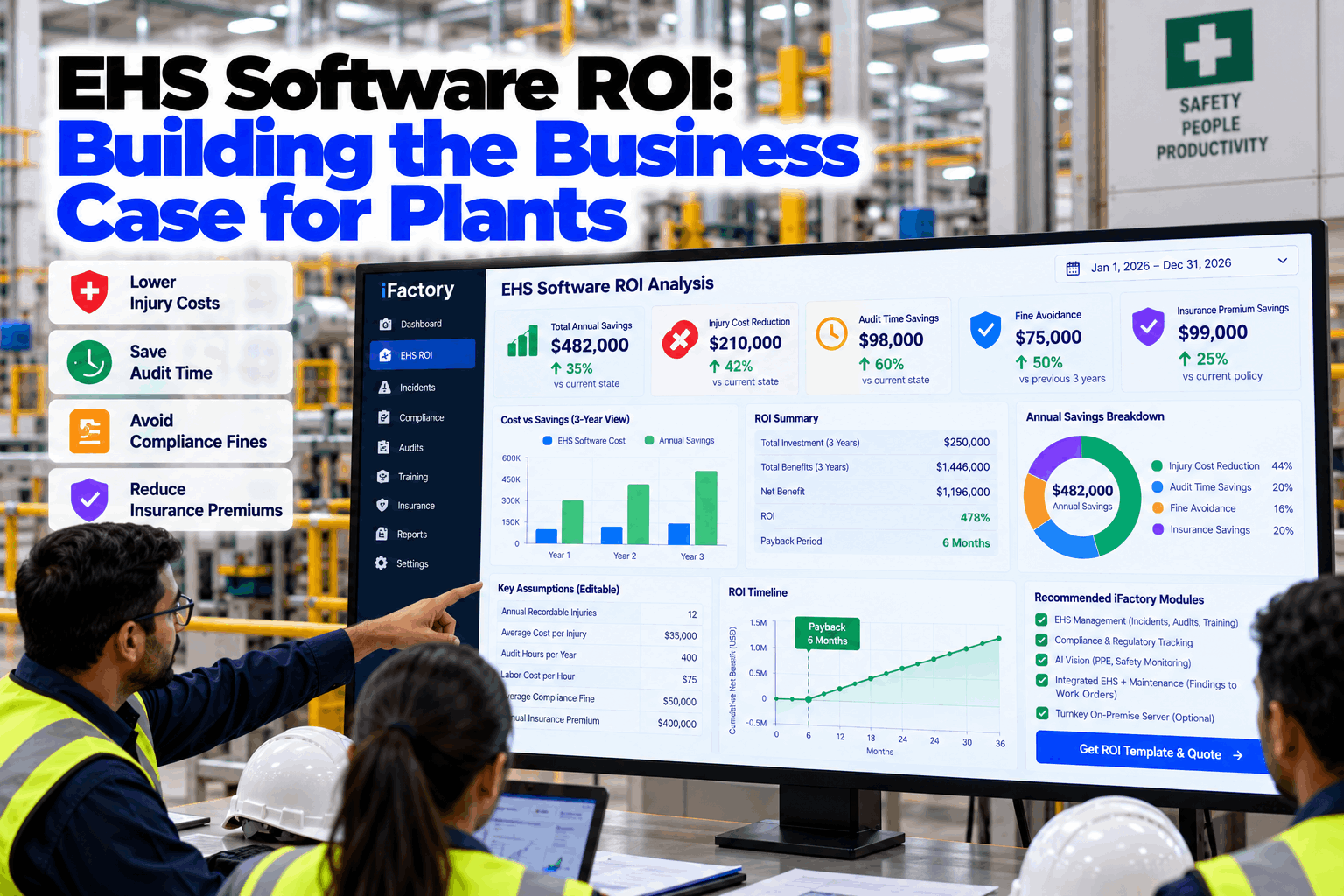
Every EHS leader has heard some version of the same answer: the project is a good idea, but show us the numbers. The benefits are real, yet they are spread across injury costs, audit hours, penalties and insurance, and each belongs to a different budget line. A business case that adds them up in one model, with clear inputs and honest ranges, is what gets a safety project approved. This page shows how to build that case for a plant, with a worked example and a template of the inputs you need. Plant managers can walk through it on their own data in an EHS ROI session.
EHS Software ROI: Building the Business Case for Plants
Calculate EHS software ROI from injury cost reduction, audit time saved, fewer fines and lower insurance premiums. Enter your injury rates, claim costs and admin hours and get payback for the EHS modules, plus AI vision, on a turnkey on-prem server.
- Four sources of return, each with its own inputs
- A worked example with payback and a range
- A template your finance team can check line by line
Why EHS Budget Requests Stall
The benefits are real, but nobody has added them up.
Finance teams approve projects they can check. EHS requests often fail because the case rests on words like risk reduction and culture, or on one big number with no workings behind it. A good case names each input, shows where it came from and tests what happens if the result is weaker than hoped. Our EHS business case specialists can help you gather the inputs.
Soft benefits
Value described in words, not in money.
Hidden injury cost
Indirect costs never added to the claim.
Split budgets
Savings land in HR, finance and operations.
No baseline
No before figure, so no proof of change.
The Four Sources of EHS Software Return
Each source has its own inputs and its own formula.
The table below is the template for the model. Each line starts from something your plant already records, applies an expected change and turns the result into a yearly amount. Leave out any line you cannot support with your own data. A smaller, defensible case is worth more than a large one that finance cannot trace. Build yours in a working session.
The claim is only part of it. Add lost production, replacement and overtime, investigation time, repairs and management attention. Use your own claim and finance records, and note which items you included so the number can be checked.
A Worked Example: Payback in Months
One plant, four lines, one investment figure.
Take a plant with 400 employees and 8 recordable cases a year at an average full cost of $45,000. The model assumes a 15 percent drop in cases, 35 percent less admin time on 1,800 hours a year at $40 an hour, half of a $30,000 yearly penalty exposure avoided and a 3 percent cut to a $400,000 premium. The investment of $150,000 is a placeholder and not a quote. All figures are illustrative.
Put Your Own Numbers Into the Model
Bring your injury rates, claim costs and admin hours, and leave with a payback range your finance team can check.
Test the Case Against a Weaker Result
If the case only works at the best result, it is not ready.
Finance will ask what happens if the savings are smaller. Show the answer before they ask. Using the same example, a benefit of half the expected amount pushes payback out to about 34 months, while one and a half times the benefit brings it to about 11. Present all three so the decision is made with the range in view.
Half the benefit
Annual benefit about $53,100. Payback about 34 months.
The worked example
Annual benefit about $106,200. Payback about 17 months.
One and a half times
Annual benefit about $159,300. Payback about 11 months.
Ask the Model What If
Change one input and see the result at once.
The ROI model lets plant managers and finance partners test their own assumptions in the room. Change the injury reduction, the admin hours or the investment, and the annual benefit and payback update straight away. See it on your own inputs in a live walk-through.
Adding AI Vision to the Business Case
One server, more than one safety benefit.
The turnkey server that runs the EHS modules can also run AI vision on cameras you already have, for example PPE detection and zone monitoring. Its value shows up mostly in the injury line, as fewer incidents from missed PPE or people in the wrong area. Model it as a separate input with its own expected change, so finance can accept or remove it without touching the rest. Discuss the scope with our AI vision team.
PPE detection
Missing helmets, vests or gloves flagged.
Exclusion zones
People in restricted areas flagged.
Observation data
Patterns by area and shift.
Same server
No extra hardware stack to justify.
From Baseline to a Measured Result
A business case is a plan to measure, not only a forecast.
Approval is easier when the case ends with a way to check the result. Set the baseline before the pilot, run the pilot on a few areas and compare the same measures after. The model is then updated with real figures, and the full roll-out is decided on evidence. Plan the steps with our implementation team.
Baseline
Record current injuries, hours, penalties and premium.
Model
Enter inputs and agree the assumptions.
Pilot
Run the EHS modules in a few areas.
Measure
Compare the same measures after the pilot.
Scale
Update the model and decide on roll-out.
What Counts as Cost
Include everything, so the payback holds up.
An ROI case loses credibility if the cost side is thin. Include the full turnkey scope and the time your own people will give. Your quote sets the figures, and we list each item in it. Request one through our quote team.
Included in the turnkey scope
- NVIDIA AI server, installed and networked
- EHS software modules and AI vision
- Integration with plant and CMMS systems
- Training and 24×7 remote monitoring
Worth adding on your side
- Internal time for data gathering and testing
- Time to train supervisors and wardens
- Camera or network upgrades if needed
- Ongoing review time for the EHS team
EHS Business Case Mistakes to Avoid
A case can look strong and still fail the first question.
These are common best practice gaps in EHS business cases. A short readiness review can catch them before the case reaches finance.
What works
- Inputs taken from your own records
- A conservative, expected and strong case
- Each benefit line owned by a named function
- A baseline and a way to measure the result
What fails
- Industry averages used for plant figures
- One best-case number with no range
- Benefits counted twice across lines
- No cost for internal time or training
How iFactory Runs the ROI Model and Turnkey Quote
The case and the system, from the same inputs.
iFactory takes your injury rates, claim costs and admin hours, builds the model with you, and issues a turnkey quote for the EHS modules plus AI vision on one on-prem server. After the pilot, the model is refreshed with measured results. Fit questions go to our solutions team.
ROI model
Four benefit lines from your inputs.
Scenario ranges
Conservative, expected and strong.
Payback in months
Shown for each scenario.
EHS modules
Incidents, audits, actions and permits.
AI vision
PPE and zone monitoring on the same server.
On-prem
Safety data stays in the plant.
The figures and exchanges on this page are illustrative, and the investment shown is a placeholder, not a quote. Your own return depends on your injury record, claim costs, systems and practices, and we measure it on your data during the pilot.
Turnkey AI: Delivered, Connected and Live in 6–12 Weeks
You do not build this. It arrives ready.
iFactory ships as a pre-configured NVIDIA AI server with the software pre-loaded, racked and ready. Rack it, plug in power and Ethernet, and the AI is live on your network. Our team handles cabling, network setup, PLC, SCADA, DCS and CMMS integration, camera links, operator training and 24×7 remote monitoring. Data stays on your network. For an implementation guide and a quote matched to your plant, request a turnkey quote.
Ship, network and baseline
Server installed. EHS records connected and the baseline captured.
Setup and pilot
Modules and AI vision configured. Live pilot runs in a few areas.
Go-live and measured ROI
Roll-out across the plant. Teams trained. The model refreshed with measured results.
Frequently Asked Questions
How do you calculate EHS software ROI?
Add the yearly savings from injury cost reduction, audit and admin time, fines avoided and insurance premiums, then divide the investment by that annual benefit to get payback, or compare total benefit with cost over several years.
What inputs do I need for the model?
Recordable injuries per year and the full cost per case, hours spent on EHS administration, your yearly penalty exposure and the current insurance premium with its loss history.
Is there a template I can use?
Yes. The four-line table and the worked example on this page are the template, and we provide the same model with your inputs in a working session.
How should plant managers present the case?
Show the baseline, each benefit line with its source, three scenarios and a plan to measure the result after the pilot. Give finance the workings and not only the total.
How reliable is the insurance saving?
It depends on your insurer and loss history, so confirm the likely effect with your broker. If it is uncertain, show it as a separate line that can be removed without changing the rest of the case.
What are the best practices for an EHS business case?
Use your own records, count the full cost of injuries, avoid double counting, include internal time on the cost side and show a conservative case next to the expected one.
What does it cost and when is the return?
Cost depends on the number of sites, modules, cameras and integrations, so we issue a turnkey quote after a short scoping call. Payback follows from your inputs, and the pilot tests it with measured results.
Is the investment case the same for AI vision?
AI vision is modelled as its own input, mostly in the injury line, so it can be included or left out. It runs on the same server as the EHS modules.
How do we start?
Start with a short session to gather your inputs. A 6-week pilot then connects your records, captures the baseline and runs live modules in a few areas. To plan it, contact our team.
Build an EHS Business Case Your Finance Team Will Accept
In thirty minutes we take your injury, claim and admin figures through the model and show the payback range for your plant. You keep the workings either way.
- 1Your injury log for the last year
- 2Claim and incident cost records
- 3Hours spent on audits and reporting
- 4Your insurance renewal and loss history
- 5Any penalties or open citations