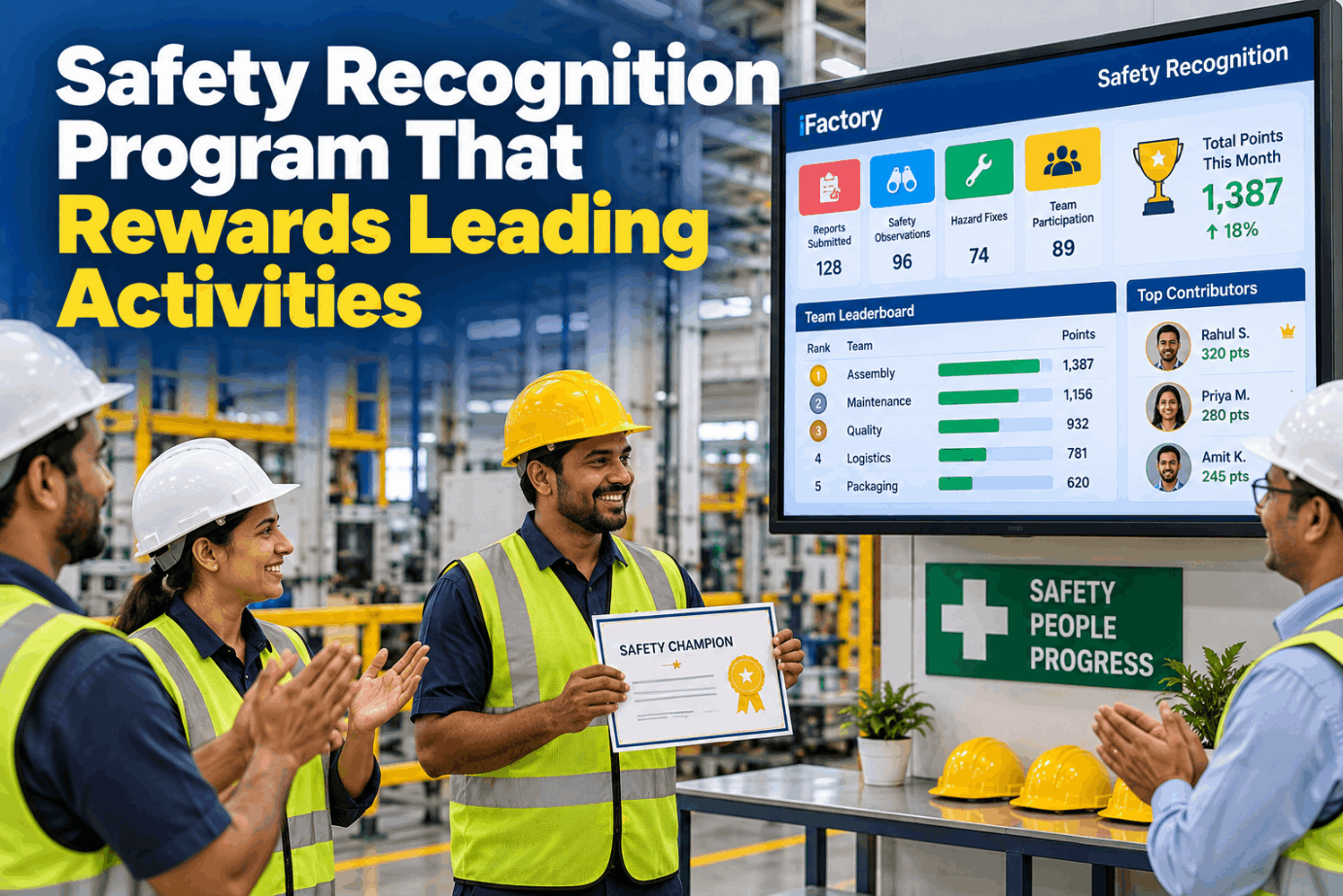
Plenty of plants still hand out a prize when a team reaches 100 days without a recordable injury. It feels like recognition, but it quietly rewards silence, because the easiest way to protect the streak is not to report. A safety recognition program works better when it rewards the activities that prevent injuries: hazard reports, near-miss reports, safety observations and fixes that actually get closed. Points, team leaderboards and firm guardrails keep the program honest. See how the scoring works in a short recognition demo.
Reward the Reports, Observations and Fixes That Prevent Injuries
iFactory's Recognition Module gives points for hazard reports, near misses, observations and closed fixes, then ranks teams on a shared leaderboard. Built-in guardrails mean a low injury count never earns points on its own.
What a Federal Review Found About Safety Incentives
In 2012 the US Government Accountability Office reviewed safety incentive programs in report GAO-12-329. Its 2010 survey estimated how common each approach was among US manufacturers. Experts told GAO that rate-based programs may discourage reporting, especially when injuries are minor and rewards are large, and that team rewards tied to zero injuries can put pressure on the whole team not to report. GAO also noted that research on the question was limited. Talk through your current program with our safety team.
Rate-Based Rewards Are Allowed Only if Reporting Stays Safe
Under 29 CFR 1904.35(b)(1)(iv), an employer must not discharge or in any manner discriminate against an employee for reporting a work-related injury or illness. OSHA's memo of October 11, 2018 set out how that applies to incentives. Rewarding near-miss and hazard reports is always permissible. Rate-based programs are permissible too, as long as they are not run in a way that discourages reporting, and a simple statement that reporting is encouraged may not be enough on its own. See how the module applies this in a guided demo.
- Rewards for reporting near misses
- Rewards for reporting hazards
- Positive action under a reporting-based program
- Thanking people who raise concerns or suggestions
- Incentives for identifying unsafe conditions
- Training for all employees on reporting rights and responsibilities
- A way to accurately judge whether employees are willing to report
Score only leading activities. If nothing in the program depends on injury counts, there is no reward for anyone to lose by reporting.
A Points Scale for Leading Activities
Points should go to things a person controls and a supervisor can verify. Weight quality over volume, so a hazard that gets fixed is worth more than a hazard that only gets mentioned, and use weekly caps so the count cannot be padded. The values below are an example scale to adapt with your safety committee, not a benchmark. Ask our support team for the scale as a starting file.
A report shows that someone noticed. A closed fix shows that the plant changed. Weighting closures highest pulls supervisors, maintenance and the reporter into the same goal, and it gives the leaderboard a link to real risk reduction rather than paperwork.
Guardrails That Keep the Program Honest
Any points system will be gamed if the rules allow it, and any reward tied to outcomes can tempt people to hide them. Write the guardrails into the program charter and build them into the scoring, so nobody has to police them by hand. Review your rules in a charter session.
If hazard reports climb while closed fixes stay flat, the program is producing noise. Shift weight toward closures before people lose faith in the board.
Points for Prevention, Never for Silence
The Recognition Module scores reports, fixes and observations, ranks teams on a leaderboard and enforces guardrails that never reward low injury counts alone. Supervisors verify, the system merges duplicates and keeps the score.
Teams for the Leaderboard, People for the Thank-You
GAO's concern about team rewards was about rewards tied to zero injuries. A team score built on leading activities works the other way: one person's report helps the team instead of costing it. Individuals still need recognition, and it works best when it is personal and fast. OSHA's worker participation guidance suggests recognizing workers who report concerns or make suggestions. Plan both levels with our EHS specialists.
- Leaderboard by area or shift, reset monthly
- Points from reports, observations and fixes
- Rewards such as a team meal or choosing the next safety improvement
- Encourages people to help each other close fixes
- A thank-you from a leader within a day
- Named in the shift briefing, if the person agrees
- A small token when a near miss leads to a real fix
- No public ranking of individuals against coworkers
One Month of Team Points
A leaderboard is only useful if people can see why a team is where it is. Show the score, the mix behind it and where a team needs help, not just the ranking. The figures below are illustrative. See a live board in a short walkthrough.
Recognition That Arrives While It Still Means Something
Positive reinforcement works best when it follows the action closely. A thank-you a month after a near-miss report feels like admin. A word from the supervisor before the shift ends tells the person the report was worth making, and a note on what happened to it tells everyone else. Set the timing so the fastest recognition is also the cheapest. Agree your own rhythm with our safety team.
Three Situations and How the Rules Handle Them
These illustrations show how the guardrails behave in practice. They are not case studies. Test your own edge cases in a scenario review.
Five Steps to Launch Without Breaking Trust
How you switch over matters as much as the points scale. People who have seen injury prizes come and go will judge the new program by what happens the first time someone reports an injury. Plan the launch with our EHS team.
A One-Page Program Charter
Put the whole program on one page that every employee can read. If a rule is not on the charter, it should not affect anyone's score. Get a blank charter in a short setup call.
Recognition Module and AI Server, Ready on Site
iFactory delivers the Recognition Module as a turnkey bundle. A pre-configured NVIDIA AI server ships racked and ready with the module and its report triage AI pre-loaded, so typed and spoken reports are tagged, de-duplicated and scored inside your network. You rack it, plug in power and Ethernet, and the AI is live. Get a scoped plan from our deployment team.
- Pre-configured NVIDIA AI edge server, racked and ready
- Recognition Module with your points scale and caps
- Report triage AI that tags hazards and merges repeats
- Team leaderboards for screens and handheld devices
- Guardrail rules locked into the scoring logic
- Network setup, supervisor and EHS team training
- 24×7 remote monitoring of models and hardware
Server installed, teams and areas mapped, points scale and guardrails agreed with the safety committee.
Reports scored in two areas, triage tuned to your hazard types, guardrails tested on real cases.
Leaderboards switched on site-wide, supervisors trained, first monthly review held.
Safety Recognition Program Software Built Around Guardrails
iFactory scores the work that prevents injuries and keeps the rules that stop a program from rewarding silence. See the scoring on a sample site in a pilot walkthrough.
What EHS Leaders Ask About Safety Recognition Programs
Make Reporting the Thing Teams Compete On
Score reports, observations and fixes, rank teams on a fair leaderboard and lock in guardrails that never reward silence. The full system is delivered turnkey and goes live in 6 to 12 weeks.