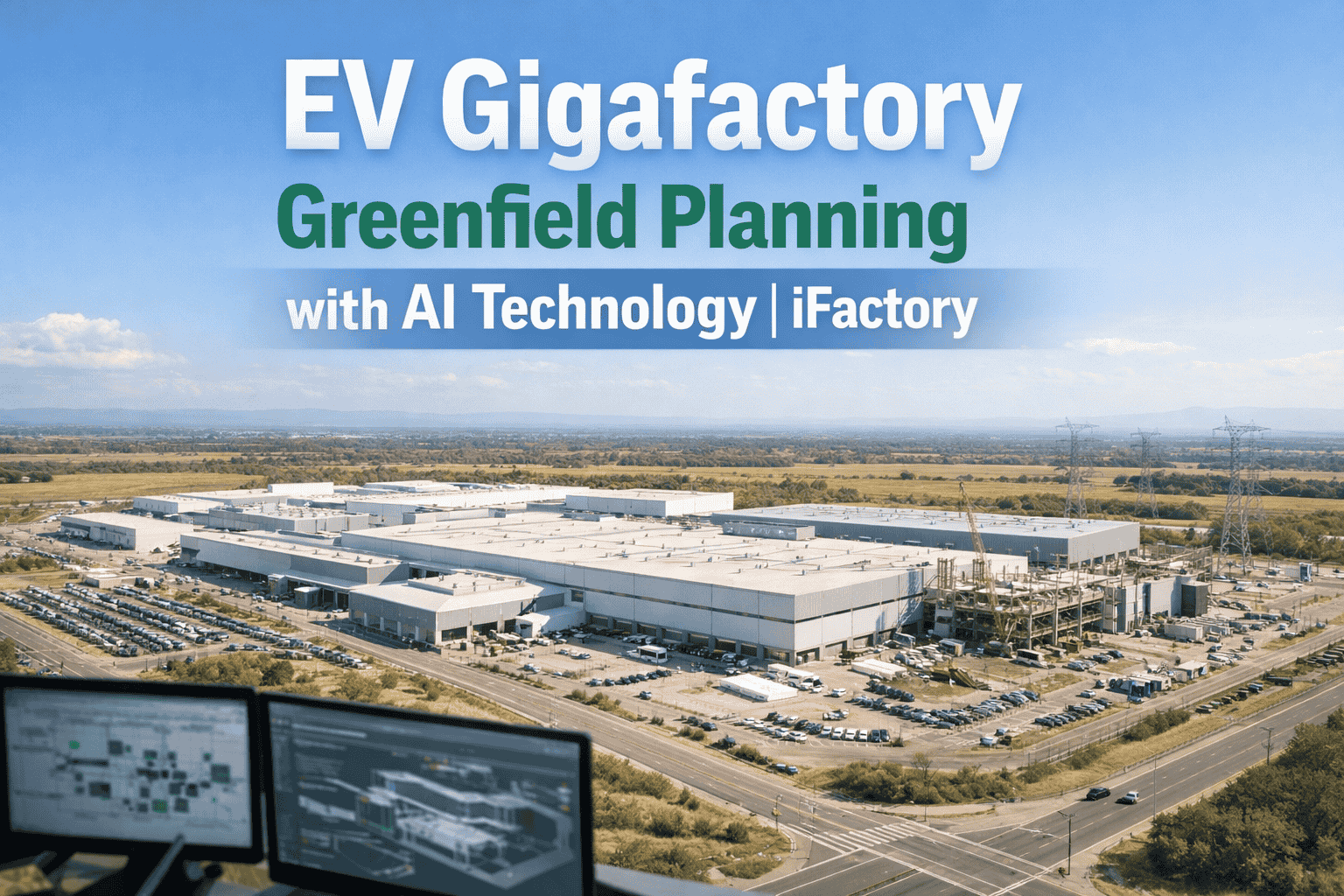
EV Gigafactory Greenfield Planning with AI Technology
By Riley Quinn on March 28, 2026
A 40 GWh battery gigafactory consumes 2.4 gigawatts of electricity and 1 million gallons of water daily. It requires dry rooms the size of five soccer fields maintaining -40°C dew points. It demands 13 sequential manufacturing processes where a single 1% quality deviation can cost $1 million in scrap per GWh annually. This isn't just factory construction—it's orchestrating the most complex greenfield projects on Earth. And without AI-driven planning, you're building blindfolded.
Why Gigafactories Are Different
The scale and precision that make battery plants the hardest factories to build
2.4 GW
Daily power consumption
1M gal
Daily water usage
-40°C
Dry room dew point
<1%
Humidity tolerance
150+ gigafactories planned globally by 2030$5-10 billion average investment per facility12-24 month compressed timelines
The 13-Step Manufacturing Gauntlet
Battery cell production isn't a single process—it's a precisely choreographed sequence where each step creates constraints for the next. Miss the tolerance at step 3, and you've compromised everything downstream.
Electrode Manufacturing
01
Slurry Mixing
Active materials + binder + conductive additive
02
Coating
Slurry applied to metal foil (cathode/anode)
03
Drying
80m ovens for gradual solvent evaporation
04
Calendering
Cylindrical rollers compress electrode foils
05
Slitting
Cut to cell-specific dimensions
Dry Room Operations
Critical Zone: <1% RH
06
Vacuum Drying
Remove residual moisture
07
Cutting/Stacking
Laser or die-cut electrode sheets
08
Cell Assembly
Winding/stacking into enclosure
09
Electrolyte Filling
Vacuum fill with liquid electrolyte
Formation & Finishing
10
Formation
SEI layer creation (time-limited bottleneck)
11
Aging
SEI stabilization + degassing
12
Testing
Capacity, voltage, cycle life validation
13
Grading
Sort by performance characteristics
Physics-Limited Bottlenecks
Coating/drying and formation/aging are the steps that ultimately cap gigafactory throughput. Facility design must treat these as first-class constraints—not afterthoughts.
Planning a battery manufacturing facility? Book a consultation to understand how AI-driven planning eliminates commissioning surprises.
The Dry Room Challenge
Dry rooms represent 43% of total energy consumption in battery production. They're also where moisture-sensitive chemistries like NMC811 live or die. Get the design wrong, and you've built a $100M humidity trap.
Dry Room Critical Parameters
Dew Point
-40°C to -60°C
Lower for NMC811 / lithium metal
Relative Humidity
<1%
Near-zero percent maintained
Typical Scale
5 Soccer Fields
VW Salzgitter dry room size
Energy Share
43%
Of total production energy
What Happens When Moisture Gets In
Cell swelling and gas formationElectrode corrosionReduced cycle life and capacityBattery explosion risk (extreme cases)
Where AI Transforms Gigafactory Planning
Traditional trial-and-error approaches can't keep up with compressed timelines and billion-dollar stakes. AI-driven planning simulates, optimizes, and validates before a single foundation is poured.
AI-Powered Gigafactory Digital Core
Digital Twin Layer
Process simulationWhat-if scenariosLifecycle optimizationDesign validation
From dry room design to formation rack optimization, iFactory's AI platform helps you simulate, validate, and commission with confidence—before the concrete cures.
Most gigafactory delays happen during commissioning—when theory meets reality. Projects that look perfect on paper collapse when equipment integrations fail, environmental controls miss targets, or MES systems don't communicate with robotics.
Common Commissioning Failures
01
Environmental Control Gaps
Dry room dew points drift during shift changes, entry/exit cycles, or equipment load variations
02
MES-to-Equipment Disconnect
Manufacturing execution systems can't read from or write to formation racks, coating lines, or quality stations
03
Power Infrastructure Mismatch
High-voltage systems undersized for peak formation loads, causing brownouts during ramp-up
04
Data Silo Blindness
Quality data trapped in disconnected systems prevents root-cause analysis across the 13-step process
The AI Solution: Virtual Commissioning
Digital twins let you execute programs in virtual environments with genuine operational logic before physical deployment. Test configurations, troubleshoot integrations, and validate performance—without consuming materials, risking production, or discovering problems at 2 AM on commissioning day.
Expert Perspective
"Digital engineering is the backbone of modern smart manufacturing. By combining physics-based simulation with real-time data, we're enabling self-optimizing production lines that adjust dynamically to changing conditions. In battery manufacturing, this means fine-tuning processes in real time—leading to higher yield, lower costs, and improved energy efficiency."
— Fredrik Westerberg, Director of Strategic Planning, Gigafactories, Honeywell
iFactory's AI-driven platform integrates digital twins, MES, and predictive analytics to help gigafactory projects hit targets on time and under budget. See how we're transforming battery manufacturing commissioning.
What makes EV gigafactory planning different from traditional manufacturing facilities?
Gigafactories combine unprecedented scale with extreme precision requirements. They consume 2.4 GW of electricity and 1 million gallons of water daily. They require dry rooms maintaining below 1% relative humidity with -40°C to -60°C dew points. The 13-step battery cell manufacturing process is both physics-limited (coating/drying) and time-limited (formation/aging), creating bottlenecks that must be designed around from day one. Traditional facilities don't face this combination of energy intensity, environmental control criticality, and process interdependency.
Why do dry rooms consume 43% of gigafactory energy?
Maintaining near-zero humidity requires continuous dehumidification using desiccant wheels, positive pressure systems to prevent outside air ingress, and temperature control. Every airlock cycle, worker entry, and equipment operation introduces moisture that must be immediately removed. For chemistries like NMC811 or lithium metal that require dew points below -50°C, the energy demands are even higher. Advanced dehumidification systems can reduce this by up to 92% compared to conventional systems, but require careful planning during facility design—not as a retrofit.
How do digital twins reduce gigafactory commissioning delays?
Digital twins create virtual replicas of the entire factory with genuine operational logic. Engineers can execute programs, test equipment integrations, and validate environmental controls in simulation before physical deployment. This lets you discover MES-to-robotics communication failures, formation rack power draws, and dry room pressure imbalances without consuming materials, risking equipment, or delaying timelines. Companies like Tesla, SK On, and Panasonic report double-digit yield improvements through this simulation-first approach.
What's the biggest cost driver in battery manufacturing?
Material scrap rate is the dominant cost driver. Scrap rates in battery production often exceed 10%, and just a 1% loss in quality control can result in $1 million in scrap costs per GWh annually. The electrode production stage offers the highest potential for digital optimization, followed by cell finishing and assembly. AI-powered MES systems with real-time quality monitoring can identify and address defects promptly, using closed-loop systems to adjust upstream processes and minimize scrap throughout the 13-step manufacturing flow.
How long does it take to build and commission a gigafactory?
Timelines are extremely compressed—typically 12-24 months from groundbreaking to production, with many projects facing delays. Tesla's Mexico gigafactory has been pushed from 2024 to potentially 2026. The UK Gigafactory Commission warns that without additional plants announced by end-2026, a material supply gap will emerge. Compressed timelines make AI-driven planning essential: you don't have time for traditional trial-and-error during commissioning. Projects that master virtual commissioning, offline testing, and digital thread traceability consistently outcompete on ramp speed and yield.