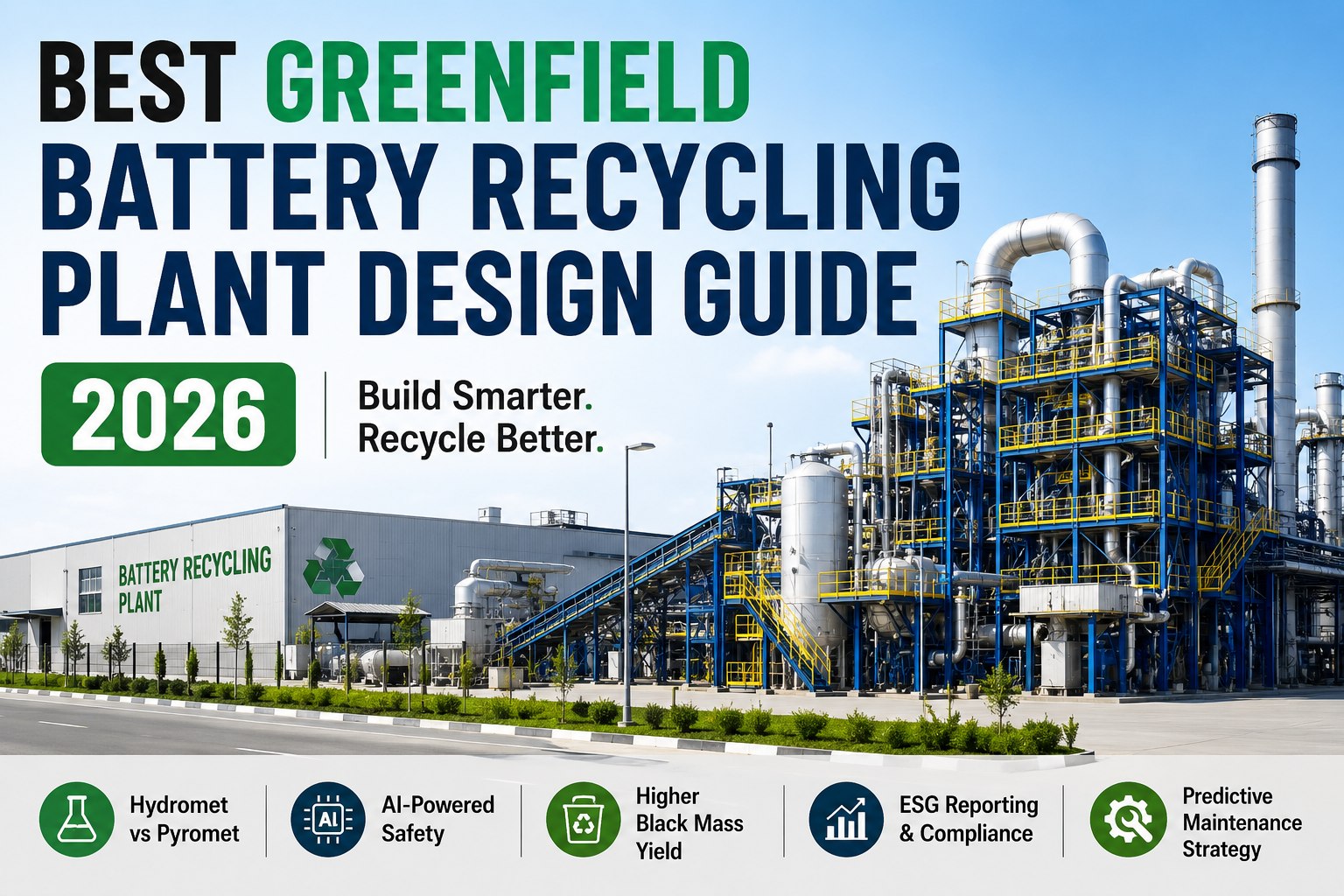
Building a greenfield battery recycling plant in 2026 means designing for a market that has nearly doubled in two years — and for regulations that now dictate how much lithium, cobalt, and nickel you are legally required to recover. Every early decision, from process route to plant layout to fire safety, locks in your recovery yield, your compliance position, and your cost per tonne for the next decade. This guide walks through the design choices that separate a profitable, audit-ready facility from a stalled one, and shows where a live AI plant-monitoring walkthrough turns a recycling line into a self-optimizing asset.
Planning a greenfield recycling facility this year? Book a 30-minute greenfield design consultation with an iFactory plant specialist to pressure-test your process route, safety architecture, and yield targets.
What a Recycling Plant Recovers — and Why It Pays
Why 2026 Is the Year to Build a Greenfield Recycling Plant
The economics have crossed the line from speculative to strategic. The global EV battery recycling market is climbing toward roughly $16.4 billion in 2026, up from about $13 billion in 2025, while installed processing capacity has reached around 1.6 million tonnes per year worldwide. Feedstock is no longer the constraint it once was: end-of-life and production scrap is projected to rise from roughly 1.4 million tonnes in 2026 to between 5 and 7 million tonnes annually by 2030. For a greenfield developer, that means a maturing supply of "urban ore" and OEMs actively hunting for closed-loop recycled-metal partners.
projected 2026 global EV battery recycling market, up from ~$13B in 2025
per-year global recycling capacity reached as of 2026
projected annual battery scrap by 2030, from ~1.4 Mt in 2026
cut in processing cost per tonne from automation versus 2024 levels
Regulation is pulling the rest of the industry forward. Under the EU Battery Regulation, black mass is set to be reclassified as hazardous waste in November 2026, restricting export and keeping critical metals onshore — and the Critical Raw Materials Act targets 25% of strategic raw materials from recycling by 2030. In the U.S., domestic-production incentives push the same direction. Even American operators increasingly design to these benchmarks, because OEM supply contracts and export markets demand the traceability they create.
Choosing Your Process Route: Hydrometallurgy vs Pyrometallurgy
This is the single most consequential design decision you will make, because it determines your recovery profile, energy footprint, output purity, and capital structure. Pyrometallurgy smelts black mass at extreme heat to produce a mixed metal alloy — fast and tolerant of mixed inputs, but it loses lithium to slag and carries a heavy emissions burden. Hydrometallurgy uses aqueous leaching at near-ambient temperatures to selectively dissolve and recover individual metals as battery-grade salts. For most greenfield lithium-ion plants in 2026, the selectivity and lithium recovery of the hydromet route win.
Design verdict: Hydrometallurgy is the default for new lithium-ion plants targeting high-purity, regulation-ready outputs. A mechanical front end feeding a hydromet core — sometimes with a small pyromet step for legacy or mixed chemistries — is the dominant 2026 architecture.
Not sure which route fits your projected feedstock mix? Schedule a process-route design session and we will model hydromet against pyromet for your specific volumes and chemistries.
Designing the Plant Layout: Six Zones That Define Throughput
A recycling plant is a sequence of dependent zones, and each one constrains the next. Designing them as an integrated line — rather than bolting stages together — is what protects your recovery yield and your safety margin. These six zones form the backbone of a modern greenfield hydromet facility.
Intake, Diagnostics & Safe Discharge
Incoming packs are assessed for state of health and fully discharged before handling. This is the highest-risk fire zone in the plant and must be engineered for thermal-event containment from the start.
Design constraint: thermal-rated quarantine & SoH loggingDismantling & Shredding
Packs are mechanically broken down and shredded. To suppress ignition and capture electrolyte off-gas, this zone is typically run under an inert or controlled atmosphere with robust dust and gas extraction.
Design constraint: inert atmosphere & off-gas extractionBlack Mass Production
Sieving and separation isolate the fine, metal-rich black mass from casings, copper, aluminum, and plastics. This concentrate is 40–50% of pack weight but carries the majority of recoverable value.
Design constraint: separation efficiency drives all downstream yieldLeaching & Solvent Extraction
The hydromet core: controlled acid or base solutions selectively dissolve lithium, nickel, cobalt, and manganese, which are then separated through solvent extraction stages tuned to your black mass composition.
Design constraint: chemistry-matched leach & SX trainsRefining & Crystallization
Recovered metals are purified and crystallized into battery-grade sulphates and carbonates. Tight process control here is what delivers the 95–99% nickel and cobalt recovery that makes the plant economical.
Design constraint: purity to battery-grade specEffluent Treatment & Reagent Recovery
Wastewater treatment and closed-loop reagent recirculation cut both operating cost and environmental footprint — and this is where your ESG and material-recovery reporting data is captured at the batch level.
Design constraint: closed-loop reagents & reporting hooksEngineering Safety In: AI Thermal-Runaway Detection
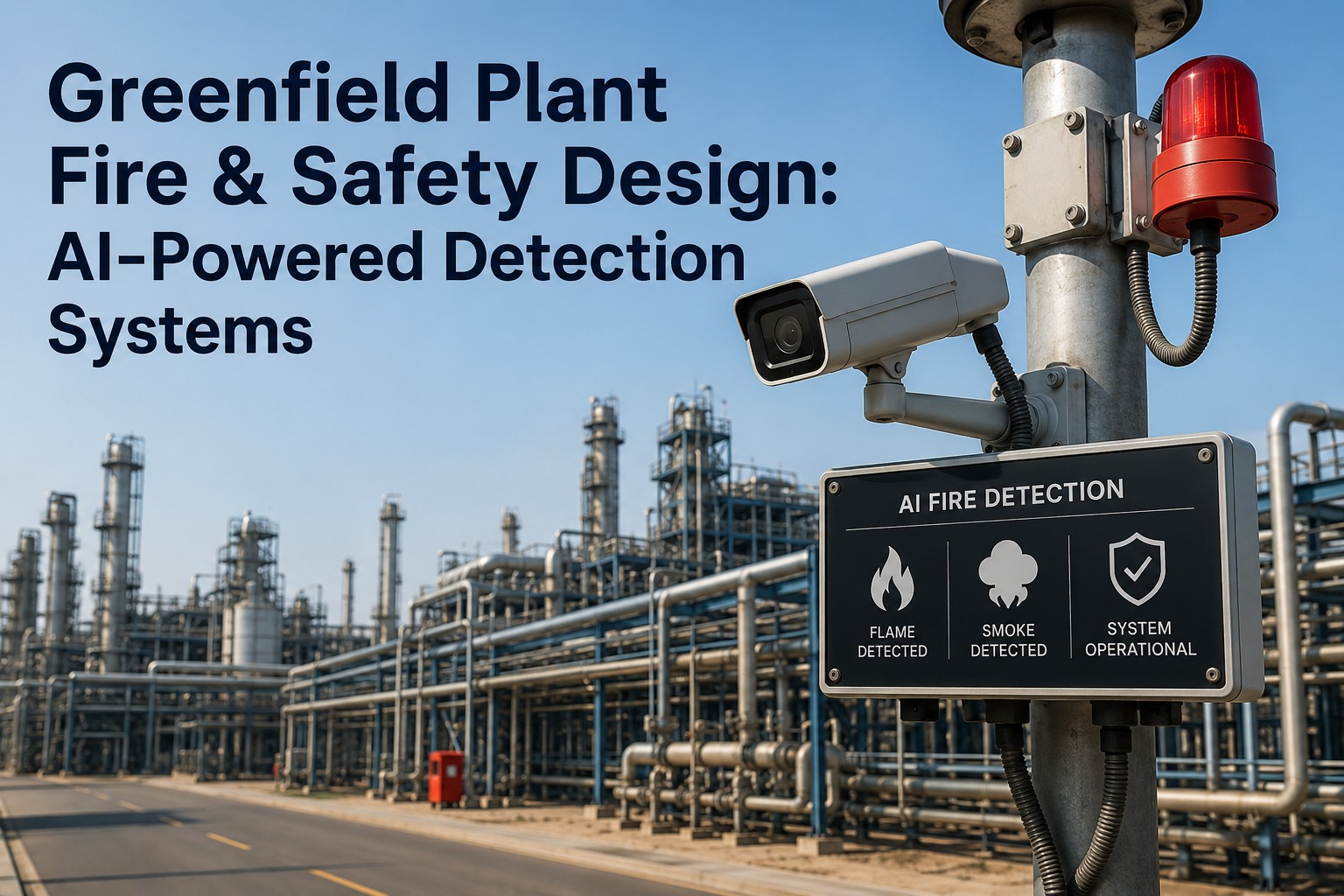
Fire is the defining design constraint of a battery recycling plant. The window between an abnormal temperature rise and a violent thermal event can be measured in seconds — and conventional smoke detectors only trigger once flame or smoke is already present, while point thermocouples miss localized hotspots in dense material. Layered AI detection moves the alarm earlier, into the window where intervention is still possible.
The intervention window lives in the first two stages. Layering AI gas and thermal detection across every zone — instead of relying on smoke alarms — is what lets operators cool or isolate a cell before a fire ever forms.
Beyond fire safety, the same sensing layer powers predictive maintenance. Vibration and thermal signatures from shredders, leaching agitators, and transfer pumps feed an AI model that flags degradation early and opens CMMS work orders before an unplanned stoppage idles the whole line. In a continuous process plant, that uptime is recovery yield you would otherwise lose.
See how iFactory layers AI thermal, gas, and vision detection across a live recycling line. Book a plant safety AI demo to walk through the detection architecture for your design.
ESG, Compliance & Recovery Economics for 2026
The compliance calendar is now part of plant design, not an afterthought. Reporting has shifted from total recycled weight toward granular material recovery efficiency — how many grams of each critical metal you actually return to the supply chain. Designing batch-level mass-balance tracking into the line from day one is the difference between an audit-ready facility and one that fails third-party verification. Battery-passport-ready composition data can also trim downstream pre-treatment costs by 10–20%.
On economics, the trend favors new entrants: automation and scale are cutting processing cost per tonne by 20–30% versus 2024, and a single 75 kWh NMC pack still holds more than $2,000 of recoverable metal. A plant that pairs a high-recovery hydromet route with automated safety and data capture isn't just compliant — it has a structurally lower cost base than a manual operation.
Design for Yield and Compliance from Day One
iFactory's AI platform unifies thermal-runaway detection, predictive maintenance, and batch-level material-recovery tracking — so your greenfield plant hits recovery targets, passes audits, and runs safely from the moment it commissions.
Expert Perspective
The plants that struggle are the ones that treat safety and data capture as things to add after commissioning. By then the camera positions, sensor coverage, and batch-tracking points are fixed by the physical layout. Designing thermal and gas detection into every zone — and wiring recovery data straight into the reporting layer — is far cheaper at the drawing-board stage than retrofitting it under a compliance deadline. Get those decisions right early and the plant essentially audits itself.
— Greenfield Recycling Plant Design Practice, iFactory Engineering Team
Ni & Co recovery achievable with hydromet and tight process control
temperature rise AI thermal imaging detects before any fire signature
lower pre-treatment cost from passport-ready composition data
The Bottom Line
A successful greenfield battery recycling plant in 2026 rests on four design pillars: the right process route, an integrated zone layout, AI-driven safety, and traceable recovery data. Hydrometallurgy gives most new lithium-ion plants the selectivity and lithium recovery the market and regulators now demand; a well-sequenced layout protects yield; layered AI detection moves you from fighting fires to preventing them; and batch-level reporting turns compliance from a liability into a competitive moat. Decide these at the drawing board, and you build a plant that is profitable, safe, and audit-ready for the decade ahead.
Build It Right the First Time
From process-route modeling to AI safety architecture and passport-ready data capture, iFactory helps greenfield teams design recycling plants that are profitable, safe, and audit-ready — and reach stable recovery yields faster.
Frequently Asked Questions
Hydrometallurgy or pyrometallurgy — which is better for a new lithium-ion recycling plant in 2026?
For most greenfield lithium-ion plants, hydrometallurgy is the stronger default. It recovers lithium that pyrometallurgy loses to slag, produces battery-grade salts directly, runs at far lower energy and emissions, and scales modularly. Pyrometallurgy still suits high-throughput mixed or legacy chemistries, which is why many plants pair a mechanical front end with a hydromet core.
How much metal value can a greenfield plant actually recover from black mass?
Black mass is 40–50% of an EV pack's weight but concentrates most of the recoverable value. With a well-controlled hydromet process, plants reach 95–99% recovery for nickel and cobalt and 85–95% for lithium. A single 75 kWh NMC pack holds upward of $2,000 in recoverable metal, which is what makes the economics work at scale.
What are the biggest safety risks when designing a battery recycling plant, and how does AI help?
Thermal runaway is the dominant risk, and the gap between an abnormal temperature rise and a fire can be seconds. Conventional smoke detectors react too late, and point thermocouples miss localized hotspots. AI gas and thermal-imaging layers detect off-gassing and 1–2°C rises earlier, giving operators time to cool or isolate a cell before ignition.
What 2026 regulations should a greenfield battery recycling plant design for?
Key items include the 65% lithium-ion recycling efficiency baseline, carbon footprint declarations for industrial batteries, black mass reclassified as hazardous waste in late 2026, and the Digital Battery Passport from 2027. Recovery targets and recycled-content minimums then tighten through 2031, so designing batch-level material-recovery tracking in now prevents costly retrofits later.
How does iFactory support greenfield battery recycling plant design?
iFactory provides the AI layer that ties a recycling plant together: thermal and gas detection for fire prevention, predictive maintenance to protect uptime, and batch-level recovery tracking for audit-ready reporting. We help design that architecture into the layout before commissioning. You can book a greenfield design consultation to map it to your facility.