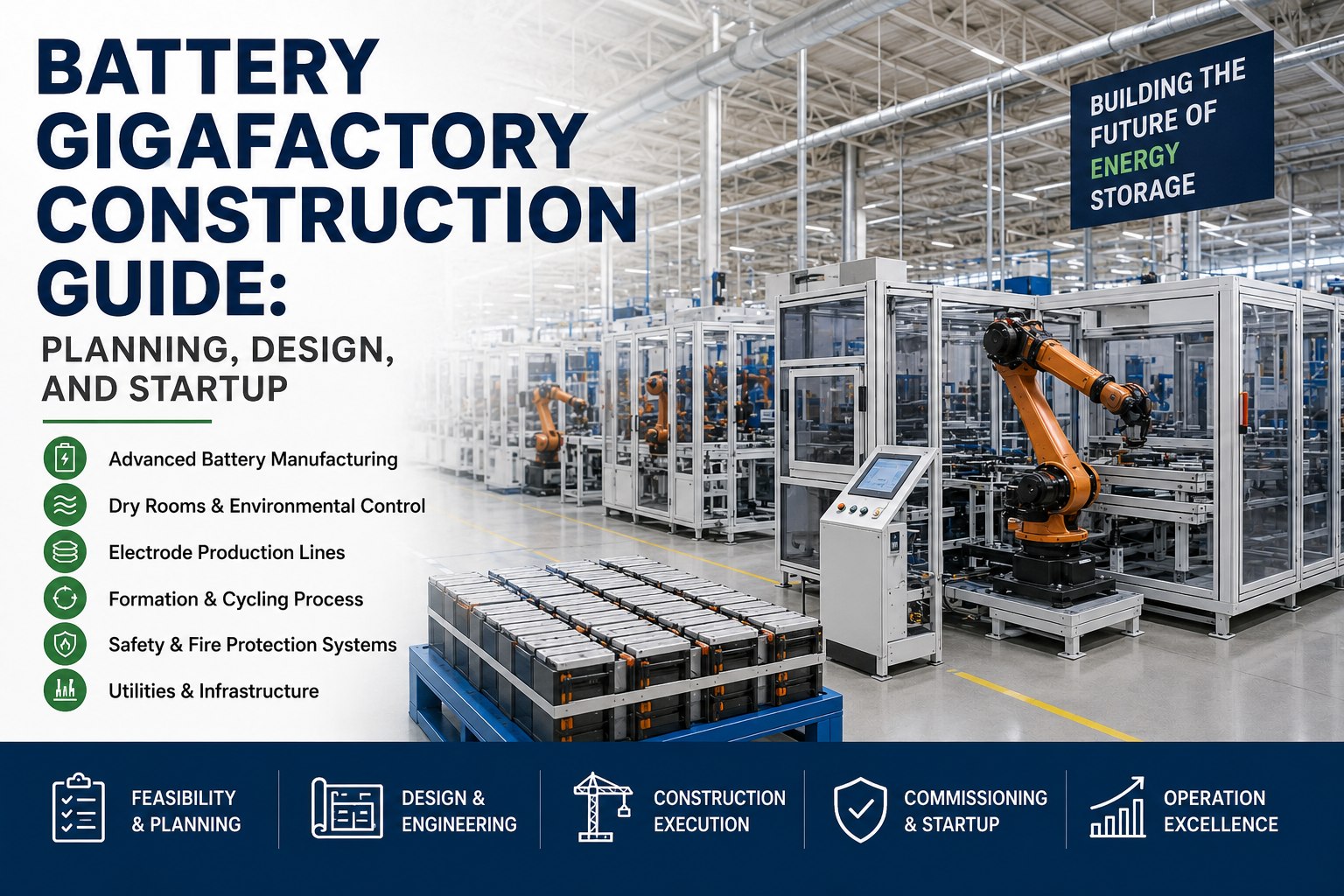
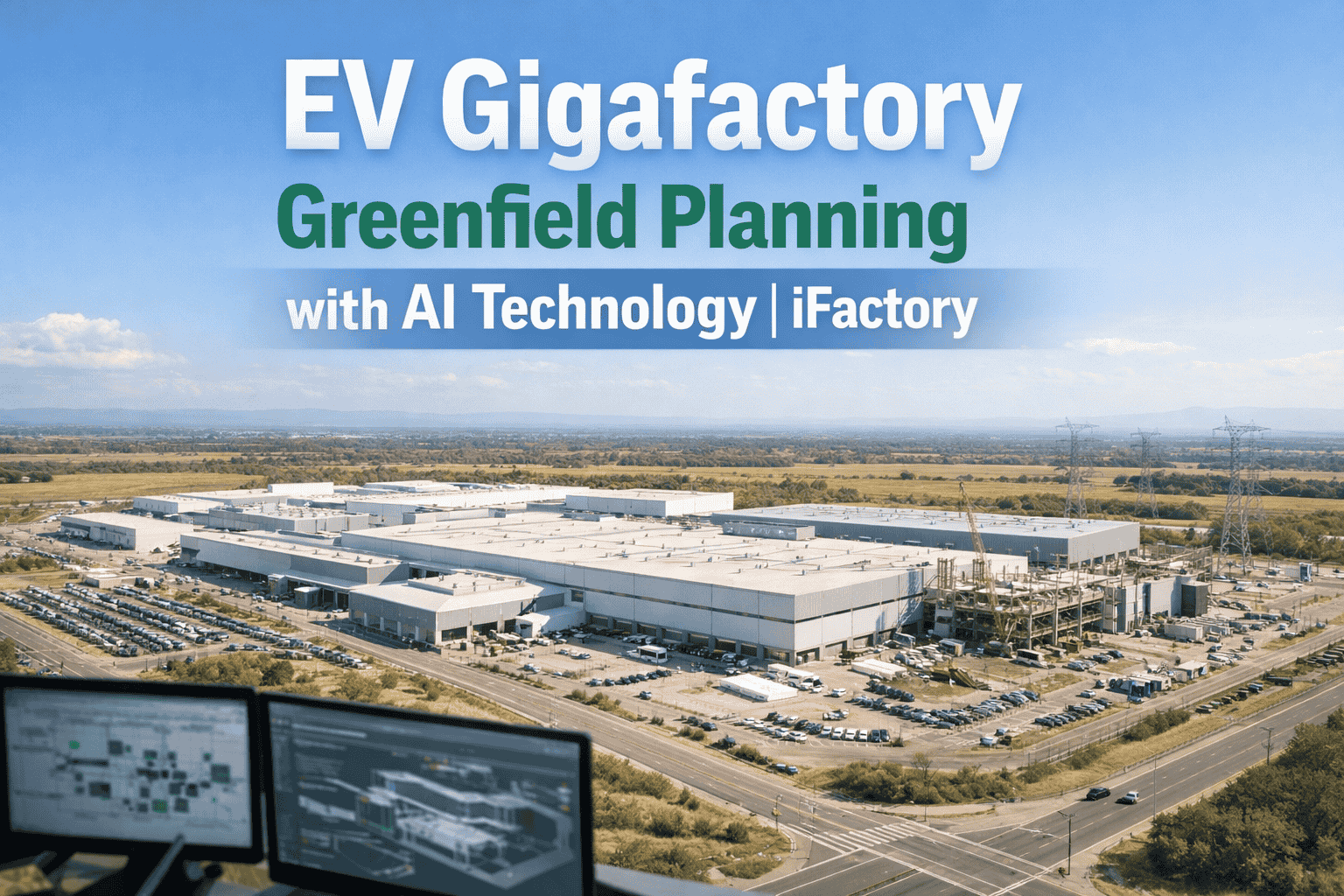
A battery gigafactory isn't a bigger version of a normal factory — it's a different category of industrial building. The cell assembly zone needs a dew point of -40°C to -60°C (drier than the driest desert on Earth). Formation and aging create the highest concentrated fire risk in modern manufacturing, demanding NFPA 855-compliant suppression and isolated wings with reinforced firewalls. A typical 40 GWh facility consumes the electrical load of a small city, recovers 96% of process water in closed loops, and integrates 12+ MW of captive solar. Construction CAPEX runs $1B-$5B, build timelines stretch 24-36 months, and ramp-to-nameplate adds another 18-24 months. Up to 150 gigafactories are planned globally — 30 in Europe alone. The ones that hit nameplate on schedule do five things right at design stage. This guide covers the production flow, dry room engineering, fire protection architecture, utilities at scale, and the construction timeline. Book a gigafactory readiness assessment for your project.
01
Electrode Production
Mix · coat · dry · calender · slit
ISO Class 7 · NMP solvent recovery
→
02
Cell Assembly
Stack · weld · fill · seal
DRY ROOM · -40 to -60°C dew point
→
03
Formation & Aging
First charge · SEI · aging · QC
NFPA 855 · isolated wing · firewall
→
04
EOL Testing
Capacity · resistance · safety
High-throughput automated
→
05
Module / Pack
Cells → modules → packs · BMS
Standard industrial environment
Why Gigafactory Construction Is Unlike Any Other Industrial Build
The five differentiators below are what separate a successful gigafactory build from a stalled one. Each demands engineering disciplines that traditional EPC firms don't have on staff. Treat them as the design constraints that drive every downstream decision.
01
Drier Than the Sahara Inside
Cell assembly dry rooms need -40°C to -60°C dew point. Desiccant dehumidification, vapor barriers, airlocks. VW Salzgitter's dry room covers five soccer fields — engineered like a clinical cleanroom plus a desert.
02
Highest Concentrated Fire Risk
Formation areas charge thousands of cells simultaneously at varying SOC. NFPA 855 mandates water-cooling suppression (clean agents don't stop thermal runaway). Isolated wings with reinforced firewalls are standard 2026 design.
03
Small-City Electrical Load
A 40 GWh plant draws 200-400 MW. Formation cycling is the dominant load. Captive solar (10-50 MW), on-site substations, and N+1 redundancy aren't optional — they're foundational design assumptions.
04
Five Different Buildings Under One Roof
Each production stage has dramatically different HVAC, cleanliness, flooring, lighting, and safety requirements. The "gigafactory" is actually five engineered envelopes connected by automated logistics.
05
Digital From the Foundation
EU Battery Regulation 2026 requires digital battery passports from 2027. Every cell >2kWh needs a digital twin from day one. The plant is "a data center that also produces batteries" — IT/OT architecture is build-stage, not retrofit.
The 5 Production Stages · Detailed
Each stage has its own facility requirements, equipment vendors, failure modes, and safety standards. The deep-dive below shows what to engineer for each stage and why mixing the requirements across zones creates build delays measured in months.
Stage 01
Electrode Production
Active material + binder + solvent mixed into slurry. Slurry coated onto copper (anode) or aluminum (cathode) foil. Dried in long ovens. Calendered for density. Slit to final width. NMP solvent recovery is mandatory — capital-intensive and emissions-controlled.
Stage 02
Cell Assembly · The Dry Room
Electrode stacks/winds inserted into casing. Tabs welded. Electrolyte injected. Sealed. Every step happens in -40°C to -60°C dew point air — any moisture exposure ruins cells and creates safety hazards. The signature engineering challenge of every gigafactory.
Stage 03
Formation & Aging
Cells charged for the first time to form the SEI (solid electrolyte interphase). Then aged for days to stabilize. Thousands of cells cycling simultaneously. The highest concentrated fire risk in modern manufacturing — and the section that drives the entire fire protection design.
Stage 04
End-of-Line Testing
Capacity, internal resistance, safety, and electrical characteristic testing on every cell. Automated handling and high throughput. Bad cells diverted; good cells binned by performance for matched assembly into modules.
Stage 05
Module & Pack Assembly
Tested cells matched and assembled into modules. Modules integrated with cooling, BMS, and structural housing into packs. Standard industrial environment with safety controls. Often a separate building or wing connected by AMR logistics.
Engineer Every Stage of the Gigafactory to Spec
iFactory's gigafactory practice delivers integrated design across all five production stages — electrode lines, dry room engineering, formation wing fire protection, EOL testing automation, and pack assembly logistics. Built for full nameplate ramp on schedule.
Dry Room · The Heart of the Gigafactory
If one thing defines battery gigafactory engineering, it's the dry room. Every cell assembly step happens inside it. Every moisture spec violation ruins production. Every kilowatt of dehumidification compounds in OPEX over decades. The reference design specs below are what world-class facilities aim for.
Specification
Standard Spec
World-Class Spec
Engineering Note
Dew Point
-40°C
-60°C or lower
Lower dew point = stricter desiccant + airlock control
Cleanliness
ISO Class 7-8
ISO Class 6 (cell stacking)
Particles >0.5μm critical for electrolyte filling
Temperature
20-25°C
22°C ±1°C
Tight band protects electrolyte chemistry
Pressure
+20 Pa positive
+25-30 Pa positive
Positive pressure prevents moisture infiltration
Footprint
5,000-15,000 m²
30,000+ m² (large GWh plants)
VW Salzgitter dry room = 5 soccer fields
HVAC Energy
~30% of plant load
20-25% (heat recovery)
Largest single energy consumer in the plant
Need dry room engineering for your gigafactory? Book a dry room design session with our battery facility specialists.
Fire Protection Architecture · NFPA 855 Compliance
Battery fire protection is fundamentally different from any other industrial occupancy. Thermal runaway can't be extinguished by smothering — it generates its own oxygen. The only effective response is water-based cooling. The layered defense below is the modern NFPA 855-compliant standard for gigafactory fire protection.
Layer 1
Prevention & Detection
Early off-gas detection (hydrogen, electrolyte vapors). Thermal imaging on formation racks. BMS state monitoring. Cell-level temperature sensing. Goal: catch thermal events 5-15 min before runaway.
Layer 2
Compartmentation
Formation and aging in isolated wings. Reinforced firewalls (2-4 hour rated). Smoke and gas isolation between bays. Separate ventilation systems. Prevents single-cell event from cascading plant-wide.
Layer 3
Suppression & Cooling
Water-based deluge or pre-action sprinklers. Purpose-designed battery suppression where applicable. Clean agents DO NOT stop thermal runaway. Cooling water capacity sized for worst-case formation rack failure.
Layer 4
Ventilation & Gas Management
Mechanical ventilation sized for hydrogen and toxic gas release. Explosion venting for high-risk zones. Automatic dampers and exhaust paths to safe discharge. NFPA 30 compliance for electrolyte storage.
Layer 5
Emergency Response Plan (ERP)
Pre-engineered ERP developed with AHJ and local fire department. Pre-incident plans, hazmat protocols, training. NFPA 855 mandates ERP as a design document — not afterthought.
Need NFPA 855-compliant fire protection design? Connect with our battery safety team for a layered protection review.
Utilities at Gigafactory Scale
A gigafactory consumes utilities like a small city. Each utility has its own engineering challenges, redundancy requirements, and sustainability optimization opportunities. The four-pillar template below shows the design baselines for a 40 GWh-scale facility.
Utility 01
Electrical
200-400 MW peak load for 40 GWh plant. On-site substations (often 220 kV or 400 kV connection). N+1 redundancy on critical buses. Captive solar 10-50 MW typical. UPS and diesel backup for formation cycling safety.
200-400 MW · on-site substations · N+1
Utility 02
Process Water & Closed-Loop
High-purity water for slurry, formation cooling, and cleaning. Closed-loop systems recover 90-96% of process water. ZLD (zero liquid discharge) increasingly mandated by permitting authorities. Sized for 4-5 million m³ annual baseline.
96% closed loop · ZLD · high-purity feed
Utility 03
HVAC & Dehumidification
Dry room HVAC is the single largest utility load (~30% of plant). Desiccant wheels + cooling coils + heat recovery from formation cycling. Critical to optimize with VFDs and AI controls — energy bill compounds over 25-year facility life.
~30% of plant load · desiccant + recovery
Utility 04
Inert Gas & Compressed Air
Argon for select welding and inert atmospheres. Nitrogen for dry purge and electrolyte handling. Compressed air for pneumatics across the plant. Inert gas storage and distribution sized for peak demand + safety margin.
Argon · nitrogen · compressed air at scale
Need utility infrastructure sizing for your gigafactory? Book a utilities engineering review with our facility specialists.
Construction & Startup Timeline
From greenlit board approval to nameplate production, expect 42-60 months. The phased timeline below shows how successful gigafactory builds sequence parallel workstreams. Compressing any single phase typically pushes downstream phases out by more time than was saved.
Phase 1
Site & Permitting
Site selection · environmental permits · AHJ engagement · utility commitments · incentive negotiation
Months 0-9
→
Phase 2
Design & Engineering
Concept design · process flow · dry room engineering · NFPA 855 fire protection · utilities sizing
Months 6-15
→
Phase 3
Civil Construction
Earthworks · foundations · structural steel · building envelope · floor slabs to spec
Months 12-24
→
Phase 4
Equipment & Fit-Out
Electrode lines · dry room HVAC · formation racks · testing equipment · fire systems · utilities tie-in
Months 20-32
→
Phase 5
Commissioning
Cold · hot · wet commissioning · first cells produced · quality validation · AHJ certification
Months 30-42
→
Phase 6
Ramp to Nameplate
Yield improvement · cycle time optimization · OEE climb · full nameplate capacity
Months 36-60
Expert Perspective
The gigafactories that hit nameplate on schedule share three discipline habits. First: they treat the dry room and the formation wing as the project schedule's critical path — every other workstream sequences around them, never the reverse. Second: they engage the AHJ and fire department on NFPA 855 in month one, not month thirty. The fire protection design is not something you tack on at the end — it shapes building geometry, ventilation, water supply, and emergency egress. Third: they accept that ramp-to-nameplate is its own phase, not a finishing touch. First cell off the line to full nameplate takes 18-24 months in well-run facilities — and the design has to support that yield-improvement journey, not just the day-one process. Get those three right and a $1B-$5B project hits its commercial window. Miss any one and ramp slips a year.
— Battery Gigafactory Construction Best Practice
-40 to -60°C
Dry room dew point requirement
200-400 MW
Electrical load for 40 GWh plant
NFPA 855
Standard fire protection compliance
96%
Process water closed-loop recovery
Bottom Line · Five Buildings, One Roof, One Schedule
A battery gigafactory is five different engineered buildings — electrode production, dry room cell assembly, formation wing, EOL testing, module-pack assembly — connected under one roof and one schedule. The dry room defines the dehumidification engineering. The formation wing defines the fire protection. The cell process defines the utility scale. The digital battery passport mandate defines the IT/OT architecture. Get the five stages designed coherently and the project hits its 42-60 month window from board approval to nameplate. Get any one stage wrong — under-spec dew point, under-sized fire suppression, under-allocated electrical load — and the build slips by quarters that compound into years. The 150 gigafactories planned globally will split into two groups: the ones that ramped to nameplate on schedule and the ones that didn't. The difference is what gets engineered in design.
Build a Gigafactory That Hits Nameplate on Schedule
iFactory's gigafactory practice delivers integrated design and digital twin from concept through ramp — site selection, dry room engineering, NFPA 855 fire protection, utilities at scale, EU Battery Passport architecture, and 42-60 month construction sequencing. Built for full nameplate on commercial commitments.
Frequently Asked Questions
What are the 5 production stages in a battery gigafactory?
1) Electrode Production (mix · coat · dry · calender · slit, ISO Class 7), 2) Cell Assembly (stack · weld · fill · seal in dry room at -40°C to -60°C dew point), 3) Formation & Aging (first charge · SEI formation · highest fire risk · NFPA 855 wing), 4) End-of-Line Testing (capacity · resistance · safety · binning), 5) Module/Pack Assembly (cells → modules → packs · BMS integration).
What dew point does a battery gigafactory dry room need?
-40°C dew point is standard; -60°C or lower is world-class. Lower dew point means stricter desiccant wheels, vapor barriers, and airlock control. The dry room covers 5,000-30,000+ m² in large GWh plants — VW's Salzgitter dry room covers five soccer fields. HVAC for the dry room consumes ~30% of total plant energy, making heat recovery from formation cycling critical to OPEX.
Why is fire protection different in battery gigafactories?
Battery thermal runaway generates its own oxygen — clean agent suppression (FM-200, Inergen) doesn't stop it. NFPA 855 mandates water-based cooling or purpose-designed battery suppression. Formation/aging is the highest fire-risk zone, requiring isolated wings with 2-4 hour reinforced firewalls, dedicated ventilation, and pre-engineered emergency response plans coordinated with AHJ and fire department.
How much does a battery gigafactory cost to build?
Typical CAPEX: $1B-$5B+ depending on scale and product chemistry. A 40 GWh facility (enough for 500,000 EVs) runs $2-3B typical. A 5 GWh smaller facility runs $200-400M. Construction takes 24-36 months; ramp to nameplate adds another 18-24 months. Total board-approval-to-full-production: 42-60 months. Up to 150 gigafactories are planned globally, with 30 in Europe alone.
What utilities does a 40 GWh gigafactory consume?
Electrical: 200-400 MW peak (small city scale), often with on-site substation at 220-400 kV and 10-50 MW captive solar.
Process water: 4-5 million m³ annually with 90-96% closed-loop recovery and increasingly ZLD-mandated.
HVAC/dehumidification: ~30% of plant energy load.
Inert gas: argon and nitrogen at scale for welding and dry purge.
Book a utilities sizing review for your project's specific scale.