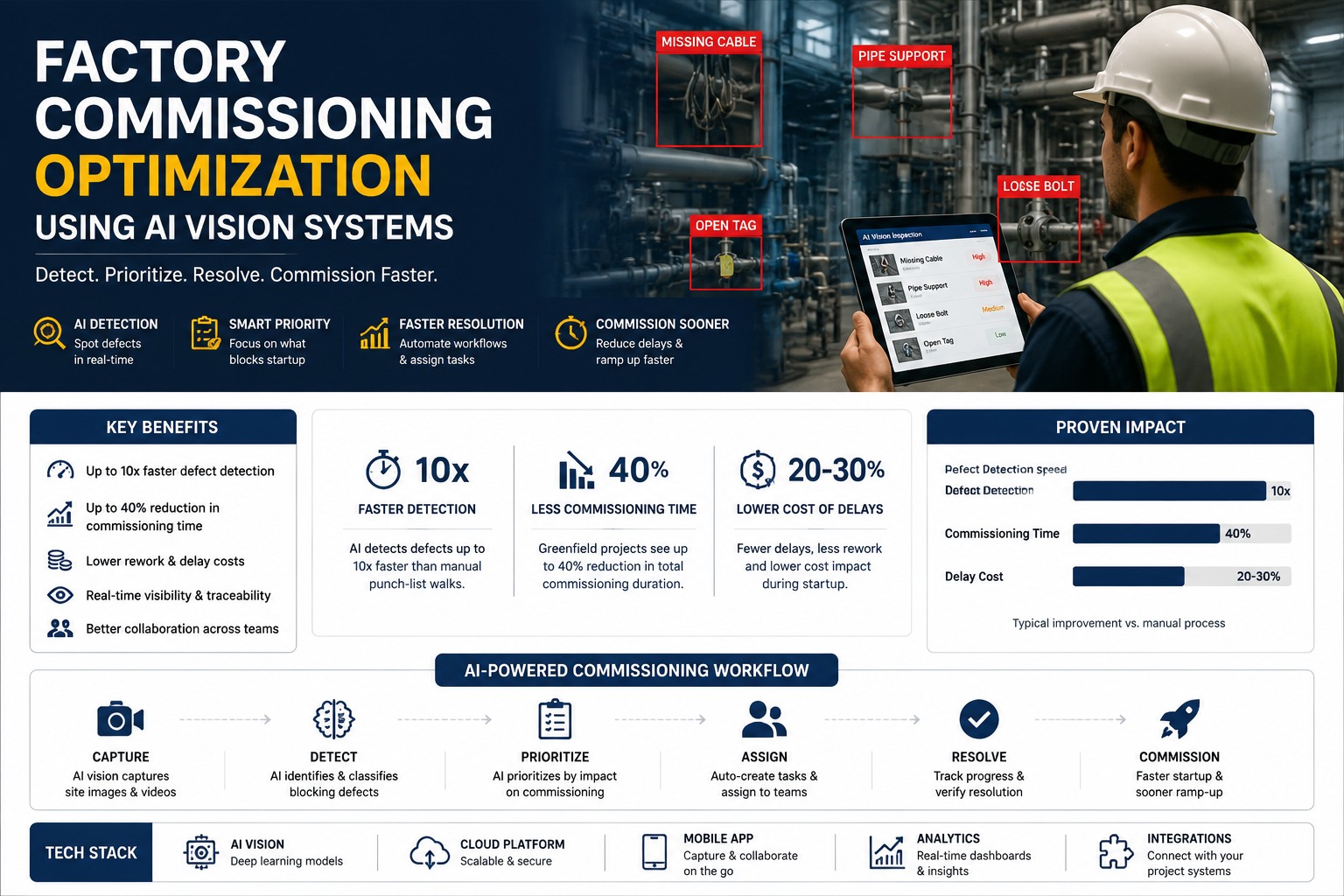
Your greenfield plant is built. Equipment is installed. Labor is on-site. And every single day of commissioning delay now costs between $50,000 and $500,000 in lost production. The traditional answer — manual punch-list walks by engineers with clipboards — misses defects, moves slowly, and cannot scale to the complexity of a modern facility. AI vision systems change that equation permanently. They detect commissioning-blocking defects up to 10× faster than manual inspection, automate punch-list generation in real time, and give your commissioning team the data clarity to compress a 14-week startup into 8.
See how iFactory's AI vision platform accelerates commissioning — book a 30-minute walkthrough with a greenfield commissioning specialist.
Why Traditional Commissioning Walks Are Breaking Down
Modern greenfield facilities are commissioning environments of unprecedented complexity. A mid-size automotive or food processing plant can contain 800 to 2,000 individual inspection points across electrical panels, mechanical connections, piping runs, safety interlocks, and structural installations. Manual punch-list walks assign two to four engineers to cover this terrain — humans who tire, whose accuracy degrades after 20 minutes of continuous visual inspection, and whose reports hit the CMMS hours after they leave the floor. The result is a commissioning bottleneck that extends timelines by weeks.
of commissioning delays trace to control software errors and missed integration defects
maximum daily cost of commissioning delay for large-scale greenfield facilities
more critical defects found by AI vs. expert human inspectors under optimal conditions
reduction in total commissioning time achievable with AI vision integration
Every week of commissioning delay compounds your losses. Schedule a commissioning acceleration workshop with iFactory's greenfield specialists to map your specific risk points.
How AI Vision Systems Work in a Commissioning Environment
AI vision for commissioning is not the same as production-line quality inspection. You are not inspecting finished products at speed — you are inspecting static and semi-static installations across a large physical area for correctness, completeness, and safety compliance. The AI vision architecture for commissioning reflects that distinction entirely.
Camera Network Deployment
High-resolution industrial cameras — fixed, pan-tilt-zoom, and mobile robotic variants — are deployed across commissioning zones. Specialized lighting rigs reveal defects invisible under standard illumination: cable routing errors, missing fasteners, pipe alignment gaps, and label verification failures.
Coverage: 100% of assigned zonesDeep Learning Defect Recognition
CNN-based models pre-trained on commissioning defect libraries analyze each frame in under 200 milliseconds. The system classifies defects by type, severity, and location — misaligned equipment, incorrect torque indicators, missing safety guards, mislabeled panels, incomplete weld profiles — with 99%+ accuracy.
Inference speed: <200ms per frameAutomated Punch-List Generation
Each defect is automatically logged to a digital punch list with photographic evidence, GPS-tagged location, defect classification, and suggested resolution action. Items are categorized as Pass, Conditional Pass, or Hold — and routed instantly to the responsible contractor or engineering discipline.
Zero manual data entry requiredResolution Verification & CMMS Integration
When a contractor resolves a punch-list item, AI vision re-inspects the location to confirm closure. Verified closures automatically update the CMMS work order, advance the commissioning milestone tracker, and release the zone for the next commissioning phase — without an engineer re-walk.
CMMS auto-update: real-timeThe Commissioning Defect Taxonomy: What AI Vision Catches
Understanding what AI vision detects in a commissioning context helps commissioning managers plan camera coverage and set realistic punch-list volume expectations. The defect categories below represent the most common commissioning-blockers in greenfield facilities — issues that, if missed during initial walks, surface as critical holds during FAT or SAT.
Mechanical
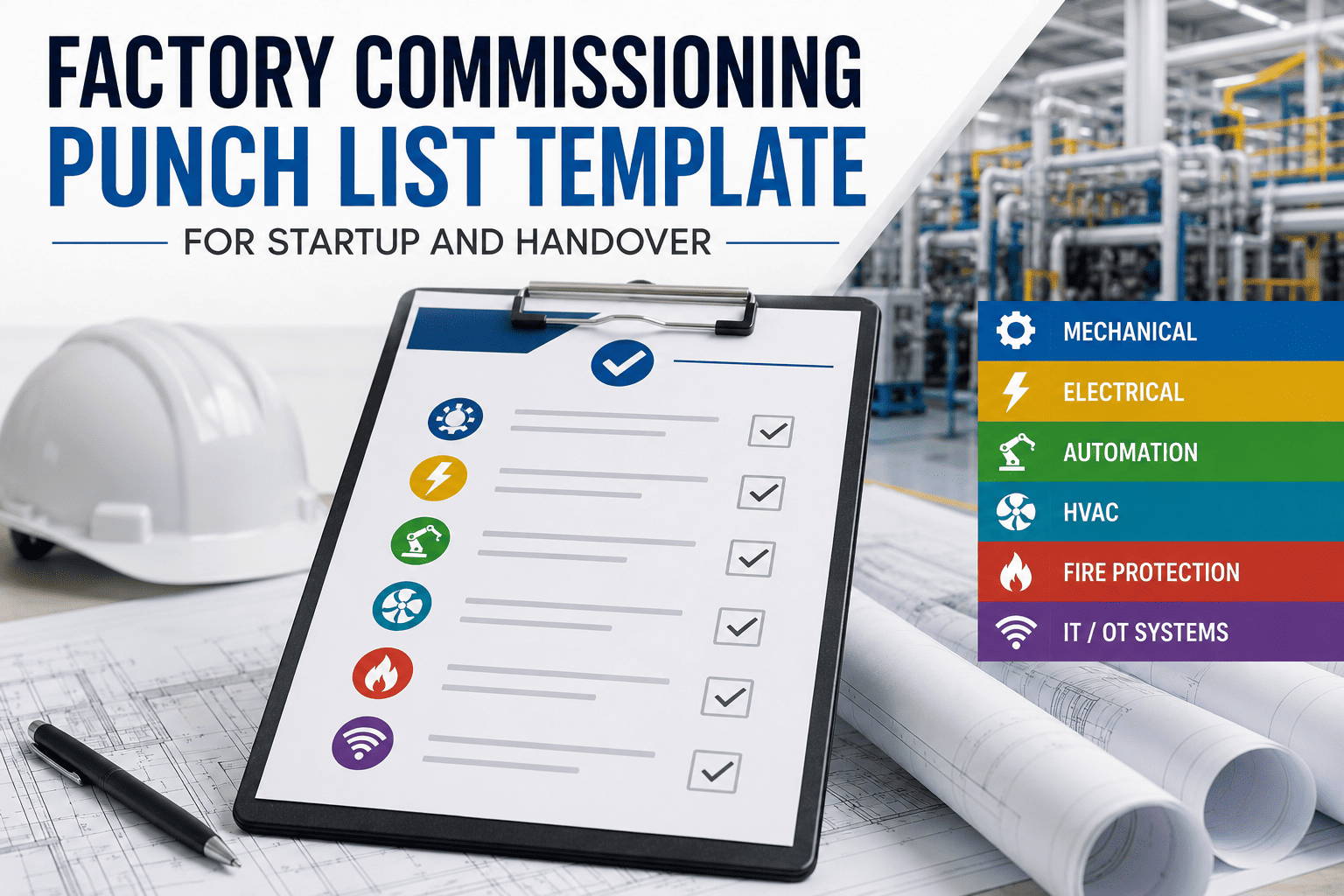
Missing fasteners, incorrect torque, pipe misalignment, gasket absence, coupling gaps
Electrical
Incorrect cable routing, unlabeled terminations, exposed conductors, missing conduit covers
Safety & Compliance
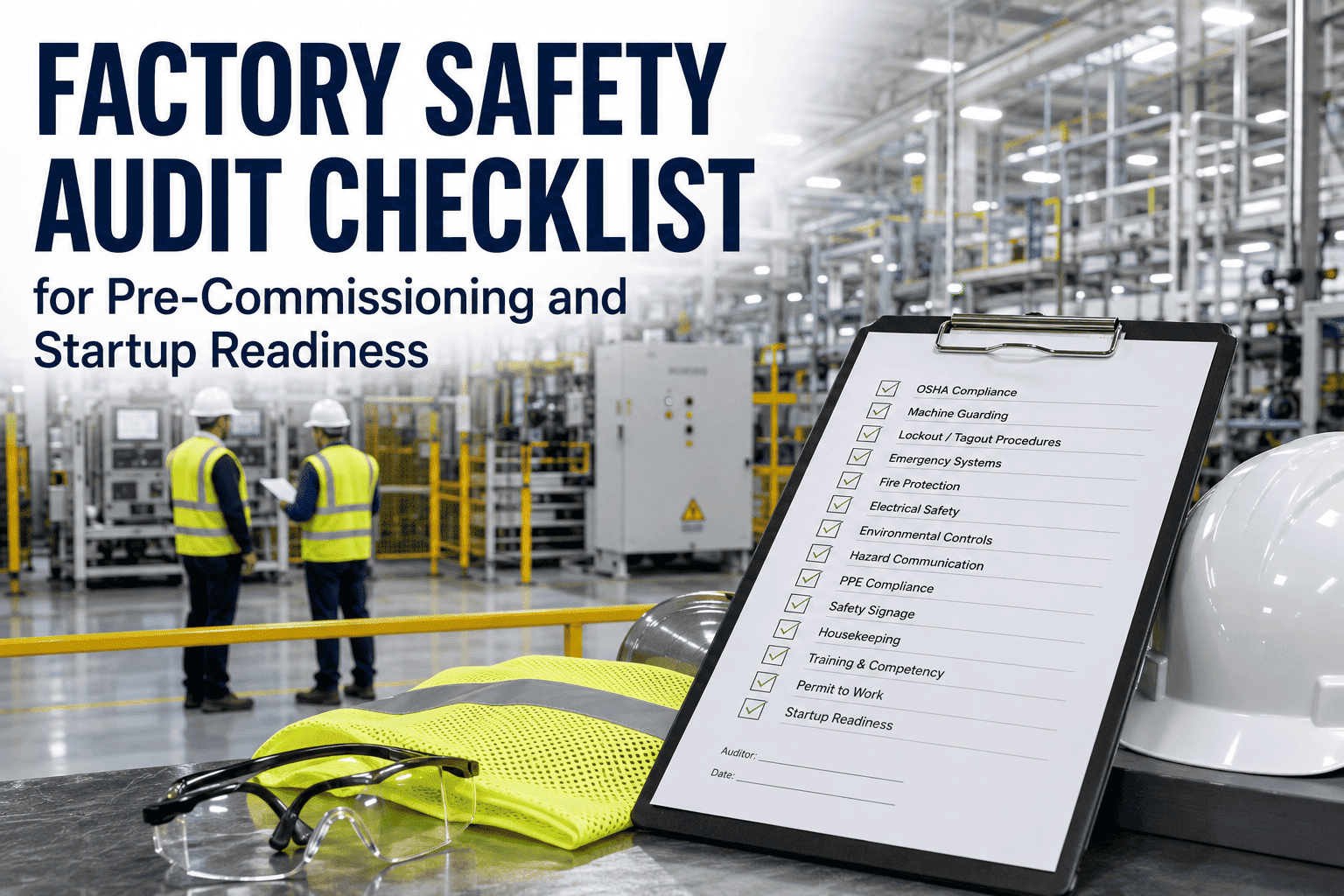
Missing guards, incorrect signage, blocked emergency access, PPE station gaps, lockout tag issues
Instrumentation
Wrong sensor orientation, tag mismatch, calibration seals missing, junction box sealing failures
Structural
Weld profile defects, surface coating gaps, structural bolt omissions, anchor plate issues
Documentation
As-built label discrepancies, P&ID mismatch, incomplete hydrostatic test stamps, spec plate errors
Not sure which defect categories are highest-risk for your facility type? Talk to our commissioning vision specialists for a scoped coverage plan.
Cut Your Commissioning Timeline by Up to 40%
iFactory's AI vision platform automates punch-list generation, accelerates defect closure verification, and integrates with your CMMS from day one of commissioning — so your team resolves issues in days, not weeks.
Commissioning Phase Benchmarks: Manual vs. AI Vision
The performance difference between manual and AI-assisted commissioning compounds across every phase of the startup sequence. The table below shows real-world benchmarks from greenfield facilities that have deployed AI vision — highlighting where the time savings accumulate fastest.
Want these benchmarks modeled against your specific commissioning scope? Request a commissioning timeline analysis — iFactory builds the projection from your facility specifications.
Integrating AI Vision Across the FAT / SAT / Startup Sequence
AI vision for commissioning does not replace your commissioning engineers — it makes each one capable of supervising five times more area. The integration pattern that delivers the fastest commissioning compression pairs AI visual coverage with human decision authority: AI surfaces, classifies, and routes; the engineer reviews, approves, and escalates. Here is how that maps onto the standard commissioning sequence.
Factory Acceptance Testing
AI vision is deployed at the vendor's facility to document baseline equipment condition, verify specification compliance, and generate the initial punch list before equipment ships. Photo-documented FAT records travel with the asset.
Gain: Fewer surprises on site arrivalSite Acceptance Testing
Cameras deployed across installed equipment zones perform continuous comparison against FAT baseline images. Installation damage, missing components, and configuration deviations are flagged automatically within hours of equipment hookup.
Gain: Same-day detection of installation defectsLoop Check & I/O Verification
AI vision cross-references physical tag installations against instrument schedules, confirms correct I/O wiring at panel level, and flags label discrepancies before loop check sequences begin — eliminating the most time-consuming rework loops.
Gain: Up to 60% reduction in loop check reworkProduction Ramp-Up
As production begins, AI vision transitions from commissioning inspection to ongoing quality monitoring — detecting surface defects, assembly errors, and process deviations at line speed. The same camera network that commissioned your facility now protects your ramp-up quality.
Gain: Day-one production quality protectionExpert Perspective
The fatigue factor is what most commissioning managers underestimate. A trained inspector's defect catch rate drops measurably after 20 minutes of continuous visual inspection under typical site conditions. AI vision doesn't experience that curve — it applies identical criteria to the first inspection point and the two-thousandth. On a complex greenfield with 1,500+ punch-list items, that consistency difference is the difference between a commissioning schedule and a commissioning delay.
— Greenfield Commissioning Best Practice, iFactory Engineering Team
AI defect detection accuracy vs. 70–80% manual
Schedule saved per project with virtual commissioning
of PLC logic validated before physical commissioning via digital twin
Start Your Commissioning Acceleration Plan
From automated punch-list generation to CMMS-integrated defect closure — iFactory's AI vision platform compresses commissioning timelines and gives your team real-time visibility across every installation zone. Greenfield plants using iFactory reach production readiness up to 40% faster.
Frequently Asked Questions
How does AI vision integrate with a digital punch list system during commissioning?
AI vision cameras continuously monitor commissioning zones and detect defects in real time — automatically generating punch-list entries with photo evidence, GPS-tagged location, defect classification, and suggested resolution action. Each item is routed immediately to the responsible contractor or engineering discipline via the CMMS. When a resolution is submitted, AI re-inspects the location to confirm closure before the item is marked complete. This eliminates manual data entry, re-walks, and the reporting lag that typically delays punch-list completion by days on conventional projects.
What types of commissioning defects can AI vision detect that manual walks typically miss?
Manual inspection miss rates are highest in documentation reconciliation (around 35%), instrumentation (around 30%), and safety compliance (around 25%) categories. AI vision consistently detects missing fasteners, incorrect sensor orientations, tag-to-P&ID mismatches, unlabeled cable terminations, incomplete weld profiles, and missing safety guards — defect types that human inspectors frequently overlook under time pressure or in low-visibility site conditions. AI also catches defects invisible to the naked eye, including sub-millimeter surface coating gaps and micro-crack initiators in structural welds.
How much can AI vision realistically reduce commissioning time for a greenfield plant?
Industry benchmarks from greenfield deployments show 40% overall commissioning time reduction when AI vision is combined with digital twin virtual commissioning. The largest time savings come from punch-list generation (reduced from 4–6 weeks to 4–6 days), defect closure verification (eliminated re-walks), and as-built documentation (generated during commissioning rather than after). Virtual commissioning with a digital twin separately saves 6–8 weeks per project by validating control logic before physical startup. The two approaches are complementary and most impactful when deployed together from the FAT stage.
Can AI vision systems be deployed during Factory Acceptance Testing at a vendor's facility?
Yes — deploying AI vision at FAT is where the highest defect-resolution leverage exists. Identifying and resolving defects at the vendor's facility costs a fraction of resolving them after equipment arrives on-site. AI vision during FAT creates a photo-documented baseline of equipment condition that travels with the asset, enabling automatic comparison during SAT to detect installation damage or configuration changes that occurred during shipping and hookup. This FAT-to-SAT continuity is one of the most effective commissioning defect-prevention strategies available to greenfield project teams.
Does AI vision for commissioning require custom model training for each facility?
Modern AI commissioning platforms use pre-trained defect models built on large libraries of industrial commissioning images — covering mechanical, electrical, instrumentation, structural, and safety categories common across manufacturing facility types. Facility-specific calibration, typically completed in one to two weeks, refines the model for the unique equipment, labeling conventions, and inspection criteria of your project. Synthetic training data generated from your facility's digital twin can further accelerate model readiness before physical cameras are deployed, reducing the cold-start period to near zero.