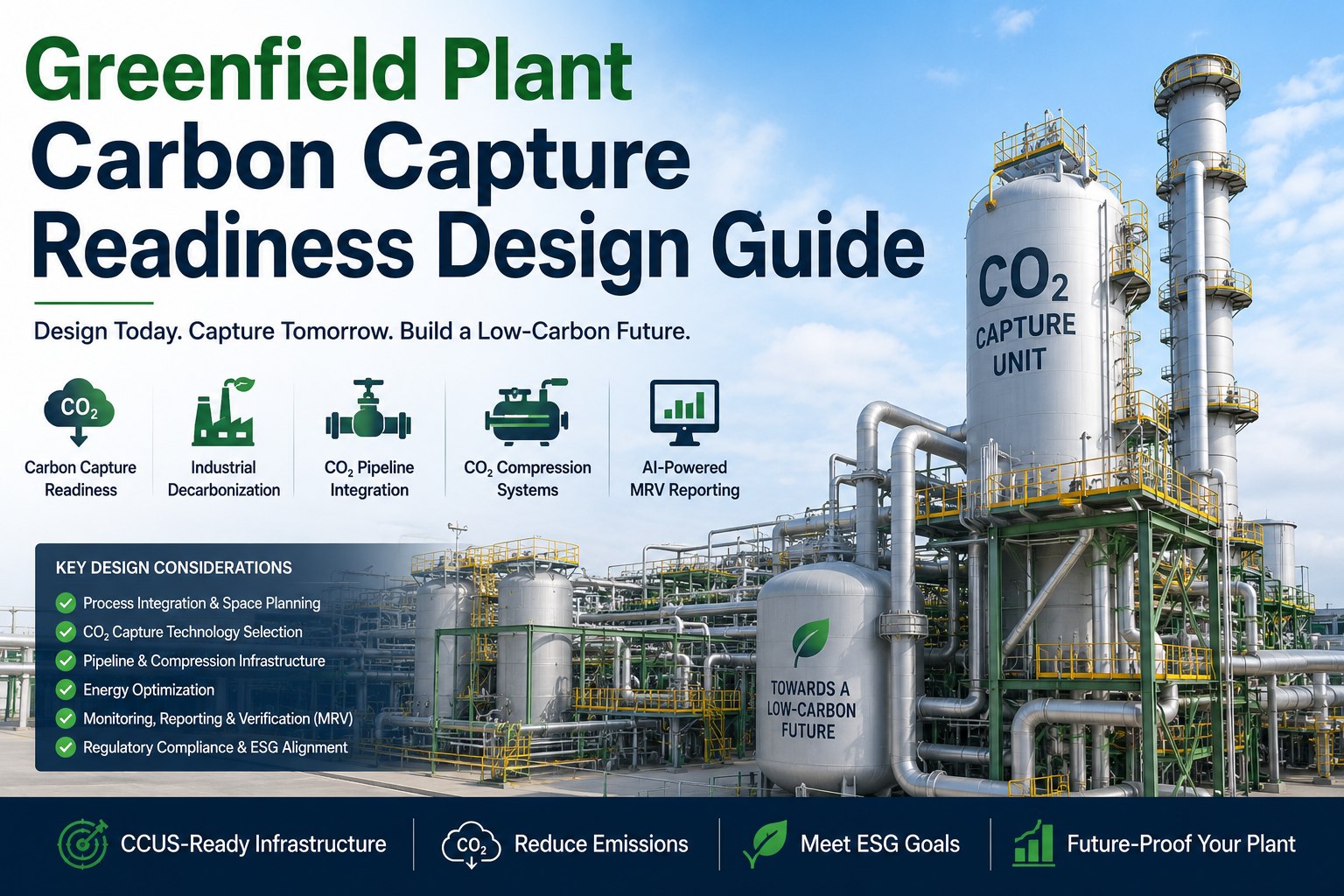
The cheapest carbon capture project is the one you never have to retrofit. Most plants being built today will, within their operating lives, run into carbon pricing, capture mandates, or customers demanding low-carbon product — and bolting capture onto a plant that was never designed for it can cost far more than building it in. Carbon capture readiness is the discipline of designing a greenfield plant now so capture can be added later, cheaply, when the economics or the rules demand it. You spend little today: some reserved space, a few tie-in points, a sized utility plan. This guide covers how to get a plant capture-ready.
Designing a new plant in a hard-to-abate sector? Book a 30-minute capture-readiness consultation to design CCUS tie-ins and MRV in from the start.
Reserve It Now, Retrofit It Later
Operating Plant
Runs without capture, so upfront cost stays lower.
Capture Island
Retrofit when carbon costs or rules make it pay.
Readiness means reserving the space, the tie-in points, and the utilities now — so the capture unit drops into a design built to receive it, instead of forcing it into one that was not.
Why Build Capture-Ready Now
Carbon capture is energy-intensive and expensive, but for hard-to-abate sectors like cement, steel, chemicals, and refining, it is often the only way to cut emissions at all. The plants being built today will operate for decades, straight into tightening carbon rules and rising carbon prices — and a plant forced to retrofit capture it was never designed for pays an efficiency and integration penalty a purpose-built one avoids. Because designing capture in is far cheaper than forcing it in later, readiness is one of the lowest-cost insurance policies a new plant can buy. If you want it scoped for your emissions profile, you can map it with a decarbonization specialist.
US 45Q credit for permanently storing a tonne of captured CO₂
efficiency penalty capture adds — cheaper to design for than to retrofit
of flue-gas CO₂ a standard amine capture unit removes
The CCUS Chain: Capture, Compress, Transport, Store
To design a plant to be capture-ready, it helps to know what it is getting ready for. CCUS is a chain, and every link has a footprint and a tie-in your design needs to anticipate.
Capture
Separate CO₂ from flue gas or process streams, most often with amine solvents.
Condition
Pre-treat flue gas to remove SOx and NOx, then dehydrate the captured CO₂.
Compress
Compress the CO₂ to a dense, supercritical phase ready for the pipeline.
Transport
Move it by pipeline, or by ship, to a storage site or an industrial user.
Store or Use
Inject into deep geologic storage, or use it as a feedstock for products.
Want the chain mapped to your site and nearest storage hub? Book a CCUS planning review and we will scope the readiness measures for your plant.
Designing for Readiness: What to Reserve Now
Capture readiness is a short list of decisions made at design time that cost little now and save a great deal later. These are the six that matter most.
Plot Space
Reserve land for the absorber, stripper, and compression island — they are large, and there is no cheap way to add the room later.
Flue Gas Tie-Ins
Provide ducting stubs and plan conditioning to strip SOx and NOx, which otherwise degrade the capture solvent.
Steam & Power
Size or plan the utility supply for solvent regeneration — the single biggest energy draw of the whole capture unit.
CO₂ Compression
Leave space and electrical capacity for the compressors that bring captured CO₂ up to pipeline pressure.
Pipeline & Storage Access
Plan the export route to a CO₂ network or storage hub early, since transport and storage are the chain's tightest constraint.
MRV-Ready Data
Instrument emissions points and build the data backbone now, so reporting and verification are ready when capture goes live.
Building a readiness checklist into your design basis? Book a design-basis session and leave with a capture-readiness plan for your project team.
AI-Powered MRV and Emissions Monitoring
Capturing carbon only counts if you can prove it. Measurement, reporting, and verification — MRV — is what turns captured tonnes into compliance and credits, and it is where carbon markets place their trust. Designing the data for it from day one is far easier than reconstructing it later.
Measure
Meter CO₂ captured, compressed, transported, and stored, plus the emissions that still leave the stack, continuously.
Report
File the mass-balance accounting that regulators and credit programs require, such as EPA Subpart RR behind 45Q.
Verify
Back the numbers with leak detection, baselines, and audit-ready records — the part markets scrutinize most.
AI carries the load here: automating the mass-balance accounting, flagging leaks and anomalies, and validating data so reporting is continuous and audit-ready rather than a year-end scramble.
Build the Readiness In, Pay the Retrofit Later
iFactory helps greenfield teams design capture tie-ins, utilities, and an MRV-ready data backbone into the plant from day one — and provides the AI emissions monitoring and reporting that make carbon accounting continuous and credit-ready.
Expert Perspective
The expensive mistake is treating carbon capture as a problem for future you. By the time the carbon price or the mandate arrives, the plant is built, the plot is full, the utilities are sized for today, and there is nowhere to put an absorber the height of a building. A retrofit into that situation carries an integration penalty a purpose-built plant simply does not have. Readiness flips it: for a small fraction of the eventual project cost, you reserve the space, leave the tie-ins, plan the steam, and instrument the emissions data. None of it commits you to building capture. It just means that when the day comes, the decision is an engineering one, not an excavation one — and that is the difference between a plant that can decarbonize and one that is stuck.
— Decarbonization Practice, iFactory Engineering Team
the credit turning stored CO₂ into revenue, for projects started before 2033
of today's capture capacity is at low-cost gas-processing plants
hard-to-abate sectors where capture is often the only option
The Bottom Line
Carbon capture is coming to hard-to-abate industry whether by price, policy, or customer pressure, and the plants that handle it best will be the ones that saw it coming. Capture readiness costs little at design time — reserved plot space, flue-gas and CO₂ tie-ins, sized utilities, a planned export route, and an MRV-ready data backbone — and it removes the integration penalty that makes retrofits painful. Understand the CCUS chain, reserve for each link, and build the emissions data in from the start. A greenfield plant is the one chance to make capture a future engineering choice rather than a future excavation, and that option is among the cheapest a new plant can hold.
Make Your Greenfield Plant Capture-Ready
From plot space and tie-in planning to CO₂ compression, pipeline access, and AI-powered MRV, iFactory helps greenfield teams design a plant that can decarbonize on demand — ready for capture, and proving its emissions from the first run.
Frequently Asked Questions
What does carbon capture ready mean?
A capture-ready plant is one designed and built to operate without carbon capture at first, but engineered so a capture unit can be added later with minimal disruption. In practice that means reserving plot space for the equipment, providing flue-gas and CO₂ tie-in points, planning the extra steam and power that solvent regeneration needs, and securing an export route to transport and storage. The plant runs at lower upfront cost today while keeping a low-cost path to decarbonization open.
How does industrial carbon capture work?
The most common method is post-combustion capture, where flue gas is passed through an amine solvent that absorbs the CO₂; the solvent is then heated to release a concentrated CO₂ stream and reused. That CO₂ is conditioned and compressed to a dense phase, transported by pipeline or ship, and either stored deep underground or used as a feedstock. A typical unit captures around 90% of the CO₂, and the heat needed to regenerate the solvent is the main energy cost.
What is MRV in carbon capture?
MRV stands for measurement, reporting, and verification — the system that proves how much CO₂ was actually captured and stored. It involves metering the CO₂ through the chain, reporting it through a mass-balance accounting framework like EPA Subpart RR, and verifying it with leak detection and audit-ready records. MRV is essential because carbon credits such as 45Q and compliance markets depend on trustworthy, verifiable numbers.
Is carbon capture readiness worth the cost?
For plants expected to operate for decades in emissions-intensive sectors, usually yes. Readiness adds a modest cost at design time, while retrofitting capture into a plant never designed for it carries a steep integration and efficiency penalty, and may be physically constrained by a full plot. With carbon prices rising and incentives like 45Q in place, keeping a low-cost path to capture open is inexpensive insurance against future regulation.
How does iFactory help with capture readiness?
iFactory's greenfield advisory helps build capture tie-ins, utility provisions, and an MRV-ready data backbone into the plant design, and its platform delivers AI-powered emissions monitoring and reporting that make carbon accounting continuous and credit-ready. The same system supports predictive maintenance of compressors and capture equipment once a unit is installed. You can book a consultation to plan it for your facility.