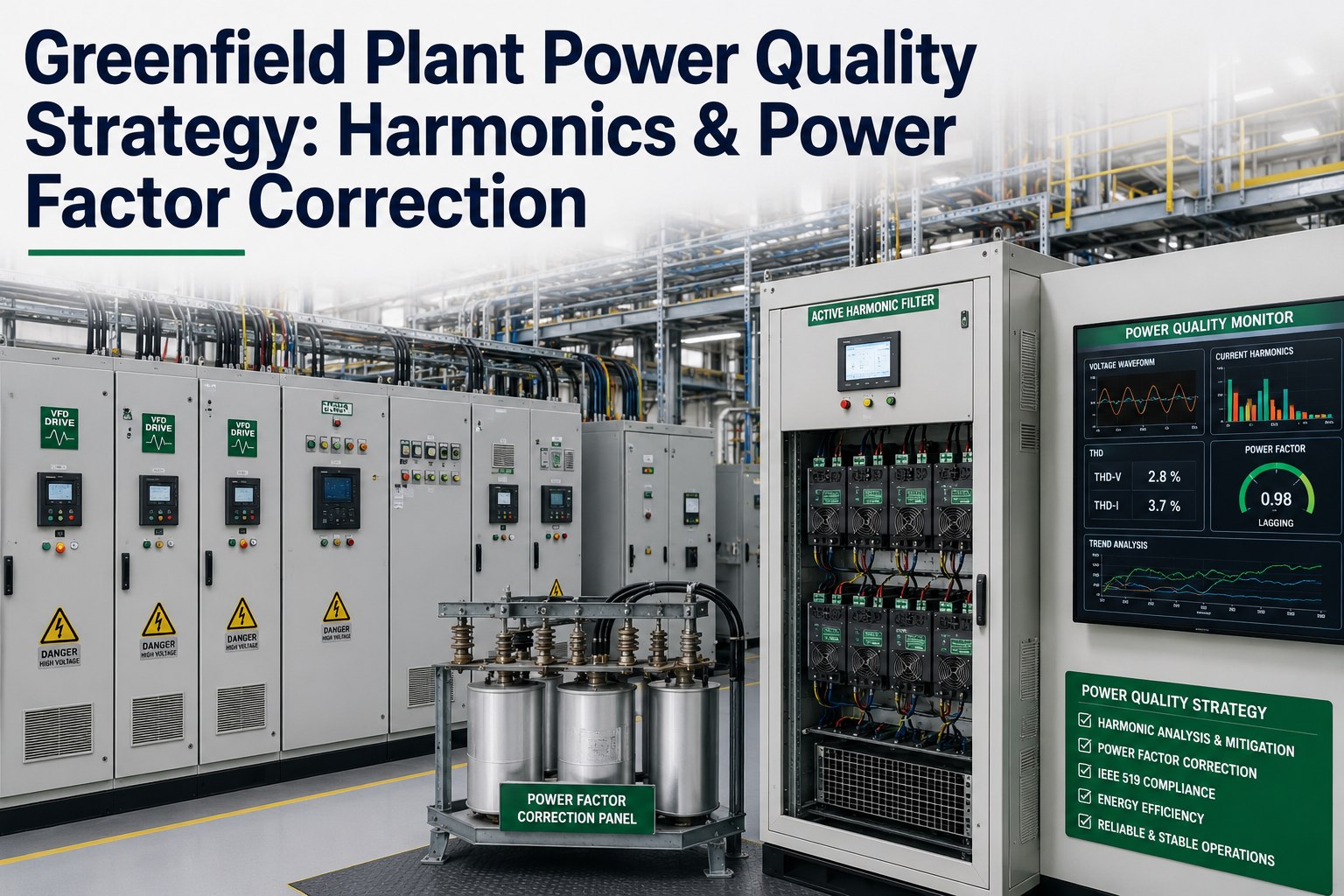
On its first day, a greenfield plant draws clean, sinusoidal power. Then you fill it with the equipment that runs a modern factory — variable-frequency drives, rectifiers, welders, server loads — and every one of them quietly bends the current out of shape and drags the power factor down. The damage is invisible at first: a transformer running hot, a capacitor bank that keeps blowing fuses, breakers that trip for no reason and a utility bill swollen with penalties. Power quality is the discipline that prevents all of it, and a greenfield plant is the place to design it in. This guide covers harmonics and power factor correction for a new plant.
Designing a new plant's electrical system? Book a 30-minute power quality consultation to engineer harmonics and power factor out before the loads go in.
The Same Power, the Wrong Shape
Nonlinear loads — drives, rectifiers, welders — pull current in distorted pulses instead of a smooth sine. That distortion is harmonics, and the measure of it is Total Harmonic Distortion, or THD.
Why Power Quality Decides What Your Plant Really Costs
Two problems hide inside the same wiring. Harmonics distort the current waveform and heat everything they touch; poor power factor means you pull more current than the work actually requires. Both force you to oversize transformers and cables, both waste energy as heat, and both invite utility penalties and equipment failures. Left unmanaged, poor power quality quietly taxes every transformer, cable, and breaker in the building, then bills you for the privilege — and designing it in is far cheaper than chasing it later. If you want it scoped for your load list, you can map it with an electrical design specialist.
current THD a single six-pulse VFD can draw unmitigated
voltage THD limit at the point of common coupling under IEEE 519
power factor utilities typically require to avoid penalty charges
Harmonics: When the Waveform Goes Wrong
Harmonics are currents at whole-number multiples of the 50 or 60 Hz fundamental — the 5th, 7th, 11th, and 13th orders dominate from six-pulse drives. They overheat transformers, cables, and motors, overload neutral conductors, cause nuisance breaker trips from zero-crossing errors, and — most dangerously — can drive a power factor capacitor bank into resonance, amplifying a harmonic until fuses blow and capacitors fail. The standard that governs all of this is IEEE 519, which sets limits at the point of common coupling where your plant meets the grid.
Power Factor: Paying for Power You Don't Use
Power factor is the ratio of the real power that does work to the apparent power you actually draw. Inductive loads like lightly loaded motors and transformers pull reactive power that does no work but still flows through every cable and transformer — so a low power factor means oversized infrastructure, higher losses, and demand penalties. The triangle below is the whole idea.
Power factor equals kW divided by kVA, which is the cosine of the angle φ. The lower it falls, the more kVA you draw — and pay for — to deliver the same kW of useful work.
Want your harmonic and power-factor profile modeled before you build? Book a power quality workshop and we will size the right fix for your loads.
The Power Quality Toolkit: Fixing Both by Design
There is no single cure — the right answer depends on your load mix, and a greenfield plant can specify it from the layout. These are the tools, from cheapest-first to most capable.
Line Reactors & DC Chokes
The cheap first defense — added impedance on each drive knocks down current harmonics at the source.
Active Harmonic Filters
Inject counter-harmonic currents in real time, adapt to changing loads, and lift power factor — the modern path to IEEE 519.
Detuned Capacitor Banks
Automatic power factor correction with a tuning reactor that corrects displacement while avoiding harmonic resonance.
Active Front-End Drives
Low-harmonic drives that draw near-sinusoidal current at the source, removing the problem before it starts.
Multi-Pulse Rectifiers
12- or 18-pulse configurations cancel the dominant lower-order harmonics on large drive systems.
Continuous PQ Monitoring
Meter THD and power factor live, so problems surface as data long before they surface as failures.
Building a load list full of drives and rectifiers? Book an implementation session and leave with a power quality plan for your project team.
Clean Power, Designed In
iFactory helps greenfield teams plan harmonic mitigation and power factor correction into the electrical design, then monitors THD, power factor, and energy live — with AI-driven optimization that keeps the plant compliant and the demand bill down.
Expert Perspective
The classic mistake is to bolt a plain capacitor bank onto a plant full of drives and assume the power factor problem is solved. What actually happens is the capacitors resonate with the harmonics already on the bus, the bank amplifies a harmonic it was never meant to see, and you get blown fuses and a transformer running well above its rating. Power factor and harmonics have to be solved together. On a greenfield plant you can look at the load list before anything is energized, decide where detuned correction is enough and where an active filter is needed, and meter it from day one — so you meet IEEE 519 by design instead of discovering you have a problem when the first capacitor fails.
— Power Systems Practice, iFactory Engineering Team
harmonic orders six-pulse drives pump out hardest
transformer over-temperature harmonics can cause
power factor an active filter can deliver while cutting THD
The Bottom Line
Power quality is the quiet difference between a plant that runs cool and compliant and one that overheats, trips, and pays penalties. Harmonics distort the waveform and must be held within IEEE 519 limits at the grid connection; poor power factor inflates the current you draw and the bill you pay. Solve them together — line reactors and active filters for harmonics, detuned correction for power factor, monitoring for both — and do it from the load list, before anything is energized. A greenfield plant is the one moment to make clean power a design choice rather than a recurring repair.
Make Clean Power a Design Choice
From harmonic analysis and IEEE 519 compliance to power factor correction and live THD monitoring, iFactory helps greenfield teams build an electrical system that stays efficient, compliant, and penalty-free — with AI-driven energy optimization from the first run.
Frequently Asked Questions
What is total harmonic distortion (THD)?
THD measures how far a current or voltage waveform departs from a pure sine, expressed as a percentage of the fundamental. Current THD describes the distortion a load draws, and voltage THD describes the distortion that appears on the bus. The higher the THD, the more harmonic energy is present to overheat equipment and interfere with sensitive electronics. As a rough rule, voltage THD above 5% or current THD above 20% at the connection point signals a harmonic problem worth addressing.
What is IEEE 519 and what limits does it set?
IEEE 519 is the standard that defines acceptable harmonic distortion at the point of common coupling, where a facility connects to the utility. It limits voltage THD to 5% for typical systems and limits current distortion as a total demand distortion that scales from 5% to 20% depending on how strong the supply is relative to the load. Meeting it is a shared responsibility between the utility and the customer, and it is often a condition of connection.
What's the difference between power factor correction and harmonic filtering?
Power factor correction addresses displacement — the phase shift between voltage and current caused by inductive loads — usually with capacitors. Harmonic filtering addresses distortion, the non-sinusoidal shape caused by nonlinear loads. They are different problems, and capacitors alone can make harmonics worse by resonating with them. A plant with significant drive loads generally needs detuned correction or an active filter that handles both, not plain capacitors.
What causes harmonics in a factory?
Nonlinear loads, which draw current in pulses rather than smoothly. The biggest contributors are variable-frequency drives and other rectifier-based equipment, along with uninterruptible power supplies, welders, induction furnaces, and LED lighting. A single six-pulse drive can draw current with 40 to 60 percent THD, so a plant full of them needs a deliberate mitigation strategy to stay within limits.
How does iFactory help with power quality?
iFactory's greenfield advisory helps plan harmonic mitigation and power factor correction into the electrical design, and its platform then monitors THD, power factor, and energy continuously, using AI-driven optimization to keep the plant within IEEE 519 limits and the demand bill down. The same data flags capacitor and filter issues before they cause failures. You can book a consultation to plan it for your facility.