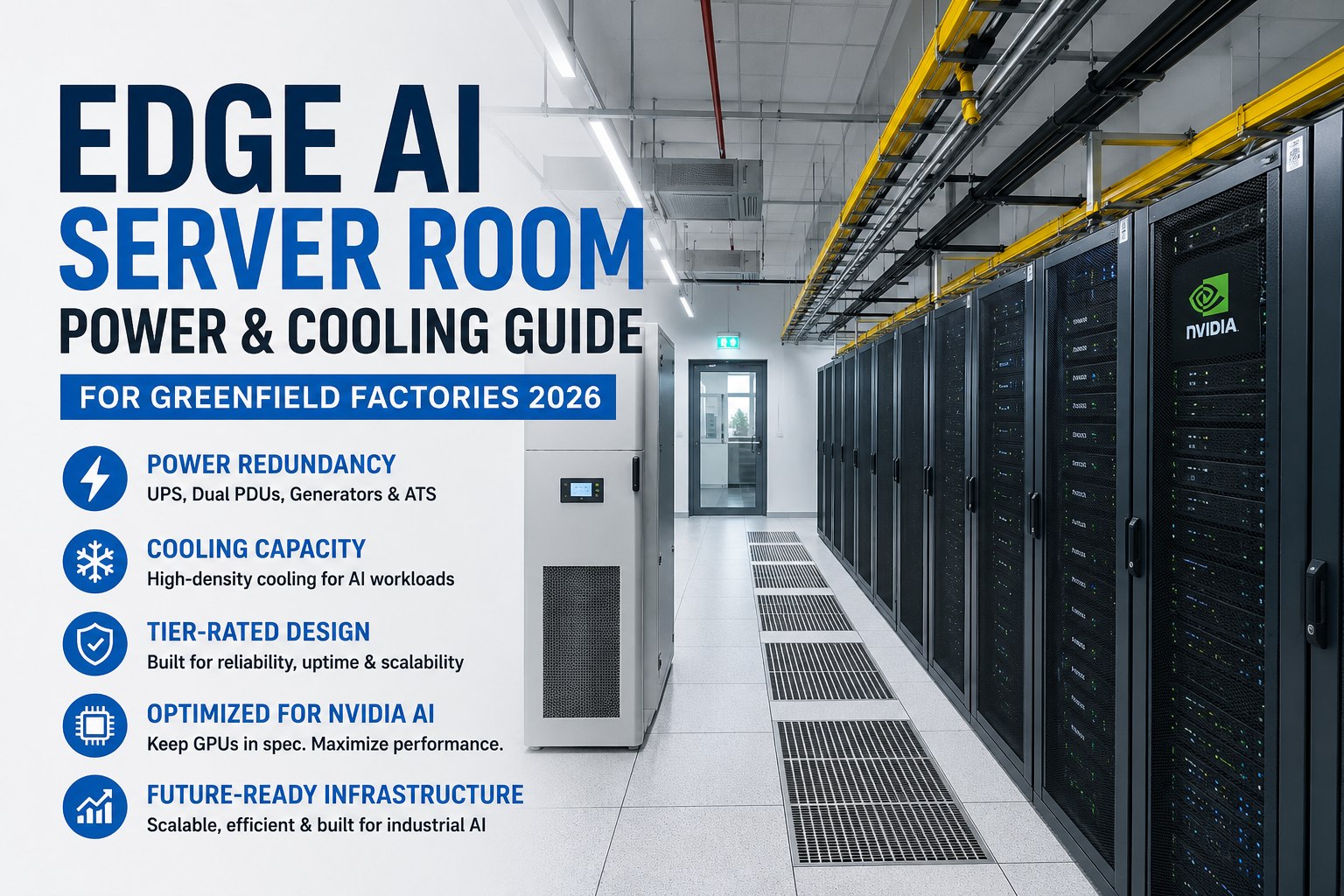
Edge AI server rooms in factories are not IT closets. A four-rack NVIDIA GPU node for vision inspection and predictive maintenance draws 40–60 kW continuously — the equivalent of running 60 residential air conditioners at full load. Factory ambient temperatures run 10–15°C hotter than office buildings, power comes from the same switchgear feeding 480V equipment loads with significant harmonic distortion, and the room must keep servers in ASHRAE A2 spec (10–35°C inlet air) while the floor outside runs at 38°C. Getting this infrastructure right in a greenfield build costs 10–15% of project budget. Getting it wrong costs 2–3× that in retrofits — plus the downtime that comes while your AI platform throttles at 42°C.
Get your edge AI server room designed into your facility layout by iFactory — we specify power, cooling, and Tier rating before your MEP engineers finalize drawings.
Room Blueprint — 2026 Reference Design
The Greenfield Edge AI Server Room: Four Infrastructure Layers
A correctly designed factory edge AI room is a purpose-built space — not a re-purposed IT closet. Each layer must be specified before MEP engineers touch a drawing.
Why Factory Edge AI Rooms Fail: The Three Underspecification Patterns
Across documented factory AI deployments, three infrastructure underspecification patterns account for the vast majority of thermal throttling, unplanned downtime, and emergency retrofits. Each one is invisible during the vendor demo and becomes expensive at 2 a.m. during a production run.
Cooling Undersizing
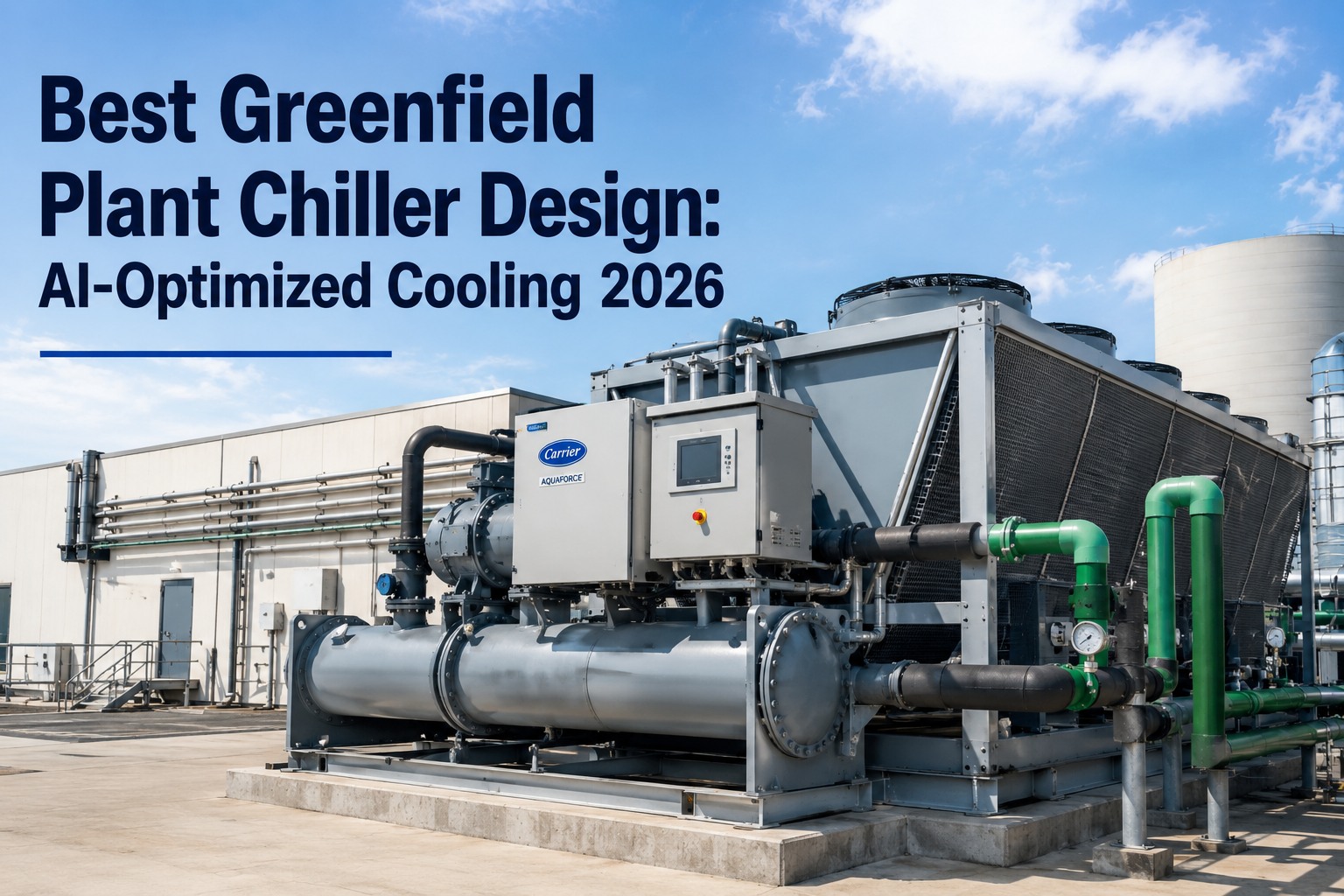
A GPU server draws 700–1,200W per chip. An 8-GPU server producing 5.6 kW generates 19,100 BTU/hr. Spec a standard 5-ton CRAC unit for a 4-rack AI room and you have 60,000 BTU/hr of capacity — against a 136,000 BTU/hr load at 40 kW. GPU thermal throttling starts within minutes. The correct formula: Cooling Tons = (kW IT load × 3.41 × 1.5) ÷ 12,000. The 1.5× factor accounts for factory ambient heat gain. At 40 kW: 17+ tons needed.
Retrofit cost: $80K–$150K + 2–4 weeks production disruption
Single-Feed Power Architecture
AI servers with dual power supplies expect two independent power feeds (PDU A and PDU B) from separate circuit breakers. Wiring both PSUs to the same breaker panel provides zero redundancy benefit. A single breaker trip or PDU failure takes down the entire rack. For continuous production AI (vision inspection, real-time OEE), the correct architecture is A+B feeds from separate electrical panels, each sized at 125% of half the rack load per NEC 80% rule.
Retrofit cost: $30K–$60K for panel separation + branch circuit rewiring
No Tier-Rated Uptime Design
Factory AI systems supporting real-time production quality or safety monitoring have the same uptime requirements as the production line itself — typically 99.5–99.9%. A Tier I server room (single path, no redundancy) delivers only 99.67% uptime — 28.8 hours of downtime per year. For a facility running three shifts at $3,000/hr production value, that is $86,400 in annual exposure. Tier II (N+1 on CRAC and UPS) reduces this to 22 hours. Tier III (N+1 with concurrent maintainability) targets 99.98%.
Greenfield Tier II premium: ~10–15% of room construction cost
typical load for a 4-rack factory AI node (GPU vision + edge compute + networking)
BTU/hr per watt — every kW of AI server load equals 3,410 BTU/hr of cooling demand
minimum recommended rating for production-critical factory AI rooms — N+1 cooling and UPS
cost multiplier for retrofitting AI infrastructure vs. designing it into greenfield from the start
Not sure how your current room spec stacks up against a 40 kW AI load? Book a server room audit with iFactory — we calculate your cooling requirement, power architecture gaps, and Tier rating before you order a single GPU rack.
Power Architecture: From Factory Switchgear to Rack PDU
Factory electrical environments are not office building environments. The 480V switchgear that feeds your production equipment also feeds harmonic distortion, voltage sags from motor starts, and transient spikes back onto the same bus your AI servers depend on. The power architecture for an edge AI room must physically isolate server power from OT equipment power — not just at the UPS level, but from the point of common coupling at the substation.
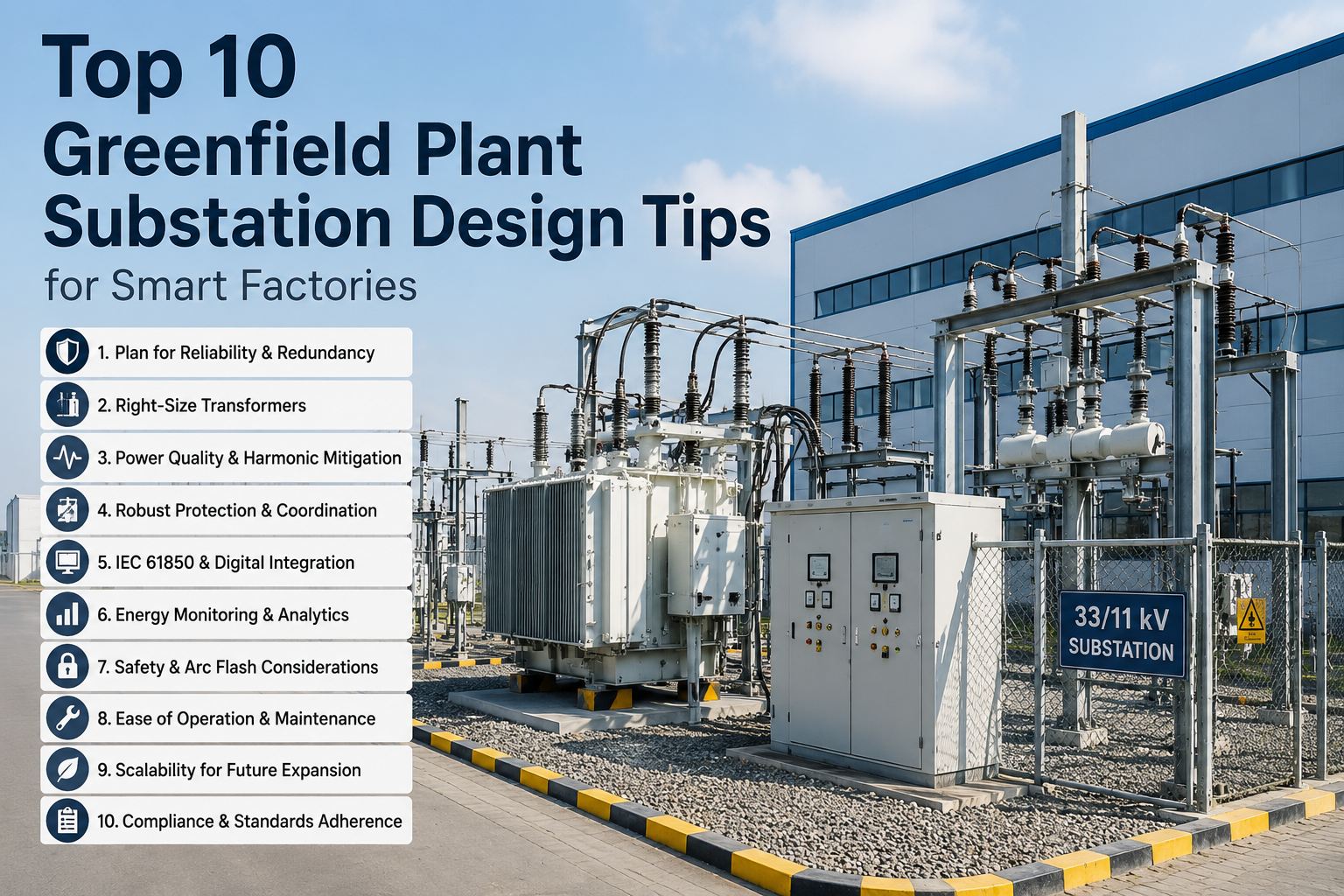
Facility Substation — Dedicated AI Panel
The edge AI server room should be fed from a dedicated distribution panel — separate from any panel feeding 480V motor loads. This isolation prevents motor start transients and harmonic distortion from propagating to AI server power. Panel sizing: total IT load ÷ 0.8 (NEC 80% rule) + 30% growth margin. A 40 kW IT load requires a panel capacity of at least 62.5 kW (50 kW ÷ 0.8).
- Voltage: 208V or 480V 3-phase (transformer to 208V for rack PDUs)
- Isolation: Separate distribution panel from OT equipment feeds
- NEC 80% rule: Size breakers at 125% of continuous IT load
N+1 UPS — Li-Ion or VRLA
The UPS provides ride-through during utility transients, clean power conditioning, and bridge time for generator start. For a 40 kW IT load, size UPS at 50 kVA N+1 (two 50 kVA modules). Modern Li-ion UPS systems support 80 kW rack loads while maintaining 5–15 minute runtime for generator transfer. GPU workloads exhibit rapid power transients (30–50% load change in milliseconds) — specify UPS with power factor correction and transient voltage suppression.
- Sizing: 125% of IT load per module, N+1 configuration
- Technology: Li-ion preferred (faster charge, 10-yr life vs. 3-5yr VRLA)
- Runtime target: 10 min at full load (sufficient for generator auto-start)
Dual PDU A+B — Per-Outlet Metering
Each rack receives two PDUs (PDU-A and PDU-B) fed from separate UPS outputs and separate breakers. AI servers connect one PSU to PDU-A and the other to PDU-B. This means any single circuit failure, breaker trip, or PDU fault does not interrupt server operation. Specify monitored PDUs with per-outlet current metering — this data feeds the DCIM system and provides early warning of overload conditions before a breaker trips.
- Configuration: A+B redundant feeds, separate upstream breakers
- Rating: Each PDU sized for 100% of rack load (redundant capacity)
- Monitoring: Per-outlet metered PDU with SNMP/REST to DCIM
Generator Backup — ATS Transfer
For Tier II compliance, an automatic transfer switch (ATS) connects a generator to the AI room panel within 10–15 seconds of utility loss. The UPS bridges this gap. Factory AI rooms do not typically require the same generator capacity as the full production facility — a 100 kW diesel or natural gas generator serving only the AI room and control systems is the correct scope. Share generator capacity with production equipment only if the generator is sized for the combined load.
- ATS transfer time: 10–15 seconds (UPS bridges gap)
- Generator sizing: 100% of AI room IT load + 30% cooling overhead
- Fuel: Natural gas preferred over diesel (unlimited supply via utility)
Need power architecture specified for your factory AI room? Talk to iFactory's infrastructure team — we size the panel, UPS, PDU, and generator for your specific AI workload and facility electrical environment.
Your Edge AI Server Room Designed Into the Facility Before MEP Engineers Touch a Drawing
iFactory specifies your edge AI room power architecture, cooling capacity, Tier rating, and physical layout as part of greenfield facility design — so the room is right-sized from day one, not retrofitted six months after your GPU racks start throttling at 42°C.
Cooling System Design: CRAC, Containment & the BTU Calculation
At 40 kW of IT load, a factory AI server room generates 136,500 BTU/hr — the equivalent output of ten 5-ton residential air conditioners running at capacity. The cooling system must remove this heat continuously, 24/7, against a factory ambient temperature that may be 15°C higher than the design condition for a standard office CRAC unit. Getting the calculation right before construction is a one-time engineering investment. Getting it wrong is a six-figure mechanical retrofit.
Want the cooling calculation run for your specific rack configuration? Request a cooling design session with iFactory — we model your exact IT load, factory ambient conditions, and cooling system options before your MEP contractor quotes CRAC units.
Expert Perspective
The smallest instance of a true AI factory starts at 120 kilowatts — it's an industrial model, replicable and being built at volume. Every single data center in the future is going to be power-limited. And your revenue is limited if your power is limited. The factories building AI infrastructure into their greenfield design today are creating a permanent competitive advantage — not just in compute capability, but in their ability to expand AI workloads without the facility becoming the bottleneck.
minimum AI factory starting point per NVIDIA — even small factory deployments require serious power planning
target Power Usage Effectiveness for a well-designed factory edge AI room with aisle containment
documented retrofit cost to fix an under-cooled factory AI room that thermal-throttled at 42°C
Build the AI Room Right the First Time — Before Your MEP Contract is Signed
iFactory designs your edge AI server room power path (panel → UPS → PDU), cooling system (CRAC sizing, containment design, BTU calculation), and Tier rating as part of your greenfield facility package — so your GPU racks run in spec from day one, at 10–15% of the cost of retrofitting the same infrastructure after construction.
Frequently Asked Questions
How much cooling does a factory AI server room require for a 4-rack GPU node?
A 4-rack edge AI node drawing 40 kW total IT load generates approximately 136,400 BTU/hr of heat. Adding UPS inefficiency (5%), lighting, and factory ambient heat gain (30% in a warm production environment) brings total cooling requirement to approximately 186,000–190,000 BTU/hr, or 15.5–16 tons. The correct specification is two 10-ton CRAC units in N+1 configuration — 20 tons total. This provides one unit of redundancy (the N+1 margin) and headroom for a 40–50% load growth without adding cooling infrastructure. At rack densities above 25 kW per rack, CRAC-based air cooling reaches its thermal limit and rear-door heat exchangers or direct-to-chip liquid cooling become necessary. The formula is: Cooling Tons = ((IT load kW × 3.41) + UPS heat + ambient gain) ÷ 12,000.
What Tier rating should a factory AI server room be designed to?
For factory AI systems supporting real-time production workloads (vision inspection, OEE monitoring, predictive maintenance), Tier II is the minimum recommended design level. Tier II provides N+1 redundancy on critical components (UPS and CRAC units) while maintaining a single distribution path — delivering 99.74% uptime (22 hours downtime per year). This is appropriate for most manufacturing AI applications. Tier III (N+1 with concurrent maintainability on dual distribution paths) is warranted when AI system downtime directly halts production — for example, an automated quality inspection system with no manual fallback. Tier III targets 99.98% uptime (1.6 hours downtime per year) and costs approximately 30–50% more to build than Tier II. Tier IV (fault-tolerant, 99.99%) is rarely justified for factory-scale edge AI deployments and is typically reserved for cloud data center applications.
How should factory AI server room power be isolated from production equipment?
Factory production equipment (motors, drives, welders, presses) generates harmonic distortion, voltage sags on motor start, and transient spikes that degrade power quality on shared electrical panels. AI server power should be fed from a dedicated distribution panel with no shared breakers with motor-load circuits. The isolation point should be as close to the facility substation as possible — ideally a dedicated transformer feeding only the AI room panel. Within the room, the UPS provides additional power conditioning (voltage regulation, harmonic filtering, transient suppression) as the last line of isolation. Each rack should receive dual PDU feeds (A and B) from separate upstream breakers — so any single circuit fault does not interrupt the server. GPU servers draw 700–1,200W per chip and exhibit rapid power transients (30–50% load change in milliseconds); the electrical system must be sized for these transients without voltage sag affecting other equipment in the room.
Can factory NVIDIA GPU servers use ASHRAE A3/A4 ratings instead of a dedicated cooled room?
ASHRAE A3 hardware is rated for inlet air temperatures up to 40°C and A4 up to 45°C — making it a viable option for factory-floor deployment in ruggedized industrial enclosures when rack density is low (under 5–10 kW). However, most current-generation NVIDIA GPU servers (including Jetson AGX Orin industrial variants) are designed for ASHRAE A2 conditions (10–35°C inlet air) in normal operating mode, with thermal throttling triggered above 35°C. The combination of 40+ kW heat density in a confined rack, factory ambient temperatures of 35–40°C, and the inability to provide adequate airflow in a production floor enclosure makes dedicated room cooling the correct solution for any deployment above 1–2 racks. The greenfield cost advantage is significant: designing a 200–300 sq ft dedicated AI room during facility construction adds 10–15% to room build cost, versus 2–3× that figure to retrofit cooling infrastructure after production starts.
What fire suppression system should a factory AI server room use?
Factory AI server rooms should use a clean agent gaseous suppression system — FM-200 (HFC-227ea), Novec 1230, or inert gas blends (IG-541/IG-55) — not water sprinklers. Water suppression systems damage server hardware, create immediate electrocution risk during suppression, and require complete hardware replacement after an event. Clean agent systems suppress fires by displacing oxygen or interrupting the combustion reaction without leaving residue or damaging electronics. FM-200 is the most widely specified choice for IT spaces in the US, providing suppression within 10 seconds at approximately 7% agent concentration. The room must be sealed to maintain agent concentration during discharge — any penetrations through walls for power or network cabling must be fire-stopped. NFPA 2001 governs clean agent design and installation in the US; verify local jurisdiction requirements as some adopt additional state-level requirements for agent concentration and discharge times.