In 2026, 67% of AI workloads are running outside public cloud — and for greenfield manufacturing plants, the reason is not ideology but physics. A vision inspection camera generating 200 frames per second cannot wait 50ms for a cloud round-trip. A digital twin updating from live PLC data cannot tolerate the jitter of a shared cloud API. But a model training job that runs once a month on 1TB of annotated defect images has no reason to tie up on-prem GPU capacity that costs $300K to provision. The correct architecture is not a binary choice between on-prem and cloud — it is a deliberate workload placement strategy that routes each AI task to the tier where its latency, data volume, and cost characteristics are best served.
Design your factory AI compute architecture with iFactory — we map every workload to the right tier before your infrastructure budget is committed.
Factory AI Compute Architecture — 2026
The Three-Tier Factory AI Stack: Edge · On-Prem · Cloud
Each tier has a distinct latency ceiling, data pattern, and cost profile. Matching workloads to tiers is the decision that determines AI ROI.
Machine-Level Compute
Latency target: <10ms
- Vision defect inspection at line speed
- Safety zone monitoring (real-time)
- Robot guidance & sensor fusion
- Anomaly detection on PLC signals
Why on-device: Camera-to-decision in <10ms. Network hop adds 5–50ms minimum — disqualifies cloud for line-speed tasks.
Factory Server Room
Latency target: <50ms
- Digital twin synchronization (live OT data)
- Real-time OEE analytics dashboard
- Multi-line SPC aggregation
- Model fine-tuning on plant-specific data
- LLM inference for operator copilots
Why on-prem: OT data never leaves the facility. Sub-50ms digital twin updates. 8× lower cost per million tokens vs. cloud for sustained inference.
Elastic GPU Capacity
Latency tolerance: Seconds
- Initial foundation model training
- Periodic large-scale fine-tuning runs
- Fleet analytics across multiple plants
- R&D experimentation (non-production)
Why cloud burst: Variable demand, no sustained utilization. Cost-effective for jobs that run hours/weeks then stop. No capital needed for occasional large training runs.
The Workload Placement Decision Matrix
Every factory AI workload has three characteristics that determine its optimal compute tier: latency requirement (how fast must the system respond?), data sovereignty constraint (can raw production data leave the facility?), and utilization pattern (does this workload run continuously or occasionally?). Mapping these three attributes determines tier placement more reliably than any rule of thumb.
of enterprise AI workloads now run outside public cloud — Dell Technologies World, May 2026
lower cost per million tokens on on-prem vs. cloud IaaS for sustained production inference (Lenovo TCO 2026)
breakeven for on-prem vs. on-demand cloud at high GPU utilization — Lenovo/NVIDIA 2026 TCO analysis
minimum cloud round-trip latency — why production vision and safety AI must run on-prem or edge
Want the matrix applied to your specific AI workloads? Book a workload placement session with iFactory — we map each workload to the right tier and produce a compute architecture specification before your infrastructure budget is finalized.
NVIDIA Server Sizing for Greenfield Factory AI: 2026 Reference Configurations
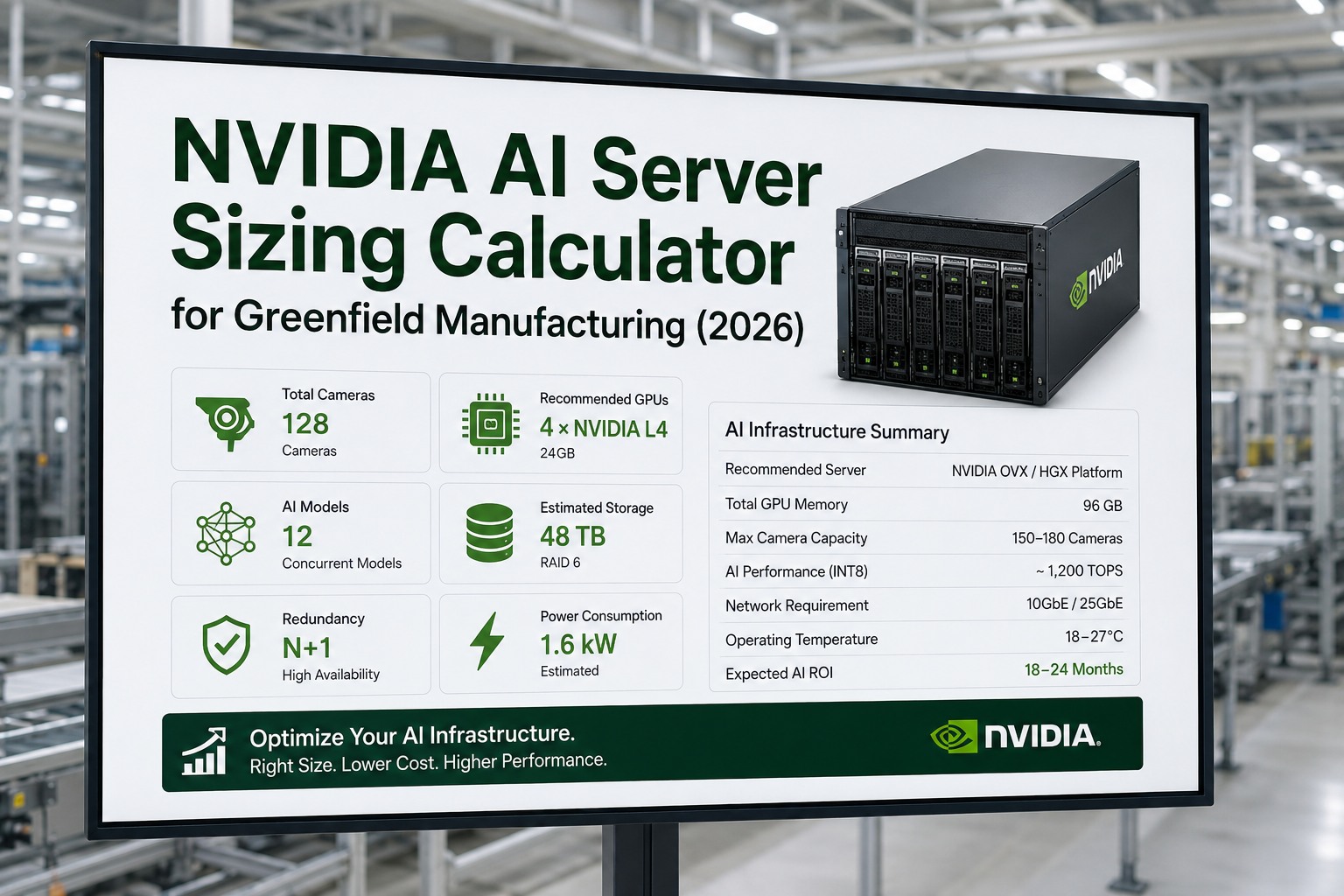
The NVIDIA compute portfolio in 2026 spans from the Jetson Orin Nano at 20 TOPS and 7W (machine-level edge) to the GB300 NVL72 rack at 1.1 exaFLOPS and 120 kW (AI factory scale). For greenfield manufacturing plants, the practical decision is not which GPU is most powerful — it is which configuration matches the plant's AI workload profile and facility power envelope. The three reference configurations below cover the range from a focused single-line inspection deployment to a multi-site AI factory.
Focused AI Deployment
- Edge: 4–8× NVIDIA Jetson AGX Orin (275 TOPS each) — one per inspection station
- On-Prem Server: 1× NVIDIA RTX 4000 Ada (20GB) or L4 — digital twin, OEE, SPC aggregation
- Network: 10GbE plant LAN, OT/IT segmented switch
- Power: 40–60 kW dedicated panel + N+1 UPS (75 kVA)
- Cooling: 2× 10-ton CRAC (N+1)
- 100% visual inspection at 2–4 camera stations
- Real-time digital twin (1–2 lines)
- OEE dashboard, predictive maintenance
- Cloud burst for model training (monthly)
Full Plant AI Stack
- Edge: 8–24× Jetson AGX Orin (one per inspection station + robot guidance)
- On-Prem Server: 1–2× NVIDIA L40S (48GB) or RTX 6000 Ada — digital twin simulation, multi-line SPC, LLM inference
- Network: 25GbE aggregation, TSN for time-critical control traffic
- Power: 80–150 kW dedicated infrastructure, N+1 UPS (150 kVA)
- Cooling: 2× 20-ton CRAC + hot aisle containment
- Full-plant vision inspection (all lines)
- Full-facility digital twin (live OT sync)
- Operator LLM copilot (shift-hours inference)
- Predictive maintenance (all equipment)
- On-prem model fine-tuning (weekly cadence)
Flagship AI Infrastructure
- Edge: 30+ Jetson AGX Orin across all lines and stations
- On-Prem Rack: NVIDIA HGX H100 8-GPU (640GB HBM) or NVIDIA DGX H100 — foundation model fine-tuning, multi-site digital twin, fleet analytics
- Network: 100GbE core + InfiniBand for multi-GPU training
- Power: 200–400 kW, medium-voltage step-down transformer, 2N UPS
- Cooling: Direct-to-chip liquid cooling (CDU) + redundant CRAC for residual air load
- Multi-site digital twin with fleet analytics
- On-prem foundation model training + inference
- Agentic AI workflows (process optimization)
- Real-time supply chain simulation
- Minimal cloud dependency — data sovereignty complete
Not sure which configuration matches your plant's AI ambition and power budget? Talk to iFactory's compute sizing team — we produce a workload-matched hardware specification before your MEP engineers begin the server room design.
On-Prem or Hybrid — Design the Right Architecture Before the Infrastructure Budget is Locked
iFactory's greenfield compute architecture service maps every AI workload to the right tier, specifies the NVIDIA hardware configuration, and designs the hybrid cloud-burst pattern that handles model training without on-prem GPU over-provisioning — so your factory launches with an AI infrastructure that fits both today's needs and the next five years.
TCO Analysis: When On-Prem Beats Cloud — and When It Doesn't
The 2026 Lenovo/NVIDIA TCO analysis establishes that on-premises infrastructure achieves breakeven against on-demand cloud pricing in under four months for high-utilization workloads. For sustained production AI inference — the pattern that dominates factory deployments — on-prem delivers up to 8× lower cost per million tokens compared to cloud IaaS and up to 18× versus commercial GenAI APIs. But the economics invert for bursty, variable-demand workloads. The correct approach is not to choose a deployment model — it is to match infrastructure to utilization pattern.
Want a 5-year TCO model built for your specific workload profile? Book a TCO analysis session with iFactory — we model your on-prem vs. cloud costs against your actual AI workload utilization before you commit to either infrastructure path.
Expert Perspective
The era of cloud-first for all AI workloads is over. The TCO analysis is decisive: for sustained, high-utilization production inference — which is exactly what a factory running three shifts generates — on-premises infrastructure achieves breakeven in under four months against on-demand cloud pricing. Over a five-year lifecycle, the savings per server can exceed $5 million. For enterprises committed to AI as a core competitive advantage, the transition from renting intelligence to owning the factory is not just a technical evolution — it is a financial imperative.
of enterprises now run at least one AI workload on-premises or at edge (Dell Technologies World, May 2026)
on-prem cost advantage per million tokens vs. commercial GenAI APIs for sustained inference workloads
savings per GPU server over 5-year lifecycle — on-prem vs. equivalent cloud on-demand pricing (Lenovo TCO 2026)
Build the Factory AI Compute Tier Your Plant Will Depend On for the Next Decade
iFactory's greenfield compute architecture service produces a complete workload-to-tier placement map, NVIDIA hardware configuration, hybrid cloud-burst pattern, server room Tier specification, and 5-year TCO comparison — before your facility's infrastructure budget is finalized. The factories that get this right in the design phase are the ones that don't spend years retrofitting compute that was never sized for the AI workloads they're actually running.
Frequently Asked Questions
Why do factory AI vision systems require on-premises compute rather than cloud inference?
Factory vision inspection systems generate 200+ frames per second per camera and require a pass/fail decision within 10ms to activate a reject gate before the defective part exits the inspection station. The minimum cloud round-trip latency — including network transmission to a cloud endpoint and return of the inference result — is 50–200ms on a well-connected enterprise network, and significantly higher during congestion. This 5–20× latency gap makes cloud inference physically incompatible with line-speed production inspection. Additionally, raw camera footage at production speeds generates 2–8 GB/min per camera — transmitting this volume to the cloud in real time would saturate most plant network connections and generate prohibitive cloud egress costs at $0.08–$0.15/GB. On-prem or edge inference eliminates both constraints: the Jetson AGX Orin processes camera data locally in under 10ms, and no raw video ever leaves the facility.
When does it make financial sense to move AI training to the cloud instead of on-prem?
Cloud training makes financial sense for workloads with low or variable utilization — defined in the Lenovo/Deloitte 2026 TCO framework as below 60–70% GPU utilization over the billing period. For greenfield factories, this typically means initial foundation model training (which runs once or quarterly), hyperparameter search experiments, and fine-tuning runs that require 100+ GPUs for a few days then stop. The economics favor cloud for these burst patterns because the CapEx of provisioning on-prem GPU capacity that sits idle 80% of the time exceeds cloud OpEx for the same workload. The practical architecture is a hybrid model: on-prem handles the 24/7 sustained inference workloads (vision, OEE, digital twin, predictive maintenance) where utilization is high and cloud egress costs would be prohibitive, while cloud handles the periodic burst training jobs that use anonymized or non-sensitive data. This hybrid approach typically reduces total AI infrastructure TCO by 40–60% versus a pure on-prem or pure cloud architecture.
What NVIDIA hardware is right for a 4–6 production line greenfield factory?
A 4–6 line greenfield factory operating Config B architecture typically deploys 12–20 Jetson AGX Orin modules at the edge (one or two per inspection station plus robot guidance) and one or two NVIDIA L40S (48GB Ada Lovelace) or RTX 6000 Ada servers in the on-prem server room. The L40S is purpose-built for inference-dominant workloads — it handles digital twin synchronization, OEE analytics, multi-line SPC aggregation, and operator LLM inference efficiently at 18 TFLOPS FP32 and 362 TOPS INT8. For plants that want on-premises model fine-tuning at weekly cadence, adding a second L40S provides the additional GPU memory needed for fine-tuning smaller models (7B–13B parameters) without cloud dependency. The total IT load for this configuration is typically 80–150 kW, requiring a Tier II server room with N+1 CRAC cooling and N+1 UPS at 150 kVA.
How does a hybrid cloud-burst architecture work for factory AI model training?
In a hybrid factory AI architecture, model training and inference run on separate tiers connected by a controlled data pipeline. The on-prem tier collects and stores training data continuously — annotated defect images from vision inspection, labeled sensor sequences from predictive maintenance, timestamped production logs from OEE. This training data is stored in an on-prem data lake (anonymized and de-identified as required for data sovereignty). When a training run is triggered — monthly for fine-tuning, quarterly for larger retraining cycles — anonymized training data is uploaded via a secure, metered connection to cloud GPU instances (AWS p5 with H100, Azure NDv5, or GCP A3). The training job runs in the cloud for hours or days, then the resulting model weights are downloaded to the on-prem server for deployment. This pattern keeps raw OT and production data entirely on-prem, uses cloud only for the occasional burst job, and ensures production inference always runs locally at sub-50ms latency regardless of cloud availability.
What is the 5-year TCO comparison between on-prem and cloud for sustained factory AI inference?
The 2026 Lenovo TCO analysis of NVIDIA Hopper and Blackwell generation servers establishes a breakeven point against on-demand cloud pricing in under four months for high-utilization GPU workloads. Over a 5-year server lifecycle, on-prem delivers 8× lower cost per million tokens versus cloud IaaS (equivalent GPU instances at on-demand rates) and up to 18× versus commercial GenAI API pricing. For a factory running three shifts of sustained AI inference — vision inspection, digital twin updates, OEE analytics, predictive maintenance — GPU utilization typically exceeds 60–70% continuously, which is the threshold where on-prem economics dominate. A single NVIDIA L40S server ($10K–$15K per card plus $150K–$400K room infrastructure) achieves its cloud equivalent cost breakeven in under 4 months against $3.50–$12/hr on-demand H100 pricing. After breakeven, the marginal cost of production inference on-prem is effectively the electricity cost — approximately $7,800/year per H100-class GPU at full utilization at $0.10/kWh.