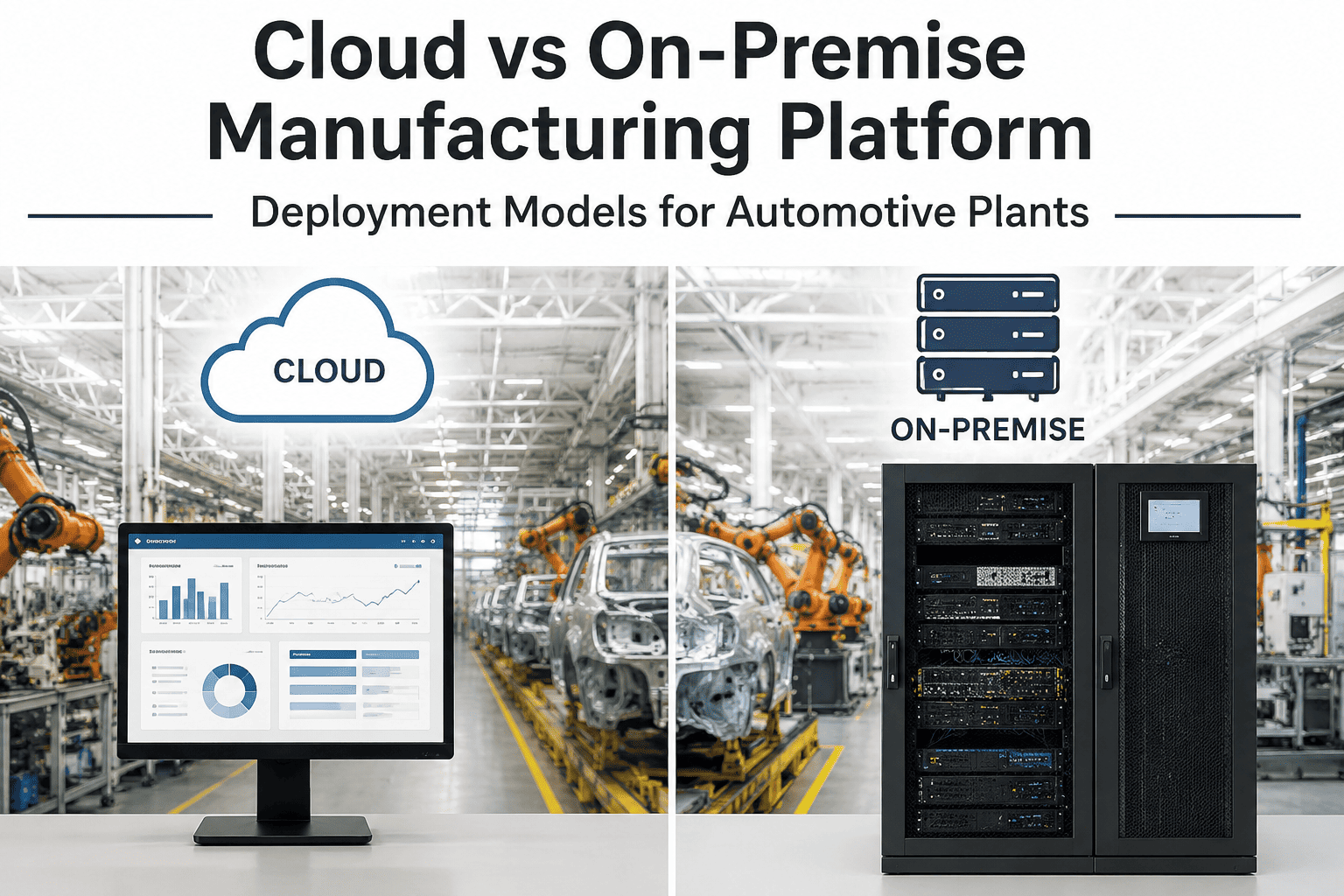
"Should our manufacturing platform run in the cloud or on-premise" is usually the wrong first question, because most automotive plants don't have a single answer — they have a vision inspection camera running at 350 frames per second that needs a response in single-digit milliseconds, and they have a plant-wide OEE dashboard that's perfectly usable with a two-second delay. Treating those as the same deployment decision is how plants end up either paying for cloud infrastructure that can't meet their real-time control requirements, or building expensive on-premise server rooms to run analytics that never needed sub-second latency in the first place. The better question is which workload goes where, and increasingly the honest answer for automotive manufacturing is both — edge processing for anything touching machine control, cloud for anything touching cross-site reporting and long-term trend analysis. Work through your specific latency and data sovereignty requirements with a Book a Demo.
Cloud vs On-Premise Was Never Supposed to Be a Single, Plant-Wide Decision
Evaluate latency, data sovereignty, cybersecurity, and total cost of ownership workload by workload — not as one deployment choice applied uniformly across every system your plant runs.
Cloud Deployment
Centralized infrastructure managed by the platform provider, accessed over the internet, elastically scalable across multiple sites without local hardware investment.
Best for cross-site benchmarking and multi-plant reporting
No local server hardware or IT overhead to maintain
2 to 5 second typical latency from floor to dashboard
Auto-updated, vendor-maintained infrastructure
On-Premise / Edge Deployment
Compute resources deployed directly at or near the machines generating data, processing locally without a round trip to an external server.
Best for real-time control and closed-loop process decisions
Single-digit millisecond inference for vision and robotics
Continues operating during internet or cloud outages
Data stays inside the facility network by default
Match Every Workload to the Right Architecture
iFactory ships as a hybrid platform — edge processing for real-time control, cloud aggregation for reporting — configured to your plant's specific latency and sovereignty requirements.
Why Milliseconds Matter for Some Workloads and Not Others
Cloud AI typically processes data with round-trip delays in the range of one to two seconds. For a defect detection camera running at over a hundred frames per second, that gap is the difference between catching a flaw in real time and shipping a scrap part before the alert even arrives. Edge processing eliminates that round trip entirely, delivering decisions in single-digit milliseconds because the compute sits directly on or near the machine generating the data — which is why safety systems, robotic controllers, and quality inspection cameras consistently favor edge deployment regardless of how well-connected a plant's internet is.
| Workload Type | Latency Requirement | Recommended Architecture |
|---|---|---|
| Vision-based defect detection | Single-digit milliseconds | Edge |
| Closed-loop robotic control | Single-digit milliseconds | Edge |
| Real-time SPC control charts | Sub-second | Edge or hybrid |
| Shift-level OEE dashboards | Seconds acceptable | Cloud |
| Cross-site benchmarking | Minutes acceptable | Cloud |
| Predictive maintenance model training | Not latency-sensitive | Cloud |
When the Architecture Decision Isn't About Speed at All
Some deployment decisions have nothing to do with latency and everything to do with where data is legally or contractually allowed to live. Operational technology networks are frequently air-gapped from corporate IT for safety and security reasons that predate any AI initiative, which structurally excludes pure cloud architectures from certain applications regardless of how fast cloud inference has become. Manufacturing recipes, production parameters, and quality data often represent years of accumulated competitive advantage that many manufacturers prefer to keep entirely within their own network boundary, independent of any performance consideration.
Edge Is Upfront Hardware. Cloud Accumulates Over Time.
The cost comparison between edge and cloud rarely favors one model universally — it depends on deployment scale and time horizon. Edge deployments carry higher upfront hardware cost concentrated at installation, while cloud deployments spread cost across ongoing storage, compute, and data egress charges that accumulate over the life of the system. A single-plant deployment with a stable workload often favors edge economics over a multi-year horizon, while a rapidly scaling multi-site rollout can favor cloud's elastic, pay-as-you-grow model.
We spent the better part of a year debating cloud versus on-premise as if it had to be one answer for the whole plant. What actually unlocked the decision was splitting it by workload — our weld quality vision system needed edge, full stop, but our five-plant OEE rollup had no reason to need sub-second latency. Once we stopped forcing a single architecture, both projects moved forward within the same quarter instead of staying stuck in the same debate.
Frequently Asked Questions
Q: Can we run edge and cloud together, or do we have to choose one architecture for the whole plant?
Hybrid architectures combining local edge computation with cloud aggregation are increasingly the default rather than the exception, precisely because a single plant typically has both latency-sensitive control workloads and latency-tolerant reporting workloads that benefit from different infrastructure. Most plants run edge for real-time control and cloud for reporting simultaneously, with the two layers integrated rather than operating as separate, disconnected systems.
Q: Does edge deployment mean we lose the ability to do cross-site analytics?
No — edge nodes can sync aggregated data to a cloud layer for cross-site benchmarking and multi-plant reporting while keeping raw, high-frequency data local, which preserves both real-time control at the edge and centralized visibility for corporate reporting. What stays local versus what syncs to the cloud is a configurable decision, not an all-or-nothing tradeoff between the two capabilities.
Q: How does edge deployment handle model updates without a constant cloud connection?
Edge appliances are typically designed to receive model updates during scheduled sync windows rather than requiring a persistent connection, so an air-gapped or intermittently connected facility can still receive improved detection models without depending on constant cloud availability for day-to-day operation. Cloud sync for updates and reporting is generally configurable and can be disabled entirely for fully air-gapped environments. Discuss your specific network constraints with Support.
Q: Is on-premise deployment always more secure than cloud?
Not automatically — on-premise deployment provides direct control over data location and network exposure, which matters for OT isolation and data sovereignty requirements, but cloud platforms with region-specific data centers, compliance certifications, and configurable encryption satisfy the regulatory requirements of most automotive and general manufacturing environments. The security comparison depends more on how each option is configured and maintained than on which model is chosen in the abstract.
Q: How long does an edge analytics deployment typically take to get running?
Edge analytics appliances that connect to existing PLCs and sensors can often be operational within a couple of hours from unboxing to a live dashboard, without reconfiguring existing equipment or requiring a broader IT overhaul. That fast deployment timeline is one of the practical advantages edge offers over a full cloud platform rollout, which typically involves more extensive integration planning across multiple sites. See a live deployment timeline mapped to your plant with a Book a Demo.
Stop Debating Cloud vs On-Premise as a Single Decision
Get a workload-by-workload architecture recommendation built around your actual latency, sovereignty, and cost requirements.