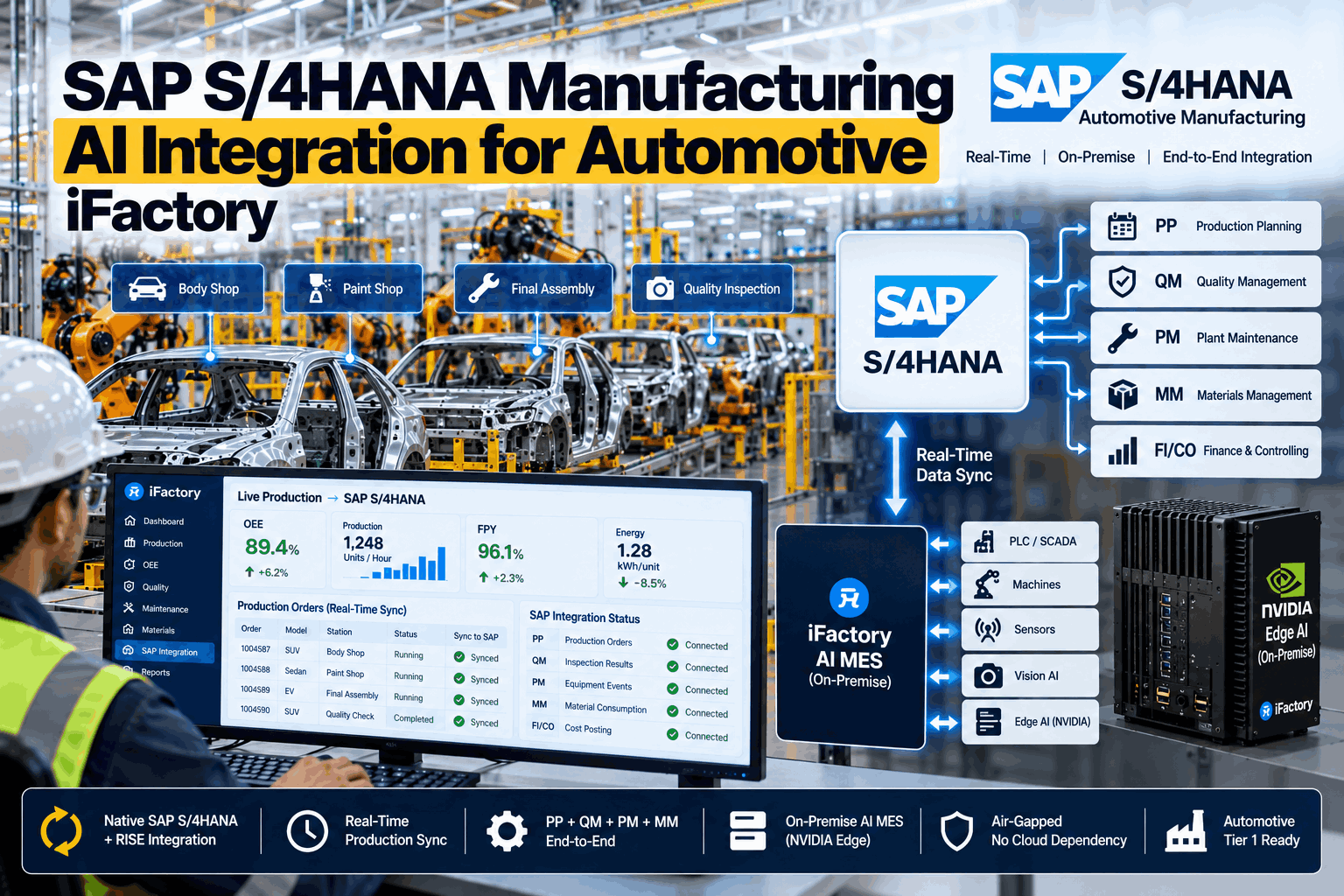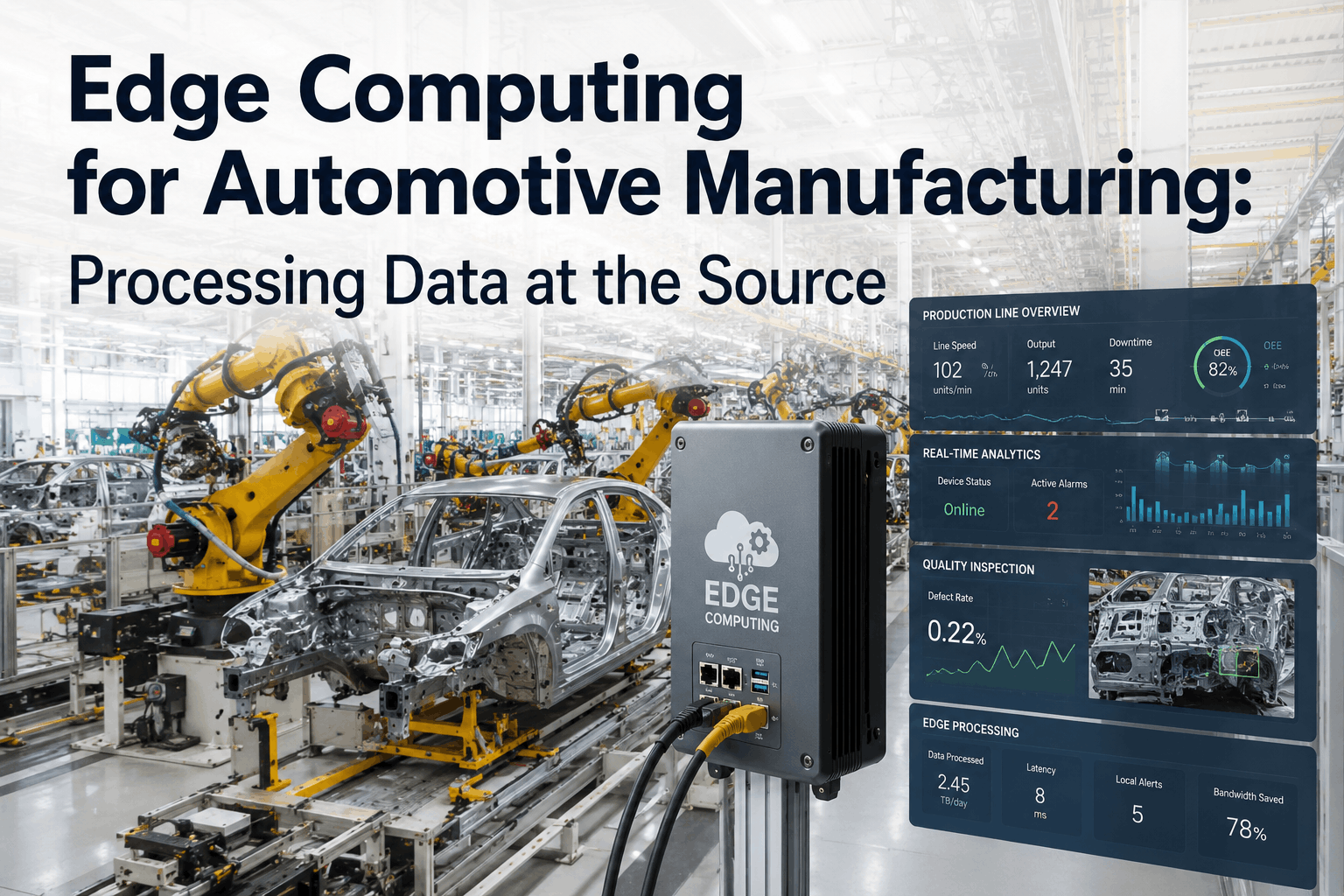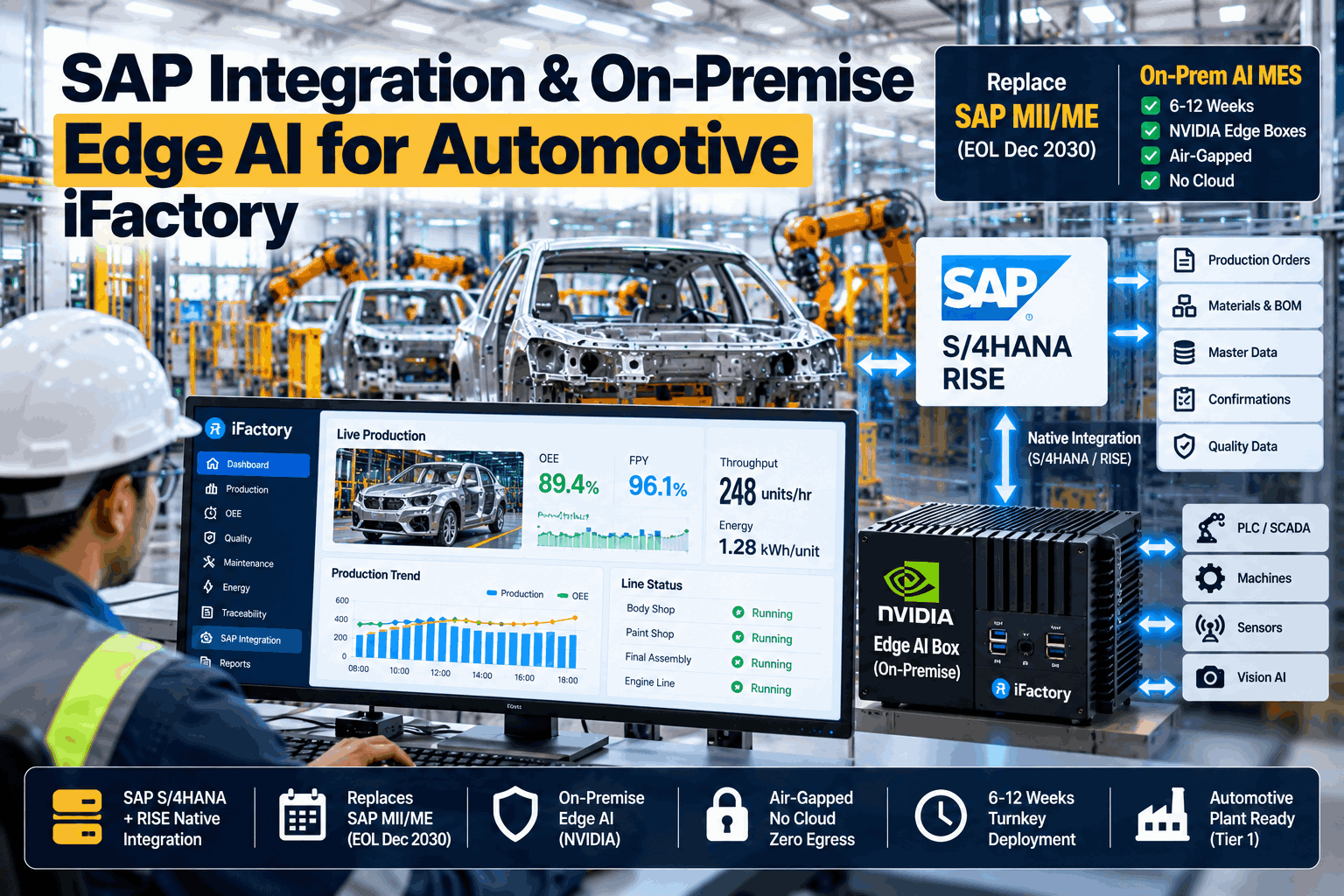
Automotive plants are being asked to do two things that pull in opposite directions: tie the shop floor more tightly to SAP, and expose it less to the outside world. SAP's own successor for the plant floor is cloud-only, and manufacturing has just been ranked the most-attacked industry for the fifth year running. iFactory takes the other route — an AI MES on NVIDIA edge servers inside the plant, with no internet egress, exchanging orders and confirmations with SAP S/4HANA or RISE through standard interfaces. It replaces SAP MII and ME and is live in 6–12 weeks. To map it against your landscape, book an architecture session.
Keep SAP as the System of Record — Run the AI Inside the Plant
iFactory sits between SAP and the line. Production orders, materials and routings come down; confirmations, goods movements and quality results go back. Everything else — cycle data, robot traces, vision images and the AI models that read them — stays on a server in your own rack, air-gapped by design.
- Standard S/4HANA interfaces — no changes to the SAP core
- AI inference on site; machine data never leaves the plant
- Line keeps running and queues postings if the SAP link is down
Three SAP Deadlines Land on the Same Day
Mainstream maintenance for SAP ECC, SAP MII and SAP ME all ends on 31 December 2027, with extended maintenance available to about 2030 at a premium. Reporting in mid-2025 put only 39% of roughly 35,000 ECC customers on S/4HANA by the end of 2024, so many automotive plants will be changing ERP and shop-floor systems inside the same window. The integration layer is the piece that has to survive every step — which is why it should be built once, against interfaces that exist in ECC, S/4HANA and RISE alike. Whichever stage you are at, our integration engineers can review it with you.
Connect now, migrate ERP later
iFactory exchanges IDocs and BAPI calls with ECC exactly as MII does today. When the ERP moves, the plant side stays as it is; only the endpoint and message mapping are repointed.
Everything inside your own network
Orders and confirmations travel between two systems in your data centres. Nothing crosses the corporate perimeter, and released OData services can replace older interfaces at your pace.
Clean core, private connection
S/4HANA runs in SAP's private cloud; the plant does not. The interface uses released APIs over the VPN or dedicated circuit your company already operates to RISE, so the core stays unmodified.
What Moves Between SAP and the Plant Floor
A shop-floor integration is a short list of business documents exchanged reliably, in both directions, thousands of times a day. The map below shows the objects an automotive plant typically needs and the standard SAP interfaces that carry them. The exact choice per object — IDoc, BAPI or OData — is agreed with your SAP Basis team during design. To walk through your own list, book a flow workshop.
Two design rules keep this dependable. First, SAP remains the single source for orders, materials and cost; iFactory never keeps a rival master. Second, every message is acknowledged, logged and replayable, so a posting that fails at 02:00 is visible and recoverable by the morning shift instead of surfacing at month-end as a stock variance.
What Never Leaves the Plant
"Air-gapped" and "integrated with SAP" sound contradictory until the data is sorted into two kinds. Business documents are small, structured and belong in the ERP. Machine data is huge, continuous and commercially sensitive — and it has no reason to travel. iFactory keeps the two apart by design, and "zero egress" means precisely this: no plant data is sent to iFactory or to any third-party cloud.
- PLC cycle data and robot traces
- Vision images and video
- AI models, training and inference
- Process parameters and recipes
- Operator questions put to the AI
- Full production history and genealogy
- Order, material and routing data coming down
- Confirmations of quantity, scrap and time
- Goods issues and receipts
- Inspection results and usage decisions
- Maintenance notifications
- Nothing else — and never over the public internet
Three network postures, one platform
SAP on-premise
The interface runs between plant and data centre across your internal network. No traffic leaves the company.
RISE with SAP
Business documents travel over your existing site-to-site VPN or dedicated circuit to the SAP private cloud. Machine data and AI stay on site.
Fully air-gapped cell
For the strictest sites, messages pass through a broker in your DMZ with store-and-forward. The production network itself has no route out.
In every posture the plant keeps building if the link to SAP is interrupted. Orders already received stay available at the stations, and confirmations queue locally and post in sequence when the connection returns. For how this fits your own network zones, speak with our network team.
Prove the SAP Round Trip on One Line in Six Weeks
Choose one line and one order type. We stand up the edge server, connect the PLCs, receive live production orders out of SAP and post confirmations back — beside your existing MII flows, so the two can be compared message for message.
Why the AI Belongs at the Edge
The case for cloud AI is strong in the office. On an automotive line it runs into physics, contracts and the threat picture. IBM's 2026 X-Force index recorded a 44% rise in attacks that began with a public-facing application and found that large supply-chain and third-party compromises have nearly quadrupled since 2020. In September 2025 a single attack stopped a major carmaker's production for several weeks and reached more than 5,000 organisations in its supply chain. An AI layer with no public surface is one less way in.
- Speed. A weld check or a pick verification has to return inside the station cycle. A server on the plant network answers in milliseconds, every time.
- Volume. Vision at line speed produces images by the thousand each shift. Processing them where they are captured avoids moving them at all.
- Continuity. The line does not stop for a WAN fault, a cloud region incident or a licence server it cannot reach.
- Contract. TISAX assessments now bring production and control systems into scope, and many OEM agreements restrict where prototype and process data may be held.
Edge AI is now the mainstream choice for this work: analysts size the market at about USD 31 billion in 2026, growing at more than 23% a year, with manufacturing the largest single vertical. To see inference running on a server like the one you would receive, join a live session.
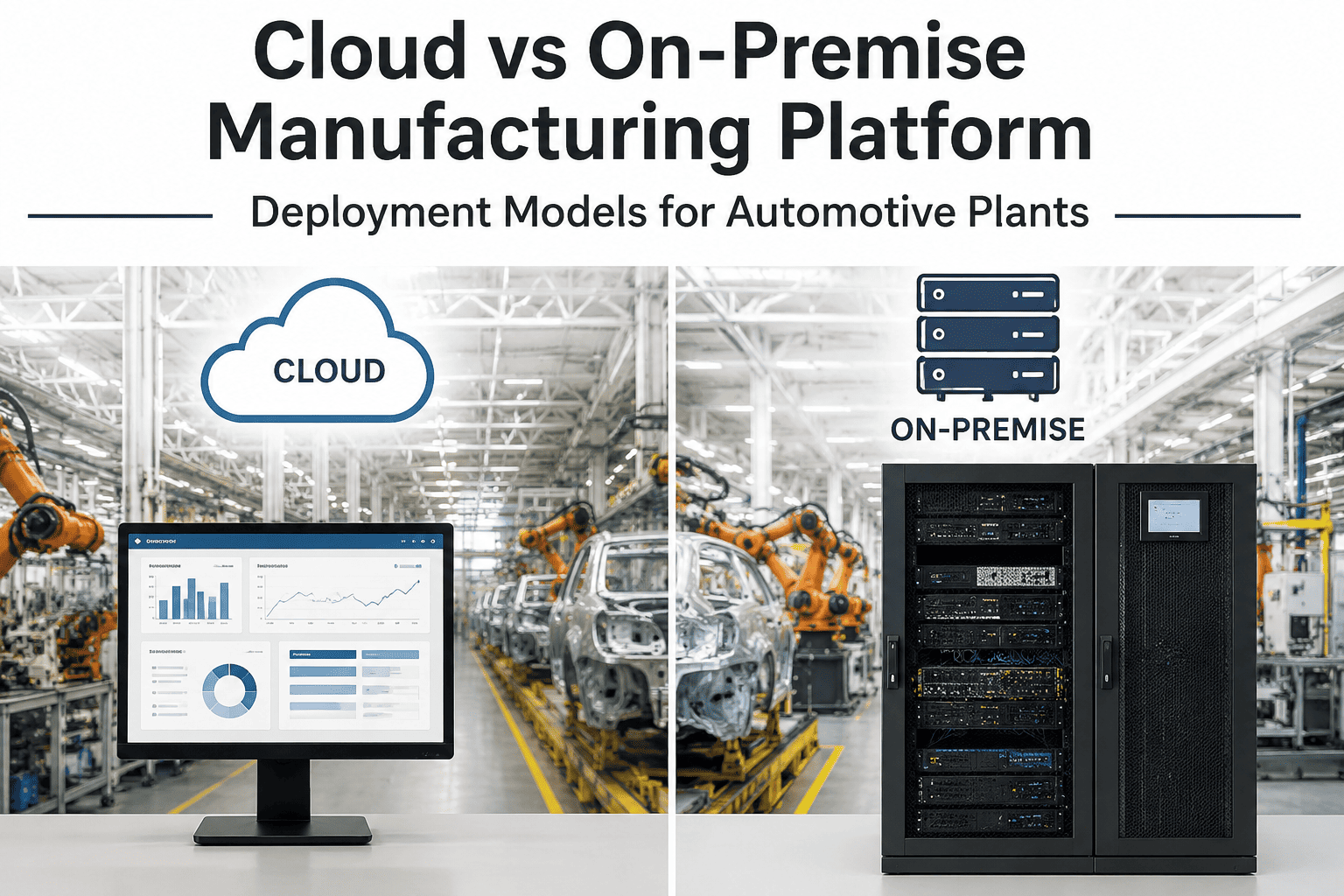
Cloud AI and Edge AI for a Plant, Compared
Neither model is wrong in general; they suit different jobs. For decisions made at the station, on data the plant would rather not move, the comparison is one-sided. Our solutions team can review the trade-offs for your own sites.
Delivered as a Turnkey AI System — Hardware and Software Together
iFactory ships as a complete bundle: a pre-configured NVIDIA AI server, racked and ready, with the MES, SAP connectors and AI models pre-loaded. Rack it, plug in power and Ethernet, and the AI is live on your plant network. Our team handles cabling, network setup, PLC, SCADA and robot integration, the SAP interface build with your Basis team, operator training and ongoing monitoring — delivered 24×7 over a managed support link where your policy permits one, or on site with offline patch media where it does not. For a scoped proposal, speak with our deployment team.
Ship, network and data
Server delivered and racked in the agreed network zone. Line controllers connected. SAP interfaces configured in a test client; orders, materials and routings flowing down.
Model training and pilot
AI models trained on your own signals and images. The pilot line runs live while confirmations post to SAP test, reconciled message by message against MII.
Go-live and training
Interfaces moved to the productive SAP client, remaining lines brought on, every shift trained, and the security design signed off with IT and OT.
What Each Team Gets
CIO and SAP lead
A shop-floor layer that keeps the core clean, works with ECC, S/4HANA and RISE, and removes MII and ME ahead of the deadline.
OT security
No internet-facing component, one documented conduit to SAP, and a design that fits existing zones and assessments.
Plant manager
Live OEE, quality and energy with AI on top — and a line that keeps running whatever happens to the WAN.
Finance and logistics
Confirmations and goods movements posted the same shift, so stock, WIP and cost in SAP match the floor.
Frequently Asked Questions
How does iFactory integrate with SAP S/4HANA?
Through SAP's standard interfaces. Production orders, materials and routings are received as IDocs or through released OData services; confirmations, goods movements, quality results and maintenance notifications are posted back through OData or BAPI calls. No modification to the SAP core is needed, and the same design works with ECC.
Does it work with RISE with SAP?
Yes. With RISE, S/4HANA runs in SAP's private cloud while iFactory stays in the plant. The two exchange business documents over the private connection your company already uses to reach RISE — a site-to-site VPN or a dedicated circuit — using released APIs, which keeps the clean-core principle intact.
How can a system be air-gapped and still talk to SAP?
The AI and the machine data are isolated; the SAP exchange is a separate, narrow path. The edge server has no route to the internet and sends nothing to iFactory or a third-party cloud. Orders and confirmations pass through one governed interface — inside your network, over your private link to RISE, or through a DMZ broker for the strictest sites.
What happens when the connection to SAP is lost?
Production continues. Orders already received remain available at the stations, the AI keeps working because it runs locally, and confirmations and goods movements are queued on the edge server. When the link returns they post in their original sequence, and the interface log shows exactly what was delayed and for how long.
Does iFactory replace SAP MII and SAP ME?
Yes. It covers the integration and visibility role of MII and the execution role of ME, with AI added. Mainstream maintenance for both ends on 31 December 2027, with paid extended maintenance to about 2030. Most plants run iFactory beside MII first, then retire the old flows line by line.
How are software patches and AI models kept current without internet access?
Where policy allows, through a managed, outbound-only support link that you control and can close. Where it does not, patches and refreshed models are delivered on signed offline media and applied by your team or ours on site. Models are trained on the edge server itself, so no plant data needs to leave for that purpose.
How long does deployment take, and what do we need to provide?
A typical plant is live in 6–12 weeks. You provide rack space, power, an Ethernet connection, access to line controllers, an SAP Basis contact and a test client. iFactory supplies the pre-configured NVIDIA AI server, software, SAP connectors, integration and training. To scope your landscape, book a scoping call.
One Interface to SAP. No Path to the Internet.
One turnkey system — NVIDIA AI server, full MES, SAP connectors and training — delivered and live inside 12 weeks per plant. Built for automotive OEMs and Tier 1 suppliers who want AI on the line without widening the attack surface.
- 1Your SAP release and the objects exchanged today
- 2Interface choice per object — IDoc, BAPI or OData
- 3Network zones and the single path to SAP
- 4MII and ME flows to retire, in order