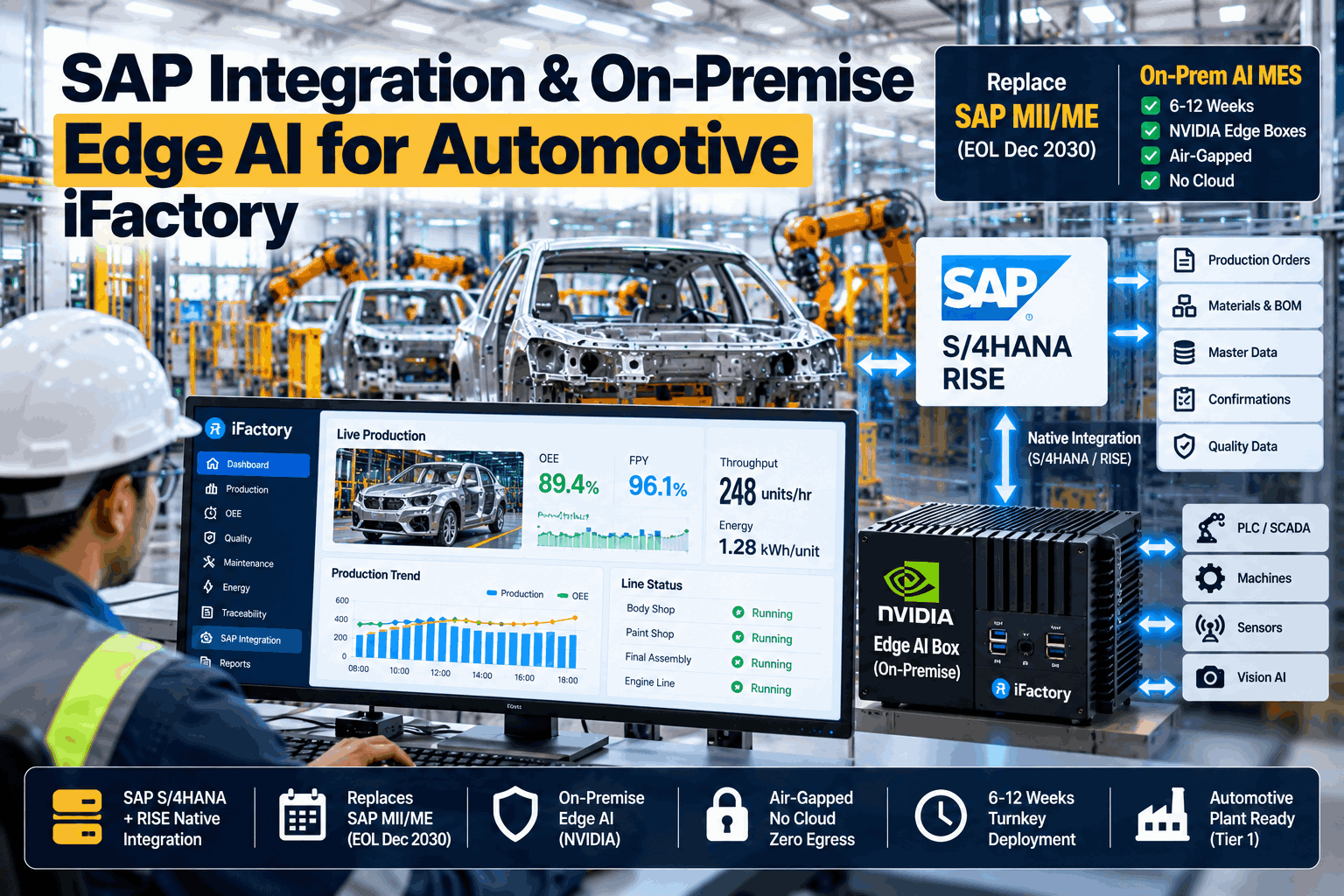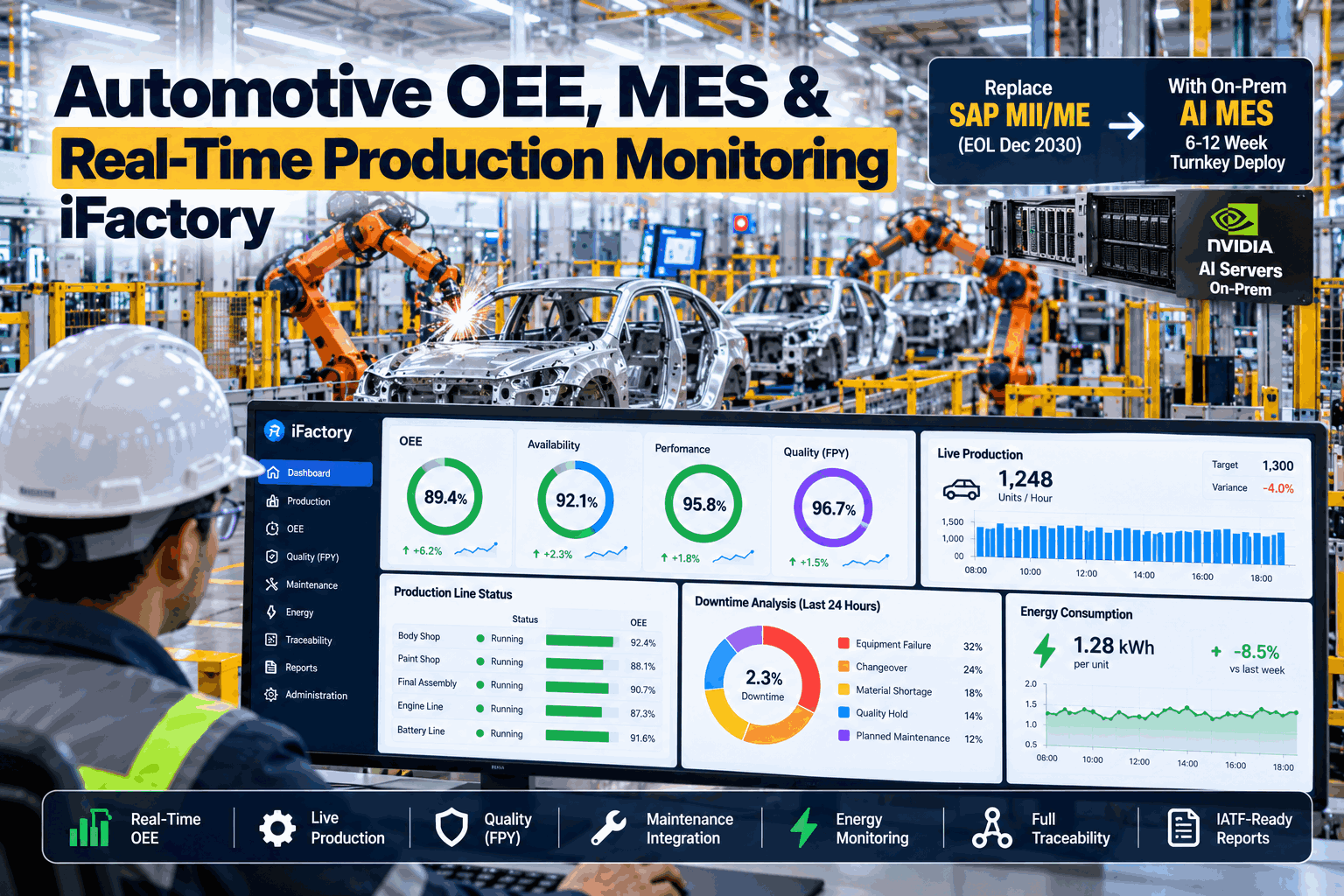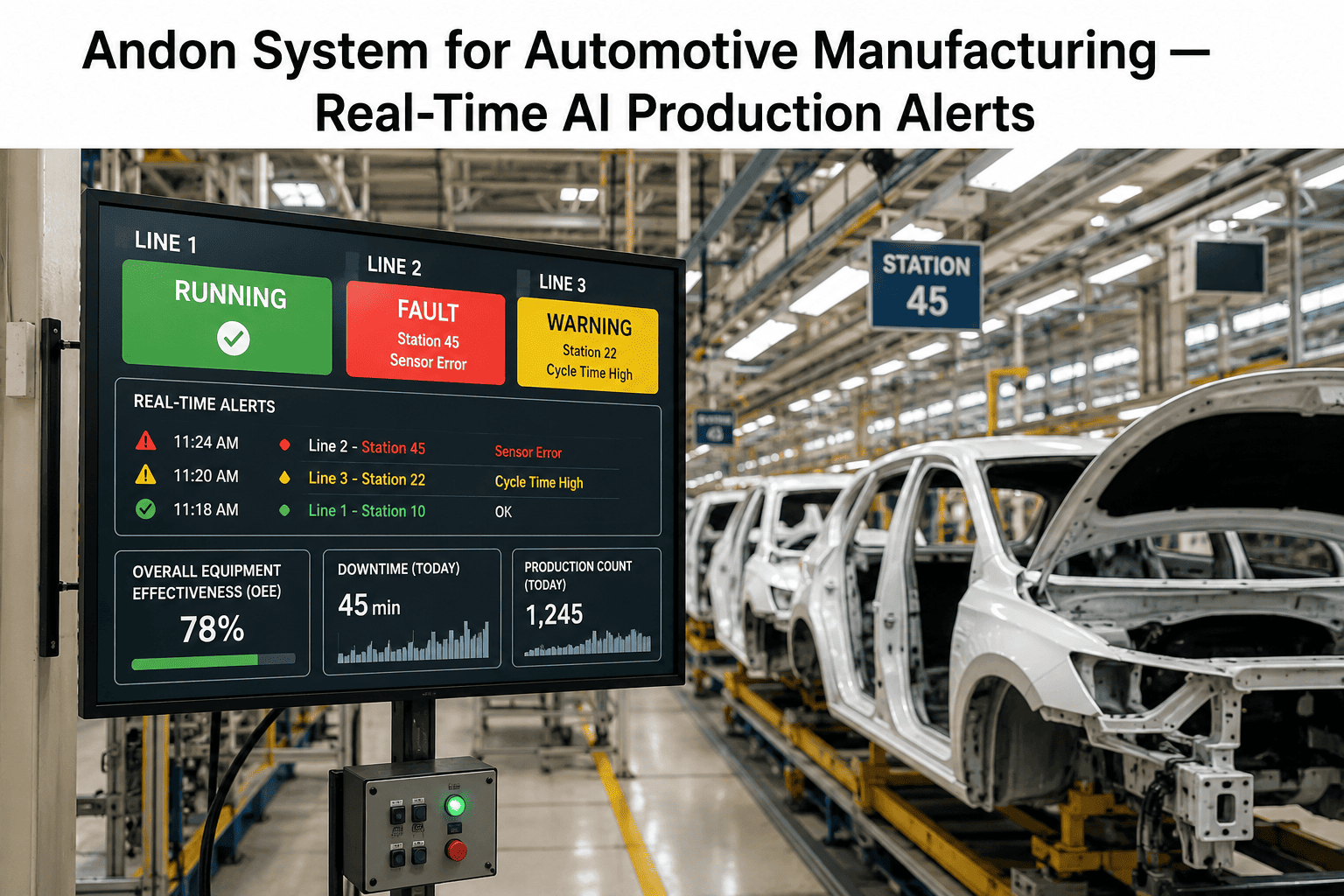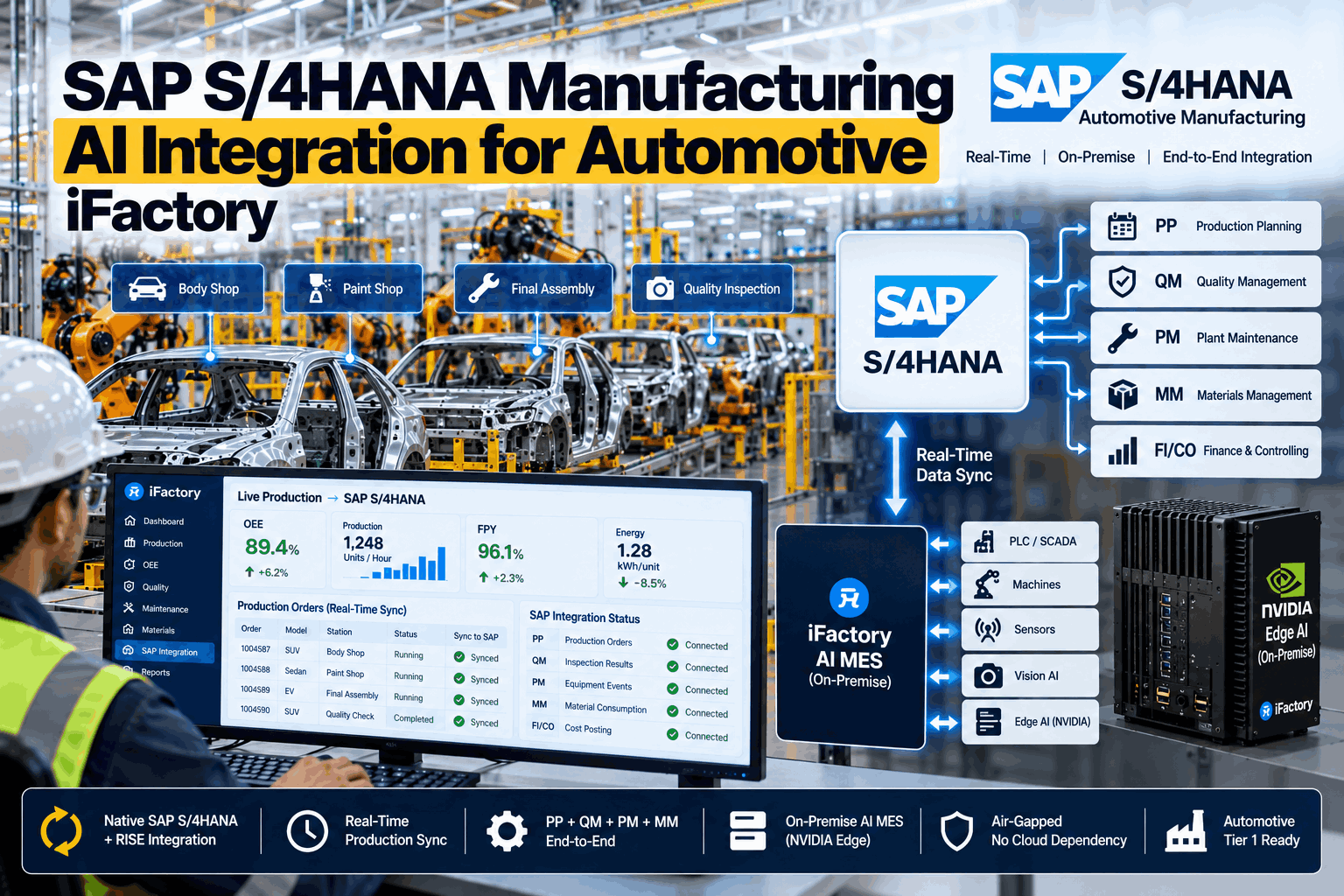
In most automotive plants SAP knows what was planned and what was reported at the end of the shift — not what is happening on the line now. Confirmations are keyed in late, stock is corrected by cycle count, quality results reach QM after the parts have moved on, and a breakdown becomes a PM notification the next morning. iFactory closes that gap. Its on-prem AI reads every production event at the source and reflects it in SAP S/4HANA, RISE or ECC within seconds, across PP, QM, PM and MM, through SAP's own standard interfaces. To see it against your order types, book a sync walkthrough.
Every Production Event in SAP as It Happens — PP, QM, PM and MM
iFactory connects PLCs, robots, torque tools and vision stations to the four SAP modules that run an automotive plant. Operations confirm themselves, components are issued as they are used, inspection results arrive with the unit, and faults raise maintenance notifications — while AI on a server in your plant predicts what SAP should hear about next.
- Standard S/4HANA services — the SAP core stays unmodified
- Posted in seconds, not at shift end
- AI runs on-prem; machine data stays in the plant
The Shift-Long Gap Between the Line and SAP
S/4HANA can plan to the minute, but it can only plan on what it has been told. When the plant reports by clipboard, by end-of-shift entry or by a nightly interface, every SAP screen is hours behind the floor. Industry commentary puts the average manufacturer's inventory record accuracy below the 95% generally treated as the minimum, with leaders above 98% — and names delayed transaction recording as a root cause. If that sounds like your month-end, our integration team can review where the delay enters.
Planning on stale orders
MRP and the planner see yesterday's confirmations. Orders that finished look open; orders in trouble look fine until the shift report arrives.
Stock that is not there
Backflush at order completion means components leave the rack hours before they leave the books. Line-side shortages appear in SAP as available stock.
Quality and maintenance after the fact
Inspection lots are closed in bulk and breakdowns are written up later as free text. The record exists, but too late and too thin to act on.
Module by Module: What the Line Tells SAP
Each SAP module needs different events, at a different level of detail. iFactory maps plant signals to the right object in each — and adds an AI layer that uses the same data to look ahead. The services named are SAP's released OData APIs for S/4HANA; IDoc and BAPI equivalents are used with ECC. For a mapping against your own configuration, book a module workshop.
Production Planning
Operation start and finish, good and scrap counts, order complete
Operation confirmations with yield, scrap and activity time, through the Production Order and Production Order Confirmation services
Forecast finish time for every open order, and an early flag on orders that will miss the shift
Quality Management
In-line measurements, torque curves, vision results, defects found
Characteristic results and defects against the inspection lot, with the unit's serial number, through the Inspection Lot service
Vision inspection at line speed, and drift detected in process signals before a characteristic fails
Plant Maintenance
Machine faults and stop durations, vibration and temperature readings, cycle counters
Maintenance notifications against the right equipment with fault code and history; counter and condition readings as measurement documents
Anomaly detection that raises a notification before the failure, ranked by its effect on open orders
Materials Management
Component fitted, part scrapped, finished unit off the line
Goods issue to the order as each component is used, goods receipt of finished units, scrap movements — with batch and serial numbers
Line-side shortage predicted on actual consumption rate, and usage variance against the bill of material
One Event, Four Modules: A Torque Fault Followed Through SAP
The modules are separate in SAP; on the line they are one story. Below is a single fault at a fastening station and what each module holds nine minutes later. The value is not any one posting — it is that all four agree, and agree with the floor.
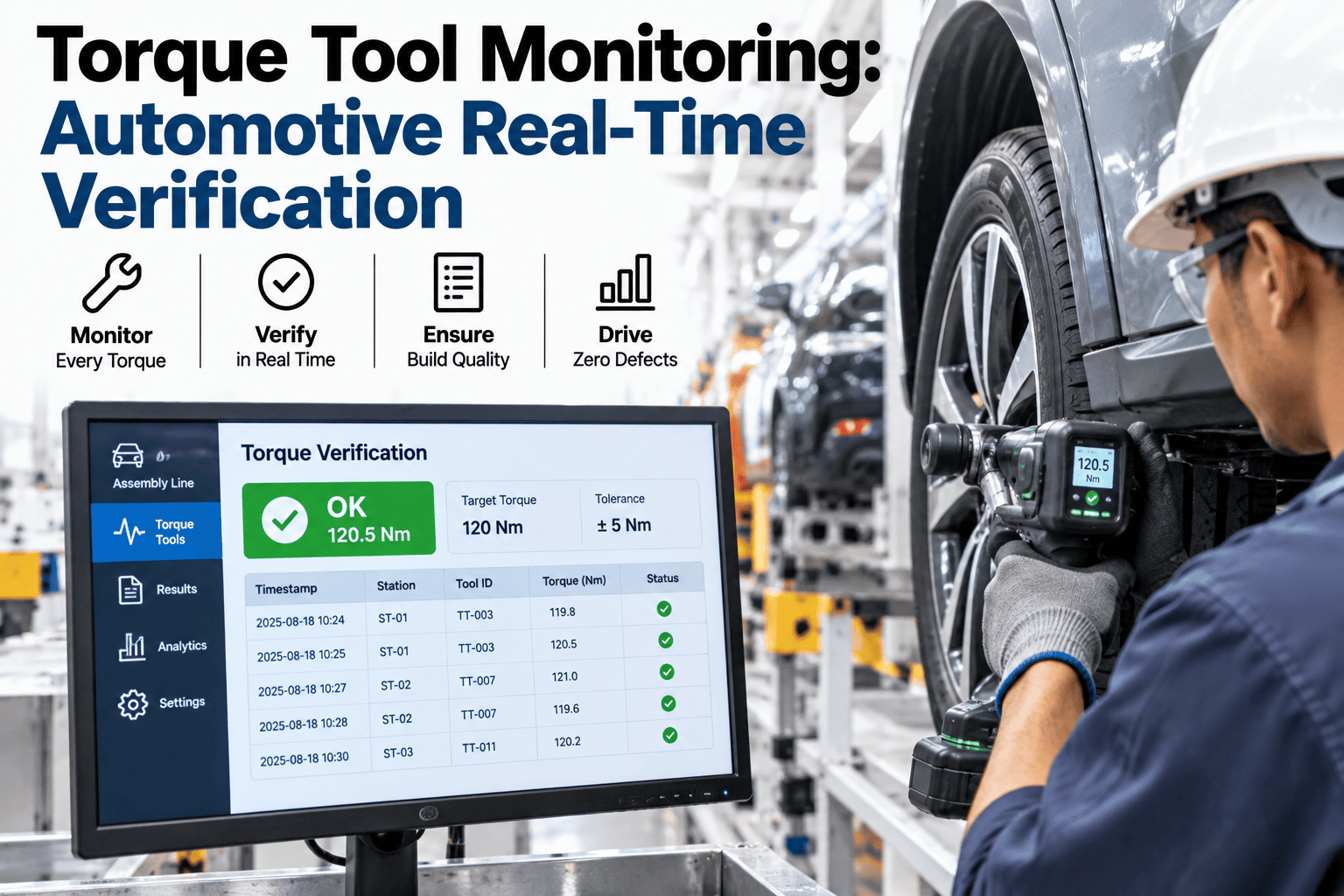
- 14:31:52Torque out of limit on one unitLine
iFactory holds the unit at station 30. The AI reads the torque curve and classifies the fault as tool-related.
- 14:31:55Defect recordedQM
The defect posts to the inspection lot against the unit's serial number, with the curve attached for reference.
- 14:32:10Operation confirmed with reworkPP
The confirmation shows one unit to rework, so the order's yield in SAP matches the line.
- 14:33:10Notification raisedPM
It is the third fault on this tool in the shift. A maintenance notification goes to the planner with the fault history.
- 14:41:00Rework parts issuedMM
Four replacement fasteners are consumed in rework and issued to the order. Stock is right without a count.
What this replaces
- A red tag on the unit and a line in the shift log
- A quality entry made in bulk at the end of the shift
- A phone call to maintenance, written up the next day
- Four fasteners that vanish until the next cycle count
For US plants the stakes are concrete: 891 vehicle safety recalls in 2025 covered more than 29 million vehicles. A recall is scoped by what the records can prove, unit by unit. Ask our quality specialists how serial-level results are structured in QM.
Watch One Line Report Itself to SAP in Six Weeks
Pick one line and one order type. We connect its stations, post confirmations, goods movements, inspection results and notifications to your SAP test client, and reconcile every message against what your team would have entered by hand.
What On-Prem AI Does With SAP Data
Posting events faster is the foundation. The AI is what turns a current SAP into a forward-looking one, by combining order data that came out of SAP with machine data SAP never sees. It runs on an NVIDIA server inside the plant, so cycle data, torque curves and images are analysed on site and only the business result travels to SAP.
- Order completion forecast. Remaining quantity and live rate give a finish time for each order, refreshed every cycle.
- Shortage warning. Actual consumption against line-side stock shows which component runs out first, and when.
- Predictive quality. Process signals are watched for the pattern that precedes a failed characteristic.
- Maintenance priority. Open notifications are ranked by the orders and volume they put at risk.
Planners and supervisors can question all of it in plain language. The AI advises and proposes; changes to orders and schedules remain a planner's decision in SAP. Try it on your own orders during a pilot call.
Works With the SAP You Run Today — and the One You Are Moving To
Few automotive companies are on a single, finished SAP landscape. A 2026 SAPinsider benchmark found 55% of organisations had deployed S/4HANA in some form but only 34% had completed the transformation, and ISG reported nearly 60% of SAP migration projects running late and over budget. The plant cannot wait for that to settle, so iFactory is built to connect now and follow the ERP as it moves. Our landscape specialists can check your own setup with you.
IDocs and BAPI calls, as your current shop-floor interfaces use. When the ERP migrates, only the endpoint and mapping change.
Released OData services between two systems inside your own network. Nothing leaves the company.
The same released services over your private connection to the SAP cloud. Clean core is preserved; machine data and AI stay on site.
Shift-End Entry, Nightly Interface and Real-Time Sync Compared
Most plants run a mix of the first two. The difference shows in how long SAP is wrong for, and in who finds out.
Delivered as a Turnkey AI System — Hardware and Software Together
iFactory ships as a complete bundle: a pre-configured NVIDIA AI server, racked and ready, with the SAP connectors, plant-floor software and AI models pre-loaded. Rack it, plug in power and Ethernet, and the AI is live on your plant network. Our team handles cabling, network setup, PLC, SCADA and tool-controller integration, the interface build with your SAP Basis and module owners, operator training and 24×7 remote monitoring. For a scoped proposal, book a deployment call.
Ship, network and data
Server delivered and racked. Line controllers connected. Orders, materials and routings received out of SAP, and event-to-object mapping agreed for PP, QM, PM and MM.
Model training and pilot
AI models trained on your signals. The pilot line posts to the SAP test client in all four modules while every message is reconciled with your module owners.
Go-live and training
Interfaces moved to the productive client, remaining lines brought on, planners and supervisors trained, and manual entry retired line by line.
What Each SAP Owner Gets
Production planner
Order status that is current to the last cycle, a finish forecast for every order, and no chasing for confirmations.
Quality lead
Results recorded per unit as it is built, defects with evidence attached, and containment scoped by serial number.
Maintenance planner
Notifications raised at the fault with equipment and history filled in, and condition readings feeding the maintenance plan.
Materials and logistics
Line-side stock that matches the rack, shortages warned ahead, and far fewer adjustments at cycle count.
Frequently Asked Questions
Which SAP modules does iFactory integrate with?
Production Planning, Quality Management, Plant Maintenance and Materials Management. Orders, materials and routings are received out of SAP; confirmations, goods movements, inspection results and maintenance notifications are posted back. Each module uses its own standard objects, so the data lands exactly where your SAP team already expects it.
What does "real time" mean here?
Each event is sent to SAP as it occurs, and is normally posted within seconds. The exact time depends on the interface used and on SAP system load. If the link is interrupted, postings queue on the iFactory server and go through in their original sequence when it returns, with a log of what was delayed.
Does it require changes to our SAP system?
No modification to the core. With S/4HANA and RISE, iFactory uses SAP's released OData services; with ECC it uses standard IDocs and BAPIs. Your Basis team sets up a communication user and the usual interface configuration, and your module owners agree the mapping of plant events to SAP objects.
Where does the AI run, and what data reaches SAP?
On an NVIDIA server in your plant. Cycle data, torque curves, vibration and images are analysed there and stay there. SAP receives only business documents — a confirmation, a goods movement, an inspection result, a notification — which is all it is designed to hold.
Can the AI change production orders or schedules in SAP?
Not on its own. It forecasts, flags and prepares proposals, such as splitting an order across shifts. A planner approves any change to orders or schedules in SAP. Factual postings — what was built, used, measured or faulted — are automatic, because they report what happened.
Does it replace SAP MII and SAP ME?
Yes, it covers their integration and execution roles. Mainstream maintenance for both ends on 31 December 2027, with paid extended maintenance to about 2030. Plants usually run iFactory alongside existing MII flows first, then retire them module by module once postings are reconciled.
How long does deployment take, and what do we need to provide?
A typical plant is live in 6–12 weeks. You provide rack space, power, an Ethernet connection, access to line controllers, a SAP test client, a Basis contact and an owner for each module. iFactory supplies the pre-configured NVIDIA AI server, connectors, software, integration and training. To scope your plant, contact our scoping team.
Make SAP as Current as the Line
One turnkey system — NVIDIA AI server, SAP connectors for PP, QM, PM and MM, integration and training — delivered and live inside 12 weeks per plant. Built for automotive OEMs and Tier 1 suppliers who are done with shift-end data.
- 1Every operation confirmed in PP without manual entry
- 2Components issued in MM as they are fitted
- 3Inspection results in QM by serial number
- 4Faults raised in PM with equipment and history