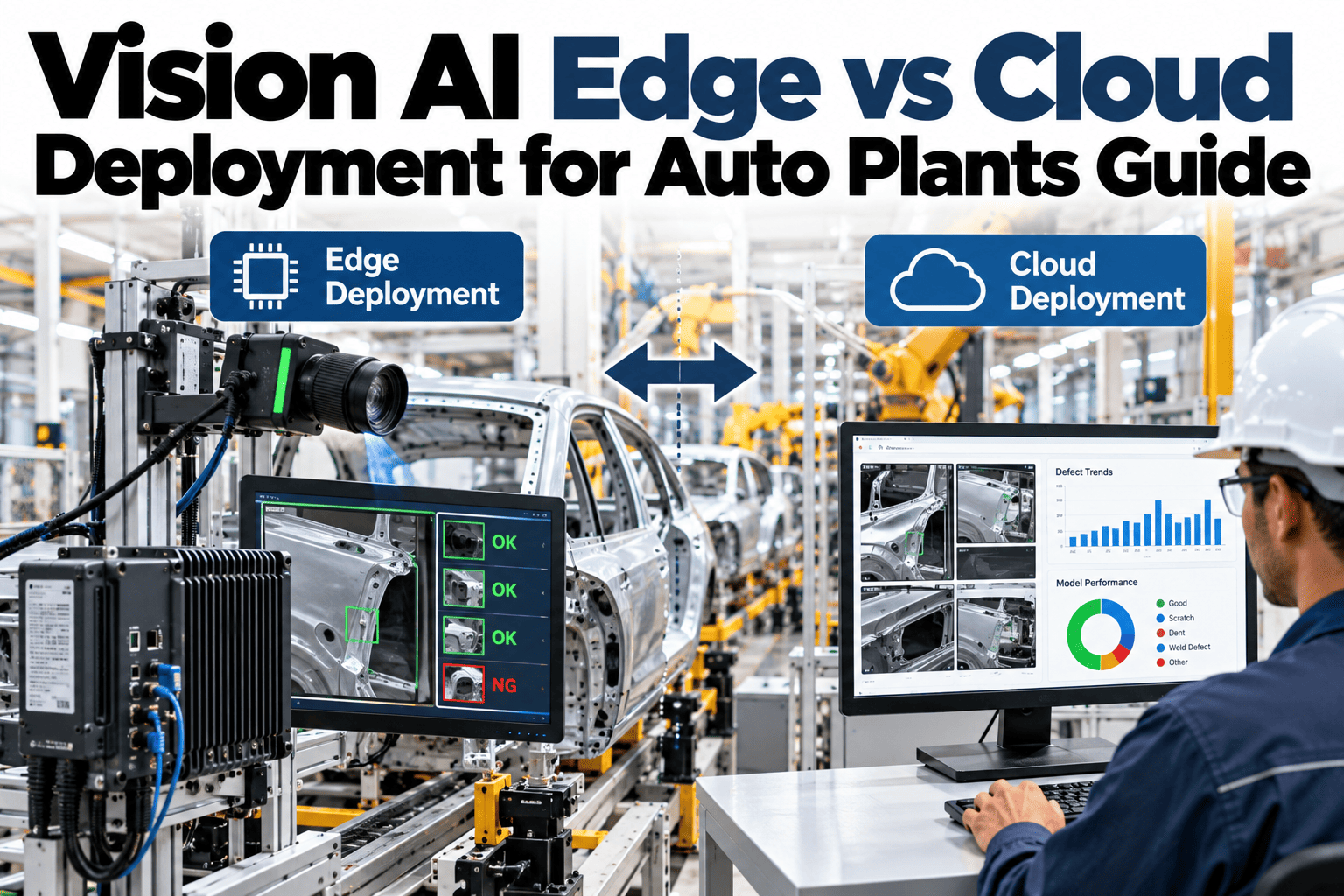
Auto plants rolling out vision AI almost always hit the same fork in the road: run inference at the camera, or send frames to the cloud and wait for a verdict. The answer changes by use case, and getting it wrong is expensive either way. A weld inspection that needs a pass or fail decision in under a tenth of a second cannot wait on a round trip to a data center, while a paint-defect trend report across twelve months of production has no reason to live on a camera's local chip. Bandwidth, latency and data privacy all push toward different answers depending on what the camera is actually checking. Plant IT teams weighing this decision can see how iFactory AI splits edge and cloud inference by use case before locking in an architecture.
Vision AI Edge vs Cloud Deployment for Auto Plants Guide
Latency, bandwidth and privacy trade-offs mapped against real assembly-line requirements, not a generic rulebook.
Why the Deployment Choice Isn't One-Size-Fits-All
Three pressures pull plants in different directions, and most lines need an answer for all three at once.
A line that stops on a defect needs a verdict before the next part arrives, not after a network round trip.
Streaming every camera's full-resolution feed to the cloud all shift can overwhelm a plant's network link.
Some OEM contracts restrict where production imagery can be stored or processed outside the plant.
None of these pressures disappear by picking one architecture for the whole plant. Different stations need different answers.
Matching Architecture to Assembly-Line Requirements
Use this table as a starting map for which stations lean edge, which lean cloud, and which need both.
| Inspection Point | Decision Driver | Best-Fit Architecture |
|---|---|---|
| Weld inspection | Sub-second stop or go decision | Edge |
| Paint defect trending | Long-range pattern across shifts | Cloud |
| Dimensional check | Line-speed pass or fail | Edge |
| Final audit record | Long-term storage and reporting | Cloud |
| Fleet-wide model tuning | Needs data from every line and plant | Hybrid |
Map Your Own Line's Latency Requirements
Book a 30-minute session and bring your inspection points. iFactory AI will show which stations need edge, cloud or both.
Edge, Cloud or Hybrid: A Decision Path
Walk each inspection point through these questions in order, and the right architecture usually becomes obvious.
What iFactory AI Supports
iFactory AI runs inference where it makes sense per station, with one dashboard across both layers.
Edge Inference at the Camera
Line-stopping decisions run locally, with no dependency on network uptime.
Cloud-Based Trend Analytics
Quality trends and model retraining run centrally across shifts, lines and plants.
Hybrid Orchestration
Edge devices sync summarized results to the cloud without streaming full video continuously.
One Unified Dashboard
Edge and cloud results appear in the same view, so quality teams never switch systems.
iFactory AI ships on a pre-configured NVIDIA server, racked and ready with software pre-loaded. Scope covers edge device placement, network design, OEM-compliant data handling and 24x7 remote monitoring.
Expert Review
Plants that try to run every camera on one architecture usually end up over-provisioning network bandwidth or accepting latency they cannot afford. Splitting inspection points by their actual decision speed and data needs, rather than by vendor default, consistently produces a lighter network footprint and faster line-stopping decisions.
The decision path above holds up well across weld, paint and assembly stations we have deployed on. The exception worth flagging is OEM-mandated data residency, which should always be checked before architecture, not after.
Frequently Asked Questions
Can edge and cloud inference run on the same camera?
Yes, a single camera feed can run a local edge model for the stop or go decision while also streaming a summarized result to the cloud for trend analysis. This avoids duplicating cameras or hardware per use case. The split is configured per station rather than per camera model. See a dual-path camera setup in a live session.
What happens if the network goes down with an edge deployment?
Line-stopping inspections continue running locally since the decision never depends on network availability. Cloud sync simply queues and catches up once the connection returns, so historical trend data stays complete. This is one of the main reasons edge is preferred for stations that cannot pause. Ask support about offline resilience for your specific stations.
Does cloud processing cost more over time than edge?
Cloud processing has an ongoing data transfer and compute cost that scales with camera count and frame rate, while edge has a higher upfront hardware cost per station but a lower running cost. Most plants end up with a mix once stations are sorted by their actual latency need. Request a cost comparison based on your camera count.
Can we move a station from cloud to edge later?
Yes, a station's architecture is not locked in permanently. As line speeds increase or OEM requirements change, a station originally run on cloud can be moved to edge inference without rebuilding the whole deployment. Most plants review this mapping annually. Contact support to review your current station mapping.
How does OEM data residency affect the architecture choice?
Some OEM contracts require that production imagery never leave the plant, which rules out cloud processing for those specific stations regardless of latency. In those cases, edge devices handle both the decision and any storage locally. This constraint should be checked before the architecture is finalized, not discovered afterward. Book a compliance-focused walkthrough to confirm your contract terms are covered.
Build the Right Architecture Per Station, Not Per Vendor Default
iFactory AI runs edge and cloud inference side by side, matched to what each inspection point actually needs. Book a walkthrough on your own line layout.